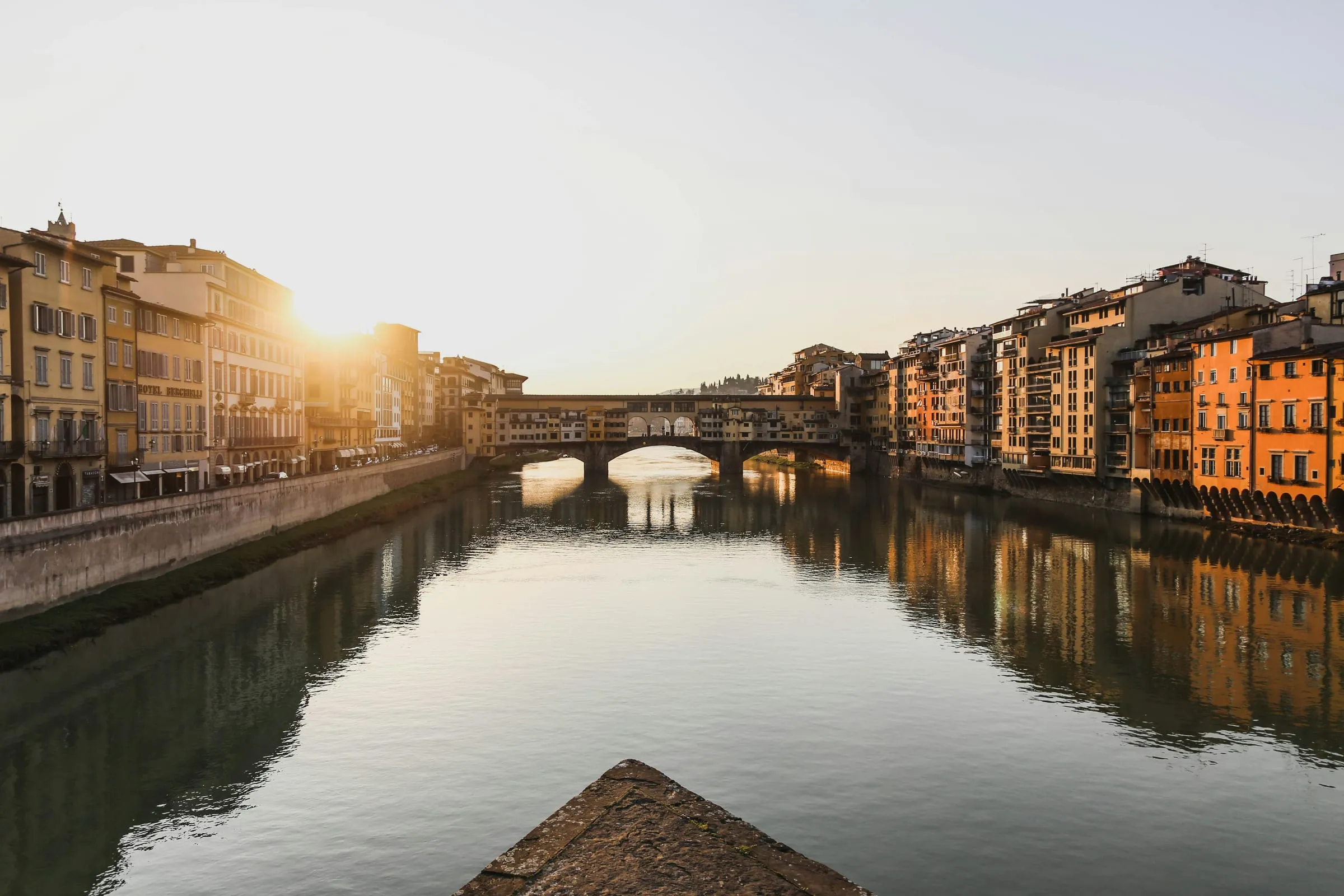
Florence is the city most travelers compress into a too-short stop on a too-fast Italy itinerary, and that’s the framing problem. The standard ten-day Italy plan — Rome for three, Florence for two, Venice for two, transit for the rest — gives Florence the shortest stretch, and it’s the wrong city to give the shortest stretch to. Florence is the Italian Renaissance compressed into one walking city: the Duomo complex, the Uffizi, the Accademia, the Bargello, the Pitti Palace, the Oltrarno workshops, the Brunelleschi dome, Michelangelo’s David, Botticelli’s Birth of Venus, Donatello, Giotto, Masaccio. Two days sees the icons. Three days starts to understand them. Five days lets the city become yours.
Done correctly, Florence is the city that rewards constraint and depth — not breadth. The Uffizi rewards a single morning where you pick three rooms instead of nine. The Oltrarno rewards an unhurried afternoon in the artisan workshops where Florentines have made gold leaf, marbled paper, and hand-stitched leather for six hundred years. The food rewards a long dinner at a real Florentine trattoria — not a Piazza della Signoria tourist menu — where the bistecca alla Fiorentina is a kilo of T-bone for two and the ribollita is the soup that’s been on Florentine tables since the Renaissance.
Most clients come to me asking about Florence in three contexts: as the middle stop on a multi-city Italy sweep (Rome →︎ Florence →︎ Venice is the classic, three days each minimum), as a standalone three-or-four-night Florence-and-Tuscany visit (Florence in the city, Chianti or Val d’Orcia for day trips), or — much rarer, and the version I most want to plan for — as the Italy specialty trip in its own right (a slow week, Florence as the base, the city revealed).
Here’s how I think about it.
At a Glance
| Best time to visit | April–early June and September–October. Spring brings the Tuscan hills greener than the postcards, fall brings golden light and the autumn truffle and olive-oil season. Skip mid-July through August — peak heat, peak crowds, and many of the best restaurants close for Ferragosto (mid-August). December has its own quiet rhythm — the Christmas-tree at the Duomo, fewer tourists, the city’s slower months. |
| How long to stay | Two full nights minimum, three ideal, for Florence itself. Five-plus if you’re combining with Chianti, the Val d’Orcia, or a Tuscan country base. Two nights is enough to see the major sights; three lets you actually inhabit the city. |
| How to get there | Florence Airport (FLR) handles regional flights; most travelers fly into Rome (FCO) or Milan (MXP) and take the train — Frecciarossa high-speed rail to Florence in 1h30m from either, often more pleasant than connecting flights. From elsewhere in Europe — Frankfurt or Munich via Bologna, Vienna via Venice. |
| Currency / language | Euro. Italian is official; English is widely spoken in tourist-facing settings. Buongiorno, grazie, prego, and un caffè (an espresso, taken standing at the bar in 90 seconds) are the bare minimum and earn small smiles. |
| One thing most guides won’t tell you | The major Florence sites — the Uffizi, the Accademia (David), the Brunelleschi Dome climb, and the Vasari Corridor — require pre-booked timed entry, and the popular slots fill weeks (sometimes months) in advance. Walking up to any of them on the day costs you two-to-three hours of queue. Pre-book the moment your dates are confirmed — this is the single most consequential planning move for Florence. |
Why I Send Travelers Here
Because Florence, planned correctly, is the most concentrated cultural-density city in Europe. The whole historic core — bounded by the Arno on one side and the medieval city walls on the other — is roughly one square mile, and inside that mile is more 14th-, 15th-, and 16th-century art and architecture than anywhere else on earth. A visit done right doesn’t try to absorb all of it. It picks a few rooms, a few neighborhoods, a few meals, and lets each one go deep.
Italy is one of my specialties, and Florence sits at the center of it. I work with the Italy Board of Tourism through a relationship that gets clients access to restaurant tables, gallery slots, and small-group experiences that don’t appear on the standard booking platforms. I send couples here for honeymoons that are about the long lunch, the Tuscan-countryside half-day, and the right hotel suite with the right view. I send multi-city sweepers for the Rome →︎ Florence →︎ Venice arc that’s the spine of any first Italy trip. I send slow-travel travelers for the Florence-base-plus-Chianti week that’s the best version of an Italy trip nobody plans for.
Every recommendation below comes through the lens of how I plan Florence for the clients I send, the hotel relationships I rely on in Florence, and a clear point of view about which sites earn the timed-entry queue, which neighborhoods earn your nights, and which restaurants are worth the table reservation versus which ones are tourist tax in Renaissance disguise.
Where I’d Anchor
Three anchoring patterns cover almost any traveler’s Florence visit:
Centro Storico (around the Duomo and Piazza della Repubblica). The historic core, walking distance to the Duomo complex, the Uffizi, the Bargello, the Mercato Centrale, and the Ponte Vecchio. Stay here on a first visit if you want to step out of your hotel into Renaissance Florence immediately. Trade-off: the most touristed quarter and the highest hotel prices.
Oltrarno (across the Arno). The “other side” of the river — quieter, more artisanal, the Florentine bottega (workshop) culture that’s been running for six hundred years. The Pitti Palace and the Boboli Gardens are here, as are the Brancacci Chapel and a denser cluster of real Florentine restaurants. Better for a second visit, or for travelers who want their Florence to feel less like a tourist set and more like a working city.
The Florentine Hills (Fiesole / Bellosguardo). Above Florence, fifteen to twenty minutes from the Duomo, a different kind of stay — countryside-luxury hotels with Florence laid out beneath you, gardens, panoramic views, and the hilltown rhythm that the centro storico can’t deliver. The pick for honeymoons, milestone trips, or slow-travel weeks where Florence is the base and not feeling like you’re in Florence between visits is the point.
For the Centro Storico flagship pick, Hotel Savoy, a Rocco Forte hotel on Piazza della Repubblica is the call. Eighty renovated guestrooms decorated by Olga Polizzi (the Rocco Forte family creative direction — same hand as Hotel de Russie in Rome and Hotel de la Ville at the Spanish Steps), the Duomo Presidential Suite with 360-degree views of the city, and Irene — the property’s restaurant — where Fulvio Pierangelini’s cooking lives at street level on the piazza. On my rate at the property, the amenity layer is meaningful and doesn’t book direct — pairing the right room category to your dates and confirming what applies is the discovery-call conversation. The property also runs seasonal promotions that can materially shift the value math if your dates line up; we’ll check what’s active for you when we talk.
For the Oltrarno-side luxury pick — and the most distinctive ownership story in central Florence — Hotel Lungarno at Borgo San Jacopo, owned by the Salvatore Ferragamo family and designed by Florentine architect Michele Bönan, sits a stone’s throw from the Ponte Vecchio with rooms looking directly across the Arno. The hotel houses a small but real 20th-century art collection including Picasso and Cocteau, and the on-site Borgo San Jacopo restaurant is Michelin-starred and one of the best dinner reservations in Florence. On my rate at the property, the amenity layer doesn’t book direct, and the specifics get walked through on the discovery call. Lungarno also runs seasonal stay-length promotions that meaningfully change the value math on longer bookings — we’ll check what applies to your dates.
For the Fiesole-hills pick — the milestone-trip honeymoon answer — Villa San Michele, a Belmond Hotel on Via Doccia is the alternative. A 15th-century former monastery in the hills above Florence, with a façade attributed to the school of Michelangelo and woodlands in which (per local tradition) Leonardo da Vinci first attempted to fly. Thirty-nine reimagined rooms and suites following the property’s 18-month renovation completed in 2026, including the Limonaia Suite with private plunge pool in the converted 17th-century orangery. The new Villa San Michele Spa by Guerlain, the heated outdoor pool with views over Florence, and a complimentary 20-minute shuttle to the city center throughout the day. On my rate at the property, the amenity layer is calibrated to your stay rather than itemized in advance — what shows up depends on dates, room category, and how long you stay, and we walk through it on the discovery call.
Want one of these stays? Start a discovery call — I’ll pull live availability, walk through the suite categories, and confirm which amenities and current promotions apply to your dates. And the small extra at check-in — a welcome note from me, the kind of touch the standard amenity package doesn’t list — is part of how I deliver these stays.
What I’d Do With Two or Three Days
Adjust to taste. The three-day version is the slower one I’d write for travelers giving Florence the time it deserves; the two-day version is for travelers passing through on a Rome-Florence-Venice sweep.
Day One — The Duomo Complex and the Uffizi
Start with the Brunelleschi Pass — Florence’s combined ticket for the Cathedral, the Baptistery, the Campanile (Giotto’s bell tower), the Crypt of Santa Reparata beneath the cathedral, and Brunelleschi’s Dome climb itself. Pre-book your timed entries weeks ahead.
Open at the Baptistery for Ghiberti’s Gates of Paradise — the gilded bronze doors Michelangelo himself called “fit to be the gates of paradise.” (The doors on the building are 1990 reproductions; the originals are restored in the Museo dell’Opera del Duomo across the piazza, and worth the additional half-hour.) Then to the Cathedral itself — Brunelleschi’s dome is the engineering marvel, but the cathedral’s interior is famously austere; the spectacle is the building, not what’s inside it.
The Dome climb is 463 steps in a narrow stairwell with no elevator and one-way traffic. If your fitness level or claustrophobia is in question, skip the climb — the better view is from the Campanile (414 steps, but in a wider tower with windows, far more forgiving) or from Piazzale Michelangelo at sunset (no climb, drive-up parking, the postcard view). The Dome climb is real work; reserve it for committed climbers.
Lunch in the Centro Storico — All’Antico Vinaio for the famous Florentine schiacciata sandwiches if you’re walking and eating, or Trattoria 13 Gobbi for a sit-down Tuscan lunch.
Afternoon at the Uffizi Gallery with a pre-booked timed entry. Pick three rooms rather than trying to do all forty-five — the Botticelli rooms (Birth of Venus, Primavera) are the headline; the Caravaggio room is the dramatic finale; the Leonardo room and the early Renaissance Italian rooms reward the morning patience. Allow three unhurried hours.
Late afternoon, walk Piazza della Signoria (the open-air sculpture museum with Michelangelo’s David replica, the Loggia dei Lanzi, and the Palazzo Vecchio) and along the Ponte Vecchio at golden hour. Dinner at Osteria del Cinghiale Bianco in the Oltrarno for genuine Florentine cucina povera — the “white boar” osteria has been on the same corner of Borgo San Jacopo since 1972 and remains a real Florentine room.
Day Two — Accademia, Mercato, Oltrarno
Morning at the Accademia — pre-booked first slot of the day — for the David. The Accademia has other things, but everyone is there for the David, and the experience changes meaningfully depending on whether you arrive before the tour groups (at opening) or after (the rest of the day). Get there at opening. Allow ninety minutes total.
Walk to the Mercato Centrale for an early lunch — the upstairs food hall is one of the great urban food markets in Italy, with vendors for lampredotto (the Florentine tripe sandwich, an acquired taste worth acquiring), Tuscan cheeses, fresh pasta, and the best gelato in the central market vicinity at Vivoli a few blocks east.
Afternoon: cross the Arno into Oltrarno. Walk Via Maggio for the antique shops and Renaissance palaces, Piazza Santo Spirito (the unfinished facade of Brunelleschi’s last church, fronting one of the prettiest residential squares in Florence), and the Brancacci Chapel at Santa Maria del Carmine for Masaccio’s Tribute Money and Expulsion from the Garden — frescos that broke the fourteenth-century pictorial language and made the Renaissance possible. Pre-book the chapel (small, timed-entry).
If you have stamina, the Pitti Palace and Boboli Gardens for the late afternoon — but allow at least three hours combined; both reward depth, and a rushed visit to either is worse than skipping.
Sunset at Piazzale Michelangelo above the Arno on the south side — the postcard view of Florence with the Duomo in the middle distance. The walk up takes 25 minutes from the Ponte Vecchio; a taxi takes ten. Dinner at La Giostra (a beloved family-run restaurant near the Synagogue, founded by Prince Soldano d’Asburgo Lorena) or Il Latini if you want the boisterous old-Florentine-trattoria experience.
Day Three — A Day Trip, Cooking, or Slower Florence
Three options, ranked by my preference for first-time travelers:
A Traveling Spoon home-cooking experience. The single best food day I plan in Florence — three to four hours in a Florentine home with a local cook, learning the Tuscan dishes that travelers eat in restaurants but rarely understand the construction of. Pici cacio e pepe hand-rolled at the table. Ribollita and the bread that goes into it. The wine that pairs with each course. The meal at the family table afterward. I have a small set of Florentine hosts I work with consistently — pairings depend on neighborhood and the night.
A Chianti or Val d’Orcia wine day. Drive south or southwest into the Tuscan countryside — Greve in Chianti, Castellina, Radda — for two or three winery visits, lunch at a fattoria (working farm with a restaurant), and the right kind of slow Tuscan-hills afternoon. Hire a car and driver for the day; this isn’t the day to rent and drive yourself.
A slower day in Florence itself. Morning at the Bargello Museum — Donatello’s David, Michelangelo’s early sculptures, an extraordinary collection of Renaissance bronzes housed in the former medieval prison. Lunch at one of the small Oltrarno trattorie. Afternoon walking the Florentine artisan workshops (Oltrarno is full of botteghe where families have made the same crafts for generations — gold-leaf gilding, hand-stitched leather, marbled paper, mosaic). End at Piazzale Michelangelo for a second sunset, or back to the hotel.
By day three, Florence makes its own recommendations.
Filling in some of your own days? When I plan your Florence trip these are handled for you — the timed entries, the right cooking host, the Chianti driver. But if you're booking a day or two yourself, here's where I'd start: my hand-picked Florence experiences — the vetted cooking classes, small-group tours, and skip-the-line tickets I'd actually send you to. A few are affiliate links; if you book through one I may earn a small commission, at no cost to you.
Specific Things I’d Tell You About
The Brunelleschi Pass is the way to do the Duomo complex. A combined ticket for the Cathedral, the Baptistery, the Campanile, the Dome climb, the Crypt, and the Museo dell’Opera. Pre-book the timed entries weeks ahead — the Dome climb in particular sells out months in advance for prime morning slots. All five sites in two days is the right pace; trying to do them in one day is a rushed slog.
The Dome climb is 463 steps in a narrow one-way stairwell. Most travelers don’t realize this until they’re inside and committed. The climb is real — narrow, steep, hot in summer, no elevator. For travelers with mobility constraints, claustrophobia, or fitness uncertainty, the climb is genuinely a hard pass — and the Campanile (414 steps but a wider, more forgiving tower) or Piazzale Michelangelo (no climb, drive-up parking, the postcard view) are the better alternatives. I flag this on the discovery call; the surprise once you’re at the foot of the stairs is the wrong moment.
Traveling Spoon is the right Florence dinner answer for honeymoons and milestone trips. Three or four hours in a Florentine home with a local host, learning to make Tuscan dishes at the family stove, then sharing the meal at the family table. The result is the dinner clients describe months later as the high point of the trip. The hosts I work with consistently know how to read the table — paced for honeymoons, language-flexible for travelers without Italian, and able to handle dietary fits (we discuss these on the booking call).
The Oltrarno workshops are the quiet differentiator. Florence has been making things — gold leaf, marbled paper, hand-bound books, leather, mosaic, hand-stitched gloves — for six hundred years, and the botteghe where these crafts still live are clustered in the Oltrarno on the streets behind Piazza Santo Spirito and Borgo San Frediano. Walking these workshops in an unhurried afternoon — popping into the ones with open doors, watching the craftsmen work — is one of the most distinctive Florence experiences and almost no first-time visitor knows to do it. Lokafy local guides can pair you with a craftsman-led walk if you want a curated version.
Rasputin is Florence’s hidden speakeasy and worth the search. Unmarked door on a small Oltrarno street, no signage, password-and-knock entry, vintage cocktail program inside. The bartenders are serious; the room is small and conspiratorial; the vibe earns the secrecy. If you’re looking for a late-night drink that isn’t a tourist bar, this is the move. Reservations are essential and the booking process is itself part of the theater.
Florentine bistecca is a kilo of T-bone for two, and it’s not the steak you’ve eaten elsewhere. Bistecca alla Fiorentina is Chianina beef (the white Tuscan cattle breed), aged on the bone, cooked rare to medium-rare on a wood fire, served sliced with nothing but salt. Order it at a real Florentine restaurant — Trattoria Mario near the central market, Il Latini, or any fattoria in the hills — and split it for two. The price reflects the cut; the meal reflects the price. One bistecca is a Florence-trip ritual; two is overkill.
What I’d Skip
Restaurants on Piazza della Signoria, Piazza del Duomo, or the immediate Ponte Vecchio approach. Same tourist-tax pattern as Vienna, Athens, Santorini, Rome, Paris, and Amsterdam. Long laminated multilingual menus, photo-illustrated dishes, hosts who try to pull you in from the alley. Walk three blocks deeper into the Centro Storico or across the Arno into the Oltrarno.
The “Florentine leather” carts in Piazza Santa Croce. The cart leather is mostly mass-produced and the sellers are aggressive. The real Florentine leather — hand-stitched, vegetable-tanned, made by a Scuola del Cuoio-trained artisan — comes from a bottega in the Oltrarno or from the Scuola del Cuoio itself behind the Basilica di Santa Croce. Same neighborhood; entirely different product.
The Uffizi in the late afternoon. The Uffizi has timed entries throughout the day, but the morning slots are materially calmer — the tour groups arrive in waves around lunch and again mid-afternoon, and the Botticelli rooms by 3 p.m. are a scrum. Open the Uffizi at first light, see your three rooms, and be out by lunch.
The Vasari Corridor unless your dates align with its open-window status. The semi-secret elevated passage Cosimo I built between the Uffizi and the Pitti Palace was closed for restoration for years and reopened in late 2024 with limited timed-entry access. Whether it’s worth doing depends entirely on which version of access is available on your dates — sometimes it’s a half-hour rushed experience, sometimes it’s a real one. Ask me on the discovery call.
Driving anywhere in central Florence. The ZTL (Zona a Traffico Limitato) is enforced by automated cameras, and unauthorized entry produces fines that arrive months later by mail. Use the trains for inter-city travel, taxis for in-city, and hire a car and driver only for the Tuscan day-trip days. Renting a car and parking it outside the ZTL for the duration of a Florence stay is technically possible but logistically painful.
For Italy Multi-City Travelers
Florence is the middle stop on the spine-of-Italy classic — Rome →︎ Florence →︎ Venice, three days each, Frecciarossa high-speed rail end-to-end (no rental car needed). The standard ten-day Italy trip is built around this arc, and Florence’s middle position means it absorbs the energy from Rome and feeds it into Venice. Pace matters: Rome demands more walking, Florence demands more art-hours, Venice demands slower meals and more boats. Plan accordingly.
Three nights in Florence is the minimum for the multi-city version. Two nights compresses to one and a half functional days and forces hard cuts on the major sites. Three nights gives you the Duomo complex, the Uffizi, the Accademia, one Oltrarno afternoon, and one dinner that lingers. If you can only give it two, you’ll feel rushed; if you give it four, you’ll feel like you finally arrived.
If you’re combining Italy with Greece, Vienna, or Paris on a longer European arc — the timing logic shifts and the city-sequencing decisions become more nuanced. That conversation happens on the discovery call.
For Honeymooners
Florence is the underrated honeymoon city. Less crowded than Paris, more architecturally cohesive than Rome, and with the Tuscan-countryside option twenty minutes from the Duomo. The classic honeymoon arc: three or four nights in Florence proper (anchored at Hotel Lungarno for the Arno views and the Michelin restaurant downstairs, or at Hotel Savoy for the Centro Storico flagship experience), two or three nights at Villa San Michele in Fiesole for the hills-and-spa centerpiece, optional add-on two or three nights in Chianti at a fattoria for the wine-and-vineyard week.
The honeymoon experience, in my read, is a Traveling Spoon home-cooking dinner with a Florentine host — three or four hours at the family table, the primo and secondo and the wine and the slow conversation that doesn’t exist at restaurant pacing. It’s the dinner most clients describe a year later as the high point of the trip. Followed by a slow walk back across the river, the Duomo lit at midnight, the Arno black beneath the bridges.
If you want me to design the full Italy honeymoon, or to combine Italy with Greece, Switzerland, or a Mediterranean cruise extension, that’s exactly the kind of planning I do. Start a discovery call.
For Travelers Following Jewish Heritage
Florence’s Jewish community is older than the Renaissance — Jews settled in Florence under Medici patronage in the 15th century, and the community survived (with the inevitable ghettoization periods) through the Napoleonic emancipations and into the present. The Tempio Maggiore Israelitico — Florence’s Great Synagogue, built 1874–1882 in Moorish Revival style with copper dome and intricate Byzantine-Moorish interior — is one of the most beautiful synagogues in Europe and a working community house of worship. The adjoining Jewish Museum of Florence documents the community’s history and holds artifacts from the 17th-century synagogue that preceded the current building.
The synagogue and museum sit at Via Luigi Carlo Farini 4, in a quiet pocket of central Florence ten minutes’ walk from the Duomo. Pre-book the guided visit through the community office; same-day walk-ins are possible but limited. The atmospheric Sinagoga di Firenze building is genuinely worth the detour even for travelers without a Jewish heritage interest — it’s one of the Renaissance city’s most surprising 19th-century additions.
I’m currently developing a co-hosted Jewish Heritage trip for 2026, and Florence — alongside Vienna, Prague, Rome, Paris, and Amsterdam — is on the early routing. Reach out if you’d like to be on the early-interest list.
For the longer thinking on how I work this thread — what makes it different from other heritage travel, what it earns, and what it doesn’t try to be — read the pillar essay: Jewish heritage travel.
Plan Florence With Me
If you’re thinking about Florence as the middle stop on a multi-city Italy sweep, as a slow Florence-and-Tuscany week, or as the honeymoon centerpiece it deserves to be — that’s exactly the kind of planning I do. A 30-minute discovery call is where it starts. No fee, no pressure. Just the city, your timeline, and what you actually want to feel when you walk out of the hotel that first morning into the same air the Medici breathed when they were funding Brunelleschi to build the dome.
Book Your Free Discovery Call →︎
Last updated: April 2026. I keep this guide current. If a hotel I recommend slips, a restaurant changes hands, or access to a site shifts, the page changes. Travel changes. The work doesn’t stop when the page goes live.
Plan this trip with me.
A 30-minute discovery call is where it starts. No fee, no pressure.
Book a Discovery Call