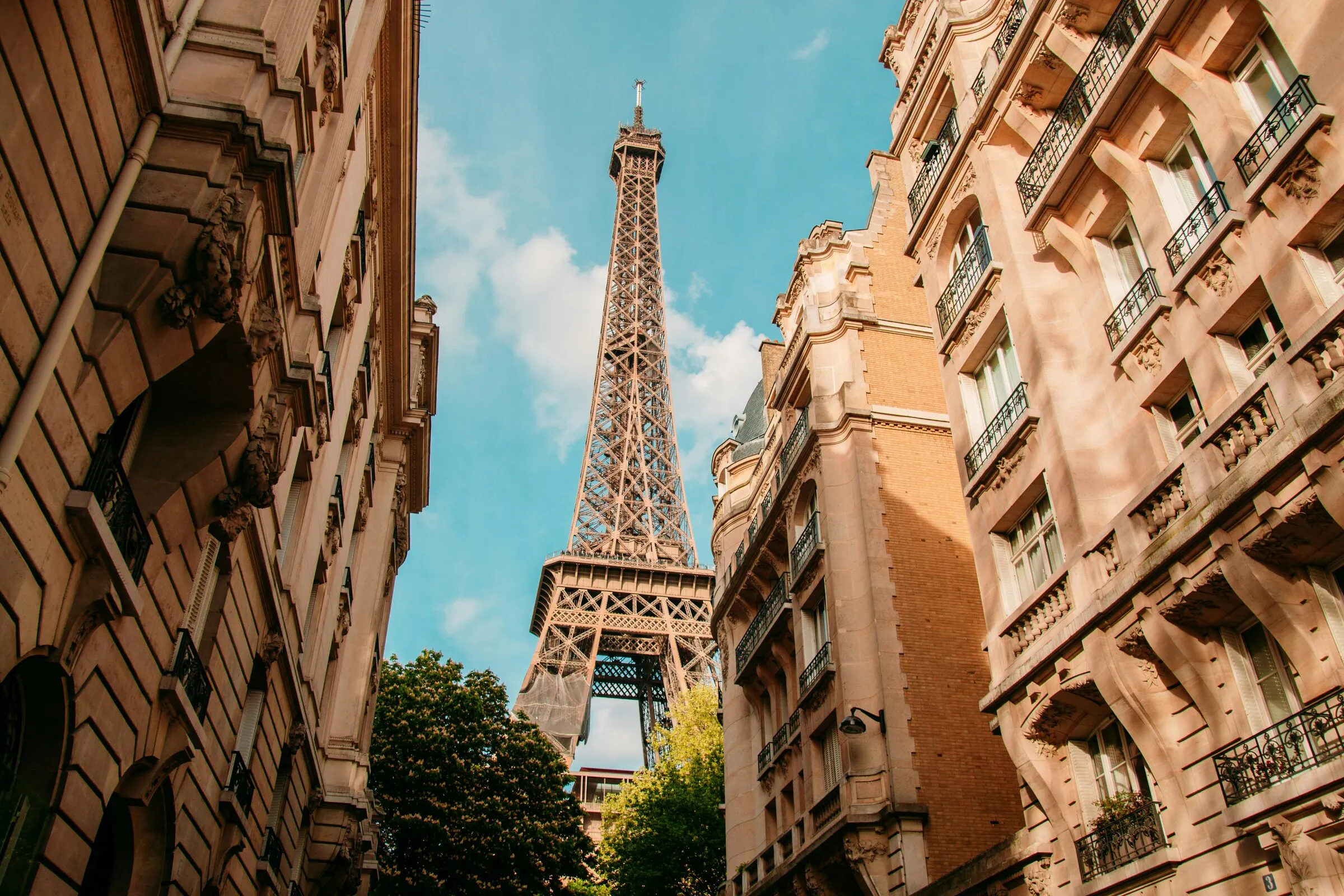
Paris is the city most travelers try to complete, and that’s the framing problem. The standard four-day Paris plan — Eiffel-Louvre-Versailles-Notre-Dame, sometimes the Champs-Élysées, dinner with a view — turns the most layered city in Western Europe into a stadium tour. You see the icons, you cross them off, you fly home with the feeling that Paris was busier and more exhausting than you’d hoped. The pictures look right. The trip never quite landed.
Done correctly, Paris is the opposite of a checklist. It’s the city where you anchor in one neighborhood, walk it slowly, and let the small things — the tabac on the corner, the boulangerie that’s been open since 1932, the man with the dog at the same café table every morning — settle in around you until you stop feeling like a tourist and start feeling, for a few mornings, like a Parisian. Twenty arrondissements, each genuinely distinct from the others. Pick one. Stay long. Walk farther.
Most clients come to me asking about Paris in three contexts: as a first-time three- or four-day visit (the most common, and the version that benefits most from sharper planning), as the front half of a multi-city European sweep (Paris →︎ Amsterdam, Paris →︎ London, Paris →︎ Rome), or — much rarer, and the version I most want to plan for — as a slow-travel anchor of a week or longer with day trips to Versailles, Giverny, or the Loire. Each one rewards a different shape of itinerary. And every version benefits from the same single principle: Pick a base. Don’t move it. Let Paris come to you.
Here’s how I think about it.
At a Glance
| Best time to visit | April–early June and September–early October. Spring blossoms and golden autumn light, weather forgiving, the Parisians actually in town. Skip August — Parisians leave the city for the month, many of the best restaurants close, and what’s left is tourist-only. December is its own thing — Christmas markets and lit-up boulevards make up for the cold and the early dark. |
| How long to stay | Three full days minimum, four ideal, for a first visit. Five-plus for a second visit or a slow-travel anchor. Two days minimum if Paris is part of a Europe sweep — and even then, three is better. |
| How to get there | Charles de Gaulle (CDG) is the main airport, 26 km northeast; the RER B train runs to Châtelet–Les Halles in approximately 35–40 minutes depending on station and schedule, for €11.45, or a fixed-rate taxi runs €56 to the Right Bank, €65 to the Left. Orly (ORY) is closer and lower-volume. From London — Eurostar to Gare du Nord in 2h20m. From elsewhere in Europe — TGV is faster than flying once you count the airports. |
| Currency / language | Euro. French is official; English is widely spoken in tourist-facing settings, less so in older cafés and outer districts. Bonjour on entering a shop and au revoir on leaving are not optional — they’re the baseline social contract, and skipping them is the single fastest way to get the rude Parisian-waiter treatment travelers complain about. |
| One thing most guides won’t tell you | Many of the best museums close on Tuesday — the Louvre, the Orangerie, the Picasso Museum, the Pompidou. Plan your “museum day” for Wednesday or later, and use Tuesday for walking neighborhoods, parks, and the smaller museums (Rodin, d’Orsay, Bourdelle) that are open. |
Why I Send Travelers Here
Because Paris is the city that rewards constraint. The famous sights — the Tower, the Louvre, the cathedral on the island in the river — are the thing, and they deliver. But the version of Paris that becomes the trip people remember a decade later is the version that happens between the sights: a long Sunday lunch in Le Marais, an afternoon at a single museum done unhurriedly, an evening at a sidewalk café in Saint-Germain that runs three hours, a midnight walk back across the Pont des Arts when the bridges along the Seine are lit up in the rain.
It’s also one of the cities on Rachel’s European-and-Greek sabbatical, and one of the cities I write about in Do I Really Need a Travel Advisor? — both for the same reason: Paris is the city most over-itinerated by online research, and the city that most rewards a planner who can set the rhythm right.
I send couples here for honeymoons that want the romantic-Paris archetype delivered properly — which means slow mornings, a Seine walk, a long dinner, the right hotel. I send slow-travel travelers who want a week in Le Marais or Saint-Germain with the icons checked off in two days and the rest of the week spent inside actual Parisian life. I send multi-city Europeans who use Paris as the front half of a sweep into Amsterdam, London, or south through France into Provence.
Paris is also one of the most over-recommended and under-planned cities in Europe. The standard four-day itinerary is wrong about half the things that matter — which arrondissement to anchor in, which museums earn the line, which restaurants are tourist tax, which neighborhoods are worth the metro ride. Every recommendation below comes through the lens of how I plan Paris for the clients I send, the hotel relationships I rely on, and a clear point of view about which pieces of Paris are worth your time and which ones aren’t.
Where I’d Anchor
Three neighborhoods cover almost any traveler’s reason for being in the city:
Le Marais (3rd & 4th arrondissements). The medieval-into-Renaissance quarter on the Right Bank, walled off in places, narrow cobbled streets, the Place des Vosges (Paris’s oldest square still in original form), the historic Jewish quarter on Rue des Rosiers, and one of the city’s strongest contemporary gallery, café, and shopping scenes. Stay here on a first visit if you want to step out of your hotel and be in Paris immediately. Walks to almost everything on the Right Bank, and across the bridges to the Île de la Cité in ten minutes.
Saint-Germain-des-Prés (6th arrondissement). The Left Bank’s literary-café quarter — Café de Flore, Les Deux Magots, the Sorbonne nearby, the Luxembourg Gardens five minutes south, the Musée d’Orsay along the Seine. Quieter than Le Marais, more genteel, the version of Paris that earns the City of Light name. Best for a second visit, or for travelers who want their Paris days book-ended by the Jardin du Luxembourg in the morning and a long café afternoon.
Around the Palais Royal (1st arrondissement). The immediate Louvre-Tuileries-Place Vendôme corridor, where most of the city’s flagship luxury hotels live and the historic Right Bank is at its grandest. Stay here if your Paris is about the iconic-Paris experience and you want walking access to the Louvre, the Tuileries, and the Île de la Cité within minutes.
For the most-distinctive recent Paris luxury opening, Cheval Blanc Paris at 8 Quai du Louvre is the call. LVMH’s Paris flagship, opened in 2021 in the redesigned Samaritaine building on the Seine, with the Pont Neuf framing the view from the Seine-facing rooms. The hotel-relationship architecture here is rare in the category: on my rate at the property, the amenity layer is materially deeper than any other Paris property I work with — the specifics get walked through on the discovery call, and a few of the touches are designed to land at arrival rather than appear in advance.
For a smaller-scale chic 1st-arrondissement pick — Italianate decor, 108 rooms, around the corner from the Chanel boutique on Rue Cambon — Castille Paris is the more intimate option. On my rate at the property, the amenity layer doesn’t book direct, deepened materially on longer stays, and the specifics — calibrated to your dates and the room category — get walked through on the discovery call.
For travelers who want a 59-room boutique hotel facing the Palais Royal Garden itself — Pierre-Yves Rochon-designed interiors, classified 18th-century façade, brand-new suites added in late 2023 — Grand Hotel du Palais Royal is the third option, currently running a We Love Families! Save 30% on the 2nd Room promotion that’s worth knowing about if you’re traveling multi-generationally. Standard amenities apply; I confirm the current package on the discovery call.
Want one of these stays? Start a discovery call — I’ll pull live availability, walk through the room categories, and confirm which amenities and current promotions apply to your dates. And the small extra at check-in — a welcome note from me, the kind of touch the standard amenity package doesn’t list — is part of how I deliver these stays.
What I’d Do With Three or Four Days
The discipline for a real Paris experience is constraint: pick one neighborhood, anchor there, and let the city reveal itself rather than racing across all twenty arrondissements. The four-day version is the slower one I’d write for first-timers; the three-day is the tighter version for travelers passing through Europe.
Day One — Le Marais, and Staying Put
Don’t start with the Tower. Start in Le Marais and don’t leave the neighborhood. Coffee at any neighborhood café — not a famous name, just a place you’ve passed. Walk the Place des Vosges slowly — Paris’s oldest square in its original 17th-century form, brick-and-stone arcades on all four sides, surprisingly quiet in the early morning. Sit on a bench facing the square for twenty minutes. This is not wasted time.
Walk Rue des Rosiers through the historic Jewish quarter. Stop at L’As du Fallafel for the best falafel in Paris (genuinely — yes, in Paris). Walk the small side streets of the Marais, the galleries, the small shops. Visit the Musée Picasso in the Hôtel Salé if you’ve timed it for an open day, or the Mémorial de la Shoah for the layered history of the Marais.
Lunch in the Marais. Spend two hours on lunch if you want; Paris rewards the slow meal. The area is dense with strong, unpretentious restaurants — not famous names, just places where Parisians eat.
Afternoon: walk the Marais, then the Seine. Walk south to the river, across to the Île Saint-Louis (the residential sister-island to the Île de la Cité, entirely from the 17th century, with Berthillon ice cream at the south end — worth the line). Cross back to the Right Bank and walk the Seine slowly, letting the light change. End the day on a sunset bridge — the Pont des Arts or the Pont de l’Alma — with Paris reflecting off the water at dusk.
Dinner anywhere in the Marais. By now you’ve walked the neighborhood for a full day; you’ve found a place you like. Eat there.
Day Two — Right Bank Icons (Louvre + Tuileries + Orangerie)
Up early. Be at the Louvre at opening. Pre-book a timed entry online weeks ahead — without one, you’ll lose ninety minutes to the queue. Pick one wing and stay in it. Three hours in the Italian Renaissance wing (Leonardo, Raphael, Botticelli, Veronese) beats six hours speed-walking the entire collection looking for the Mona Lisa over the heads of the crowd. The painting is small, the room is a scrum, walk past it without guilt.
Lunch in the Tuileries Gardens. Small kiosks sell respectable sandwiches; the chairs are free. Sit for a long lunch and watch the Paris light change.
Afternoon: two museums, both in walking distance. The Musée de l’Orangerie in the southwest corner of the Tuileries — Monet’s enormous Water Lilies fill two oval rooms designed specifically to display them in natural light. Most travelers skip it because it isn’t the Louvre. They’re wrong. Spend ninety minutes here in the quiet rooms. Then walk through the Palais Royal Garden — the most architecturally serene space in central Paris, bordered by arcades, with gravel and trees and benches. Sit. There’s no requirement to move.
Late afternoon: Either climb the Arc de Triomphe for the sunset view down the twelve radiating avenues, or walk the small streets of the Palais Royal neighborhood finding dinner. Skip the Champs-Élysées entirely — it’s a tourist tax and the locals don’t eat there.
Dinner in the 1st arrondissement or back to Le Marais. You’ve walked the city for two full days; you have neighborhoods you know now. Eat in one of them.
Day Three — The Left Bank, Slowly
Morning at Sainte-Chapelle on the Île de la Cité. The small Gothic chapel built in the 13th century to house Louis IX’s relic collection has stained-glass windows that are arguably the best in Europe. Most travelers skip it for Notre-Dame next door (reopened December 2024 after the 2019 fire — worth adding to your itinerary if it’s on your list). They shouldn’t. Go in the morning when the south light hits the south rose window. Sit inside and look up. Allow forty-five minutes.
Walk south across the river into the Latin Quarter, then west into Saint-Germain-des-Prés. This is where you slow down. Coffee at Café de Flore or Les Deux Magots — sit at one, walk past the other, acknowledge both. The two are across the street from each other and have been rivals since the Hemingway era. Spend an hour here. Watch the Parisians pass. This is part of the trip.
Lunch on Rue de Buci or in the small streets behind Saint-Sulpice. Eat slowly. Two hours if the restaurant and the company allow it.
Afternoon: pick one museum and one garden. Either the Musée d’Orsay for three unhurried hours in the impressionist and post-impressionist galleries (avoid speed-walking; pick your favorites and sit with them), or the Musée Rodin in a former private mansion with sculpture in the gardens — smaller, much less crowded, the better afternoon if the Louvre wore you out yesterday.
Late afternoon in the Luxembourg Gardens. The Parisian version of Central Park. Rent a chair (€2), sit facing the palace and the pond, read or watch the light change. The point is not to see everything; it’s to feel the rhythm of a Parisian afternoon. By 5 p.m., sit at a café at the garden’s edge and have coffee with a view of the light softening.
Dinner in Saint-Germain or back across the Seine. You know the neighborhoods now. Eat where you want to be.
Day Four — Your Version of Paris
Three options, in order of recommendation:
A slower day in Paris itself (recommended). Père Lachaise Cemetery in the morning — the graves of Jim Morrison, Oscar Wilde (kissed-with-lipstick gravestone under glass), Edith Piaf, Chopin, Proust. Ninety minutes, free, eerily peaceful. Lunch in the 11th arrondissement around Rue Oberkampf (younger, artsy, less touristy than the 1st or 6th). Afternoon at a museum you skipped (the Centre Pompidou for modern art, or back to one you loved for a second unhurried visit). End at the Eiffel Tower at sunset — from the Trocadéro side, where the view is, not from underneath. Walk the bridge back into the city slowly.
Giverny. Half a day northwest of Paris. Monet’s house and gardens — open April through October, peak in May–June for the famous water lilies. Pair with lunch in Vernon. The right day trip for honeymoon-era romantic-Paris energy, but it breaks your neighborhood anchor.
Versailles. A full day. RER C train from central Paris, 40 minutes. Reserve the Passport ticket weeks ahead — the queue without one runs hours. The palace and the gardens each deserve unhurried time. Skip if you’re skeptical about overpriced palace tours; Versailles either lands or it doesn’t, and if it doesn’t, the day is a slog.
By day four, Paris has made its own recommendations. The point is not that you’ve seen everything; it’s that you’ve understood the rhythm of one neighborhood deeply enough that you could walk it again and find new streets.
Specific Things I’d Tell You About
Sainte-Chapelle is the most underrated thing in central Paris. Most travelers walk past it on the way to Notre-Dame. The Gothic chapel inside the Palais de la Cité has fifteen 13th-century stained-glass panels covering the upper walls — over 1,100 individual scenes, the largest concentrated single collection of medieval stained glass in the world. Go in the morning when the south light is at full strength. Forty-five minutes. Around €15. The single most disproportionate beauty-to-effort ratio in the city.
The Pont Neuf is the oldest surviving bridge over the Seine, despite the name. Built 1578–1607. Pont Neuf meant “new bridge” in 1578. It’s been the new bridge for four hundred and fifty years. The walk across it at midnight, when the lit-up Île de la Cité is on one side and the Louvre’s east wing on the other, is one of the iconic Paris hours.
Île Saint-Louis is the most architecturally cohesive village in central Paris. The whole island is essentially one block of 17th-century townhouses, the oldest from 1660. Marie Curie lived there. So did Camille Claudel. Berthillon ice cream is on the island and worth the line. Walk every street; the entire island takes thirty minutes.
Café de Flore vs. Les Deux Magots is a friendly rivalry not a real choice. They’re across the street from each other. Both have served the same Sartre / de Beauvoir / Hemingway era of writers. Sit at one for the afternoon. Walk past the other. The two are different on the inside than they look from the photos — both have long terraces under green awnings, both serve mediocre food, both have espresso that earns the price-tag, both are worth the hour of sitting and watching Saint-Germain pass by.
Père Lachaise Cemetery is the right kind of strange day. 110 acres on the eastern edge of central Paris, more graves than there are people alive in many small cities, and several of the most famous occupants in Western culture: Jim Morrison, Oscar Wilde (kissed-with-lipstick gravestone now under glass), Edith Piaf, Chopin, Bizet, Proust. Walking it is free, takes ninety minutes, and is one of the genuinely moving Paris experiences.
Paris has two Chinatowns, and the lesser-known one is the more interesting one. The 13th arrondissement Chinatown is the bigger and the more famous; the Belleville quarter in the 19th has a smaller, more layered version — also Chinese, also Vietnamese, also Maghrebin, also Sephardic Jewish, also West African, all in five blocks. Birthplace of Édith Piaf. Cheaper, more honest, harder to find. Worth a Saturday lunch.
The smaller museums beat the icons. The Musée Rodin, Musée de l’Orangerie, Musée Bourdelle, Musée du Montparnasse, Musée Cluny (medieval art and the Lady and the Unicorn tapestries) — every one of them rewards two unhurried hours where the Louvre demands six harried ones. If your Paris visit has only one museum afternoon, skip the Louvre and do one of these.
What I’d Skip
The Eiffel Tower line at peak hour. The queue for the elevator midday in summer runs two hours. Either book the timed entry weeks ahead, or — better — don’t go up. The view from the top is the same view from the Tour Montparnasse observation deck, plus the Eiffel Tower itself in the photo. The view of the Tower from the Trocadéro across the river is the picture you actually want.
The Champs-Élysées as a shopping or dining destination. It’s a tourist tax. Walk it for thirty minutes if you want the photo of the Arc framed at the end of it. Don’t shop or eat there. The locals don’t.
The Mona Lisa frenzy. It’s small, the room is mobbed, you’ll get fifteen seconds of unobstructed view if you’re lucky. Walk past her if you want; do not anchor your Louvre visit on her. The Louvre’s Italian Renaissance wing has a hundred works on the way to the Mona Lisa that reward you more — Leonardo’s Saint Anne, Raphael’s La Belle Jardinière, Botticelli, Veronese. Look up.
Restaurants near the Tower, Notre-Dame, the Champs, or the Louvre with English menus and pushy hosts. Same tourist-tax pattern as Vienna, Athens, Santorini, and Rome. Long laminated menus, photo-illustrated dishes, pushy touts. The good icon-adjacent restaurants don’t need to advertise; they’re booked weeks out, which is the tell.
Versailles unless you have a full day to give it. A half-day Versailles visit is worse than no Versailles visit. The travel time, the queue, the palace, the gardens — it’s six honest hours minimum, and that means a 9 a.m. departure and a 4 p.m. return at the earliest. If you can’t give it the day, skip it on this trip and come back.
Driving anywhere in Paris. The metro is excellent (and on long days, taxi or Uber is cheap and fast). Driving in Paris is a sport for residents.
For Honeymooners
Paris is the honeymoon archetype, and it earns the archetype when planned correctly. Anchor at Cheval Blanc if you want the milestone-trip flagship with the complimentary roundtrip transfer and the Pont Neuf out your window; Castille if you want the smaller-scale chic 1st-arrondissement pick with the Italianate patio breakfast; Grand Hotel du Palais Royal if you want a sixty-room boutique facing the Palais Royal Garden.
The honeymoon dinner, in my read, is somewhere in Le Marais — the neighborhood that gets romantic-Paris exactly right without trying — followed by a slow walk west along the Seine, across the Pont des Arts (where lovers used to attach padlocks; the city removed them in 2015 because the bridge was about to collapse from the weight), and ending wherever feels right.
If you want me to design the full Paris honeymoon — or to combine Paris with Rome, with the Loire, with Provence, or with Greek-isles cruising for the 10–14 day version — that’s exactly the kind of planning I do. Start a discovery call.
For Travelers Following Jewish Heritage
Le Marais has been Paris’s Jewish neighborhood for centuries — first as the historic Pletzl of the medieval and early-modern Sephardic and Ashkenazi communities, then as the destination for Eastern European Jewish immigrants in the 19th and 20th centuries. Rue des Rosiers is the historical center: kosher bakeries, falafel and shawarma counters (L’As du Fallafel is the most famous, deserved), the Mémorial de la Shoah a five-minute walk south, and the Jewish quarter’s sense of layered continuity intact in a way few European Jewish quarters are.
The Musée d’Art et d’Histoire du Judaïsme in the Hôtel de Saint-Aignan covers the history of Jewish life in France from the Middle Ages to the present and is one of the better small museums in the city. Walk to the Pletzl itself and to the Memorial des Martyrs de la Déportation at the eastern tip of the Île de la Cité for the somber arc of the 20th century.
I’m currently developing a co-hosted Jewish Heritage trip for 2026, and Paris — alongside Vienna, Prague, Rome — is on the early routing. Reach out if you’d like to be on the early-interest list.
For the longer thinking on how I work this thread — what makes it different from other heritage travel, what it earns, and what it doesn’t try to be — read the pillar essay: Jewish heritage travel.
For Multi-City Europeans
Paris is the Western anchor of European multi-city travel. TGV to Brussels in 1h25m. Eurostar to London in 2h20m through the Channel Tunnel. Thalys to Amsterdam in 3h20m. TGV south to Lyon in 2h, to Avignon for Provence in 2h40m, to Marseille in 3h. Train to Florence via Italian high-speed in roughly 11h with one change (worth it; the views are good and the alternative is a CDG flight).
If you’re stitching Paris to a Greek-isles trip, I’d start in Paris, fly to Athens, end in Santorini. If you’re combining Paris with Italy, Paris + Rome + Florence is the classic ten-day arc — Paris first when your energy is fresh, Italy on the back end where the days slow naturally. If you’re going Paris →︎ London →︎ Amsterdam, plan the Eurostar and Thalys legs in advance for the cheaper fares; both run several times daily.
If you want me to design the full multi-city European sweep — train timing, hotel sequencing, day-trip logistics — that’s exactly the kind of planning I do. Start a discovery call.
Plan Paris With Me
If you’re thinking about Paris as a first visit, as the front half of a Europe sweep, or as the slow honeymoon week it deserves to be — that’s exactly the kind of planning I do. A 30-minute discovery call is where it starts. No fee, no pressure. Just the city, your timeline, and what you actually want to feel when you walk out of the hotel that first morning into the same air the Parisians have been breathing since the Île de la Cité was an island in a river populated by a tribe called the Parisii.
Book Your Free Discovery Call →︎
Last updated: April 2026. I keep this guide current. If a hotel I recommend slips, a restaurant changes hands, or access to a site shifts, the page changes. Travel changes. The work doesn’t stop when the page goes live.
Plan this trip with me.
A 30-minute discovery call is where it starts. No fee, no pressure.
Book a Discovery Call