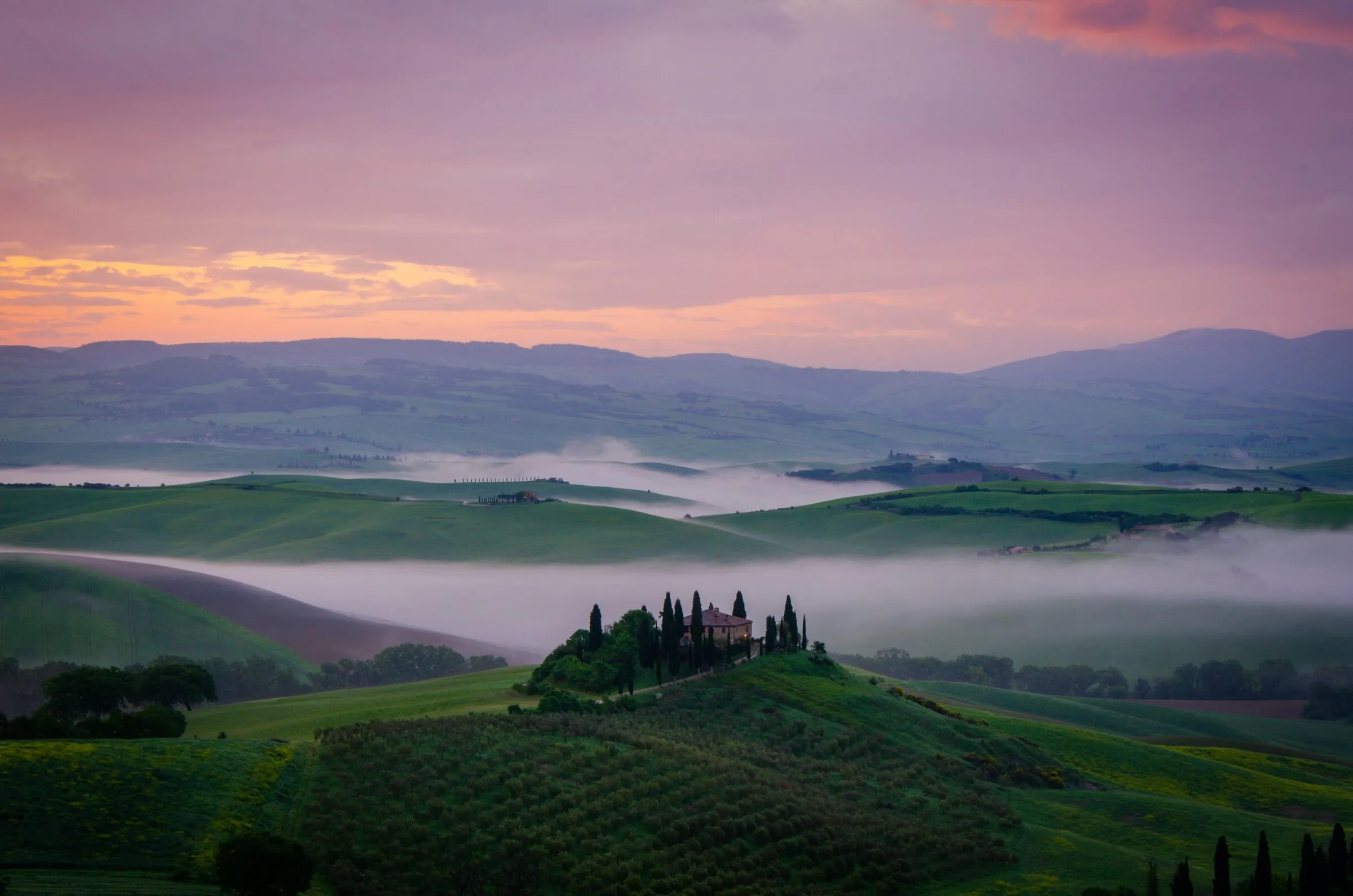
Tuscany is the version of Italy most travelers think about but almost never actually visit. They imagine it: cypress-lined roads, rolling hills the color of wheat and rust, medieval hilltowns perched on ridges, wine flowing at lunch and dinner, no schedules. The Tuscan daydream is real. It’s just not what happens when you fly into Florence for four days and try to add Tuscany as a sidecar.
Tuscany works — and I mean actually works, lands the way you imagine it — only when you stop treating it as a day-trip destination from Florence and start treating it as the base itself. The region is built for slowness: drives that take an hour to cover twenty miles because the road curves around vineyards and follows medieval property lines, meals that begin at 2 p.m. and don’t finish until sunset, evenings where the only sound is crickets and the occasional church bell. To experience Tuscany at tourist pace is to miss Tuscany entirely.
Most clients come to me with one of three Tuscany requests: as a wine-country week anchored at a working estate (staying at a fattoria where the vineyard is literally your backyard), as a honeymoon in the countryside with spa, gardens, and slow pace as the centerpiece, as a hilltowns loop (Siena, San Gimignano, Montepulciano, Pienza) as a multi-day detour from Florence, or as a multi-generational base where three generations can move at different paces and still share meals.
Here’s how I think about it.
At a Glance
| Best time to visit | April–early June for spring wildflowers and green hills. September–October for golden light, harvest season, the olive-oil and truffle seasons, and the landscape at its most photogenic. Avoid July–August: peak heat, peak crowds, many restaurants close for Ferragosto (mid-August holiday). December–January is quiet and beautiful for those comfortable with rain and cooler temperatures. |
| How long to stay | Five nights minimum at a countryside base to feel the rhythm settle in. Seven nights is ideal — enough time for wine tastings, hill-town days, cooking classes, and long lunches without rushing. Three nights in Tuscany as a Florence add-on works only if expectations are managed; you’ll see one hilltowns loop and that’s it. Better to commit to a full week. |
| How to get there | Fly into Florence (FLR) or Rome (FCO) and drive south, or train to Florence and arrange a car-and-driver pickup for the countryside week. A personal driver costs €60–80/hour and is infinitely less stressful than renting and navigating the winding hill roads yourself. |
| Currency / language | Euro. Italian is official. English is less widely spoken in the countryside than in Florence. Buongiorno, grazie, and a smile open doors. Learning wine terms (rosso = red, bianco = white, secco = dry) earns respect at tasting rooms. |
| One thing most guides won’t tell you | Many small hilltowns and wineries close between 1 p.m. and 3 p.m. for lunch — the entire region stops. Plan your day with this rhythm in mind. Don’t try to visit a winery at 1:30; no one is there. Lunch is the heartbeat; build your day around it. |
Why I Send Travelers Here
Because Tuscany is the place where “vacation” stops being a noun and starts being a verb — something you actually do rather than somewhere you go. The landscape is so deliberate, so obviously designed for slowness, that rushing through it feels genuinely wrong.
Tuscany has more UNESCO World Heritage sites per square mile than almost anywhere on earth. The region produces three of the world’s greatest wines (Brunello di Montalcino, Vino Nobile di Montepulciano, and Chianti Classico). The medieval hilltowns — Siena, San Gimignano, Montepulciano, Pienza — are so perfectly preserved they look like the versions of themselves painted during the Renaissance. The landscape itself — cypress avenues, Val d’Orcia’s white-clay hills, Chianti’s vine-carpeted valleys — is the background to centuries of paintings and photographs, which means seeing it in person is the surreal experience of stepping into images you’ve known your whole life.
I send couples here for honeymons where the point is not sightseeing but being together slowly — the spa, the garden walks, the long dinners at the property. I send wine-country travelers for a week at a working fattoria where every meal comes from the property, and the vineyard is part of the commute. I send multi-generational groups because the countryside rhythm allows grandparents, parents, and kids to move at different speeds and still share tables. I send slow-travel anchors who want one base for seven nights and the freedom to not make plans.
Every recommendation below comes from the lens of how I plan Tuscany for the clients I send, the property relationships I’ve locked in, and a clear point of view about which bases anchor which version of the Tuscan trip.
Where I’d Anchor
Three regions, each with its own character and each worth five to seven nights:
Chianti (wine country between Florence and Siena): Gentle rolling hills, Chianti Classico wine (the version with the black rooster seal), intimate wineries, the towns of Greve, Castellina, and Radda as day-trip anchors. Better for travelers who want wine to be central but don’t need the architectural drama of the south.
Val d’Orcia and Crete Senesi (the white clay hills south of Pienza): The landscape that stopped me the first time I saw it — rolling hills in shades of wheat, rust, white, and deep umber. UNESCO protected. Pienza, Montepulciano, and Montalcino are the anchoring hilltowns. Brunello di Montalcino wine. The most dramatic and most photographable region.
The Siena region (central Tuscany): Home to the Palio horse race (July and August), Siena itself (medieval jewel), and the rolling countryside that connects them. Less wine-focused than Chianti; more about the towns and the landscape.
For each region, the right base is a luxury fattoria — a working wine estate with hotel rooms, a restaurant, spa, and gardens. These are not hotels; they’re countryside escapes where the wine-making is real and visible.
Castiglion del Bosco (Montalcino, Val d’Orcia): A Tuscan fortress-turned-luxury-estate in Brunello di Montalcino wine country. Stone buildings clustered on a hilltop, a working winery, gardens, a spa, and the kind of countryside views that have been painted for five hundred years. Forty-five rooms in the converted fortress and stone cottages spread across the property. One honest note: Castiglion del Bosco sits outside my Signature consortium program, so I book it through other channels — the consortium amenity layer doesn’t apply here the way it does at Castello di Casole. It’s still a property I love sending couples to; I’ll be straight on the call about what the booking does and doesn’t carry. The restaurant sources from the estate farm — the produce is literally grown around you.
Borgo Santo Pietro (Pienza, Val d’Orcia): A 13th-century hamlet converted into twelve luxury suites and villas, built around medieval stone houses. The centerpiece is the property’s fine-dining restaurant and the Bernardus Spa (one of Tuscany’s best). The focus here is wellness and the landscape — less about wine-making, more about the spa, the walks, the slow pace. Like Castiglion, Borgo Santo Pietro sits outside my consortium program — I book it through other channels and I’ll tell you honestly what the amenity layer looks like. The cooking school (where you can learn Tuscan pasta-making) is worth building in. The quieter, more wellness-focused sibling to Castiglion.
Castello di Casole (Siena region): A restored medieval castle in the Siena hills with 30 suites in the castle proper and stone cottages spread across the grounds. Wine estate with its own vineyard, a truffle hunt (seasonal), a Espace Spa, and a Michelin-starred restaurant (L’Olmo). On my rate at the property, the amenity layer is calibrated to your stay rather than itemized in advance — what applies depends on dates, the suite category, and whether your timing aligns with the seasonal truffle hunt. We walk through it on the discovery call — and as a Belmond property, it’s the one of these estates that carries my Signature consortium amenity layer. The grandest and most architecturally dramatic of the three.
COMO Castello del Nero (Tavarnelle, Chianti): COMO’s first European property — a twelfth-century castle on a 740-acre estate in the heart of the Chianti wine region, 50 rooms and suites, a COMO Shambhala spa, and the design-led calm the brand does better than anyone. Like Castello di Casole, it carries my Signature consortium amenity layer, so it’s a fully deliverable alternative to the Val d’Orcia estates. The refined, wellness-meets-wine pick.
Want one of these countryside bases? Start a discovery call — I’ll walk through the three regions, match you with the property that fits your pace and interests, and lock in the wine tastings, cooking classes, and day trips that make the week work.
What I’d Do With Five to Seven Days
The Castiglion del Bosco Week (Brunello Wine Country, Val d’Orcia)
Day One — Arrival and Orientation Arrive midday, check in, long lunch at the property restaurant (the ribollita and the local wine). Afternoon walk around the property — the fortress, the gardens, the vineyard below. Early dinner to sync with Italian hours. Sleep.
Day Two — Montalcino and Wine Morning wine tasting at the property or a neighboring estate (the region produces Brunello di Montalcino, one of the world’s greatest wines — you want the full experience). Lunch at a fattoria restaurant in the hills. Afternoon walk through the medieval town of Montalcino perched on its hill above the valleys. Back to the property for sunset and dinner.
Day Three — Val d’Orcia Countryside Loop Drive through Val d’Orcia with a guide or driver — stop at Pienza (the papal village with Renaissance architecture and the best pecorino cheese in Italy), Montepulciano (another medieval hilltop town, another wine region), and the landscape stops that made Val d’Orcia a UNESCO site. Long lunch somewhere in the hills. Return to the property for spa time and dinner.
Day Four — Truffle Hunt (Seasonal) or Cooking Class If autumn (October–November): a truffle hunt with a dog and trainer, then a lunch featuring the truffles found. If not truffle season: a half-day cooking class at the property learning to make fresh pappardelle and Tuscan soups, then a lunch featuring what you’ve made. Afternoon free for walks or spa. Dinner at the property.
Day Five — Siena Day Trip or Slow Day Option A (if you have energy): Drive to Siena (45 minutes), spend the day in the medieval streets, visit the Cathedral and the Contrade (the neighborhoods that compete in the Palio horse race), lunch at a local trattoria, back to the property by dinner. Option B (if you want to stay slow): Walks around the property, long spa treatments, cooking classes, meals. By day five, many travelers want to stop moving.
Day Six — Whatever You’ve Fallen For A second wine tasting if you loved it. A return to a hilltownif you connected with one. A full spa day. A drive to San Gimignano (two hours north) if medieval drama is calling. The property is designed for you to decide.
Day Seven — Departure or Stay If staying longer, repeat the mix. If departing, morning drive back to Florence or the airport.
The Borgo Santo Pietro Wellness Week (Val d’Orcia, Spa-Focused)
Day One — Arrival and Spa Reset Arrive, check in, a light lunch, then a signature Espace Spa treatment (the property is famous for spa work). Early dinner. Sleep.
Day Two — Pienza Cooking and Wine Morning cooking class learning to make Tuscan pasta and the vegetables that go with it. Lunch (eating what you’ve made). Afternoon walking through Pienza — the papal architecture, the cheese shops, the light. Dinner at the property’s restaurant.
Day Three — Val d’Orcia Drive and Walk A scenic drive through the white-clay hills with stops for photographs and views. A walk through the landscape. Lunch at a fattoria in the hills. Back to the property for spa time (massage, thermal baths if available) and dinner.
Day Four — Montepulciano Wine and Medieval Streets Drive to Montepulciano (a working medieval town, not as tourist-heavy as Siena), explore the wine caves beneath the town (the cellars are carved into the hillside), taste Vino Nobile di Montepulciano. Lunch in town. Back to the property for spa and dinner.
Day Five — Slow Day Spa-focused day — multiple treatments, garden walks, long meals, no rushing. This is the version of Tuscany that feeds the soul.
Day Six — Truffle Hunt (Seasonal) or Second Adventure If autumn: the truffle hunt with dog and trainer. If spring: wildflower walk. If you want a second structured day. Lunch and dinner at the property.
Day Seven — Departure or Extended Stay The spa-focused version of Tuscany is the one you least want to leave.
Specific Things I’d Tell You About
Tuscan wine is not precious — it’s alive. Brunello di Montalcino, Vino Nobile di Montepulciano, Chianti Classico are world-class wines, but the version you drink at lunch at a fattoria restaurant is the version meant to be drunk at lunch. Order it by the glass, pair it with pasta, and don’t overthink it. The same wine in New York costs three times as much. Here it costs the price of admittance to Italian life.
The lunch hours are not negotiable. Between 1 p.m. and 3 p.m., most of the region closes — schools, offices, shops, smaller wineries. Restaurants open. This is not an obstacle; it’s the design. Plan your wine tastings for 10:30 a.m.–12:30 p.m., then stop for the long lunch at 1 p.m., then resume tastings or activities at 3:30 p.m. The rhythm is built into the landscape.
A car-and-driver is worth every euro. The roads are winding, narrow, and built for slow movement. Renting a car and driving yourself adds stress; hiring a driver costs €60–80/hour and eliminates both the navigation stress and the anxiety about drinking wine at lunch. I arrange driver pickup from Florence or the property.
Cooking classes at the properties work better than scheduled cooking tours. A group cooking class in Florence is a tourism checklist item. A private class at your property — you, a chef, learning what the property grows — is the version that becomes a story you tell for years.
Truffle hunts are real and surreal. You hike with a truffle hunter and their trained dog, the dog sniffs out buried truffles, you dig them up, you eat them at lunch. October–December only. It’s the kind of experience that sounds kitschy and is actually magical. If your dates align with truffle season, book it.
The white clay of Val d’Orcia is not a cliche — it’s real. The Crete Senesi hills south of Pienza are literally white clay beneath the grass, which shows through when the light hits certain ways. The landscape looks like an Impressionist painting because the light and the landscape are genuinely that beautiful. Pienza itself is the Renaissance on a hilltop — built by Pope Pius II in the 1460s as the perfect city, then abandoned when the money ran out. It’s frozen in the 15th century. Walking through it is the surreal experience of stepping into a painting.
Medieval hilltowns are worth walking slowly. San Gimignano has 14 medieval towers (most cities have zero). Siena has the Piazza del Campo and the Palio horse race tradition (twice yearly, July and August). Montepulciano has Renaissance architecture and wine caves beneath the streets. Pienza is the architectural jewel. Pick two towns and walk them slowly rather than hitting all four in a day. You’ll understand them better and photograph them better.
What I’d Skip
Crowded wine tours that pile you on a bus with forty other tourists. Find a small winery (many don’t advertise) through your property concierge, or arrange a private tasting. The winery owner or a family member will likely lead it, the tasting will be real, and you won’t share the experience with a tour group.
Tuscany as a day trip from Florence. If you only have one day, skip the countryside and anchor in Florence or a hilltowns loop you can drive to in under an hour. Driving two hours from Florence, spending four hours in a village, and driving two hours back is a travel day masquerading as a wine day. Better to commit to a full week.
The tourist-heavy hilltowns if you want quiet. San Gimignano and Siena are spectacular but crowded, especially June–September. If you want authentic, quieter towns, pick Montepulciano or Pienza instead. If you want the most dramatic backdrop, San Gimignano earns it; know what you’re getting.
“Typical Tuscan restaurants” aimed at tourists. If a restaurant has a sign promising “traditional Tuscan cuisine” on the street, it’s probably tourism. Ask your property concierge for the local trattoria where the menu doesn’t change and the staff knows the people at the next table.
Driving yourself if you’re uncomfortable with winding roads. The roads are beautiful and narrow. Hire a driver and drink the wine. It costs less than you think and is worth every euro.
For Honeymooners
Tuscany is the honeymoon region where the point is not sightseeing but being slow together. Anchor at Borgo Santo Pietro for the spa focus and the wellness angle, or Castiglion del Bosco for wine and landscape.
The ideal day: Late breakfast in the garden, a cooking class at 11 a.m., lunch featuring what you’ve made, a walk in Val d’Orcia in the afternoon, spa treatments at 4 p.m., a long dinner at the property restaurant as the sun sets. Repeat for seven nights.
The honeymoon meals are not restaurant-hopping; they’re long, slow, at tables where the light changes as you eat. The wine is the regional wine from the estate. The spa is a centerpiece as much as the landscape.
If you want me to design the full Tuscany honeymoon — which property, which season, which version of the week — start a discovery call.
For Wine-Country Travelers
If wine is your focus, anchor at Castiglion del Bosco in Brunello di Montalcino country, or Castello di Casole in the Siena hills if you want the option that carries my consortium amenities. The region produces one of the world’s greatest wines, the properties have working wineries on the grounds, and tastings can be daily if that’s your pace.
A wine-focused week might look like: Day 1: Property winery orientation and tasting. Day 2: A neighboring winery visit (the region is full of smaller producers). Day 3: Montalcino town exploration and winery caves. Day 4: A wine-pairing cooking class. Day 5: A trip to Montepulciano to taste Vino Nobile di Montepulciano (different wine, different region, 45 minutes away). Days 6–7: Repeat tastings at your preferred wineries, or explore the region’s many cantinas (wine bars).
Wine in Tuscany is meant to be drunk slowly, at meals, paired with food. The week is designed around that rhythm.
For Multi-City Italy Travelers
If Tuscany is part of a larger Italy trip, anchor in Florence (not countryside) and do a day trip or overnight to the wine country or hilltowns.
Option A: Chianti day trip from Florence Drive into Chianti in the morning, visit one or two wineries, long lunch at a fattoria restaurant, back to Florence by dinner. A half-day to full-day excursion.
Option B: San Gimignano day trip Drive southwest to San Gimignano (1.5 hours), spend the day exploring the medieval towers and streets, long lunch, back to Florence by evening.
Option C: Siena day trip Drive south to Siena (1.5 hours), explore the medieval streets and the Cathedral, the Piazza del Campo, long lunch, back to Florence by dinner.
For a multi-city Italy trip where you want countryside immersion, split your time: two nights in Florence, then three nights at a countryside base (Castiglion, Borgo, or Castello), then back to Florence for a night before heading to Venice. The train is your friend for city-to-city; a car-and-driver makes countryside movement easy.
For Multi-Generational Trips
Tuscany works for three generations because everyone can move at different paces and still share meals. The property bases offer this naturally.
Grandparents: Long spa treatments, garden walks, meals. Parents: Wine tastings, hilltowns, cooking classes. Kids: Truffle hunts, exploring medieval streets, pool time (most properties have pools). Evening: Everyone at the dinner table.
The countryside rhythm accommodates all of it. No one is forced to museum-hop or rush between cities.
Plan Tuscany With Me
Whether you’re thinking about Tuscany as a wine-country week, as a honeymoon retreat, as a hilltowns loop, or as the centerpiece of a multi-city Italy trip — that’s exactly the kind of planning I do. A 30-minute discovery call is where it starts. No fee, no pressure. Just the region, your timeline, and what you actually want to feel when the sun is setting over cypress-lined roads and the dinner table is set.
Book Your Free Discovery Call →︎
Last updated: April 2026. I keep this guide current. If a property changes hands, a winery shifts focus, or a hilltowns road closes for renovation, the page changes. Tuscany changes. The work doesn’t stop when the page goes live.
Plan this trip with me.
A 30-minute discovery call is where it starts. No fee, no pressure.
Book a Discovery Call