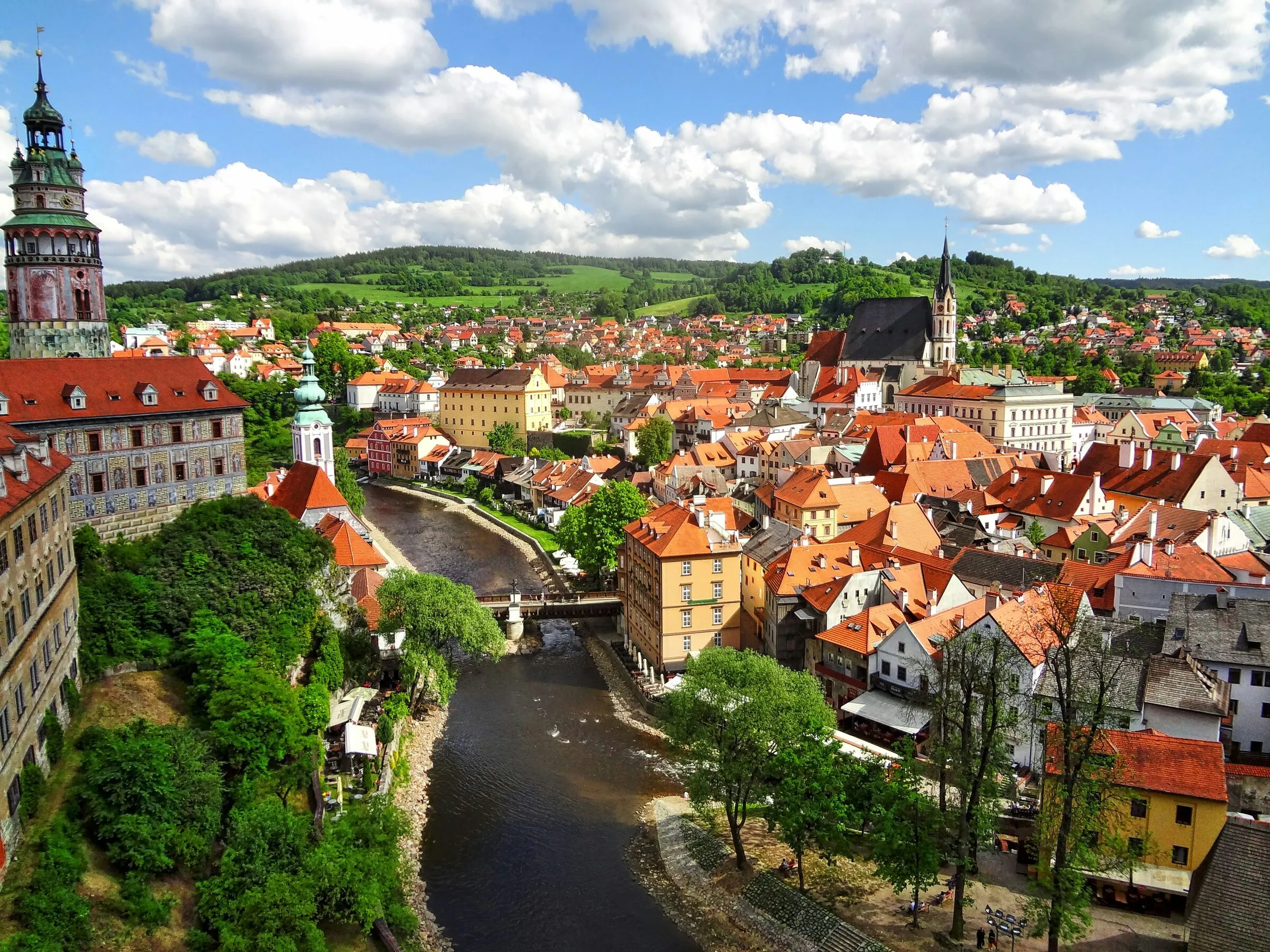
Prague is the European city travelers fall in love with the moment they cross the Charles Bridge at sunset and look back. The image is real, the cliché is earned, and the city does not disappoint at the level the photographs promise. Where most travelers go wrong is in how much of Prague they try to see and how fast — the standard two-day cruise-extension visit treats Prague like a checklist (Castle, Charles Bridge, Old Town Square, Jewish Quarter, fly home), and the city deserves more.
Done correctly, Prague is one of the most architecturally complete capitals in Europe. The city escaped the worst of WWII bombing and the post-war Soviet-era erasure that flattened so much of central Europe; the Old Town and Lesser Quarter (Malá Strana) survived essentially intact, with seven major architectural styles layered into a single dense walking city — Romanesque, Gothic, Renaissance, baroque, classicist, art nouveau (Mucha was Czech and the city wears it), and contemporary (Frank Gehry’s Dancing House epitomizes the post-1989 layer). The Czech Republic has more preserved castles per square mile than any country in the world, with Prague Castle — at over 1,000 years old, the largest ancient castle in the world — at the center of the inventory.
Most clients come to me asking about Prague in three contexts: as a Danube river cruise extension (the most common — Prague is the most-added pre or post extension to AmaWaterways, Viking, Avalon, and Uniworld Danube itineraries, with a bus or rail transfer from Nuremberg or Vienna and 2–3 nights in the city), as the northern anchor of a Central European multi-city sweep (Munich →︎ Prague →︎ Vienna →︎ Budapest, or any permutation, all train-connected), or — rarer, and the version I most want to plan for — as a standalone three-or-four-night Prague visit in its own right.
Here’s how I think about it.
At a Glance
| Best time to visit | May–June and September–October. Long days, the gardens of Malá Strana are at their best, and the Christmas-market crush hasn’t yet arrived. Late November–December is its own iconic version — the Old Town Square Christmas market with the Astronomical Clock as backdrop is one of the great central European market scenes. Avoid mid-July through August — peak heat in the basin, peak cruise-bus surge. |
| How long to stay | Two full nights minimum if Prague is a cruise extension, three or four nights for a real city visit, five-plus if you’re combining with day trips to Český Krumlov or Karlovy Vary. |
| How to get there | Václav Havel Airport (PRG) is 17 km west of the city; the Airport Express bus runs to Hlavní nádraží (main station) in 30–40 minutes for CZK 100 (around USD $4.50). From elsewhere in central Europe — direct rail from Vienna (4h), Munich (5h30m), Budapest (6h45m); rail is genuinely better than flying for any of those city pairs once you count airports. |
| Currency / language | Czech koruna (CZK) — note: Prague is in the Czech Republic but does not use the Euro. Cards work everywhere; many tourist-facing places quote in EUR but settle in CZK. Czech is official; English is widely spoken in tourist-facing settings. Dobrý den (good day) and děkuji (thank you) are appreciated. |
| One thing most guides won’t tell you | The Astronomical Clock’s hourly mechanical-figures show is famously underwhelming — the figures are small, the procession is brief, and the crowd that gathers in Old Town Square is much more interesting to watch than the clock itself. See it once. Then ignore it for the rest of the trip. The clock as a mechanical object is far more interesting than the show, and you can examine it at any non-hourly minute without the crowd. |
Why I Send Travelers Here
Because Prague, planned correctly, is the most architecturally rewarding small-walking-city in central Europe. The historic core is roughly the same square-mileage as central Vienna but compresses more layered architectural history into the same footprint. The Charles Bridge at sunset is the iconic central European image; the Prague Castle complex on the hill above Malá Strana is the world’s largest ancient castle; the Astronomical Clock in the Old Town Square has been keeping time since 1410; the Old Jewish Cemetery in the Jewish Quarter is twelve layers of graves stacked on top of one another over six centuries because the medieval ghetto wasn’t permitted to expand outward.
It’s also the natural northern endpoint of the Munich-Vienna-Budapest-Prague four-city central European arc — the spine of historic central Europe done in a single rail-connected loop that pre-1990 was politically impossible and is now pleasantly straightforward. And it’s the most-added extension to a Danube river cruise; if your cruise terminates in Nuremberg or starts in Vienna, Prague is the natural 2–3 night add-on, accessible by direct bus or rail transfer.
I send travelers here as the northern anchor of a Central European sweep, as the post-cruise capstone for Danube travelers, for honeymoons that want the romantic-bridge-and-castle version of central Europe, and for travelers following Jewish heritage — Prague has one of the most complete medieval Jewish quarters surviving in Europe, with seven preserved synagogues, the Old Jewish Cemetery, and the Spanish Synagogue’s Moorish-Revival interior.
Every recommendation below comes through the lens of how I plan Prague for the clients I send, the hotel relationships I rely on, and a clear point of view about which sights earn your time and which version of the Charles Bridge hour is the one most travelers miss.
Where I’d Anchor
Three neighborhoods cover almost any traveler’s reason for being in the city:
Malá Strana (Lesser Town). The west bank of the Vltava, beneath Prague Castle. Cobblestoned streets, hidden courtyard gardens, baroque palaces, and the most architecturally cohesive quarter in Prague. Stay here for the romantic-Prague version of the trip — quiet at night, dramatic at dawn, walking distance to the Castle and across the Charles Bridge into Old Town. The pick for first-time honeymoons and milestone trips.
Old Town (Staré Město). The east bank, anchored on Old Town Square. The Astronomical Clock, Týn Church, the medieval lanes around Pařížská avenue, the Jewish Quarter (Josefov) just north. Stay here for the heart-of-things version — most central, most touristed, walking distance to almost everything.
New Town (Nové Město). Surrounding Wenceslas Square south and east of the Old Town. Less ancient, more 19th- and early-20th-century, with the major commercial streets, the Mucha Museum, the Dancing House, and the National Museum. Best for travelers who want a less-touristed base or who’re combining Prague with business meetings.
For the Malá Strana monastery-quiet pick — and the most distinctive property in the city — Mandarin Oriental, Prague at Nebovidska 459/1 is the call. The hotel occupies a carefully restored 14th-century former Dominican monastery below Prague Castle, with 99 guest rooms and suites woven into the historic monastic architecture. The holistic spa is housed in a former Renaissance chapel; the Baroque Grand Ballroom is a real baroque ballroom; Monastiq Restaurant serves modern Czech cuisine in a room that combines original historical architecture with contemporary design. On my rate at the property, the amenity layer is meaningful and doesn’t book direct — what applies depends on your dates and whether you split time between the spa and the dining room, and the specifics are the discovery-call conversation.
For the Old-Town flagship pick on Pařížská avenue — Prague’s most prestigious address, running from Old Town Square to the Vltava — Fairmont Golden Prague is the Old Town anchor. The property sits directly on the Vltava banks, moments from the Old Town Square, with six restaurants and bars, a stylish Grand Ballroom, a Spa & Wellness program, and a unique indoor/outdoor pool that earns its differentiator status (very few central Prague hotels have a real pool, and even fewer indoor/outdoor). On my rate at the property, the amenity layer doesn’t book direct, and the specifics get walked through on the discovery call. The property also runs seasonal stay-length promotions that materially shift the value math on cruise-extension stays; we’ll check what’s live for your dates.
For the boutique-luxury alternative in Malá Strana — and the property with the strongest single-meal inclusion in Prague — Aria Hotel Prague at Trziste 9 is the pick. Fifty-one rooms in a music-themed boutique a few minutes’ walk from the Charles Bridge or Prague Castle, each room dedicated to a specific composer or musical style. The fine-dining CODA Restaurant has a rooftop terrace with views over Malá Strana; the property has private entrance access to a UNESCO-protected garden adjoining the hotel. On my rate at the property, the amenity layer is real and quiet — and the inclusion package here is materially stronger than any other Prague property I work with, deepened further on longer stays. The specifics get walked through on the discovery call.
For travelers who want a third option in New Town with strong Art Deco heritage, Almanac X Alcron Prague on Štepánská near Wenceslas Square is the alternative — built 1932, fully refurbished March 2023, 204 rooms, with a Third Night FREE promo currently running. Standard amenities apply.
Want one of these stays? Start a discovery call — I’ll pull live availability, walk through suite categories, and confirm which amenities and current promotions apply to your dates. And the small extra at check-in — a welcome note from me, the kind of touch the standard amenity package doesn’t list — is part of how I deliver these stays.
What I’d Do With Three Days
Adjust to taste. The three-day version is the right length for a real Prague visit; the two-day version is the cruise extension that compresses the must-sees.
Day One — Old Town and the Jewish Quarter
Start at the Old Town Square before 10 a.m. — see the Astronomical Clock orloj’s hourly figure procession once (it’s small, it’s brief, the crowd is more interesting than the show — but you should see it once). Walk the square — Týn Church, the Kinsky Palace, Old Town Hall — and into the small medieval lanes radiating outward.
Mid-morning, walk into the Jewish Quarter (Josefov), just north of the Old Town Square. Allow at least three hours for the Jewish Museum complex — the Old-New Synagogue (the oldest still-active synagogue in Europe, in continuous use since 1270), the Spanish Synagogue (Moorish-Revival 1868, the most architecturally beautiful interior in the complex), the Pinkas Synagogue (with the names of Czech Holocaust victims hand-painted on every wall — 78,000 names), the Klausen Synagogue, the Maisel Synagogue, the Ceremonial Hall, and the Old Jewish Cemetery — twelve layers of graves stacked on top of one another over six centuries because the medieval ghetto wasn’t permitted to expand outward. The cemetery alone is one of the most striking spaces in any European city.
Lunch in the Jewish Quarter — Kolkovna (Czech classics, casual) or Field (modern Czech, Michelin-starred) if you can get a table.
Afternoon walking the Old Town’s smaller streets — the lanes between Old Town Square and the Charles Bridge, with their astronomical clock carvings on building facades, the medieval guild halls, the small courtyards. Cross the Charles Bridge at sunset (this is the moment) — westbound, into Malá Strana, with the bridge towers and statues silhouetted against the Castle on the hill ahead. Allow forty-five minutes to walk it slowly and stop at the saint statues that draw the most attention.
Dinner in Malá Strana — Café Savoy (heritage Czech-Viennese), U Modré Kachničky (Czech game-and-duck classics in a 17th-century house), or back across the bridge to Old Town for Field or La Degustation Bohême Bourgeoise (modern Czech, 2-Michelin-star).
Day Two — Prague Castle and Malá Strana
Up early. Be at Prague Castle at opening (9 a.m. or earlier in summer). The complex is the largest ancient castle in the world — over 1,000 years of continuous use, with the St. Vitus Cathedral (1,000-year-old foundations, the current Gothic structure begun 1344), the Old Royal Palace, the Basilica of St. George, the Golden Lane (the small alley of preserved 16th-century artisans’ cottages — Franz Kafka lived briefly at No. 22), and panoramic terraces back across the city.
Pick a ticket level: the basic ticket includes the cathedral, the Old Royal Palace, the Basilica, and Golden Lane. The full Tour adds the Picture Gallery, the Powder Tower, and the Rosenberg Palace. The basic ticket is enough for most travelers; allow two-and-a-half hours for the basic loop.
Lunch in Malá Strana — at one of the small restaurants on Nerudova or Mostecká streets (the medieval lanes connecting the Castle down to Charles Bridge). Mlýnec (Old-Bohemian classics with views of Charles Bridge) is the iconic-view pick.
Afternoon walking the Wallenstein Garden (a remarkable 17th-century baroque garden hidden behind the Wallenstein Palace — peacocks, sculptures, an artificial grotto, and almost no tourists), the Vrtba Garden (smaller and more famous, with the Charles Bridge view), and the Petřín Hill funicular for the view from the Petřín Lookout Tower — Prague’s mini-Eiffel-Tower from 1891, with the city laid out beneath you.
End the day at the Charles Bridge again at dusk (the second crossing — eastbound this time, with the Old Town spires lit ahead) or with a sunset drink at the Mandarin Oriental’s bar if you’re staying or visiting the property.
Day Three — Modern Prague, the Mucha Museum, and Day Trip Options
Morning at the Mucha Museum in New Town — Alfons Mucha’s life work, including the Slav Epic frieze studies, the famous Sarah Bernhardt theater posters, and the Art Nouveau ornament that defines the period in central European visual culture. Allow ninety minutes.
Walk to the Municipal House (Obecní Dům) — the Art Nouveau concert hall and former civic center, with one of the great Smetana Hall interiors. The café in the Municipal House is one of Prague’s most beautiful Art Nouveau rooms and serves a credible coffee-and-cake afternoon.
Lunch in New Town — Café Imperial for the Art Nouveau dining hall (the chef is one of the most famous in Czech cuisine), or Eska for modern Czech-bakery if you’ve crossed into Karlín.
Afternoon: choose one.
- Vyšehrad — the cliff-top fortress complex south of the Old Town, with the Vyšehrad Cemetery where Smetana, Dvořák, and most other major Czech cultural figures are buried, and one of the best Vltava-and-Castle panoramas in the city.
- A day trip — Český Krumlov (the picture-perfect medieval Bohemian town, 2.5h south by train or bus), Karlovy Vary (the historic spa town, 2h west), or Kutná Hora (the bone church and 13th-century silver mines, 1h east).
- A slower Prague afternoon — Letná Park for the panoramic city view (and the metronome where Stalin’s statue once stood), the Dancing House and a riverside walk, or the Vltava paddle steamer for an hour-long river loop.
By day three, Prague makes its own recommendations.
Specific Things I’d Tell You About
Prague Castle is the largest ancient castle in the world. The Guinness Book of World Records confirms it: over a thousand years of continuous construction and use, an irregular polygon spanning 70,000 square meters of grounds. Allow at least two-and-a-half hours for the basic ticket loop. The cathedral alone is an hour.
The Old Jewish Cemetery is twelve layers of graves stacked vertically. When the medieval Prague ghetto was prohibited from expanding outward, the cemetery had no choice but to grow upward — graves stacked on top of older graves, soil added, more graves placed on top, repeated for nearly four centuries. The result: roughly 12,000 visible tombstones over an estimated 100,000 burials. It’s one of the most physically distinctive Jewish-historical spaces in Europe.
The Astronomical Clock has been keeping time since 1410. The mechanism is the world’s third-oldest astronomical clock and the oldest still in operation. The hourly figure procession is small and brief; the clock itself — its astrolabe dial showing the position of the sun, moon, and zodiac, the calendar dial below with the months illustrated as agricultural scenes — is the worth-looking-at piece. Look between hours, when the crowd is gone.
Czech beer is better than you’ve been told and predates almost everything else you drink. Pilsner — the world’s most-imitated beer style — was invented in 1842 in Plzeň, 90 km west of Prague. The Czech Republic has the highest per-capita beer consumption in the world, and the everyday tap beer at any neighborhood hospoda is genuinely excellent and inexpensive (around CZK 50 — USD $2.30 — for a half-liter). Pilsner Urquell, Budvar, Kozel, Staropramen are all worth ordering by name.
The Stalin statue used to stand where the metronome now ticks. From 1955 to 1962, the largest Stalin statue in the world — a 22-meter-tall monument weighing some 17,000 tons — stood on the Letná promontory above the Vltava. Khrushchev denounced Stalin in 1956; the Czech government dynamited the statue in 1962. The pedestal sat empty for thirty years; in 1991, a 75-foot kinetic metronome was installed on the same spot and still ticks today. Walk up to Letná for the panoramic city view and stand at the metronome’s foot — it’s the most quietly devastating piece of post-Soviet public art in central Europe.
Mucha was Czech and the city wears it. Alfons Mucha invented the visual language of European Art Nouveau (the swirling-haired women on theatrical posters; the decorative panels for advertising) and lived most of his career in Prague. The Mucha Museum in New Town holds the major collection; the Municipal House is decorated throughout with his work; the St. Vitus Cathedral has a Mucha-designed stained-glass window. Look for him.
What I’d Skip
Restaurants near the Charles Bridge or Old Town Square with multilingual menus and pushy hosts. Same tourist-tax pattern as every European city in this library. The good Prague restaurants don’t need to advertise that hard, and they’re often two streets back from the heavily-touristed lanes. Walk one street off Karlova or off Old Town Square in any direction.
The “ghost tours” and “torture museums” along Karlova. Tourist tax with theatrical lighting. Skip.
Driving anywhere in central Prague. The Old Town and Malá Strana are essentially pedestrianized, the metro is excellent, taxis are metered and cheap, and the traffic in the periphery is hostile to outsiders. Hire a car and driver only for the Český Krumlov / Karlovy Vary day-trip days.
The hourly Astronomical Clock figure show as a destination event. See it once — it’s underwhelming, but cultural completeness demands witnessing it. Don’t plan around it. The clock is interesting as a clock; the show is the worst-lit minute of your day.
Going up the Petřín Tower without checking the weather. The view is the entire point; on overcast days the tower delivers a gray middle-distance view of fog. Save it for a clear afternoon.
For Travelers Following Jewish Heritage
Prague’s Jewish community is one of the oldest and most architecturally complete-surviving in Europe. The Jewish Quarter (Josefov) retained its medieval ghetto layout (largely; it was aggressively redeveloped in the 1890s, but the major synagogues were preserved) through the Habsburg, Austro-Hungarian, Czechoslovak, and Soviet periods, and the seven preserved synagogues plus the Old Jewish Cemetery comprise one of the most layered Jewish heritage walks in central Europe.
The Old-New Synagogue (1270) is the oldest continuously-active synagogue in Europe. The Spanish Synagogue (1868) is Moorish-Revival, the most architecturally beautiful interior in the city. The Pinkas Synagogue holds the names of all 78,000 Czech and Moravian Jewish Holocaust victims hand-painted on its walls — quietly devastating. The Old Jewish Cemetery is the twelve-layer vertical-graves space described above.
The Jewish Museum complex sells a single ticket valid for all the synagogues, the cemetery, and the Ceremonial Hall — pre-book, especially in season; same-day tickets sell out by midmorning.
I’m currently developing a co-hosted Jewish Heritage trip for 2026, and Prague — alongside Vienna, Budapest, Rome, Paris, and Amsterdam — is a primary city on the routing. Reach out if you’d like to be on the early-interest list.
For the longer thinking on how I work this thread — what makes it different from other heritage travel, what it earns, and what it doesn’t try to be — read the pillar essay: Jewish heritage travel.
For Multi-City Central Europeans
Prague is the northern anchor of the four-city Central European spine — Munich →︎ Prague →︎ Vienna →︎ Budapest, three or four nights each, all train-connected. The pacing varies by direction but the math is roughly: Munich for the Bavarian energy, Prague for the architectural compression, Vienna for the imperial weight, Budapest for the Danube drama. Three nights each is the floor; four is the right pace for travelers who want to actually inhabit each city.
The Munich →︎ Prague →︎ Vienna →︎ Budapest direction is my preference for first-time travelers — Munich’s Bavarian energy as the front, Prague’s medieval beauty in the middle-north, Vienna’s grand-imperial weight in the middle-south, Budapest’s eastern-different character as the close. The reverse direction works equally well.
If you want me to design the full Central European spine — train timing, hotel sequencing, day-trip options out of each base, restaurant reservations — that’s exactly the kind of planning I do. Start a discovery call.
For Danube River Cruise Extenders
Prague is the most-added pre or post extension to a Danube river cruise. If your sailing terminates in Nuremberg (the most common Danube terminus), Prague is a 3.5-hour direct bus or rail transfer; many cruise lines offer a packaged extension. If your sailing starts or ends in Vienna, Prague is a 4-hour direct rail journey, and the extension is worth doing whenever the cruise schedule allows. Two nights minimum, three is better — the cruise rhythm has been slow, and Prague rewards the slower pace it earns when you’re not catching another flight three days later.
The deeper conversation about which Danube itinerary fits which traveler — and whether your cruise dates allow a Prague extension — lives on the Rivers & Small Ships specialty page.
For Honeymooners
Prague is the underrated central European honeymoon city — the Charles Bridge at sunset, the Castle silhouette from Malá Strana, the small hidden gardens, the medieval lanes, and the kind of architectural-romance backdrop that delivers the romantic-Europe version without the cost or the crowd of Paris. Anchor at the Mandarin Oriental for the 14th-century-monastery quiet, the Aria Hotel for the music-themed boutique with the included three-course dinner, or the Fairmont Golden Prague for the Pařížská-avenue flagship experience.
The honeymoon evening, in my read, is dinner at one of the Malá Strana fine-dining anchors (Café Savoy, U Modré Kachničky, CODA at the Aria), followed by the Charles Bridge walk back at midnight — the bridge clears around 11 p.m., the Castle is lit, and the walk in near-silence with the river beneath is the version of Prague most travelers don’t realize they can have.
If you want me to design the full Prague honeymoon, or to combine Prague with Vienna, Munich, or a Danube river cruise, that’s exactly the kind of planning I do. Start a discovery call.
Plan Prague With Me
If you’re thinking about Prague as a Danube river cruise extension, as the northern anchor of a Central European multi-city sweep, or as the standalone three-or-four-night visit it deserves to be — that’s exactly the kind of planning I do. A 30-minute discovery call is where it starts. No fee, no pressure. Just the city, your timeline, and what you actually want to feel when you stand on the Charles Bridge at sunset and look back across the Vltava at the Castle.
Book Your Free Discovery Call →︎
Last updated: April 2026. I keep this guide current. If a hotel I recommend slips, a restaurant changes hands, or access to a site shifts, the page changes. Travel changes. The work doesn’t stop when the page goes live.
Plan this trip with me.
A 30-minute discovery call is where it starts. No fee, no pressure.
Book a Discovery Call