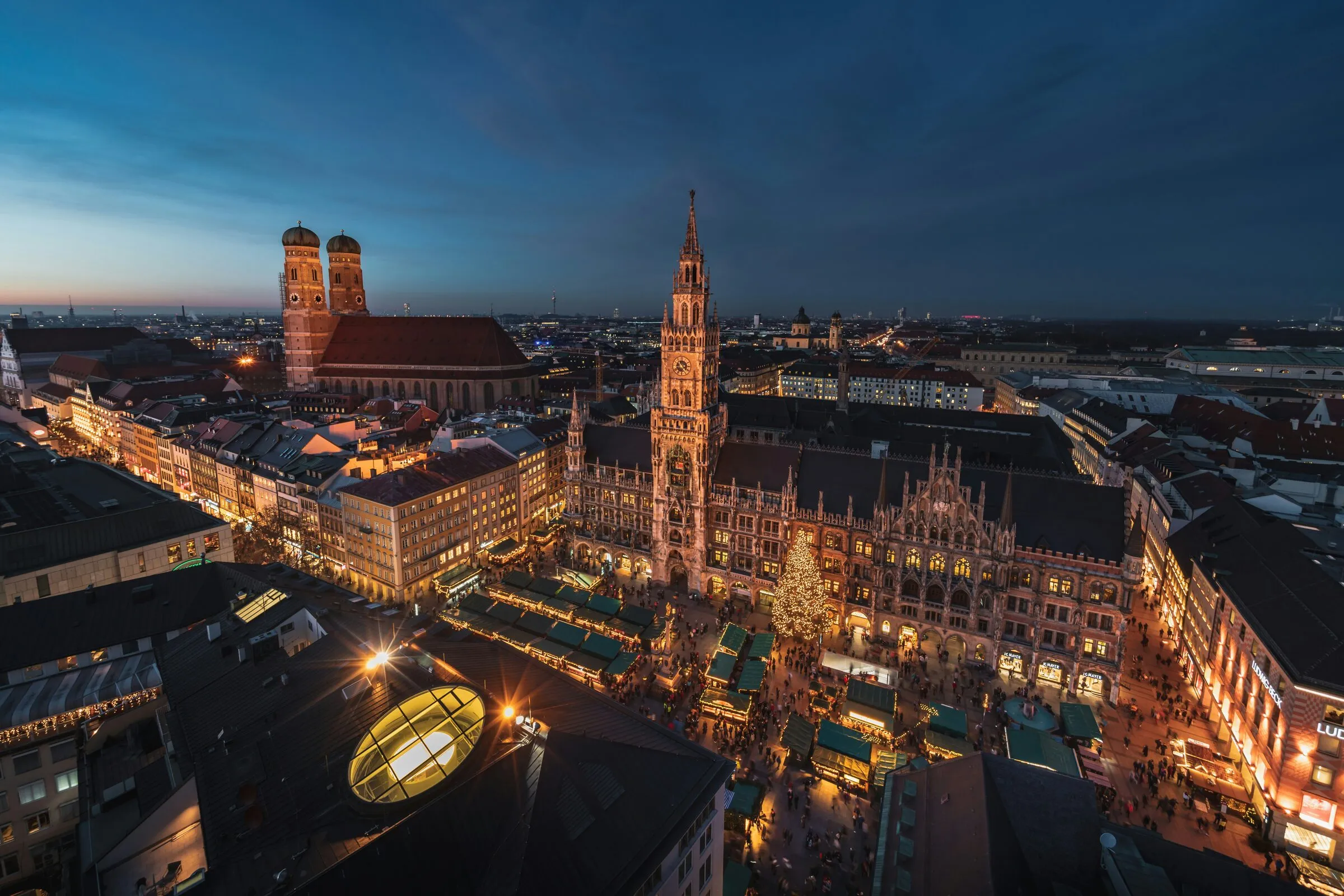
Munich is the city most travelers arrive with one of two pictures in mind, and both of them are misleading. The first picture — Oktoberfest, lederhosen, beer halls, the Hofbräuhaus — is one accurate fortnight a year and a tourist cliché the other fifty weeks. The second picture — a stuffy old Bavarian capital, more functional than charming — is what travelers tell themselves when they don’t realize they’ve been handed the wrong itinerary. Both are wrong by half.
Done correctly, Munich is one of the most layered medium-sized cities in Europe. Six world-class museums in a five-block stretch (the Kunstareal — Alte Pinakothek, Neue Pinakothek, Pinakothek der Moderne, Brandhorst, Lenbachhaus, Glyptothek). One of the largest urban parks in Europe (the Englischer Garten, with a surfing wave in the middle of it and a beer garden that holds 7,000). The Maximilianstrasse luxury corridor that carries from Marienplatz to the Bavarian Parliament. A baroque-and-rococo Old Town center that survived enough of WWII to feel genuinely old. And one hour south, the Bavarian Alps; ninety minutes east, Salzburg; two-and-a-half hours west, Neuschwanstein. The whole city is a Bavaria-and-Alps base disguised as a flight destination.
Most clients come to me asking about Munich in three contexts: as the Oktoberfest base (peak demand mid-September through early October — book a year ahead, not earlier than that, not later), as the front of a Bavaria-and-Alps sweep (Munich →︎ Salzburg →︎ Berchtesgaden →︎ Neuschwanstein, sometimes adding Garmisch-Partenkirchen for the mountains proper), or as a stop on a multi-city European sweep (Vienna–Munich–Amsterdam is the high-speed-rail spine of central Europe). A small slice of clients arrive for a standalone three-day Munich-only visit, and the irony is they’re often the ones who leave most impressed.
Here’s how I think about it.
At a Glance
| Best time to visit | May–early July and September. Long days, beer-garden weather, the city’s at its most Bavarian. Late September–early October is Oktoberfest — book a year out and accept that prices triple. December is its own thing — the Christmas markets at Marienplatz, Residenzhof, and Schwabing are quietly some of the best in Germany. Avoid late November (in-between season) and the dead first half of August. |
| How long to stay | Three full days minimum for the city itself. Add another two if you’re doing day trips to Neuschwanstein, Salzburg, or Dachau. Add at least two days if Oktoberfest is the centerpiece — one day in the tents goes long and the next day requires recovery. |
| How to get there | Munich Airport (MUC) is 28 km northeast; the S-Bahn S1 or S8 trains run every 10 minutes to the city center in 40 minutes. From elsewhere in Europe — high-speed rail to Vienna in 4h, Salzburg in 1h30m, Frankfurt in 3h, Berlin in 4h. Flights are slower than rail once you count airports for any of those city pairs. |
| Currency / language | Euro. German is official; English is widely spoken in tourist-facing settings, and Bavarians have an affectionately distinct dialect even other Germans struggle with. Grüß Gott is the regional hello (different from the standard Guten Tag); using it earns small Bavarian smiles. |
| One thing most guides won’t tell you | Munich’s restaurant culture front-loads. Lunch starts at 11:30, dinner at 6:30 — earlier than you’d expect from a European capital. Many restaurants stop seating at 9 p.m. If you’re coming from Italian or Spanish meal hours, recalibrate, or you’ll go hungry on day one. |
Why I Send Travelers Here
Because Munich, planned correctly, is one of the strongest Bavarian-Alps base cities in Europe — and one of the most under-planned. The famous version of the city (Oktoberfest, the Hofbräuhaus, lederhosen) is a small slice of the actual surface area; the Kunstareal museum quarter, the Maximilianstrasse luxury corridor, the Old Town’s residual baroque, the Englischer Garten, and the day-trip access to Neuschwanstein, Salzburg, and the Bavarian Alps make it a much deeper European city than most travelers expect.
It’s also one of the cities on Rachel’s European sabbatical, and the natural northern bookend to a Vienna-and-Bavaria pairing — Vienna and Munich on opposite ends of the Bavarian-Austrian rail spine, easily connected by a four-hour ICE train, and rewarding as a paired week.
I send travelers here for Oktoberfest with the right tent reservations and the right pacing (more on that below — Oktoberfest done wrong is a worse trip than not going at all). I send couples for Bavaria-and-Alps sweeps that anchor in Munich for the city days and then move south to Salzburg, Berchtesgaden, or Neuschwanstein. I send multi-city European travelers who need a central-European city stop between Amsterdam and Vienna, or between Frankfurt and Italy. And I send travelers following Jewish heritage to one of the most layered and difficult 20th-century histories in Europe — the city where the Nazi movement first organized politically, and the city whose 21st-century reckoning with that history is taken seriously and built into the architecture.
Every recommendation below comes through the lens of how I plan Munich for the clients I send, the hotel relationships I rely on (with Mandarin Oriental, Munich as the Erik-flagged property at the lead), and a clear point of view about which neighborhoods earn your nights, which cliché versions of the city are real and which aren’t, and which day trips are worth the train ticket.
Where I’d Anchor
Three neighborhoods cover almost any traveler’s reason for being in the city:
Altstadt / Maximilianstrasse (the city center). The Old Town is essentially the inside of the medieval ring of city gates — Marienplatz at the center, the Frauenkirche cathedral, the Residenz palace, the Hofbräuhaus a few blocks east, and the Maximilianstrasse luxury-shopping-and-museum corridor running east toward the Bavarian Parliament. Stay here on a first visit if you want to walk to almost everything that defines the iconic Munich.
Schwabing. North of the city center, beyond the Siegestor (Victory Gate), bordering the Englischer Garten. Munich’s traditional artistic-and-academic quarter — Thomas Mann’s neighborhood, Kandinsky’s, the home of the Blaue Reiter movement — and now the closest thing the city has to a sustained creative-residential energy. Quieter at night than the city center, more local-feeling, and the right base for a second visit or for a traveler who wants their Munich evenings in a real neighborhood rather than a tourist orbit.
Glockenbachviertel & Gärtnerplatz. South of the Viktualienmarkt, the trendiest neighborhood in central Munich — small bars, design shops, the city’s strongest LGBTQ+ scene, restaurants without multilingual menus. The pick for travelers who want to skip the postcard version of Munich and stay where younger Bavarians live.
For Erik’s flagged property — and the lead Maximilianstrasse-adjacent pick — Mandarin Oriental, Munich at Neuturmstrasse 1 is the call. Quietly tucked away on a side street steps from the Maximilianstrasse luxury corridor, the property combines Mandarin’s classic personalized service with a particularly strong dining bench: Matsuhisa, Munich by Chef Nobu Matsuhisa himself, and the Munich Sushi Club rooftop (opened May 2024 atop the property, also a Nobu venture) with panoramic views across the Old Town. On my rate at the property, the amenity layer is meaningful and doesn’t book direct — what applies depends on your dates and the room category, and the specifics get walked through on the discovery call.
For the iconic family-owned heritage pick on Promenadeplatz — Munich’s Bayerischer Hof has been operating since 1841 — Hotel Bayerischer Hof is the heritage anchor. Three hundred and thirty-seven rooms and seventy-four suites, five restaurants (including the two-Michelin-starred Atelier), the heritage-protected Falk’s Bar that’s the unofficial heart of the hotel, and the 1,300-square-meter Blue Spa designed by Andrée Putman with a glass-roofed mosaic pool that opens to the sky. On my rate at the property, the amenity layer doesn’t book direct, and the specifics get walked through on the discovery call. Notably, upgrade availability here is confirmed at booking rather than at check-in — you find out earlier than at most properties whether the upgrade is happening, which can shape how you think about the room category at booking.
For the design-forward Schwabing-district pick away from the city-center crowds, Andaz Munich Schwabinger Tor at Leopoldstrasse 170 is the alternative. Munich’s lifestyle-luxury Andaz, in the historic Bohemian-and-bookish heart of Schwabing, with 234 residentially styled rooms (starting at 420 square feet — among the most spacious hotel rooms in Munich) and 43 suites with separate living-and-sleeping areas. The rooftop bar and outdoor terraces have city views and, on clear days, the Bavarian Alps to the south. On my rate at the property, the amenity layer doesn’t book direct, applicable broadly across the property’s signature restaurant The Lonely Broccoli and other on-site outlets. The specifics get walked through on the discovery call.
Want one of these stays? Start a discovery call — I’ll pull live availability, walk through suite categories, and confirm which amenities apply to your dates.
What I’d Do With Three Days
Adjust to taste. Add a fourth day if you’re doing one of the day trips (Neuschwanstein, Salzburg, or Dachau).
Day One — Marienplatz, the Old Town, the Residenz
Start at Marienplatz before 11 a.m. — the Glockenpiel in the Neues Rathaus tower performs daily at 11 a.m. and noon (and again at 5 p.m. March–October), and the eleven-o’clock performance is the one to plan around. Walk to the Frauenkirche afterward (the twin onion-domed Gothic cathedral, with the famous Devil’s Footprint cast in the stone of the entrance hall — local legend, take the photo). Then to the Residenz — the former royal palace of the Wittelsbachs, ten centuries of accumulation in one complex. Allow ninety minutes minimum. Stroke the lion’s nose at the front entrance on the way in; Bavarian luck.
Lunch at the Viktualienmarkt — the open-air food market at the heart of the Old Town, with stalls for sausages, breads, cheese, beer, Bavarian in every direction. Pick up a weisswurst and a pretzel and stand under the maypole. Afternoon at the Asamkirche on Sendlinger Strasse — the small baroque-rococo church the Asam brothers built between 1733 and 1746, a hidden treasure tucked into a busy shopping street, free, and twenty unhurried minutes that may be the most beautiful indoor space you see in Munich.
Late afternoon, walk Maximilianstrasse east toward the Bavarian Parliament — the prettiest commercial avenue in Munich, lined with luxury shops, museums, and the Bayerische Staatsoper opera house. Dinner anywhere along it that catches you. Or back to the hotel for a beer in the bar.
Day Two — Museum Quarter and Englischer Garten
Up early. Be at the Alte Pinakothek at opening — the Old Masters collection, with Dürer, Cranach, Rubens, and the largest Rubens collection outside of Antwerp. Allow two unhurried hours. Walk across the museum quarter (the Kunstareal) to the Pinakothek der Moderne for 20th-century art and design — or to the Lenbachhaus for the Blaue Reiter (Kandinsky, Marc, Münter, Macke) collection that may be the strongest single early-20th-century group in any European museum. Pick one. The whole museum quarter rewards depth, not breadth.
Lunch in Schwabing — the Leopoldstrasse cafés are the historic version, the smaller streets behind them have the better food.
Afternoon in the Englischer Garten — Munich’s enormous central park, larger than Central Park, with one of the city’s strangest open secrets at its southern end: the Eisbach river produces a standing surfing wave inside the park, and there are actual surfers in wetsuits riding it year-round (yes, in central Munich, half a kilometer from the Bavarian Parliament). Walk north toward the Chinesischer Turm beer garden — 7,000 seats under chestnut trees, one of the great urban beer gardens in Europe. The Schönfeldwiese meadow is the famously clothes-optional sunbathing area; warned, not recommended, but accurate.
Dinner at the beer garden if you’re committing to the experience, or back to a real restaurant in Glockenbachviertel if you want something quieter.
Day Three — A Day Trip, or Slower Munich
Three options, ranked by my preference:
Salzburg by train. Ninety minutes by direct ICE. Mozart’s birthplace, the Sound of Music set, the Hohensalzburg Fortress, and one of the most architecturally cohesive baroque old towns in Europe. A day trip is realistic; an overnight is better if you can manage it. Pair with breakfast at the hotel and a late dinner back in Munich.
Schloss Neuschwanstein and the Bavarian Alps. The fairy-tale castle that inspired Disney’s logo, two-and-a-half hours southwest of Munich (longer if you go by tour bus). Reserve the timed-entry ticket weeks ahead. The day is long — leave by 7 a.m., back by 8 p.m. — but the castle, the surrounding lakes, and the Marienbrücke pedestrian bridge with the iconic photo angle are worth the day. Don’t try to also do Linderhof or Hohenschwangau on the same day unless you’re willing to lose the part of the trip that makes it feel unhurried.
Dachau Memorial. About 16 km northwest of the city center, twenty-five minutes by S-Bahn. The first Nazi concentration camp, opened in 1933, now a thoughtful and difficult memorial site. Allow the morning, plan a quiet afternoon afterward. Do not pair with anything cheerful on the same day; the afternoon needs to breathe.
If three days is all you have and the day trip isn’t appealing, take the third morning slower — coffee at Cafe Frischhut for Schmalznudeln (the local fried-pastry breakfast), the Viktualienmarkt for one more walk, and the Deutsches Museum in the afternoon for technology, science, and a couple of hours that adults underrate and kids will remember.
Specific Things I’d Tell You About
There are surfers in the middle of Munich, year-round. The Eisbach wave at the southern end of the Englischer Garten is a standing wave in a small artificial channel — part of the Isar’s tributary system — and Munich’s surfers ride it in shifts, in wetsuits, ten meters from a public footbridge that has a permanent crowd watching them. It’s one of the strangest urban-Bavaria-hidden-in-plain-sight things in Europe. Fifteen minutes of watching is the right amount.
The Devil’s Footprint at the Frauenkirche is real (or at least the stone is). Cast in the dark tile floor of the entrance hall is a footprint-shaped impression that local legend says belongs to the Devil himself, who was tricked by the architect into believing the cathedral had been built without windows. Stand in the print, look toward the altar, and you’ll see the legend’s logic — from that exact spot, the side windows are hidden behind the columns. The architect won.
Asamkirche is the most disproportionate-beauty-to-effort hour in central Munich. The 18th-century baroque-and-rococo church the Asam brothers built next to their own residence is barely 30 feet wide, packed wall-to-ceiling with gold, marble, and frescoes, and most Munich tourists walk past it on Sendlinger Strasse without realizing it’s there. Free, ten minutes, the closest thing to the inside-of-a-jewelry-box you’ll find at this scale.
Stroke the lion’s nose at the Residenz. It’s a Bavarian luck tradition. The bronze lions guarding the front entrance have noses worn smooth from generations of locals walking past and giving them a quick rub. You’ll see Bavarians do it without breaking stride.
The Augustiner-Keller is the locals’ Hofbräuhaus. The Hofbräuhaus is the famous beer hall — and it’s a tourist conveyor belt, brimming with cruise-bus groups and Americans-in-lederhosen on Oktoberfest weekends. The Augustiner-Keller near the Hauptbahnhof is the one Bavarians actually drink at: an enormous beer garden under chestnut trees, the original Augustiner brewery’s flagship, and beer pulled from wooden barrels rather than steel kegs. Same prices, same lederhosen, ten times the soul.
Munich’s Christmas markets are sneakily some of the best in Germany. The big four — Marienplatz, Residenzhof, Schwabing, and Tollwood in Olympic Park — each have a different feel. Marienplatz is the postcard. Residenzhof is the most refined. Schwabing is the locals’ choice. Tollwood is the alternative-and-international one. If you’re here in early December, plan for two of them, not all four.
The doner kebab in Munich is its own argument for the city. Munich has a deep Turkish-immigrant culinary culture, and the doner-kebab scene that grew out of it is — without exaggeration — better than what you’ll find in Istanbul on most days. The Turkish-Bavarian fusion happened first in Berlin in the 1970s, and Munich has been refining its own version for decades. A late-afternoon doner from any of the small Schwabing or Glockenbachviertel kebab spots is the right between-meals food moment, and one clients describe months later as the surprise highlight of the trip. Don’t sleep on it.
What I’d Skip
The Hofbräuhaus as a sit-down dinner destination. Walk through it for the historical photo-op (Mozart drank here; so did Lenin; the “Mein Kampf”-era political meetings happened upstairs). Don’t anchor a meal there. The Augustiner-Keller or the Chinesischer Turm beer garden in the Englischer Garten is the better Munich beer experience by an order of magnitude.
Schloss Neuschwanstein as a half-day add-on. It’s a full day or it’s not worth it. The bus tour versions that promise “Munich plus Neuschwanstein in nine hours” are the worst kind of tourist-hostage situation — you spend more time on the bus than at the castle, and you don’t have the Marienbrücke photo moment that’s the actual point of the visit. Either give it the full day, or skip on this trip and come back.
Restaurants near Marienplatz with multilingual menus and pushy hosts. Same tourist-tax pattern as Vienna, Athens, Rome, and Paris. Long laminated menus, photo-illustrated dishes. Walk three blocks toward Glockenbachviertel or Schwabing instead.
Driving anywhere in central Munich. The U-Bahn and S-Bahn are excellent. Trams cover what the metro doesn’t. Taxis are cheap and reliable. The Old Town’s Altstadt-Ring traffic loop is hostile to outsiders, parking is genuinely difficult, and the Umweltzone (low-emission zone) regulations require a certain kind of windshield sticker that most rental cars don’t have. Hire a car only for the day-trip days, and take the U-Bahn within the city.
The “Oktoberfest as casual drop-in” plan. Oktoberfest is not a casual drop-in. The tents are reservation-only after about 11 a.m. on weekends; without a reservation, you’re at the mercy of weather, queue chaos, and tent-bouncer discretion. Either book the tents in advance (sometimes a year out for the best Saturday night slots) or visit on a weekday morning when walk-in seating is realistic.
For Oktoberfest Travelers
Oktoberfest runs sixteen days from mid-September through the first Sunday of October, with about 6 million visitors over those days. The version that gets photographed — packed tents, Maß steins lifted, oompah bands, Bavarian-and-tourist mixing — is real and earned. The version that fails is the casual-walk-in tourist who arrives on a Saturday afternoon without a tent reservation and discovers all 14 main tents are full.
The right Oktoberfest plan: book a tent reservation months ahead (some open up almost a year in advance for the prime Saturday-evening slots). The major tents — Hofbräu-Festzelt, Hacker-Festzelt, Schottenhamel, Augustiner-Festhalle, Käfer Wiesn-Schänke — each have different vibes; Käfer is the most celebrity-and-foodie, Hofbräu is the most international (the one English-speakers default to), Augustiner is the most local, Schottenhamel is the historical ground zero (the Mayor taps the first keg there). Book hotels at least a year out — peak Oktoberfest weekends, even mid-tier hotels list at triple their normal rates.
My version of the Oktoberfest week: arrive on a Tuesday, do one full tent day on the reservation, recover Wednesday with Munich’s other museums and meals, do a half-day on Thursday for a quieter walk through the Wiesn grounds (the morning and weekday slots are surprisingly civilized), depart Friday before the weekend chaos. Three nights, two tent moments, one recovered city day, no airport madness on the way home.
If you want me to design the full Oktoberfest week with tent reservations, hotel timing, and the right amount of not-Oktoberfest day balance — that’s exactly the kind of planning I do. Start a discovery call.
For Bavaria & Alps Multi-City Sweepers
Munich is the natural front-of-trip anchor for a Bavaria-and-Alps sweep. Three honest itinerary shapes:
Munich →︎ Salzburg →︎ Vienna (or reverse). Seven to ten days. ICE rail end-to-end (no rental car needed). Munich for three nights, Salzburg for two, Vienna for three. The tightest Mozart-to-Habsburg arc in Europe.
Munich →︎ Berchtesgaden →︎ Salzburg. Six to seven days. Munich for three, Berchtesgaden for one or two (the Eagle’s Nest, Königssee Lake, the salt mines), Salzburg for two. Some rental-car days needed for Berchtesgaden access.
Munich + Neuschwanstein + Garmisch-Partenkirchen. Five to seven days, anchored in Munich with day trips. The Bavarian-Alps-light version that doesn’t require relocating bags.
The Vienna pairing is the easiest sell — Munich and Vienna are an essentially-one-trip pair, four hours by train, and the two cities together cover the spine of historic central Europe.
For Travelers Following Jewish Heritage
Munich’s 20th-century Jewish history is one of the most layered in Europe — and one of the most thoughtfully reckoned with in the city’s contemporary architecture. Munich was where the National Socialist movement first organized politically (the failed 1923 Beer Hall Putsch happened at the Feldherrnhalle south of Odeonsplatz; Hitler named the city Hauptstadt der Bewegung — Capital of the Movement — in 1935). The Jewish community of pre-war Munich was almost completely destroyed.
The contemporary memorials are notably honest. The NS-Dokumentationszentrum München (Documentation Center for the History of National Socialism) is on Brienner Strasse where the Nazi Party headquarters once stood — opened 2015, free entry, four floors of rigorous historical exhibition. The Ohel Jakob Synagogue at St.-Jakobs-Platz was completed in 2006 next to the Jewish Museum Munich, and the entire complex is a deliberate piece of contemporary Jewish-Munich architecture in the heart of the Old Town. The Dachau Memorial is twenty-five minutes by S-Bahn — the first Nazi concentration camp, opened 1933, now a difficult and necessary day.
I’m currently developing a co-hosted Jewish Heritage trip for 2026, and Munich — alongside Vienna, Prague, Rome, Paris, and Amsterdam — is on the early routing. Reach out if you’d like to be on the early-interest list.
For the longer thinking on how I work this thread — what makes it different from other heritage travel, what it earns, and what it doesn’t try to be — read the pillar essay: Jewish heritage travel.
Plan Munich With Me
If you’re thinking about Munich as your Oktoberfest base, as the front of a Bavaria-and-Alps sweep, or as the standalone three-day European city visit it deserves to be — that’s exactly the kind of planning I do. A 30-minute discovery call is where it starts. No fee, no pressure. Just the city, your timeline, and what you actually want to feel when the glockenpiel starts up at eleven o’clock and you’re standing in a square that’s been the heart of Munich since 1158.
Book Your Free Discovery Call →︎
Last updated: April 2026. I keep this guide current. If a hotel I recommend slips, a restaurant changes hands, or access to a site shifts, the page changes. Travel changes. The work doesn’t stop when the page goes live.
Plan this trip with me.
A 30-minute discovery call is where it starts. No fee, no pressure.
Book a Discovery Call