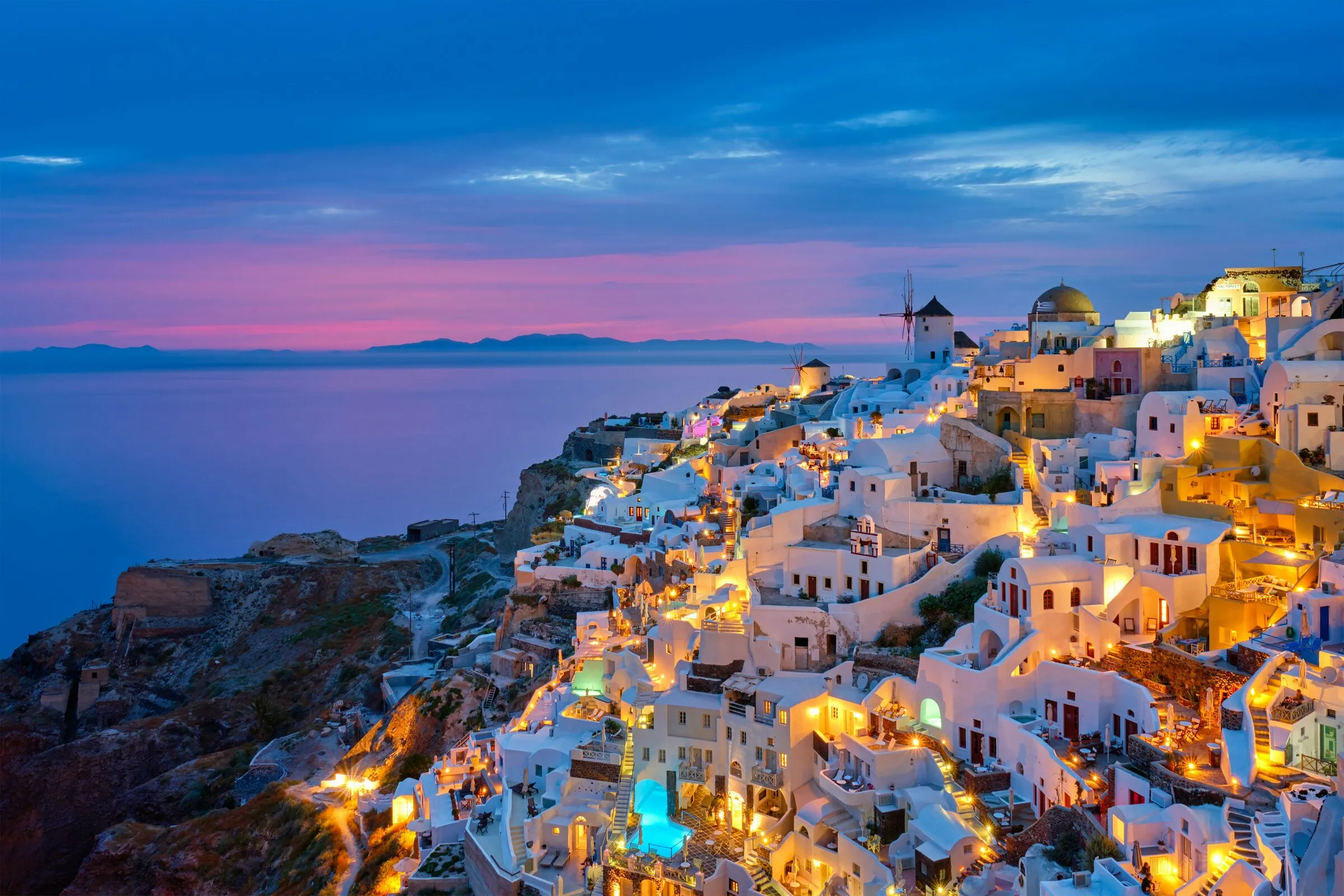
Santorini is one of the rare places that delivers everything the photographs promise and rewards travelers who slow down enough to look past the photographs. The views earn the hype. The freshness — the air off the caldera, the food coming up from volcanic soil, the wind that breaks the heat — earns it twice. And the pace, when you choose your base correctly, is the kind that makes you exhale on day one and breathe differently for the rest of the trip. For honeymooners, it’s actually about cliff-side privacy and the right hotel — and you have to plan it like an operation.
Most clients come to me asking about Santorini in three contexts: as a honeymoon or milestone trip in its own right, as the climax of an Athens-Santorini-Crete or Athens-Santorini-Mykonos sweep, or as a single port day on a Greek-isles cruise. Each one is a different trip, and each one rewards a different version of the island.
Here’s how I think about it.
At a Glance
| Best time to visit | Mid-May–late June and mid-September–October. Warm-not-suffocating, the sea is swimmable, and the crowds are sane. Avoid mid-July through August — peak season runs near 60,000 visitors a day, and the heat sits hard between the cliff houses. |
| How long to stay | Three full nights minimum to do the island justice. Four or five if it’s a honeymoon and you actually want to rest. One day if it’s a cruise port stop — and even then, plan it carefully. |
| How to get there | Santorini Airport (JTR) is reached by 45-minute flights from Athens or direct seasonal service from a handful of European capitals. The high-speed catamaran from Athens (Piraeus) takes about 5.5 hours; the Blue Star ferry takes 8. From Mykonos, the catamaran is the friendly option. |
| Currency / language | Euro. Greek is official; English is widely spoken in tourist-facing settings. Yamas (cheers) and efharisto (thank you) carry you a long way. |
| One thing most guides won’t tell you | The black-sand beaches on the east coast (Kamari, Perissa) get hot. If you’re picturing Cycladic white sand and easy swimming, you’re picturing a different island — Mykonos, Paros, Naxos. Santorini’s beaches are a side dish, not the main event. |
Why I Send Travelers Here
Because Santorini is one of the few honeymoon-shorthand destinations that actually earns the shorthand. The views land. The freshness lands. The pace, set right, rebuilds you. I send couples here for honeymoons that are about quiet, food, and views — not bottle service. I send slow-travel travelers who anchor on Imerovigli or Pyrgos and let the island settle in around them. I send first-time Greek-isles cruisers who get one full day on the caldera and need to know exactly what to do with it.
It’s also the climax of the multi-island Greek sabbatical Rachel took last year — Athens to Lucerne to Santorini to Rome — which has been the most-read trip on this site for a reason. Santorini was the part she didn’t want to leave.
It’s also one of the most over-recommended islands in Greece, which means the standard itinerary is wrong about half the things that matter most — where to stay, when to do Oia, which beaches to skip, which restaurants are tourist tax. Every recommendation below comes through the lens of what works in practice for the clients I send, the hotel relationships I rely on for the island, and a clear point of view about what Santorini does well, what it’s overrated for, and what the brochures will never show you.
Where I’d Anchor
Four villages cover almost any traveler’s reason for being on the island:
Oia. The clifftop village in the photographs. White cubic buildings, blue domes, narrow alleys, the iconic sunset. Stay here if it’s your first trip and you’re willing to pay for being inside the picture. The trade-off is real — Oia is the most expensive village on the island and the most crowded, especially the hour before sunset.
Imerovigli. The hillside between Fira and Oia, sometimes called the balcony of Santorini. Same caldera views, half the crowds, often the better light. This is where I’d anchor a second visit — or a first visit for travelers who want the Oia photograph without the Oia crush.
Fira. The capital and transport hub — bus station, cable car down to the cruise port, the most restaurants and shops. Stay here if you want convenience and dining range over postcard quiet. Fira is louder, busier, more commercial than Oia or Imerovigli — fine for a single night, less ideal for the whole trip.
Pyrgos. The hilltop former capital, in the middle of the island, surrounded by vineyards. Quietest, least touristy, and the village I’d recommend most often for travelers who came to Santorini to actually rest. The pick for slow-travel couples and honeymoons that want the opposite of nightlife.
For honeymoons and milestone trips that want maximum privacy, Carpe Diem Santorini in Pyrgos is the call — adults-only, ten suites with private pools, 270-degree island views, and the strongest hotel relationship I keep on the island. On my rate at the property, the amenity layer is real and quiet — calibrated to your dates and the suite category, deepened materially on longer stays, and the specifics get walked through on the discovery call. None of it books direct.
For travelers who want the iconic Oia caldera experience with a recently renovated property, Mystique, a Luxury Collection Hotel is the pick. Perched on the caldera cliff in Oia, the 2024 refurbishment redid suites, restaurants, and spa around Cycladic-architecture-meets-understated-luxury, with custom Greek-artisan furnishings throughout. On my rate at the property, the amenity layer doesn’t book direct, and the specifics get walked through on the discovery call — calibrated to your dates and the suite category.
For the Imerovigli sweet spot — caldera views, less crowd than Oia, contemporary Greek design — Grace Hotel, Auberge Resorts Collection is the pick. The hotel sits 363 meters above the caldera with sunset views the photographs underrate. On my rate at the property, the amenity layer is calibrated to your stay rather than itemized in advance — what applies depends on dates and how long you stay, and we walk through it on the discovery call.
Want one of these stays? Start a discovery call — I’ll pull live availability, walk through suite categories, and confirm which amenities apply to your dates.
Where I’d Anchor for a Honeymoon
For honeymooners, the decision is simple — and it’s geography-first. Lean Imerovigli over Oia: same caldera views, materially quieter, the cruise-ship photo crowds thin out, and the light is actually better for the five days you’re staying. The three-hotel push here:
Grace Hotel, Auberge Resorts Collection (Imerovigli) — 363 meters above the caldera, the contemporary-Greek-design play, and the right balance of luxury and actual quiet. This is the hotel for the couple who want the famous sunset views without the famous sunset crowds.
Cavo Tagoo (Imerovigli) — the quieter, more contemporary alternative if Grace is booked. Smaller, design-forward, the same cliff-side privacy without the resort-scale footprint.
Canaves Oia (Oia, suites and epitome category) — if you’re set on Oia for the photograph, this is the villa-suite play: private cliff-side pools, the kind of privacy Oia doesn’t usually offer, and the suites feel like private homes rather than hotel rooms.
On my rate across all three, the amenity layer is meaningful and doesn’t book direct — pairing the right property to your dates and the right suite category to the trip is the discovery-call conversation, and the specifics of what applies are calibrated property by property.
What I’d Do With Three Days
This is the version I’d send you if you asked me to plan it tomorrow. Adjust to taste — and add a fourth and fifth day if it’s a honeymoon.
Day One — The Caldera Edge
Wake early. Breakfast at the hotel. If you’re staying in Pyrgos or Imerovigli, take the bus or hire a transfer to Fira. Walk the cliffs. The full 8-mile path from Fira to Oia along the calderimi if you’re up for three hours and a hat; or just the prettier final stretch from Imerovigli north to Oia, which is closer to three miles and the postcard half of the walk anyway. Lunch in Imerovigli, or in Fira at a caldera-edge restaurant — Saltsa is the underrated choice, with east-coast views instead of the caldera (most caldera-edge restaurants in Fira are mediocre and overpriced; you pay for the view, not the food).
Late afternoon, head to Oia. Don’t go to the sunset spot. Have dinner with a caldera-edge table at 1800 Restaurant (in a restored 19th-century mansion) or Ambrosia (eleven outdoor tables, candles, rose petals — book months out for high season), and let dinner be the sunset. Or skip Oia for sunset entirely and go to Pyrgos. More on that below.
Day Two — The South Coast
Morning at Akrotiri, the Minoan settlement buried in the eruption around 1600 BC and now reopened with a bioclimatic roof covering the entire excavation site. It’s where Plato may have built his Atlantis legend from — no human remains were ever found there, suggesting the Minoans were forewarned and fled. Then a winery: Sigalas in Oia (north of the island) for the sunset terrace if you’re chaining it with another sunset, or Boutari or Santo near Pyrgos if you’re staying south. Plan for three unhurried hours — lunch and tasting. Skip Red Beach unless you really want the photograph; access has been restricted intermittently for landslide concerns and the crowds when it’s open are unpleasant.
Dinner at Selene in Pyrgos — creative Greek cuisine prepared with hyper-local produce, a restaurant I love for serious creative Greek cuisine built from hyper-local Santorini produce. There’s also a casual annex downstairs if a tasting menu isn’t tonight. Reservations required.
Day Three — Quieter Santorini
Pyrgos at sunrise. Climb the kasteli — the small fortress at the top of the village — for views over the entire island and the morning coffee that has earned every step. Walk the village’s narrow alleys before the day heats up. Late morning, Ancient Thira on the Mesa Vouna headland between Kamari and Perissa — Dorian-founded ninth-century BC, much less visited than Akrotiri, often more rewarding in terms of preserved ruins.
Late afternoon, depending on stamina: a semi-private sailing trip across the caldera (Santorini Sailing’s catamaran is the friendly option for two; the boat seats up to ten and includes a barbecue lunch and swim time), or another winery, or just back to the hotel pool until sunset.
For sunset, take yourself to Franco’s Café in Pyrgos. The original Franco’s owner moved here from Fira; the café sits next to the Pyrgos kasteli with views over the entire island, classical music, an unhurried martini. Almost no tourists. The single best sunset hour on Santorini, and most travelers don’t know it exists.
Specific Things I’d Tell You About
Franco’s Café in Pyrgos is the sunset hour. I’ll repeat it because it matters. The original Franco’s owner moved up here from Fira. View over the whole island. Opera plays. You can think. Almost no one is there. If you do nothing else from this guide, do this.
Sigalas Winery’s sunset terrace is the second-best sunset. West-facing, room for forty, paired tastings with cheese and olives, much smaller crowd than Oia. If your itinerary lands you in north Santorini at sundown, this is the move.
Atlantis Books in Oia is a real bookshop. Run by a small group of British and American writers and artists who’ve kept it running since the early 2000s. Stocks novels, biographies, poetry — predominantly in English. Hours are unpredictable; the shop sometimes closes for weeks. Call ahead. The fact that it’s irregular is the charm.
Vlihada is the beach answer if you must do a beach. South coast, black sand, way fewer tourists than Kamari or Perissa, and Theros Wave Bar built into the rocks above the sand for cocktails after. The right beach day on an island where beach days aren’t really the point.
The Fira-to-Oia cliff walk is real and most travelers don’t know it exists. Eight miles, three hours, dramatic the entire way. Don’t do it midday in summer — start at sunrise or late afternoon, take twice as much water as you think you need.
Don’t take the donkey ride up from the cruise port. Walk the 580 steps if it’s cool, take the cable car otherwise. The donkey ride has documented animal welfare problems that the operators are slow to address. The cable car is four euros and eight minutes.
What I’d Skip
The literal Oia sunset point. Yes, see one Oia sunset. No, don’t fight a thousand other people for the corner everyone is angling toward. Watch it from a private terrace, a dinner table at 1800 or Ambrosia, or — better — from Pyrgos with a martini.
Kamari and Perissa as primary beach days. Black sand gets so hot you need beach shoes; the resorts behind them are mid-range and overbuilt; the views are toward the open sea, not the caldera. If beach is what you want, plan a Mykonos add-on or pick a different Greek island.
Restaurants in Fira with multilingual menus and pushy touts. The destination report literally calls these out by appearance — long laminated menus in English, German, Russian, Italian, plus a host who tries to pull you in from the alley. Walk past them.
The boat trip to swim in the sulphurous springs at Palea Kameni. It sounds romantic on paper. The reality is muddy water, big crowds, briefer than you expected, and a hot tender ride back. Skip unless you’re a volcanologist or a completist.
Driving a moped or quad-bike if you’re not already comfortable on one. The roads around the caldera have hairpin turns and narrow shoulders, and the rental shops will hand you keys regardless of your experience. Hire a transfer or take a taxi.
For Honeymooners
Santorini is honeymoon-shorthand for a reason — but the version most clients arrive imagining isn’t the version that actually delivers. The version that delivers is anchored in Pyrgos or Imerovigli, not Oia. Three nights minimum, ideally four. Carpe Diem if you want adults-only privacy with a private-pool suite and the strongest amenity package on the island; Mystique if you want the Oia caldera-cliff drama; Grace if you want Imerovigli’s quieter sunset and contemporary Greek design.
The honeymoon night, in my read, is dinner at Selene in Pyrgos — local pigeon, sea-urchin-and-artichoke, lamb with white eggplant — and then a martini at Franco’s a hundred steps away. That’s the night that earns the trip.
If you want me to design the full Greek-isles honeymoon — Athens for two nights, Santorini for four, optional Crete or Mykonos extension — that’s exactly the kind of planning I do. Start a discovery call.
Honeymoon Planning — Couples-Specific Notes
Three things that matter when you’re planning as a couple, not as travelers:
Dinner reservations. The best caldera-view tables — at 1800 Restaurant, Ambrosia, or the smaller spots in Pyrgos — get claimed months ahead in high season. Book these before you book the hotel. If dinner is a component of the trip you care about, lock the two or three restaurants you want the moment you know your dates. The 7 p.m. seating is a trade (rushed, overlapping with sunset crowds); the 8:30 p.m. and 9 p.m. tables are the honeymoon-paced version — unhurried, slower, dinner is the sunset instead of racing between them.
The afternoon ritual. Greek lunch is at 2 p.m. dinner is at 9 p.m. If you don’t build a room window into the day — let’s say 4 p.m. to 7 p.m. — you’ll be hangry, overtired, or overheated by 8 p.m. The honeymoon rhythm is: breakfast at 8, leisurely departure by 10, lunch at 2, back to the hotel by 3:30, rest/pool/walk until 6:30, dinner at 9. That’s the version of Santorini that rebuilds you.
Honeymoon length — constraint is a gift. The standard honeymoon pitch is “stay a week.” Santorini at a week gets repetitive; the island is genuinely small. Four nights is the tight version; five is the right version. If Santorini is part of a longer Greece trip (Athens + Santorini + Rome, for example), three nights plus four nights elsewhere is better than six on one island. The island’s gift is that it delivers everything — the views, the food, the pace — in a tight window. Longer doesn’t mean better; it means you’re reading the same book twice.
For Greek-Isles Cruisers
If Santorini is a port day on a small-ship or large-ship cruise, the realistic version of your day is: morning at Akrotiri (the Minoan site reopened with the bioclimatic roof; cool, shaded, the most interesting hour you’ll spend on the island), lunch in Pyrgos at Franco’s casual annex or Selene’s downstairs bistro, afternoon back to Fira for the cable car down. Skip Oia unless your ship overnights — the round trip will eat your day and you’ll be rushed for both Akrotiri and the cable car return.
If your ship overnights, Oia for sunset becomes possible — but plan an Oia dinner reservation in advance and head up there in the late afternoon. Sunset crowds clear around 9 p.m. and the village is unrecognizably pleasant for the hour after.
If you’re considering small-ship Greek-isles cruising and don’t already know which itinerary fits which traveler, that’s a conversation worth having before you book — there’s significant variance in port days, ship size, and whether the ship anchors in the caldera or docks at Athinios.
For Slow-Travel Couples
The case for slow-travel Santorini is the case for the version of the island that 60,000-visitors-a-day Santorini doesn’t show you. Pyrgos as the base. Five nights minimum. Day-trip rhythm: alternate-day pace, one active morning, one quiet morning, no schedule before 9 a.m., dinners booked but the days flexible.
This is also the version of Santorini that most rewards the slow-travel client’s biggest unspoken request — I want to come home rested. You can. The view, the freshness, the pace — set up correctly, that’s the whole gift of this island.
Plan Santorini With Me
If you’re thinking about Santorini as a honeymoon, as part of a multi-island Greek sweep, or as a single port day on a cruise — that’s exactly the kind of planning I do. A 30-minute discovery call is where it starts. No fee, no pressure. Just the island, your timeline, and what you actually want to feel when you wake up on day one.
Book Your Free Discovery Call →︎
Last updated: April 2026. I keep this guide current. If a hotel I recommend slips, a restaurant changes hands, or access to a site shifts, the page changes. Travel changes. The work doesn’t stop when the page goes live.
Plan this trip with me.
A 30-minute discovery call is where it starts. No fee, no pressure.
Book a Discovery Call