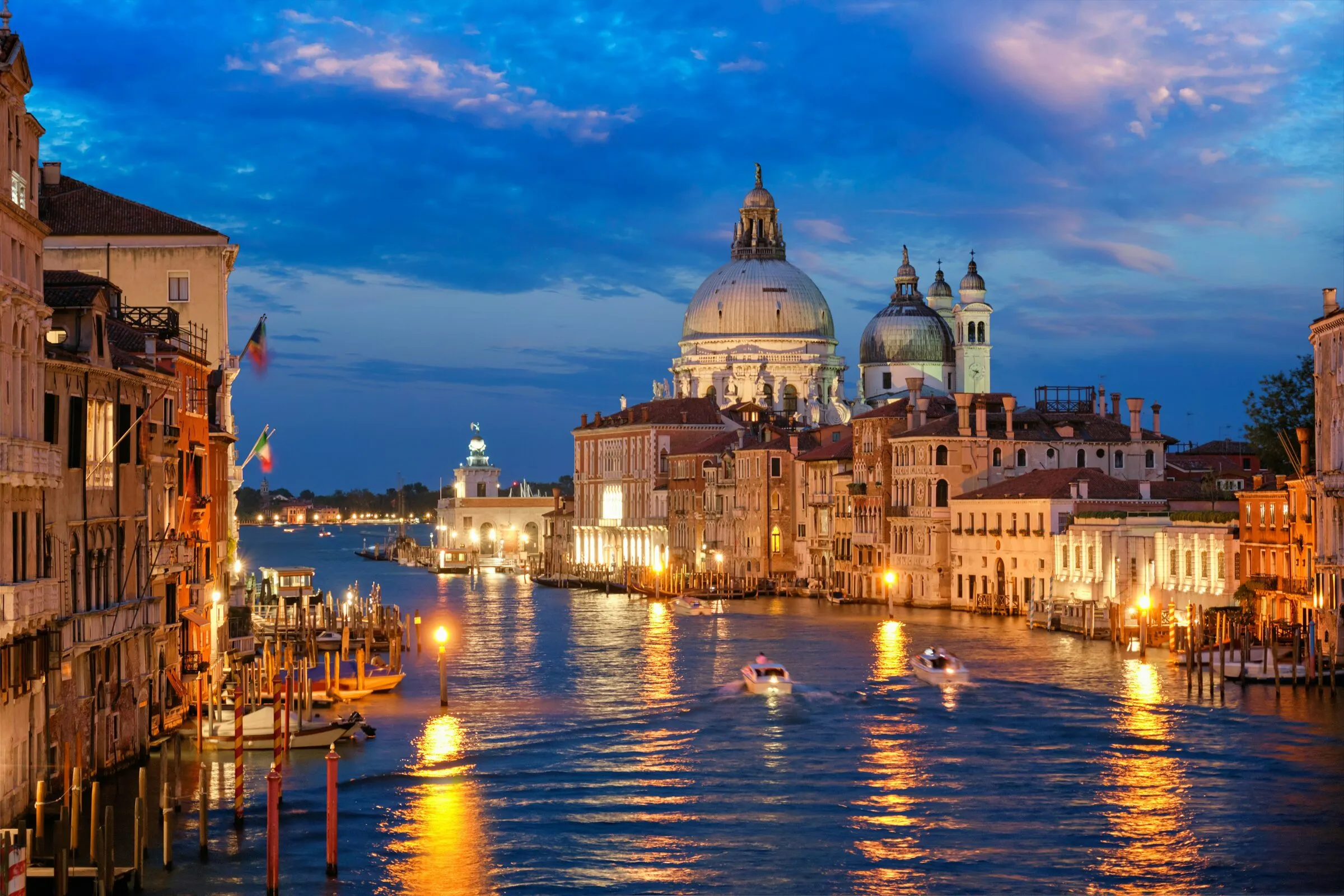
Venice is the city most travelers come to as a one-day stop and leave wishing they’d stayed three. The standard Venice itinerary — San Marco, the gondola, the Bridge of Sighs, lunch on a piazza somewhere, back to the cruise ship by four — turns one of the strangest and most singular cities on earth into a souvenir. You leave with the photos. The trip didn’t land.
Done correctly, Venice is the opposite of a checklist. It’s the city where you eat dinner standing at a bacaro counter with a glass of Prosecco and a small plate of sardines, get lost finding your way back to the hotel through six identical alleys, take a vaporetto the wrong direction on purpose because the light off the lagoon is doing something at golden hour, and end up at a small island church with a Bellini above the altar that almost no one knows is there. The city earns the cliché not by being romantic but by being unrepeatable — there is no other city like it, and there will never be one again. The trick is to plan for fewer monuments and more time on water.
Most clients come to me asking about Venice in three contexts: as a stop on a Mediterranean small-ship sailing or a longer ocean cruise, as the start or end of a Rome →︎ Florence →︎ Venice train sweep up the spine of Italy, or as an anchor city for a slower week with day trips into the lagoon and the Veneto. Each one rewards a different shape of itinerary. And every version benefits from the same single principle: Sleep in Venice. Don’t day-trip it.
Here’s how I think about it.
At a Glance
| Best time to visit | Late April–early June and mid-September–October. The shoulder seasons give you the city without the worst of the heat, the cruise-day crush, or the November–December acqua alta flooding. Skip mid-July through August — the heat sits hard between the buildings, the canals smell, and the lagoon haze flattens the views the city is famous for. Carnival (the ten days before Lent) is a separate calculation: spectacular if it’s why you came; difficult if it isn’t. |
| How long to stay | Three full nights minimum if Venice is your reason for coming. Two if it’s the front or back end of an Italy sweep. One night if it’s a cruise stop — and even then, get off the ship, sleep in the city, and rejoin in the morning if your itinerary allows. Day-tripping Venice from the cruise terminal is the single most common mistake travelers make in this city. |
| How to get there | Marco Polo Airport (VCE) is on the mainland; the Alilaguna water bus from the airport to San Marco takes about 80 minutes and is the right introduction. Trains arrive at Santa Lucia station, which is in the city — you walk out the door and onto the Grand Canal. Cruise ships dock at the Stazione Marittima or San Basilio, both in walking range or short vaporetto range of the historic center. |
| Currency / language | Euro. Italian is official; the Venetian dialect is everywhere if you listen for it. English is widely spoken in tourist-facing settings. Buongiorno in the morning, buonasera after about 3 p.m. Cin cin when the glass goes up. |
| One thing most guides won’t tell you | Venice empties at night. The cruise crowds leave by six, the day-trippers by seven, and the city you walked through at noon becomes a different place by ten — the alleys are quiet, the bridges are empty, the canal water is glass. The traveler who sleeps in Venice gets that city. The day-tripper does not. |
Why I Send Travelers Here
Because Venice is a city that doesn’t exist anywhere else, and that singularity rewards travelers who give it more than the standard half-day. The headline sights — San Marco, the Doge’s Palace, the Grand Canal — are the thing, and they deliver. But the Venice that becomes the trip people remember a decade later is the Venice that happens between them: a long ombra (small glass of wine) in a bacaro a tourist would never find, an early-morning vaporetto across the lagoon to Burano when the light is still pink, an evening service at one of the city’s older churches with no audience except locals and the priest.
It’s also the city that earns the lagoon — the islands of Burano (the lace-making, candy-colored fishing village), Murano (the glassblowers’ island, with workshops that have been running since the 13th century when the foundries were exiled from the main city for fire safety), and Torcello (the original lagoon settlement, now nearly empty, with the oldest church in the lagoon still standing on it). The traveler who doesn’t see at least one of these has only seen half of Venice.
Venice earns the slot for couples honeymooning into quiet baroque grandeur — the kind of trip where the hotel garden matters as much as the museum. It rewards slow-travel travelers who want a base for four or five nights with day trips into the Veneto, and first-time Mediterranean cruisers who’ll embark or disembark in Venice and need to know how to get a real day in the city before or after. It’s also the natural anchor for travelers following Jewish heritage to the Cannaregio Ghetto — the original ghetto, where the word itself was coined in 1516, and one of the oldest continuous Jewish neighborhoods in Europe.
Venice is also one of the most over-itinerated cities in the world — the standard one-day plan is wrong about almost everything that matters. Every recommendation below comes from a clear point of view about which sites earn the line, which neighborhoods are worth your nights, and which restaurants are tourist tax in Grand-Canal-adjacent disguise.
Where I’d Anchor
Three neighborhoods cover almost any traveler’s reason for being in the city:
San Marco (the headline sestiere). The dense ribbon of canal, alley, and palazzo around Piazza San Marco. Stay here on a first visit if you want to step out of your hotel and be inside the postcard. Trade-off: it’s the most touristed quarter, the highest hotel prices, and the most multilingual menus on the side streets. Choose a hotel whose courtyard or canal-side terrace lets you escape the crowd without leaving the sestiere.
Cannaregio (the locals’ choice). The northern sestiere, away from the cruise crush, with the historic Jewish Ghetto at its center. Quieter, residential in stretches, with the kind of bacari and neighborhood restaurants that make Venice feel like a city rather than a museum. An option I love for the second-visit traveler — or the first-visit traveler who wants their lodging inside the version of Venice locals still live in.
Dorsoduro (the art-and-academia base). Across the Grand Canal from San Marco via the Accademia Bridge. Home to the Gallerie dell’Accademia (Italian Renaissance painters at the highest level) and the Peggy Guggenheim Collection (the modern-art counterpoint). Walkable to San Marco when you want it; quieter when you don’t. The pick for travelers whose Venice is built around art.
For honeymoons and milestone trips, the lagoon’s outer islands also belong on the consideration list — Giudecca and the San Clemente lagoon island both put you a short hotel-launch ride from the city, with a level of quiet and view that San Marco simply cannot offer.
San Marco — Aman Venice. One of only eight monumental palazzos on the Grand Canal, the Aman is a mid-1500s palazzo with museum-quality art and frescoed ceilings — 24 rooms, two private gardens, and a directness of access to the water that newer hotels can’t manufacture. Through Signature: daily breakfast for two, a $100 spa credit, and priority on upgrades, early check-in, and late checkout. For suites: lunch or dinner for two once per stay (minimum $100 value), combinable with the above.
San Marco — Baglioni Hotel Luna. Reputedly the most ancient hotel in Venice, housed in a 12th-century palazzo steps from St. Mark’s Square. The Marco Polo Ballroom — an 18th-century frescoed hall — is where breakfast happens. The Canova Restaurant is one of the better hotel meals in the city. Through Signature: buffet breakfast for two daily, a $100 food and beverage credit once per stay, and standard availability considerations on upgrades and timing.
Cannaregio — Palazzo Nani Venice (Radisson Collection). A 16th-century building on the Cannaregio canal, steps from the historic Jewish neighborhood and well-connected to Murano and Burano. The quieter, more residential version of Venice stays here — 52 rooms with original frescoes, a garden, and a terrace restaurant. Through Signature: full breakfast for two daily at the Zoja Restaurant and Terrace, a $100 food and beverage credit, welcome amenity, and availability considerations on upgrade, early check-in, and late checkout.
Giudecca / Lagoon — Belmond Hotel Cipriani. The landmark Giudecca property, open April through September. Five minutes from San Marco by courtesy shuttle launch, with the self-contained feel of somewhere that doesn’t need the city for its identity — Michelin-starred Oro restaurant, the legendary pool, Casanova gardens, and the kind of guest list the hotel has maintained since Giuseppe Cipriani opened it in 1958. Through Signature: daily breakfast included in rate, a special Signature rate, $100 food and beverage credit per stay, welcome amenities, and upgrade/timing considerations. Suite privileges require a two-night minimum.
Lagoon island, year-round — San Clemente Palace. On its own private island 10 minutes from San Marco by complimentary boat, San Clemente is a 900-year-old monastery complex converted into a 170-room resort — 15 acres of gardens, a 12th-century chapel, three restaurants, and a spa. The year-round alternative to the Cipriani for travelers who want the lagoon retreat without the seasonal constraint. Through Signature: full daily breakfast in Restaurant Insieme, $100 food and beverage credit, and availability considerations on upgrades and timing.
Want one of these stays? Start a discovery call — I quote rates, walk through the suite categories, and confirm which amenities apply to your dates. The small extra at check-in — a welcome note from me, the kind of touch the standard amenity package doesn’t list — is part of how I deliver these stays.
What I’d Do With Three Days
This is the version I’d send you if you asked me to plan it tomorrow. Adjust to taste. (For one-night cruise stops, see the For Cruisers section below.)
Day One — San Marco, the Right Way
Start at Piazza San Marco at 8 a.m., before the cruise tenders land and the day-trippers arrive. The piazza is a different square at that hour — quiet, the cafés just opening, the light hitting the basilica facade. Coffee at the bar (standing, sixty seconds, no tip) at one of the historic cafés around the square — Caffè Florian if you want the heritage experience, the bar of any neighborhood café if you want the local one.
Be at the Basilica di San Marco when it opens (9:45 a.m. weekdays, 2 p.m. Sundays) with a pre-booked timed entry (€2 — book online; without one you queue 90 minutes). Dress modestly (knees and shoulders covered) and check your bags at the side entrance. Spend an hour inside. The mosaics on the central dome — the Ascension and Pentecost — earn their reputation, and the Pala d’Oro behind the altar (a screen of gold and gemstones dating to 976) is one of the great pieces of Byzantine craftsmanship in Western Europe.
Walk next door to the Doge’s Palace (Palazzo Ducale) and book the Secret Itineraries Tour if you can — small-group access through the inquisition chambers and the rooftop prison from which Casanova famously escaped. The standard tour is fine; the Secret Itineraries is the version travelers tell stories about for years.
Lunch at a bacaro in San Marco — All’Arco for cicchetti (small plates) standing at the counter, Osteria al Squero in Dorsoduro if you’ve crossed the bridge by then. Afternoon walk through the back alleys of San Marco — Sestiere di San Marco is meant to be wandered without a map. Cross the Rialto Bridge at golden hour. Dinner at Vini da Gigio in Cannaregio (book ahead) for fried razor clams and the kind of warm neighborhood Venice does best.
Day Two — The Lagoon
Whole-day excursion to the lagoon. Take a morning vaporetto (Line 12 from Fondamente Nove) to Burano first — the candy-colored fishing village, lace-making since the 16th century, and the most photographed island in the lagoon. Lunch at Trattoria al Gatto Nero for risotto di gò (made from a small lagoon fish caught only here) and the kind of slow seafood meal Venice forgets it does well.
Afternoon to Torcello, a five-minute hop. Almost empty now, but the Cattedrale di Santa Maria Assunta has Byzantine mosaics that rival San Marco and almost no one is in the church. The Locanda Cipriani next door (yes, that Cipriani family) is where Hemingway wrote part of Across the River and Into the Trees; lunch there if you switch the order.
Back via Murano — the glassblowers’ island, with workshops that have been running for seven hundred years. A morning workshop demonstration is more interesting than the gift-shop version most cruise excursions deliver; ask your hotel for the smaller foundries that still take individual visitors.
Dinner back in Venice. Walk anywhere. The city after dark is the one most travelers don’t see.
Day Three — Quieter Venice, with Choices
This is the day to choose your own Venice. Three options, depending on the trip:
The art day. Morning at Gallerie dell’Accademia for the Italian Renaissance (Bellini, Tintoretto, Veronese, Titian); afternoon at the Peggy Guggenheim Collection for the 20th-century counterpoint (Pollock, Picasso, Magritte, Calder), in the unfinished palazzo on the Grand Canal that the American heiress turned into one of Europe’s great modern museums.
The Jewish-heritage day. Half-day in the Cannaregio Ghetto — the original ghetto, the Museo Ebraico, and the five surviving synagogues on the Campo di Ghetto Nuovo. (See For Travelers Following Jewish Heritage below.)
The Dorsoduro and Frari day. Morning at the Basilica di Santa Maria Gloriosa dei Frari for Titian’s Assumption of the Virgin (the painting that more or less made his reputation) and the works by Bellini and Donatello inside. Afternoon at Santa Maria della Salute at the foot of the Grand Canal — the great plague-thanksgiving church that holds the Titian Pentecost and is the iconic Venice silhouette across the Grand Canal at sunset.
End any of the three days with a sunset vaporetto up the Grand Canal — Line 1 (the slow one), top-deck seat, no audio guide needed. The S-curve through the city from Piazzale Roma to San Marco is the right last hour of any Venice day.
Specific Things I’d Tell You About
Eat where Venetians eat — in bacari, standing up. The bacaro is the Venetian wine bar — small, often standing-room-only, with a counter of cicchetti (Venetian tapas: marinated sardines, baccalà mantecato, fried polenta squares, small grilled vegetables) and a glass of house wine called an ombra. The price-to-experience ratio is the best in Italy. All’Arco in San Polo and Osteria All’Arco in Cannaregio are the historic anchors. The right way to eat lunch in Venice is two cicchetti and an ombra at three different bacari between sights. Better than any sit-down lunch you’ll find within three blocks of San Marco.
The Doge’s Palace Secret Itineraries Tour. Standard Doge’s Palace is the public route — apartments, council halls, the bridge. The Secret Itineraries Tour takes a small group through the inquisition chambers, the prison cells where Casanova was held, the secret administrative offices the doges used out of public sight, and the rooftop attic where the records were kept. Three or four times daily, English versions limited, books out weeks ahead. This is the better Doge’s Palace ticket for travelers who want the historical depth, not the postcard.
Carnival is one trip; Carnival is not the only trip. If you’re in Venice in the ten days before Lent, the city dresses for the masks, the Festa delle Marie parade winds through San Marco, and the Grand Canal opens for the Sunday Water Parade. It’s spectacular if it’s why you came. It’s also more expensive and more crowded than peak summer, and the city you came to walk through quietly is not the city you’ll get. Plan Carnival deliberately or plan around it. Don’t accidentally arrive into it.
The Biennale — both years. Venice runs a major Biennale every year on alternating themes: art in odd-numbered years, architecture in even-numbered years. Both occupy the Giardini della Biennale and the Arsenale complex from late spring through November and reshape what Venice is for during those months. If your dates land on either, build half a day into them — the Arsenale alone is worth it for the building, even if contemporary art isn’t your thing.
The traghetto is the cheap-and-fast Grand Canal crossing locals use. Eight stations along the Grand Canal where, for a few euros, you board a working gondola (no music, no romance, no costumed gondolier) for a 90-second crossing to the other bank. Stand for the ride — locals do. It’s the only way most Venetians actually use a gondola, and it’s a small daily piece of theater you’d never find as a tourist.
The vaporetto is your friend; the gondola is your splurge. A 24-hour vaporetto pass (around €25) gets you unlimited rides on the public water buses. The gondola ride is €80 for forty minutes (€100 after 7 p.m.) and is worth doing once, but with a clear understanding that you’re paying for the experience, not the transport. Take it at sunset, on the smaller back canals (not the Grand Canal), and skip the singer.
What I’d Skip
The cruise-ship excursion that offers Venice in five hours. No matter how well it’s organized, you cannot do Venice in five hours. The right move on a cruise day is to skip the included excursion entirely, take the ship’s port shuttle to San Marco, and spend the day walking Cannaregio or Dorsoduro on your own. (More in the For Cruisers section below.)
The Bridge of Sighs at noon. Forty-deep tourist crowd on both sides, eight-deep selfie line on the bridge view itself. Walk over to it at 7 a.m. or after 10 p.m. The lit bridge in the empty alley at night is the version that earns the name.
Restaurants on or within fifty meters of San Marco with menus in five languages. Same tourist-tax pattern that operates near the Trevi Fountain in Rome. Long laminated menus, a host who tries to pull you in, photo-illustrated dishes, mediocre pasta, premium prices for the location. Walk three streets out of the headline piazze and the food gets better and the bill gets smaller.
Buying glass on Murano without doing the homework. The headline glass shops on Murano are real, but the gift-shop tier of Murano glass — much of which is now made in China and sold under “Murano” branding — is everywhere. If you’re buying serious glass, ask your hotel for the specific foundries (Venini, Pino Signoretto, Seguso) and visit them directly. If you’re buying a souvenir, buy it knowing it might not be what the label says.
The €100 gondola at noon on the Grand Canal. Crowded canal, mid-day light, half the trip spent dodging the wakes from larger boats. If the gondola is happening, take it at sunset, on a smaller back canal, with a clear understanding of the price you’re paying for the picture.
Driving anywhere near Venice. There are no cars in Venice — the city ends at Piazzale Roma. If you’re road-tripping into Venice from elsewhere in Italy, leave the car in a paid mainland garage at Mestre or Tronchetto and walk in. The traffic patterns at the bridge are designed to discourage drivers, and they do.
For Honeymooners
Venice is the city for a honeymoon that wants to feel like a honeymoon without trying — long bacaro lunches with the canal at your elbow, slow walks back from dinner over bridges with no destination in mind, a hotel garden where breakfast extends until eleven and the city’s noise can’t reach you. Anchor at one of the lagoon-island properties (Belmond Hotel Cipriani on Giudecca, the JW Marriott Venice Resort & Spa on Isola delle Rose) if you want the garden-and-pool retreat with a private launch into San Marco; at one of the great San Marco palazzo hotels (Bauer, Gritti Palace, Hotel Danieli) if you want the city as your front door and the Grand Canal as your view.
The honeymoon dinner, in my read, is Quadri above Caffè Quadri on Piazza San Marco for the Michelin tasting menu with Alajmo brothers’ cooking and the orchestra below your window, or Locanda Cipriani on Torcello for the trip out to the empty island and back. Followed by a vaporetto to San Marco at 11 p.m. for the empty piazza and the slow walk home — which is the version of Venice you came for.
If you’re combining Venice with a Rome →︎ Florence sweep, with a Mediterranean small-ship sailing through the Croatian coast, or with a Lake Como add-on after — that’s exactly the kind of planning I do. Start a discovery call.
For Cruisers (Mediterranean Small Ship + Larger Ocean)
Venice is one of the great embarkation cities — and one of the harder cities to do well as a single port day. If your itinerary includes Venice as a one-day cruise stop, my honest advice is:
Skip the included excursion. The standard cruise tour does San Marco and the Doge’s Palace in three hours alongside three hundred other passengers and doesn’t leave time for the rest. Take the ship’s shuttle to San Marco, walk into the city on your own, and use the day for a single anchored experience instead — half a day in Cannaregio with the Jewish Ghetto, a half-day in Dorsoduro with the Accademia and a long lunch, or a vaporetto run to Burano and back with lunch on the island.
Sleep in the city before or after the cruise. Venice as embarkation port becomes a different trip entirely if you arrive a night early or stay a night after. One night in a real Venice hotel, with the city quiet at 10 p.m. after the cruise crowds have left, is the version of Venice the day-tripper never sees. Building this into the cruise booking adds two or three hundred dollars and turns the cruise stop into a real visit to the city.
The cruise terminals are walkable to the city. San Basilio is fifteen minutes on foot to the Accademia Bridge; Stazione Marittima is a thirty-minute walk or a short vaporetto to anywhere central. Take the vaporetto — you’ll be in the city in twenty minutes, at a fraction of the water-taxi cost.
If you’re considering a Venice-anchored cruise — Mediterranean small ship, Adriatic to the Greek isles, or a transatlantic with Venice as the European end — the Rivers & Small Ships page covers how I think about which itinerary fits which traveler.
For Travelers Following Jewish Heritage
Venice is where the word ghetto was first used — in 1516, when the Republic of Venice walled off a small island in Cannaregio (named for the getto, or foundry, that had previously occupied the site) and required the city’s Jews to live within it. The Cannaregio Ghetto — Ghetto Nuovo and Ghetto Vecchio, which despite the names were established in that order — remained Venice’s Jewish quarter for nearly three centuries. Its tall, narrow buildings (built up rather than out, since the walls couldn’t be moved) still stand today.
The neighborhood holds five working synagogues, each built by a different Jewish community as they arrived in Venice — the German, Italian, Spanish, Levantine, and Canton synagogues, layered through the centuries on the upper floors of the Campo di Ghetto Nuovo buildings. The Museo Ebraico di Venezia runs guided synagogue tours daily (the only way most of the synagogues can be visited) and houses a small but excellent collection of Venetian Jewish artifacts. Lunch at Gam Gam at the entrance to the Campo — kosher, friendly, and the only place in Venice where you’ll hear Friday-night candle-lighting.
I’m currently developing a co-hosted Jewish Heritage trip for 2026. Venice is a natural anchor for that program. Reach out if you’d like to be on the early-interest list.
For the longer thinking on how I work this thread — what makes it different from other heritage travel, what it earns, and what it doesn’t try to be — read the pillar essay: Jewish heritage travel.
For Multi-City Italy Travelers
Venice is the north anchor of the spine-of-Italy train trip. The high-speed rail to Florence is two hours; Florence to Rome another 90 minutes. Three cities in ten days is the well-paced version (four days Venice including a lagoon day, three days Florence, three days Rome), and the train takes the rental-car decision off the table entirely — Italy’s high-speed rail is the right way to move between these cities.
If you’re starting in Rome and ending in Venice (south to north), plan Venice at the back when your energy is lower — Venice is the most walkable of the three and rewards a slower week. If you’re starting in Venice and ending in Rome, plan Venice at the front when the lagoon mornings still have the power to surprise you. If you’re combining Venice with the Veneto wine country (Valpolicella, Soave, Prosecco hills), build a day trip out of Verona — 90 minutes by train and one of Italy’s great underrated cities. If you’re combining with Lake Como, the train via Milan is straightforward and worth the day.
If you want me to design the full Italy sweep — train timing, hotel sequencing, day-trip logistics — that’s exactly the kind of planning I do. Start a discovery call.
Plan Venice With Me
If you’re thinking about Venice as the back end of an Italy sweep, as the front of a Mediterranean cruise, or as the slow honeymoon week the city deserves to be — that’s exactly the kind of planning I do. A 30-minute discovery call is where it starts. No fee, no pressure. Just the city, your timeline, and what you actually want to see when you step off the train at Santa Lucia and walk out the door directly onto the Grand Canal.
Book Your Free Discovery Call →︎
Last updated: April 2026. I keep this guide current. If a hotel I recommend slips, a bacaro changes hands, or access to a site shifts, the page changes. Travel changes. The work doesn’t stop when the page goes live.
Plan this trip with me.
A 30-minute discovery call is where it starts. No fee, no pressure.
Book a Discovery Call