Jewish heritage travel is one of the hardest categories to plan well, and one of the simplest to plan badly.
Plan it badly: package tours, the same Tuesday-morning synagogue walk for thirty different groups a season, a forced day at Auschwitz with no time on either side to absorb it, a Tel Aviv hotel chosen for its star rating instead of its neighborhood, a kosher request handled as an afterthought instead of a planning conversation, an itinerary built around what tourists are supposed to see instead of what your particular family came for.
Plan it well: the operator who knows your kids’ names by the second day, the synagogue threshold that lands on the right grandmother on the right morning, the Friday-evening hotel setup that makes Shabbat possible without making it a project, a day at Auschwitz with a guide who knows what to slow down for and a quiet afternoon afterward to absorb it, a Tel Aviv hotel in the right neighborhood for the kind of city you want to be in.
The difference is not the destinations. It’s the planning. This page is about the planning.
Why I Do This Work
I’m a Jew. The word does some heavy lifting in 2026 and I’m not pretending otherwise. From here, this page is about the work, not the personal arc.
The independent-advisor side of luxury Jewish heritage travel is a vacuum. Heritage tour operators sell packages, which is fine if you want a package. Synagogue trip leaders run congregational pilgrimages once a year, which is also fine if your synagogue is the right fit. The bespoke version of this work — the version where an advisor knows your family, knows the destinations, knows the operators, and stitches the trip to your particular reason for going — barely exists in the indie-advisor channel.
That’s the gap I’m closing. Not because every Jewish traveler needs an advisor with the lens; many don’t. But for the ones who do — the ones planning a b’nai mitzvah their grandmother will fly in for, the ones with a Sephardic surname doing the slow Iberian arc, the ones doing the slow Eastern European arc with their parents while their parents can still travel — the work is unbuilt. I’m building it.
What This Work Looks Like
There are four shapes that Jewish heritage trips tend to take. None is exclusive. Most real trips are some blend of two or three.
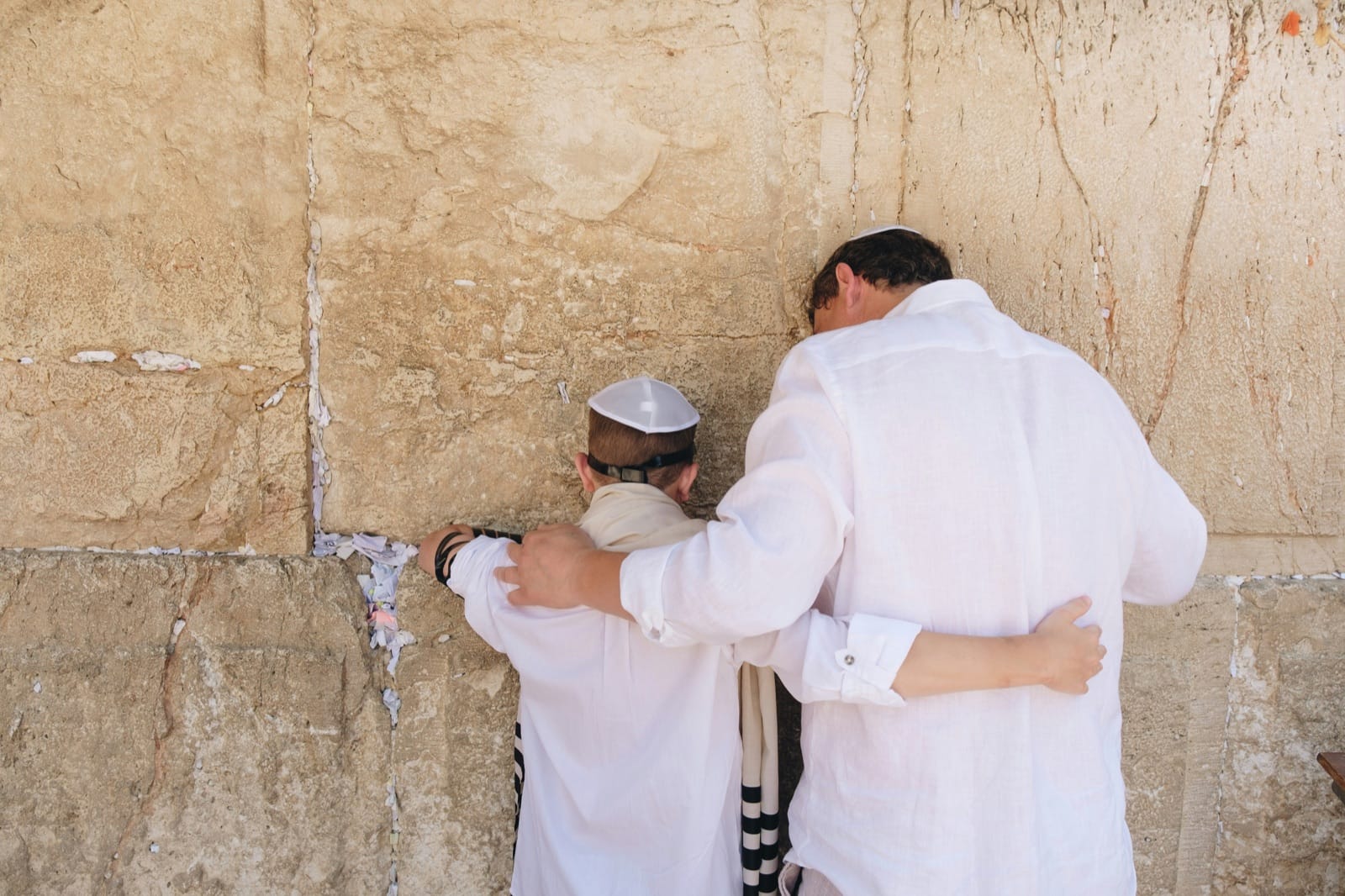
The B’nai Mitzvah trip. A child is becoming a Jewish adult and the trip is the punctuation mark on the year of preparation. Sometimes it’s Israel — the aliyah at the Kotel, the desert, the Tel Aviv beach where the kid finally relaxes. Sometimes it’s an arc through Europe that ends in Israel. Sometimes it’s a smaller, family-only thing in Spain or Italy that connects the kid to the half of the heritage they’re growing into. The shared trait: the trip needs to land on a specific human at a specific moment. That’s not a brochure trip.
The multigenerational heritage trip. Grandparents, parents, kids — three generations on the road through a region that means something to the family. Often Sephardic Iberia (Toledo, Córdoba, Girona, Lisbon). Often Ashkenazi Eastern Europe (Prague, Krakow, Budapest, Vilna). Sometimes both, on a longer arc. The work is logistics — pacing for three generations of stamina — and emotional bandwidth, which the itinerary has to make space for. The thresholds — three generations stepping into a synagogue together — are the moments these trips are organized around. Everything else serves them.
The Israel trip. I plan trips to Israel for clients who love it as I do. That sentence is doing some work and I want it to stay direct. Tel Aviv as a city in its own right — Bauhaus, Florentin, the food scene, the queer life, the beach, the night. Jerusalem as a city in its own right — Old City quarters, Mahane Yehuda, Yad Vashem, Shabbat in the city. Galilee for the wine and the slowness. The Negev for the sky. I am not in the business of ranking the trip against political headlines. I am in the business of planning a trip that meets the client where they are.
Holocaust memorial travel done with care. This is the most delicate shape and I take pains with it. There is a way to visit Auschwitz that turns the visit into trauma tourism — selfies, three-cities-in-a-day, the visit as a check-the-box. There is also a way to visit that honors what the place is. The difference is the operator, the pacing, the framing of the day, and what we do with the days on either side. I plan trips with Yad Vashem, Auschwitz, the Jewish Museum in Berlin, and quieter monuments in Vilna and Salonika as anchor moments. I do not plan trips to atrocity sites. I plan trips that include them as part of the larger work of remembering.
These four shapes overlap. A Sephardic family heritage trip can include a side stop in Lisbon for the kosher-friendly hotel and a quiet morning at the synagogue. A B’nai mitzvah arc can land in Israel after a week through Italy. A multigenerational trip can include Auschwitz, if the family is built for it and the days on either side are designed for it.
The common thread is the lens. The trip has to know what it is.
What Does Your Judaism Look Like?
That’s the question I tend to ask early in the discovery call, because the answer changes everything that comes after.
There’s a saying — two Jews, three opinions — and a less-quoted version of it: there are about sixteen million of us in the world, and roughly sixteen million ways to be Jewish. Reform, Conservative, Orthodox, Reconstructionist, secular, cultural. By birth, by choice, by marriage, by quiet rediscovery. A trip that meets each of those differently is not the same trip.
In practice that means I plan for the family that wants Friday-night candle-lighting in the hotel room and a kosher restaurant for Shabbat lunch, and I plan for the family that wants to see the synagogue in Toledo because the architecture is incredible. I plan for the b’nai mitzvah where the parents are Reform and the grandparents are Orthodox and the trip needs to hold both. I plan for the multi-faith couple where one partner is rediscovering a Jewish heritage they grew up half-detached from. I plan for the Jew by choice doing their first Israel trip post-conversion, wondering quietly whether it’s going to feel different than they expect.
Your Judaism is the lens. The trip adapts to it. There is no version that’s too observant for me to plan around, and there is no version that’s not “Jewish enough” to belong on this page.
Where I Send People
The cluster of destinations I go deep on, for this work:
Sephardic Iberia. Toledo for the synagogue-converted churches and the Sephardic Museum. Córdoba for the Maimonides statue and the old Jewish Quarter. Girona for one of the most intact medieval Jewish quarters in Europe, where the call still has the stone for it. Lisbon for the city and the kosher infrastructure. Porto for the small synagogue that’s a story in itself. Belmonte if you want to meet the descendants of crypto-Jews who kept practicing in secret for five centuries.
Ashkenazi Central + Eastern Europe. Prague for the Maisel, the Pinkas, the Old-New Synagogue, the Old Jewish Cemetery, the Golem story stitched into the streets. Vienna for pre-1938 Leopoldstadt, the Jewish Museum, the Sigmund Freud Museum. Berlin for Stolpersteine, the New Synagogue, Rosenstrasse, the Jewish Museum, Bavarian Jewish history on day trips. Krakow for Kazimierz and the Galicia Jewish Museum, paired with a properly planned day at Auschwitz. Budapest for the Dohány Street Synagogue and the Jewish quarter that is now also the city’s nightlife district, which is a fact I find more interesting than ironic. Vilna and Thessaloniki for the deeper diaspora work.
Israel. Tel Aviv for the city. Jerusalem for the city. Galilee, Negev, the coast for the country. I plan Israel trips at every length and every intensity, including the ones where the client wants a beach and a great hotel and not a single guided tour, which is also a legitimate way to be in Israel.
Italy. Venice for the original ghetto (the word itself is Venetian) and the five synagogues stacked above the campo. Rome for the Jewish Ghetto in Sant’Angelo and the Great Synagogue. Less a destination cluster of its own; more a thread that runs through Italian trips when the client wants it.
Morocco, Greece (Rhodes), the Czech and Slovak countryside, Lithuania. All work. All on the menu when the trip earns the depth.
The Vendor Question
What separates this from a heritage tour package isn’t the destinations. It’s the operators.
Heritage packages run on a known set of guides who do the same Tuesday tour for thirty groups a season. The depth is professional; the experience is, by design, replicable. What I do is different. The operators I work through in Prague, Toledo, Krakow, Tel Aviv — vetted through the trade, validated by colleagues whose judgment I trust, several of them direct relationships I’m cultivating as the trips for them materialize. They will adjust the day on the day. They will linger at the cemetery longer than the schedule says. They will skip a stop if the seven-year-old is done. They will sit with the grandmother at the threshold of the synagogue while she gathers herself.
Same logic on the lodging side. I won’t put a Jewish heritage trip into a hotel that’s wrong for the family — wrong neighborhood, wrong vibe, wrong bandwidth for the kosher-leaning kitchen conversation. The Sephardic-Iberia trips tend to land in independent properties that respect the heritage of the cities they’re in. The Israel trips land in properties whose reputation, ownership, and operator-bandwidth I’ve vetted directly through the trade. The Eastern European trips run on a smaller bench of operators, many of them Jewish-owned or Jewish-aligned, who will tell me when to push and when to ease off.
River cruising is the part of this cluster I have the deepest direct vendor knowledge in — multiple Danube sailings have built the operator-relationship map for the Vienna–Bratislava–Budapest corridor, which is itself one of the densest Jewish-history routes in Europe. Kosher-friendly extensions to those itineraries are a planning conversation, not a separate product.
When a client wants kosher logistics — fully kosher, kosher-leaning, observant-Shabbat, or a once-a-week kosher dinner — we have that conversation early. The infrastructure exists across Europe and Israel if the advisor knows where to look. I know where to look.
What You’ll Need From Me, What I’ll Need From You
If you’ve read this far, you probably have a sense of whether this is the kind of advisor work you’ve been looking for. A few practical notes for the discovery call.
What I’ll need from you: a sense of the trip — who is going, what you’re marking, where the family’s roots run, what depth of Jewishness you want the trip to operate at. Whether you keep kosher, want kosher options, or it’s not a factor. Whether you want guides, or you want to be left alone with a great map and the right hotel. Whether the kids are part of the plan or it’s the adults’ trip. Whether Israel is on the list, off the list, or under discussion. There are no wrong answers; the answers shape the trip.
What you’ll get from me: the work I outlined above. A small number of options chosen because each one earns the slot. Operators vetted through the trade and through colleagues whose judgment I trust. Hotel choices I’d put my own family in. A pacing that respects three generations if the trip is built for three generations, or a pacing that respects a child’s stamina if it’s the b’nai mitzvah arc, or a pacing that respects two adults who haven’t been alone together in a year if it’s the romantic Israel piece. A point of view, where I have one. A willingness to be talked out of it, where you have a stronger one.
I’ll tell you what I’d do, and I’ll tell you why, and then you tell me what you want to do, and we work it out. That’s the standing model. The Jewish heritage piece adds a lens, not a different model.
A Note on the Climate
Antisemitism is rising. I know it; you know it. I’m not going to pretend the air around this work is the same air it was three years ago.
What that means in practice: I take seriously the question of where Jewish travelers feel safe and where they don’t. I will tell you the truth about a destination if I think the climate has changed enough to factor in. I will route around a hotel or a guide that’s signaled the wrong direction. I will not plan a trip I wouldn’t take my own family on.
It also means I think this work matters more than it did. The trips themselves — the standing in the synagogue, the candle-lighting at the Friday-night table, the family photo at the threshold — are themselves a kind of refusal. Showing up in these places, with our families, deliberately, on trips planned with depth and care. That’s the work. I’m here for it.
What These Trips Are Actually About
The brochure version of Jewish heritage travel is sites and synagogues. The honest version is the people the trip is for.
Most of the work happens before the trip starts. The right operator. The right pacing. The right Friday-evening hotel setup. The right pre-call with the grandmother to find out what she actually wants and what she’s not saying. The right answer when the seven-year-old asks something at Auschwitz that the parents haven’t figured out how to answer yet. The right hotel restaurant for the Shabbat dinner that ends up being the photograph everyone keeps from the trip.
If that’s the kind of trip you’re planning — a b’nai mitzvah punctuation mark, a multigenerational Sephardic arc, an Israel trip done with care, a Holocaust memorial visit that honors what the place is — I’d love to talk.
Common questions
Do I have to be Jewish for this work to apply to me?
No. The lens accommodates the multi-faith couple where one partner is rediscovering a Jewish heritage they grew up half-detached from, the family where the kids are figuring out their relationship to it, the partner-of-a-Jewish-spouse trip, the Jew-by-choice doing their first Israel trip post-conversion. There is no version that’s not “Jewish enough” to belong here. The trip adapts to the lens, not the other way around.
How do you handle Israel given the political climate right now?
I plan Israel trips for clients who love the country as I do. I am not in the business of ranking the trip against political headlines — I’m in the business of planning a trip that meets the client where they are. I will tell you the truth about a destination if I think the climate has changed enough to factor in. I will route around a hotel or a guide that’s signaled the wrong direction. I won’t plan a trip I wouldn’t take my own family on.
Is this only Holocaust memorial travel, or is the work broader?
Holocaust memorial travel is one of four shapes — alongside B’nai Mitzvah trips, multigenerational heritage arcs (Sephardic Iberia, Ashkenazi Eastern Europe), and Israel as a country in its own right. Most real trips blend two or three. The shared trait is the lens: the trip has to know what it is, and the planning has to serve the specific people the trip is for.
Discovery calls are thirty minutes, free, and the only thing they commit you to is finding out whether we’re the right fit.
— Erik
Plan your trip with me.
A 30-minute discovery call is where it starts. No fee, no pressure.
Book a Discovery Call