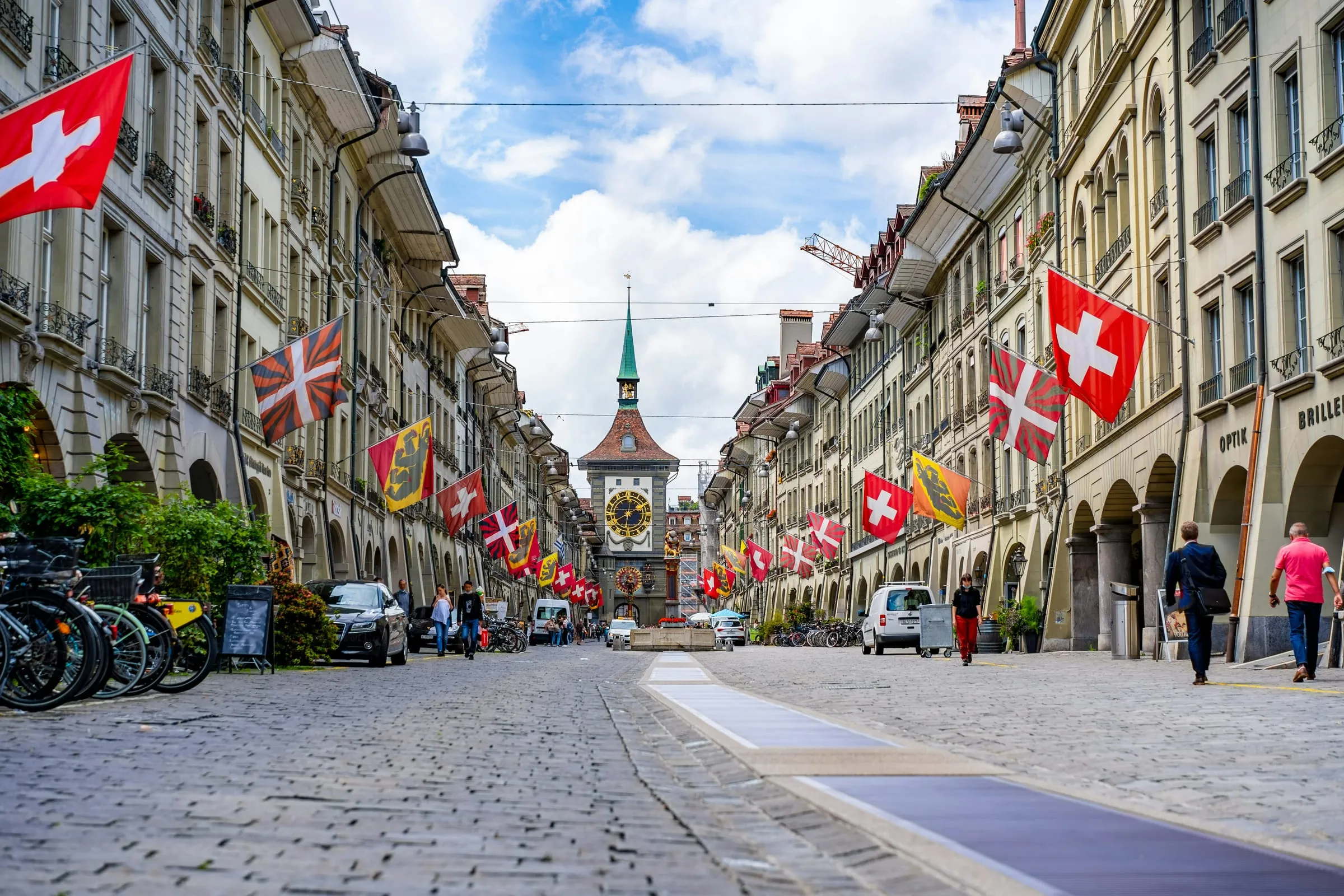
Bern is the city most travelers don’t realize is the answer to the question they’re asking. The standard Switzerland mental model goes Zurich or Geneva for the airport, Lucerne or Interlaken for the lake-and-mountains, Zermatt or St. Moritz for the alpine resort — and Bern, the actual federal city of Switzerland, the seat of government, the only UNESCO-World-Heritage-Old-Town capital in central Europe, gets quietly dropped from the itinerary entirely. It’s a planning error.
Done correctly, Bern is one of the most strategically valuable bases in Europe — geographically central enough to day-trip the entire country in 60 to 90 minutes (Interlaken in 40, Lucerne in 60, Zurich in 60, Lake Geneva in 60, Basel in 60), architecturally cohesive enough that the whole Old Town is UNESCO-listed (not a section, the whole 15th-century medieval core), and home to a single Grand Hotel — the Bellevue Palace — that doubles as the official guesthouse of the Swiss Confederation. Add four miles of vaulted medieval arcades, the apartment where Einstein formulated special relativity, the largest Paul Klee collection in the world, and the bears the city is literally named after, and the case for not basing here starts to fall apart on examination.
Most clients come to me asking about Bern in three contexts: as the strategic hub for a multi-city Switzerland trip (this is the most common — and the framing this guide is most strongly built around), as a standalone Bern visit (rare, sophisticated, and almost always a second-Switzerland-trip choice), or as the city anchor for a Bernese Oberland alpine week (Bern in town, Interlaken or Grindelwald for the day trips, Jungfrau and the Eiger for the headline alpine excursion).
Here’s how I think about it.
At a Glance
| Best time to visit | May–early July and September. Long days, river-and-Alps weather, the Old Town arcades are at their best in spring sunlight. Late November–December has the Bern Christmas Market along the medieval streets and the city’s quiet pre-holiday rhythm. Avoid late February through early April (in-between season) and the dead first half of August. |
| How long to stay | Two full nights minimum for the Old Town itself. Four to five nights as a multi-city Switzerland base — that’s the version this guide is built around. |
| How to get there | Zurich Airport (ZRH) is 2 hours by direct train; Geneva Airport (GVA) is 2 hours by direct train. Fly into either, take the train. From elsewhere in Europe — direct rail from Munich (4h), Milan (4h via the Gotthard Pass — one of the best train rides in Europe), Paris (5h via TGV Lyria). |
| Currency / language | Swiss Franc (CHF). German is official; Bernese German is its own dialect, even more impenetrable than standard Swiss German — even Germans don’t fully understand it. English is widely spoken in tourist-facing settings. Grüessech is the local Bernese hello — different from the standard Swiss-German Grüezi — and using it earns immediate small smiles. |
| One thing most guides won’t tell you | Bern is technically not Switzerland’s official capital. The Swiss constitution doesn’t designate one. Bern is the federal city — the Bundesstadt — by tradition and political convenience. Switzerland is, on paper, a capital-less country. The trivia matters less than what it signals: this is a federation that takes its decentralization seriously. The Old Town wears it. |
Why I Send Travelers Here
Because Bern, planned correctly, solves the multi-city Switzerland problem that almost every other base creates. Switzerland is small geographically and dense topographically — moving hotels every two nights costs you a day in transit, packing, and check-in friction. Anchoring in Bern eliminates that cost. Forty minutes by train to Interlaken. One hour to Lucerne, Zurich, Lake Geneva, or Basel. The country comes to you.
It’s also a city that earns the days you give it. The UNESCO Old Town isn’t a section of Bern; it’s the whole thing — the only national capital where the entire historic core is World-Heritage-listed. The arcades — four miles of continuous vaulted medieval covered walkways — are one of the great urban assets in central Europe. The Zentrum Paul Klee holds the largest single collection of Klee’s work in the world (about 4,000 pieces, in a Renzo Piano-designed building on the city’s edge). The Albert Einstein House at Kramgasse 49 is the apartment where Einstein worked at the patent office downstairs and wrote the four 1905 papers — including special relativity — that broke modern physics open.
I send travelers here as the hub for multi-city Switzerland weeks — five-to-seven-night trips that unpack once and run day excursions to Interlaken, Lucerne, Lake Geneva, and the Jungfrau region. I send couples for slow Swiss honeymoons that want the architectural-romance version of the country (medieval Old Town, Aare river, Alps in the distance) without fighting Lucerne’s cruise-bus surge or Interlaken’s adventure-tourism chaos. I send the rare client a standalone three-or-four-night Bern visit — almost always travelers on a second Switzerland trip who already know Lucerne and Zurich and want the version of the country they missed the first time.
Every recommendation below comes through the lens of how I plan Bern for the clients I send, the hotel relationships I rely on (a single property, called out below — Switzerland has one Grand Hotel in Bern, and it’s where this guide will send you), and a clear point of view about which version of Swiss multi-city travel actually works.
Where I’d Anchor
Bern’s compact UNESCO Old Town concentrates almost everything worth seeing inside a 1.5-mile-long peninsula formed by a tight loop of the Aare River. There is essentially one anchoring decision: stay in the Old Town. The exact sub-neighborhood matters less than it does in larger cities.
The Innerstadt / Old Town core. Centered on the Zytglogge (the 12th-century Clock Tower at the heart of the Old Town), with the medieval main street running east toward the Münster cathedral and west toward the Bundeshaus (Swiss Parliament). Cobblestone streets, the four miles of arcades, the painted fountains every few blocks. Stay here, full stop — the whole Old Town is walkable in 25 minutes, and there is no other version of Bern that makes the trip make sense.
There is one Grand Hotel in Bern. It is the Bellevue Palace, on Kochergasse 3-5, directly behind the Bundeshaus on the southern edge of the Old Town with a terrace looking out across the Aare to the Bernese Alps. The hotel is the official guesthouse of the Swiss Confederation — when foreign heads of state visit Switzerland on official business, the Swiss government books them into the Bellevue Palace by default. It is the only Grand Hotel in Bern’s UNESCO World Heritage zone, and one of the few hotels in Europe with 150 years of continuous Grand-Hotel operation. The Bellevue Bar features in John le Carré’s spy novels (genuinely, not a marketing line) and remains the unofficial after-hours meeting point for Swiss politicians and diplomats. The Brasserie Vue terrace — Chef Gregor Zimmermann’s signature is on every dish — is one of the great Alps-view dinner rooms in central Europe.
On my rate at the property, the amenity layer is real and quiet — calibrated to your dates and the room category, deepened materially on longer stays, and the specifics get walked through on the discovery call.
A few words about price. Bellevue Palace is an unapologetically expensive Grand Hotel in an unapologetically expensive country, and the budget conversation around it is one I’ve had often enough to be direct with you about it. Switzerland is at the top of Europe’s price ladder — that’s the country, not the hotel. The federal-city Grand Hotel, with the Swiss government’s stamp on the door and 150 years of state-event history in the lobby, sits at the top of that ladder. The math of pretending otherwise on a multi-city Swiss trip — booking smaller hotels, moving every other night to chase a lower nightly rate — usually breaks anyway: what you save in the rate you spend back in transfer time, daily packing, and the friction of restarting your week every 48 hours. For travelers with the budget to plan Switzerland the way the country earns to be planned, Bellevue Palace is the answer that makes the rest of the trip work. The discovery call below is where we figure out if that’s you.
Start a discovery call — I’ll pull live availability, walk through the suite categories, and confirm which amenities apply to your dates.
What I’d Do With Two or Three Days
Adjust to taste. The two-day version covers the city itself; the three-day version adds a day trip or a slower second Bern day. Add another two to three days if Bern is your multi-city Switzerland base.
Day One — The Old Town, on Foot
Start at the Zytglogge Clock Tower at the heart of the Old Town. Be there four minutes before the hour for the mechanical-figure show — a rooster crows, a jester rings a bell, knights joust, the original 1530s mechanism (still working) clicks through its sequence. Walk east down Kramgasse — the medieval main street — past the painted fountains and the arcaded shopfronts. Number 49 is the apartment where Albert Einstein lived from 1903 to 1905, the period in which he wrote the four papers that broke physics. The apartment is now a small museum, two flights up, free entry with a modest fee for the exhibit, and one of the genuinely surprising twenty minutes you’ll spend in any European Old Town.
Continue east to the Münster cathedral — the late-Gothic five-aisled basilica with the tallest church spire in Switzerland. Climb the 344-step tower for the best view of the Old Town from above and the river-loop laid out beneath you. Allow forty-five minutes for the climb and the view.
Lunch at the Münsterplatz or in the arcades. Afternoon: walk the arcades themselves. Four miles of continuous vaulted covered walkways, mostly 15th–17th century, lined with shops, cafés, the original Bernese chocolatiers (Confiserie Tschirren is the local benchmark), and the kind of small antique-and-design boutiques that don’t exist anymore in larger Swiss cities. The arcades are also why Bern shrugs off the rain — you can walk most of the Old Town under cover regardless of weather.
Late afternoon, walk down to the BärenPark (Bear Park) on the east side of the river — Bern is named after the bears, and live ones still live in the city, in a recently expanded 6,000-square-meter parkland habitat (a meaningful improvement on the historical bear pits). Cross the Nydeggbrücke for the postcard view back across the river to the Old Town. Climb the path up to the Rose Garden above the river — the rose collection is real, the view is the view.
Dinner at Brasserie Vue in the Bellevue Palace for the Alps-and-Bundeshaus terrace, or Restaurant Kornhauskeller in the historic 17th-century granary cellar for the Bernese-classics dinner under frescoed vaulted ceilings.
Day Two — Klee, the River, the Aare
Morning at the Zentrum Paul Klee on the city’s eastern edge. Renzo Piano’s three-wave undulating building is itself worth the visit — three architectural waves that mirror the surrounding hills — and the collection inside is the largest single body of Klee work in the world. Allow two unhurried hours.
Lunch back in the Old Town, ideally in one of the small streets between Kramgasse and the river. Afternoon at the Kunstmuseum Bern — eight centuries of paintings, sculpture, and works on paper, including the Gurlitt collection (which has its own complicated provenance history that the museum addresses directly).
Late afternoon: walk down to the Aare river itself. In summer, locals literally swim the Aare as urban transport — a kilometer-long current carries swimmers from the upstream Marzili swimming complex back to the city, where they climb out at the Bundes-Marzili stair-and-railing system the city installed for exactly this purpose. The river runs cold, fast, and clean. If your dates land in June through August and you’re a confident swimmer, do it once. If you don’t swim it, watch the locals do it; the fact that this is a thing in Switzerland’s federal city is the kind of detail you’ll remember a year later.
If you’re not in summer, walk the riverbank instead — the Marzili-Bahn funicular takes you down from the Old Town for one Swiss franc.
Dinner anywhere along the river or back at Vue.
Day Three — A Day Trip, or the Bernese Oberland
Three options:
Interlaken and the Jungfrau. Forty minutes by direct train. Interlaken sits between two lakes; the Jungfraubahn cogwheel railway from there climbs to the Jungfraujoch at 3,454 meters — the highest railway station in Europe, with views over the Aletsch Glacier and the Eiger’s north face from a glass-walled observation deck. Pre-book the Jungfrau ticket; it’s expensive and weather-dependent. Don’t go up if visibility is poor — the only thing you’re paying for at altitude is the view.
Lucerne for the day. One hour by direct train. The Old Town walking tour, the Kapellbrücke, the Lion Monument, lunch by the Reuss, optional Mount Pilatus afternoon if you have the energy. Back to Bern by dinner. (See the Lucerne guide for the full version.)
Gruyères and the Emmental. The Swiss-cheese day trip. Gruyères is a 13th-century walled hilltop village an hour west of Bern, with the cheese-making demonstration center, a real medieval castle, and one of the best Swiss-cheese fondues you’ll have. Pair with Cailler Chocolate Factory in nearby Broc for the chocolate-history afternoon. The day is longer than it sounds; rent a car or pre-book a private driver.
By day three, Bern makes its own recommendations. The Old Town is quiet enough at this point that simply staying in for a slow morning and a long arcade walk is a legitimate choice.
Specific Things I’d Tell You About
Albert Einstein wrote special relativity at Kramgasse 49. Not metaphorically — literally. Einstein lived in the apartment at Kramgasse 49 from 1903 through 1905 while working as a third-class clerk at the Swiss Federal Patent Office down the street. During 1905 — what physicists now call his annus mirabilis, the miracle year — he wrote the four papers that established the photoelectric effect, Brownian motion, special relativity, and mass-energy equivalence (E=mc²). The apartment is now a small museum on Kramgasse, two flights up, and you can stand in the front room where the four papers were written. Twenty minutes, modest fee, the strangest cause-and-effect in any European Old Town.
The arcades are four miles long and most of them are 500 years old. Bern’s Lauben arcades — continuous vaulted covered walkways under the upper floors of the Old Town buildings — total roughly six kilometers across the medieval core, and the vast majority of them date from the 15th to 17th centuries. They’re why Bern feels coherent in a way Lucerne doesn’t; they’re why you can shop or walk the Old Town in the rain without an umbrella; they’re why every Bern photograph has the same recognizable framing. There is no other European Old Town with this much continuous covered walking infrastructure.
Locals swim the Aare river like a moving sidewalk. From May through September, Bernese commuters (genuinely — including the occasional politician) walk to the upstream Marzili complex, jump in the Aare, and float a kilometer downstream past the federal buildings to a riverside stair where they climb out and walk back to work. The current does the work. The water is meltwater-clean and meltwater-cold. The city installed permanent rails and stairs for the purpose. It’s one of the most distinctive urban habits in Europe, and unless you’re seeing it in person, it doesn’t sound real.
The bears are real, alive, and live in the city. The BärenPark on the east side of the river houses a small population of live brown bears in a 6,000-square-meter parkland habitat — a meaningful upgrade from the historical bear pits the city was previously known for. The expansion was designed with animal-welfare consultation; this isn’t a Vienna-Lipizzaner-stables kind of “look at the working animals,” it’s a city honoring its namesake while updating the standard of care. Worth the half-hour visit.
The Zentrum Paul Klee is the largest single Klee collection in the world. Roughly 4,000 paintings, drawings, watercolors, and prints — about 40% of Klee’s total surviving output. Renzo Piano designed the building as three architectural “waves” that echo the surrounding hills. The collection rotates; you’ll see different bodies of his work on different visits. This is the museum that justifies the trip on its own, and most travelers planning Switzerland have never heard of it.
Switzerland doesn’t have a constitutional capital. Bern is the Bundesstadt — federal city — but the constitution declines to name an official capital, in keeping with the country’s deliberately decentralized federation. The Federal Council, the Federal Assembly, and the Swiss central administration all sit in Bern. So does the National Bank. But the constitution leaves the capital designation deliberately blank. The detail tells you everything about how Switzerland thinks about power: distributed, federated, suspicious of centers.
What I’d Skip
Trying to do Bern in less than two nights. A day trip from Zurich or Geneva sees the Münster, the Zytglogge, and one arcade walk. It misses the river, the Klee, the Einstein apartment, the bears, the slower second-day rhythm, and the entire reason Bern earns the visit in the first place. Two nights minimum, even if the rest of your Switzerland trip is elsewhere.
Driving anywhere in Bern. The Old Town is closed to general car traffic, the U-shaped river loop limits the surrounding road grid, and parking at Bellevue Palace or any Old Town hotel is meaningfully more expensive than the train ticket from anywhere in Switzerland. Use the rail. Hire a car only for the Gruyères-and-Emmental day trip if you want to do that one (and even then, a private driver is often cheaper than rental-plus-parking math).
The Bundeshaus tour during off-hours. Free guided tours of the Swiss Parliament building run every weekday when Parliament is not in session, and they’re excellent — the Federal Council chambers, the inner courtyard, the surprisingly direct architectural symbolism of Swiss federalism. Pre-book. Walk-ins are routinely turned away. If you can’t pre-book, walk past the building’s exterior at sunset, when the Bundesplatz fountains are running — that’s the substitute experience.
Eating dinner in the Bahnhofstrasse pedestrian zone near the train station. Same tourist-tax pattern as every city in this library. The good Bernese restaurants are in the Old Town proper or one block off it. Walk past the chain-restaurant Bahnhofplatz blocks.
Trying to do the Jungfrau on a marginal-weather day. The Jungfraujoch ticket is one of the most expensive day excursions in Europe (roughly 250 CHF round-trip from Interlaken). On a clear day, the views from Sphinx Observatory and the Aletsch Glacier walk justify it. On an overcast day, you’ve paid 250 CHF to stand inside a high-altitude train station in clouds. Pre-book the night before only when the forecast confirms clear skies for the morning. If the weather is wrong, do Lucerne or Gruyères instead.
For Multi-City Switzerland Travelers
This is the section the Lucerne guide sends most readers to, and it’s the dominant frame for how I plan Switzerland.
The standard Swiss multi-city plan moves hotels every two nights — Zurich for two, Lucerne for two, Interlaken for two, Geneva for two — and loses a quarter of the trip to packing, check-in friction, and rail-with-luggage logistics. Done that way, a six-night trip yields roughly four real travel days and two write-off transit days. The Bern-base alternative inverts the math: anchor in Bern for the entire week, day-trip to Lucerne (1h), Interlaken (40 min), Zurich (1h), Lake Geneva (1h), Basel (1h), and Gruyères (1h). Six nights at the same hotel. Six full days actually in Switzerland. Bags packed once.
Bellevue Palace is the anchor — see the section above. The price is unapologetic and intentional. The case for it isn’t “splurge”; the case for it is strategic: with one excellent base in the most central city in the country, the rest of the trip pays for itself in time recovered. Six days of Switzerland-at-walking-pace from a UNESCO Old Town hotel, instead of three packing-days disguised as a Switzerland trip.
The day-trip pattern from Bern, by example:
- Day 1 — Bern itself (Old Town, Münster, Einstein apartment, Klee)
- Day 2 — Interlaken + the Jungfraujoch (40 min each way; long but reasonable)
- Day 3 — Lucerne and Mount Pilatus (1h each way; full day)
- Day 4 — Slower day in Bern; Aare walk, Rose Garden, the bears, dinner at Vue
- Day 5 — Gruyères and the Emmental (cheese, fondue, medieval castle)
- Day 6 — Lake Geneva or Zurich for the day, depending on flight home
That’s the version that actually works. Six nights, one base, the entire country at day-trip range, and a Grand Hotel that earns the role of home for a week.
For the day-trip days themselves, I work with Lokafy’s local-guide network rather than the standard big-bus operators — locally-led half-days in Lucerne or Interlaken with a guide who actually lives there, instead of the scripted highlights tour that 200 cruise-day visitors are hearing the same hour. The cost difference is small; the experiential difference is large.
If you want me to design the full multi-city Switzerland week — Bellevue Palace booking, day-trip rail tickets, Jungfrau-weather contingencies, locally-led guide pairing, restaurant reservations along the way — that’s exactly the kind of planning I do. Start a discovery call.
For Honeymooners
Bern is the quietly excellent honeymoon city in Switzerland — less crowded than Lucerne, more architecturally cohesive than Zurich, and with the river-and-Alps backdrop that delivers the romantic version of the country without the cruise-bus surge. The classic honeymoon arc: three or four nights at Bellevue Palace in Bern, one or two nights at Bürgenstock above Lake Lucerne for the lake-resort centerpiece, optional add-on two or three nights in the Bernese Oberland for the alpine scenery (Grindelwald or Wengen, mountain hotels with Eiger views).
The honeymoon dinner, in my read, is at Brasserie Vue in the Bellevue Palace — terrace seats, the Alps in the distance after sundown, the Aare in the foreground. Walk back to the suite through the lit arcades. The setup does the work.
If you want me to design the full Swiss honeymoon, or to combine Switzerland with Italy, Bavaria via Munich, or Vienna for a longer European honeymoon, that’s exactly the kind of planning I do. Start a discovery call.
For Bern + Bernese Oberland Travelers
Bern is also the city anchor for a Bernese Oberland alpine week — the version of Switzerland built around the Alps directly south of the city. The standard arc: three nights in Bern, three or four nights in Grindelwald or Wengen for the mountain experience, one return night in Bern before flying out. Train-only logistics; no rental car needed (and most Bernese Oberland villages are car-free anyway).
The headline alpine excursions are well-known: Jungfraujoch (the highest railway station in Europe at 3,454 meters), Schilthorn (the Piz Gloria James Bond rotating-restaurant peak), First above Grindelwald with the First Cliff Walk, and the Eiger Trail that runs along the base of the north face. The less-known ones are often better: the Schynige Platte railway (less crowded than Jungfrau, similar views, half the price), the Brienzersee paddle steamer (the same kind of historic Swiss steamship as Lake Lucerne), and the Männlichen ridge walk above Wengen.
If you want me to design the full Bern-Bernese-Oberland alpine week — Bellevue Palace plus a curated Grindelwald or Wengen mountain hotel, the right combination of cogwheel railways and cable cars, weather-window flexibility for the high-altitude excursions — that’s exactly the kind of planning I do. Start a discovery call.
Plan Bern With Me
If you’re thinking about Bern as the strategic hub for a multi-city Switzerland week, as a quietly excellent honeymoon city, or as the anchor for a Bernese Oberland alpine arc — that’s exactly the kind of planning I do. A 30-minute discovery call is where it starts. No fee, no pressure. Just the city, your timeline, and an honest conversation about whether the version of Switzerland I plan — Grand-Hotel-based, day-trip-out, and unapologetic about what the country costs to do correctly — is the version of Switzerland you want.
Book Your Free Discovery Call →︎
Last updated: April 2026. I keep this guide current. If a hotel I recommend slips, a restaurant changes hands, or access to a site shifts, the page changes. Travel changes. The work doesn’t stop when the page goes live.
Plan this trip with me.
A 30-minute discovery call is where it starts. No fee, no pressure.
Book a Discovery Call