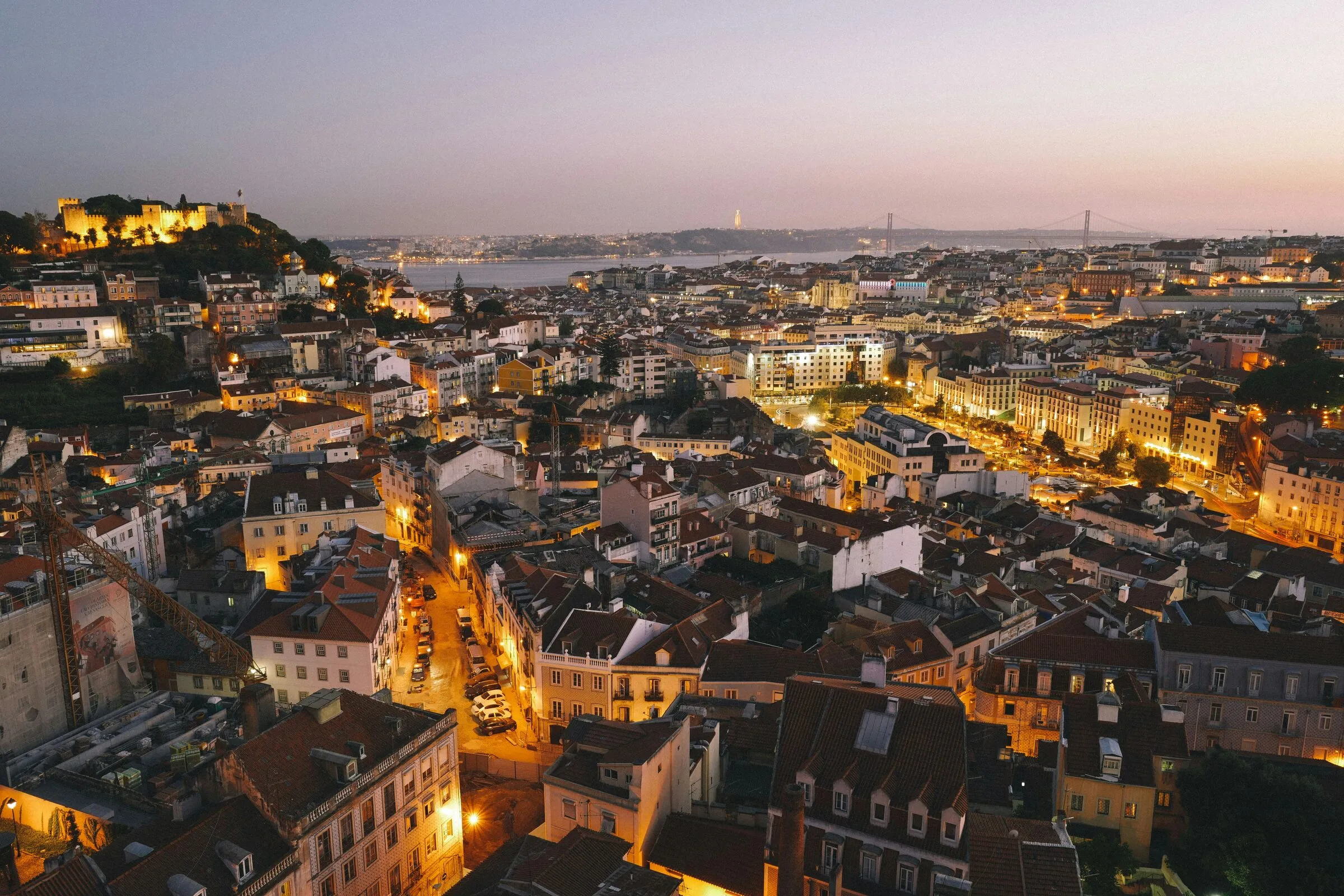
Lisbon is the European capital that quietly runs at a different temperature than the rest of the continent. It’s farther west than any other major European city — farther west, actually, than London — sits on the Atlantic with the Tagus estuary opening into the ocean, and was the launching point for the 15th- and 16th-century voyages that fundamentally reshaped European understanding of the world. Vasco da Gama sailed from here. Ferdinand Magellan sailed from here. The kingdom of Portugal financed the entire Age of Discoveries from this riverbank, and the wealth that came back built the city’s most distinctive surviving architecture.
Done correctly, Lisbon is one of the most layered Atlantic-Mediterranean capitals in Europe. The city was leveled by the 1755 earthquake — one of the most catastrophic seismic events in European history; 60,000 dead, three-quarters of the city destroyed — and the surviving older quarters (especially Alfama) preserve the medieval and pre-earthquake fabric, while the rebuilt Baixa (lower city) is one of the great early planned-rebuilding projects in Europe, laid out in a strict geometric grid by Marquês de Pombal in the years immediately after the quake. Built on seven hills like Rome, with neighborhood characters that change every block — the miradouros (panoramic viewpoints) appear at every hilltop, and the city’s defining experience is walking from one neighborhood to the next and watching the light shift across the tile-fronted buildings.
Most clients come to me asking about Lisbon in three contexts: as the southern anchor of a multi-city Portugal arc (the most common — Lisbon →︎ Porto is the spine of any first Portugal trip, three or four nights each, Alfa Pendular high-speed rail in between), as a standalone Lisbon-and-Sintra week (rare, sophisticated, the version I most want to plan for), or as a stop on a longer European or Atlantic-cruise sweep (Lisbon is a major transatlantic-cruise hub and the natural Iberian gateway from the U.S.).
Here’s how I think about it.
At a Glance
| Best time to visit | April–early June and September–October. Spring has the jacaranda trees blooming purple along the city’s avenues — one of the most distinctive seasonal images in any European capital. Atlantic-side weather is forgiving year-round (Lisbon’s microclimate is meaningfully milder than its latitude suggests), but avoid mid-July through August — peak heat, peak cruise-bus surge, and many of the best restaurants close for férias (holiday). |
| How long to stay | Two full nights minimum if Lisbon is a transit stop, three or four nights for a real city visit, five-plus if combining with Sintra, Cascais, or the Atlantic coast. |
| How to get there | Humberto Delgado Airport (LIS) is in central Lisbon, 7 km from the historic center; the metro Red Line runs to Saldanha or São Sebastião in 15 minutes. From Porto — Alfa Pendular high-speed train, 2h45m. From elsewhere in Europe — direct rail to Madrid (8h, change at Salamanca) or short-haul flight; the Lisbon-Madrid sleeper train is also an option. From the U.S. — Lisbon is one of the closest European capitals to the East Coast, with direct flights from JFK, EWR, BOS, MIA, IAD, and PHL. |
| Currency / language | Euro. Portuguese is official; English is widely spoken in tourist-facing settings. Bom dia and obrigado/obrigada (gendered — obrigado if the speaker is male, obrigada if female) carry you a long way. |
| One thing most guides won’t tell you | The trams in Lisbon are not a tourist-attraction novelty — they’re working public transit (especially the famous Tram 28 that loops Alfama, Baixa, and Estrela). They’re packed at peak hours with both tourists and Lisboetas going about their day. Buy a 24-hour transit card rather than fighting individual tickets, and ride at off-peak hours for the experience without the elbows. |
Why I Send Travelers Here
Because Lisbon, planned correctly, is the most underrated European capital still genuinely underrated. The city is meaningfully more affordable than Paris, Rome, or Vienna at every tier; the food culture is strong and accessible (Atlantic seafood, bacalhau in dozens of variations, the iconic pastéis de nata); the architectural character — tile-fronted buildings, narrow streets climbing the hills, the miradouros and the river and the bridges — is distinct from any other European capital. The 1755 earthquake gave the city a distinctive bifurcated structure: the older surviving Alfama district preserves the medieval/Moorish/pre-earthquake fabric, while the rebuilt Baixa downtown is one of the great early urban-planning projects in European history.
It’s also the southern anchor of the Lisbon →︎ Porto multi-city Portugal arc — the high-speed rail makes the pairing click — Lisbon to Porto in under three hours, door to door, and the spine-of-Portugal week is one of the most rewarding southern-European arcs I plan for clients. Three nights in Lisbon, three nights in Porto, optional add-ons for Sintra (palaces day-trip from Lisbon), Douro Valley (wine day from Porto), or a Douro river cruise originating in Porto.
I send travelers here as the gateway to Iberia from the U.S. (Lisbon’s transatlantic-flight access is genuinely better than from Paris or Rome for East Coast travelers), for honeymoons that want a southern-European week with Atlantic-coast pace, for multi-city Iberians doing the Portugal arc, and for travelers following Jewish heritage to one of the most layered Sephardic histories in Europe — Portugal had one of the largest medieval Jewish communities, the 1496 expulsion order created the Marrano/converso diaspora, and the city’s Jewish heritage walks tell that arc directly.
Every recommendation below comes through the lens of how I plan Lisbon for the clients I send, the hotel relationships I rely on, and a clear point of view about which version of Lisbon earns the days you give it.
Where I’d Anchor
Three anchoring patterns cover almost any traveler’s reason for being in the city:
Avenida da Liberdade. Lisbon’s grand 19th-century boulevard running north from Restauradores Square — the city’s most prestigious commercial avenue, with luxury shops, embassies, and the highest concentration of major-brand luxury hotels. Stay here on a first visit if you want the central walking position with easy access to the Baixa downtown and the Bairro Alto district.
Lapa & Chiado / Bairro Alto. Lapa is the residential luxury quarter west of central Lisbon — quieter, garden-and-palace heritage, with views over the Tagus. Chiado/Bairro Alto are adjacent — Chiado is the elegant theater-and-literary district, Bairro Alto is the nightlife quarter just above. Better for second visits or for travelers who want their Lisbon to feel less curated and more lived-in.
Praça do Comércio. Lisbon’s vast riverfront ceremonial square — the largest plaza in Europe at the time of its 1755 rebuilding, still one of the most architecturally striking — with one of the city’s distinctive hotels actually built into the square’s arcades. Stay here for the cinematic-arrival version of Lisbon.
For the Lapa palace-and-garden pick — and the most distinctive heritage property in central Lisbon — Olissippo Lapa Palace at Rua do Pau de Bandeira is the call. The 19th-century stately building sits on a hilltop overlooking the Tagus River, with a peaceful private garden of centuries-old trees, streams, and small waterfalls — the kind of in-town garden setting that doesn’t exist at this scale in most European capitals. On my rate at the property, the amenity layer is meaningful and doesn’t book direct, with a guaranteed 4 PM late checkout (better than the standard “subject to availability” framing — useful when you’re flying out evening and don’t want to pack at noon). The rest of what applies depends on your dates and gets walked through on the discovery call.
For the Praça do Comércio flagship — the most central possible Lisbon location, on the great riverside square — Pousada de Lisboa at Praça do Comércio 31-34 is the alternative. Part of Small Luxury Hotels of the World, the property is built into the historic 18th-century arcades that line the square — the hotel’s restaurant tables look out across the plaza to the Tagus, the location puts you on the doorstep of the Baixa downtown, and the cinematic-arrival version of Lisbon (riverside tram bell, plaza opening into the city, the Cais das Colunas marble columns at the Tagus edge) starts at the front door. On my rate at the property, the amenity layer is calibrated to your stay rather than itemized in advance — what applies depends on dates and the room category, and we walk through it on the discovery call.
For the Avenida da Liberdade Grande Dame pick, Tivoli Avenida Liberdade has been Lisbon’s address-of-record since 1933. The hotel is the heritage flagship of the Avenida — a place to see and be seen that has hosted celebrities, heads of state, and royalty for over 90 years. The Cervejaria Liberdade restaurant serves the best fish and seafood in Lisbon (sourced from the 800 km of Portuguese coastline); the Sky Bar by Seen rooftop has panoramic city views with a Michelin-touched cocktail program; the Anantara Spa is the city’s standard-bearer hotel-spa program. On my rate at the property, the amenity layer doesn’t book direct, applicable broadly across the restaurant, the bars, and the Anantara Spa. The specifics — calibrated to your dates — get walked through on the discovery call.
Want one of these stays? Start a discovery call — I’ll pull live availability, walk through suite categories, and confirm which amenities apply to your dates. And the small extra at check-in — a welcome note from me, the kind of touch the standard amenity package doesn’t list — is part of how I deliver these stays.
What I’d Do With Three Days
Adjust to taste. The three-day version is the right length for a real Lisbon visit; the two-day version is the multi-city pause that compresses the must-sees.
Day One — The Baixa, the Alfama, and the Castelo
Coffee in the Baixa at one of the historic cafés — Pastelaria Suíça on Rossio Square or A Brasileira in Chiado (the latter has the bronze statue of poet Fernando Pessoa at an outdoor table that everyone photographs). Walk Praça do Comércio at the Tagus edge — stand at the Cais das Colunas (the marble columns where 18th-century arrivals first stepped onto Lisbon soil from arriving ships), then north through the Arco da Rua Augusta into the rebuilt-after-the-earthquake geometric grid of the Baixa.
Walk east into Alfama — the old Moorish-and-medieval quarter that survived the 1755 earthquake. Narrow stepped lanes, fado music coming from open doorways at night, the pre-Pombaline city fabric in something close to its original shape. Climb to the Castelo de São Jorge — the medieval Moorish castle on the hilltop, with the panoramic Tagus-and-Lisbon view that’s the iconic image. Allow ninety minutes for the climb-and-walk-the-walls.
Lunch in Alfama — Tasca do Chico for a casual fado lunch, or Lisboa à Noite if you want the Alfama tasting-menu experience.
Afternoon: walk back through Baixa down toward the river, with stops at the Elevador de Santa Justa (the 1902 cast-iron elevator connecting the Baixa to the higher Bairro Alto — a structure by Raoul Mesnier de Ponsard — an Eiffel-trained engineer — and a 30-meter ride that gives you a panorama from the top). End at Sé — the fortress-cathedral built on the site of the city’s main mosque after the 1147 reconquest from the Moors.
Dinner with fado music in Alfama or Bairro Alto — Café Luso (Bairro Alto, large and traditional), Mesa de Frades (Alfama, intimate, in a former chapel), or Sr. Vinho (Lapa, fado-with-dinner heritage). The music is Portugal’s national soul; the Lisbon variant is brighter and more theatrical than the Atlantic-melancholy Porto variant.
Day Two — Belém and the Atlantic Edge
Morning to Belém — the western neighborhood at the Tagus mouth where most of Lisbon’s discovery-era monuments cluster. Take Tram 15 (or a taxi) from central Lisbon; the ride is 25 minutes.
Mosteiro dos Jerónimos (Jerónimos Monastery) — the Manueline-Gothic masterpiece begun in 1501, financed by the spice trade Vasco da Gama opened. Pre-book the timed entry; same-day tickets are essentially impossible at peak hours. Allow ninety minutes for the church, the cloisters, and Vasco da Gama’s tomb. Pastéis de Belém — the original pastéis de nata bakery (the recipe was a closely-guarded monastic secret until 1837 when the Jerónimos monks sold it) — is a few blocks east of the monastery. The line is usually 30 minutes; the line is also usually worth it. Do the line at least once.
Walk along the riverfront to the Padrão dos Descobrimentos (Monument to the Discoveries — Henry the Navigator at the prow, the great explorers behind him) and the Torre de Belém (the 1515 fortified tower at the river edge, Manueline architecture, the iconic photograph). The walk is 25 minutes between the major sites; allow a full half-day.
Lunch in Belém — Cervejaria Ramiro is across the city in central Lisbon (the legendary seafood restaurant is worth the trek if you have a serious seafood-and-shellfish appetite), or Jamboree in Belém for casual riverside.
Afternoon: optional — the Berardo Collection Museum (modern and contemporary art at the Centro Cultural de Belém, free admission, three hours’ worth of major 20th-century work) or back to central Lisbon for a slower afternoon.
Dinner in central Lisbon — Belcanto (2 Michelin stars, Chef José Avillez, modern Portuguese), Alma (1 Michelin star, Chef Henrique Sá Pessoa), or A Cevicheria for the casual-creative Peruvian-Portuguese alternative.
Day Three — Sintra, or Slower Lisbon
Two strong options:
Sintra (the day-trip). Forty-five minutes by direct train from Rossio station. Sintra is the cool-microclimate hill town the Portuguese kings used as a summer retreat — the Pena Palace (the romanticist 19th-century pastel-colored fortress on the highest peak, instantly recognizable from any Portuguese tourism campaign), the Quinta da Regaleira (the eccentric early-20th-century estate with the famous Initiation Well — a 27-meter spiral staircase descending into the earth, complete with neo-Templar symbolism), the Moorish Castle ruins, and the Palace of Sintra in the village center. Pre-book Pena Palace the timed entry.
Slower Lisbon: the Gulbenkian and the LX Factory. Morning at the Calouste Gulbenkian Museum — one of the great private art collections in Europe (Egyptian, Greek, Roman, Persian, Chinese, Japanese, plus a major European Old Masters and Impressionist collection), housed in a modernist 1969 building set in landscape gardens. Lunch at the museum café or in the surrounding Avenidas Novas. Afternoon at the LX Factory — the converted industrial complex in Alcântara, with design shops, galleries, restaurants, the famous Ler Devagar bookstore (multi-level, with a flying-bicycle installation suspended from the ceiling), and the contemporary-Lisbon creative-class hour the city’s older quarters don’t deliver.
By day three, Lisbon makes its own recommendations.
Specific Things I’d Tell You About
Pastéis de nata are the egg-custard tarts you’ve heard about, and the originals at Pastéis de Belém are different from the ones elsewhere. The recipe — a closely-guarded monastic secret from the Jerónimos Monastery — was sold to a sugar refinery in 1837 and has been made in the same building, by the same family, ever since. The pastry is laminated dough; the custard is a specific egg-yolk-and-cream ratio; the bake produces a slightly burnt sugar surface that the rest of the world’s pastéis de nata haven’t quite matched. Buy at least two warm. Eat them with cinnamon and powdered sugar, the way Lisboetas do.
The 1755 earthquake is more present in the city’s structure than most travelers realize. The earthquake (and the tsunami and fires that followed) killed roughly 60,000 of Lisbon’s 200,000 residents and destroyed three-quarters of the city. Marquês de Pombal — the prime minister of the time — rebuilt the downtown Baixa as one of Europe’s first deliberately anti-seismic urban grids, with reinforced wood-frame buildings designed to survive future quakes (the famous “Pombaline cage”). The straight grid of Baixa, the cinematic ceremonial sweep of Praça do Comércio, the geometric Rossio Square — those are all post-earthquake decisions made deliberately within ten years of the event.
The Tram 28 is the most photographed ride in Lisbon and you should still take it. The yellow vintage tram loops through Alfama, Baixa, and Estrela on a steep narrow-track route that’s been running essentially the same circuit since 1914. Yes, it’s touristy; yes, it’s also working public transit; yes, it’s also one of the genuinely distinctive urban-transport experiences in Europe, especially the climb up through Alfama with the carriage tilted at angles you wouldn’t believe possible. Ride at 8 a.m. or after 10 p.m. to avoid the peak-tourist crush; the experience is materially different at off-peak hours.
Fado is the national music and the Lisbon variant is brighter than the Porto variant. The genre is roughly 200 years old, originated in Lisbon’s working-class quarters (Mouraria, Alfama), and the lyrics canonize saudade — the Portuguese word for the longing for what is gone, or what may never have been. The right way to encounter fado is in a small casa de fado at dinner, with the room dimmed and the singers performing without amplification a few meters away. Do not settle for a dinner-show “fado” performance at a restaurant chain. Mesa de Frades in Alfama (in a former chapel), Tasca do Chico in Bairro Alto, Sr. Vinho in Lapa. Reservations are essential.
Lisbon’s Jewish history is older than Portugal as a country. The Jewish community was here under the Visigoths, expanded under Moorish rule (749–1147), thrived under early Portuguese Christian kings, and reached perhaps 30% of the population in some quarters by the 15th century. In 1496, King Manuel I issued the expulsion order — Jews were given the choice of conversion or exile, and the Marrano/converso community that resulted (Jews who converted publicly but practiced privately) became one of the great surviving Sephardic-diaspora threads in Europe. The Inquisition operated in Lisbon until 1821, longer than in Spain. The contemporary Jewish quarter walks (Alfama and around the Largo de São Miguel) preserve this history with quiet directness; the Memorial to the Victims of the 1506 Lisbon Massacre at the Largo de São Domingos is the single most important piece of that arc preserved in the city.
Belém’s Manueline architecture is unique in the world. The decorative style — emerging in Lisbon in the 1490s during Manuel I’s reign — combines Late Gothic, early Renaissance, and the iconography of the Age of Discoveries (ropes, anchors, armillary spheres, exotic-flora-and-fauna carvings) into a single distinctive Portuguese hybrid. The Jerónimos Monastery cloisters and the Tower of Belém are the two great surviving examples. Once you see the style, you’ll spot it for the rest of the trip.
What I’d Skip
Restaurants in the Baixa with multilingual menus and pushy hosts. Same tourist-tax pattern as every European city in this library. The good Lisbon restaurants don’t need to advertise that hard. Walk three blocks deeper into Bairro Alto, Chiado, or Alfama.
Driving anywhere in central Lisbon. The hill grades alone are punishing for non-Lisbon drivers, parking is genuinely difficult, and the city’s tram-and-metro system is excellent. Hire a car and driver only for the Sintra-Cascais coastal day-trip and only if you want the flexibility; otherwise the train to Sintra is faster.
Sintra as a half-day visit. It’s a full day or it’s not worth it. The Pena Palace alone is two hours including the queue and the climb; Quinta da Regaleira is another two unhurried hours; the village center deserves a slow lunch. Plan it as a full day or skip it on this trip.
The Tower of Belém line at peak hour. The 1515 fortified tower has small interiors, narrow stairs, and a queue that runs over an hour at midday in summer. Pre-book the earliest morning slot, or skip the interior and admire the building from the riverfront — the photograph everyone wants is the exterior, not the inside.
The Pink Street nightlife as a destination plan. Rua Cor de Rosa (the painted-pink-asphalt street in Cais do Sodré) is a tourist-Instagram phenomenon that has displaced what was once the city’s most genuine sailor-bar district. Drink elsewhere. Bairro Alto has the variety; Park Bar (atop a parking garage) and Topo (atop a shopping center) have the views without the queue.
For Iberian Multi-City Travelers
Lisbon is the southern anchor of the Lisbon →︎ Porto multi-city Portugal arc. The high-speed Alfa Pendular train connects the two cities in 2h45m and is the right way to do the trip. Three nights each is the floor; four is the right pace if you’re folding in either Sintra (from Lisbon) or the Douro Valley (from Porto).
The classic Portugal week: Lisbon for three nights (city plus a Sintra day), Porto for three nights (city plus a Douro day), with optional add-on for a Douro river cruise in between (3-night, 4-night, or 7-night sailings, all originating in Porto). The 10-day version is one of the most rewarding southern-European arcs I plan for clients.
For travelers extending into Spain — short-haul flight to Madrid is the easy default, the Lisbon-Madrid sleeper train is a more atmospheric alternative, and the longer Iberian sweep adds Madrid + Seville + Granada or Madrid + Barcelona depending on direction. If you want me to design a full two-week Iberian Peninsula sweep, that’s exactly the kind of planning I do. Start a discovery call.
For Honeymooners
Lisbon is the underrated southern-European honeymoon city. The Atlantic-coast pace, the miradouro sunset hours, the fado dinners, and the warm-stone-and-tile-fronted small streets combine into the romantic-Portugal version of the trip without the cost of an Italian-Riviera honeymoon. Anchor at Olissippo Lapa Palace for the residential-palace-and-garden experience with the half-bottle-of-port-wine welcome, Pousada de Lisboa for the Praça do Comércio cinematic-arrival version, or Tivoli Avenida Liberdade for the grand-boulevard heritage experience.
The honeymoon evening, in my read, is dinner at Belcanto (2 Michelin stars, modern Portuguese, the city’s most-celebrated dining room) followed by a slow walk back through Chiado with the city lights coming up over the Tagus. The setup does the work.
If you want me to design the full Iberian honeymoon — Lisbon plus Porto plus optional Douro Valley days plus optional Sintra extension plus optional Madeira island finale — that’s exactly the kind of planning I do. Start a discovery call.
For Travelers Following Jewish Heritage
Portugal’s Jewish history is one of the deepest and most continuous in Europe — the community predated the kingdom of Portugal as a political entity, thrived under Moorish and early Christian rule, and reached perhaps 30% of Lisbon’s population in some quarters by the late 15th century. The 1496 expulsion order under King Manuel I created the Marrano/converso community whose diaspora seeded Sephardic populations from Amsterdam to Salonika to the Caribbean, and the Lisbon Inquisition operated from 1536 until 1821 — meaning that public Catholicism with private Jewish practice persisted in many Portuguese families for centuries.
The contemporary Jewish heritage walks in Lisbon are quieter than the equivalent in Vienna, Rome, or Prague — the Lisbon community was forced into invisibility for so long that many of the surviving traces are subtle (street names, building features, the occasional small commemorative plaque). The Memorial to the Victims of the 1506 Lisbon Massacre at the Largo de São Domingos is the most direct piece of that history preserved in the city. The contemporary Shaaré Tikvá Synagogue in Lapa (1904, the first synagogue built in Portugal after the 1496 expulsion — 408 years of no synagogue in the country) is the active community house of worship.
I’m currently developing a co-hosted Jewish Heritage trip for 2026. Lisbon isn’t a primary city on the early routing — the focus is on Vienna, Rome, Paris, Prague, Amsterdam, and Budapest — but the Iberian Sephardic story is a future-trip natural extension. Reach out if you’d like to be on the early-interest list.
For the longer thinking on how I work this thread — what makes it different from other heritage travel, what it earns, and what it doesn’t try to be — read the pillar essay: Jewish heritage travel.
Plan Lisbon With Me
If you’re thinking about Lisbon as the southern half of an Iberian Portugal sweep, as a standalone three-or-four-night Lisbon-and-Sintra week, or as the gateway to a longer European or Atlantic-cruise itinerary — that’s exactly the kind of planning I do. A 30-minute discovery call is where it starts. No fee, no pressure. Just the city, your timeline, and what you actually want to feel when you stand at the Cais das Colunas at sunset and watch the Tagus widen toward the Atlantic.
Book Your Free Discovery Call →︎
Last updated: April 2026. I keep this guide current. If a hotel I recommend slips, a restaurant changes hands, or access to a site shifts, the page changes. Travel changes. The work doesn’t stop when the page goes live.
Plan this trip with me.
A 30-minute discovery call is where it starts. No fee, no pressure.
Book a Discovery Call