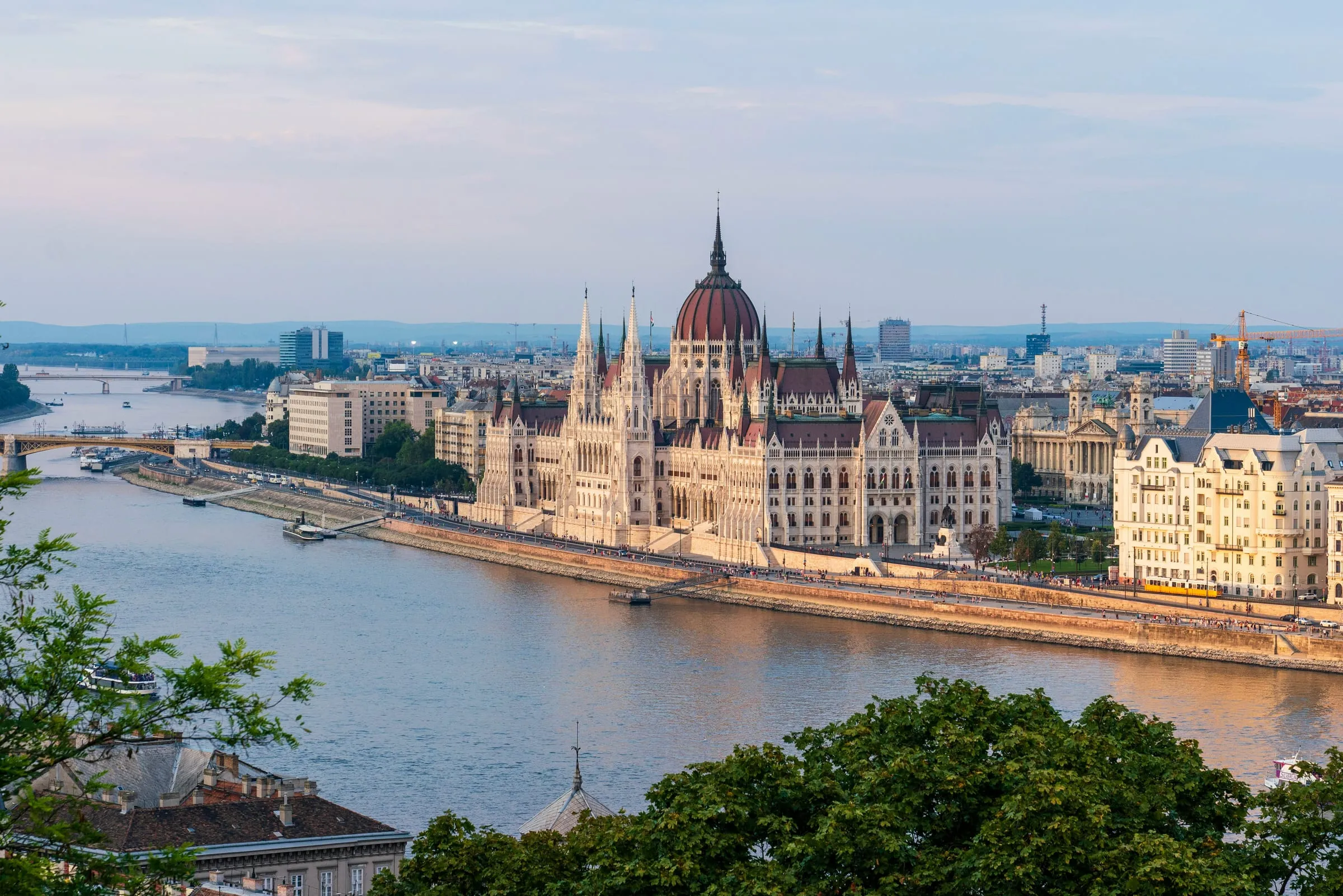
Budapest is the city most travelers underrate before they arrive and overcorrect about afterward. The pre-trip mental model is roughly “the cheaper Danube cousin to Vienna” — a stop on a river cruise itinerary, two days, the iconic Parliament photograph, the chain-bridge sunset, then on to Bratislava or back to Vienna. Done that way, Budapest is fine, and the photographs come out the way the brochures promised. The mistake isn’t visiting Budapest. The mistake is treating it as Vienna’s quieter sibling instead of as a great European capital in its own right.
Done correctly, Budapest is one of the most architecturally dramatic cities in Europe — the Banks of the Danube, Buda Castle Quarter, and Andrássy Avenue are UNESCO World Heritage-listed — and it’s the only European capital built atop more than 100 active mineral springs. The thermal-bath culture here is not a tourist amenity layered onto a city; it’s been a structural part of Hungarian urban life since the Romans (Aquincum, the Roman city in present-day Óbuda, had the bathing infrastructure two thousand years ago) and was institutionalized under the Ottoman Turks during their 150-year occupation. The skyline along the Danube — Parliament on the east bank, Buda Castle on the west, the chain bridges between them — is one of the great photographed silhouettes in Europe and earns the cliché. The Jewish history here is among the oldest, deepest, and most thoughtfully preserved of any European city. And the Hungarian language, which is spoken essentially nowhere else and is related more closely to Finnish than to any of its neighbors, gives the city a cultural distinctness that most travelers register only after the third day.
Most clients come to me asking about Budapest in three contexts: as the embarkation or disembarkation city of a Danube river cruise (this is the most common — almost every Danube itinerary starts or ends in Budapest, and the city deserves more than the standard one-night embarkation pause), as the eastern anchor of a Central European multi-city sweep (Munich →︎ Vienna →︎ Budapest is the high-speed-rail spine of the region, with Prague as a possible northern extension), or as a standalone three-or-four-night Budapest visit in its own right.
Here’s how I think about it.
At a Glance
| Best time to visit | May–June and September–October. Long days, river-and-bridge weather, the bath season is in full swing without the August heat. Late November–December has the Vörösmarty Square Christmas market — one of the great Central European markets, with the Danube and the lit Parliament in the background. Avoid mid-July through August — peak heat in the basin, peak cruise-bus surge. |
| How long to stay | Two full nights minimum if Budapest is a pre- or post-cruise pause, three or four nights for a real city visit, five-plus for combining with day trips to Eger or the Lake Balaton wine country. |
| How to get there | Budapest Airport (BUD) is 24 km southeast of the city; the new Airport Express bus 100E runs to Deák Ferenc tér in 30–45 minutes for HUF 2,200 (around USD $6). From elsewhere in Europe — direct rail from Vienna (2h40m), Munich (7h), Prague (6h45m); fly into Vienna and take the Railjet for the most pleasant arrival. |
| Currency / language | Hungarian Forint (HUF). Hungarian is official — and spoken essentially nowhere else (it’s related to Finnish, not the surrounding Slavic or Germanic languages). English is widely spoken in tourist-facing settings. Köszönöm (thank you) and jó napot (hello/good day) are appreciated and unexpected. |
| One thing most guides won’t tell you | Budapest is two cities joined by chain bridges, and the geography matters for planning. Buda (west bank, hilly) holds Castle Hill, the Citadel, and most of the historic thermal baths. Pest (east bank, flat) holds Parliament, the Jewish Quarter, the major shopping streets, and most of the hotels. Stay in Pest for first visits — almost everything you’ll do is on that side, and the Buda views are best appreciated from across the river anyway. |
Why I Send Travelers Here
Because Budapest, planned correctly, is one of the strongest single-city values in Europe — high architectural drama, a one-of-a-kind thermal-bath culture, dense Jewish heritage, a distinctive food-and-coffee tradition (the Hungarian kávéház — grand café — pre-dates Vienna’s by a generation), and prices materially below Vienna or Munich for a comparable luxury experience.
It’s the embarkation or disembarkation city of nearly every Danube river cruise running today (AmaWaterways, Viking, Avalon, Uniworld, Tauck — all of them start or end here), and the version of those cruises that includes a real Budapest stay before or after the sailing is meaningfully different from the version that doesn’t. One night in Budapest as the cruise embarkation pause is the most common avoidable mistake in Danube river cruising — the city earns at minimum two full pre- or post-cruise nights.
It’s also where the Danube journal post — the AmaReina trip report on this site — both starts and ends. Budapest was the home base for that sailing, and the version of the city you encounter on a December Christmas-markets evening is the version that converts most cruisers into people who say “I want to come back and actually see Budapest properly.” This guide is built for that come back and actually see Budapest properly trip.
I send travelers here as the post-cruise capstone of a Danube week — three or four city nights after the disembarkation, the version of Budapest the cruise schedule doesn’t allow. I send couples for honeymoons that combine a Danube cruise with a Budapest city week — the romantic-Pest-skyline-from-Buda-Castle view at sunset is the kind of evening that earns the trip on its own. I send multi-city European travelers for the Munich-Vienna-Budapest spine sweep — three nights each, all train-connected. And I send travelers following Jewish heritage to the Dohány Street Synagogue complex, the largest synagogue in Europe and the second-largest in the world.
Every recommendation below comes through the lens of how I plan Budapest for the clients I send, the hotel relationships I rely on, and a clear point of view about which version of Budapest earns the days you give it.
Where I’d Anchor
For first-time Budapest visits, stay in Pest. The Buda side is dramatic to look at and worth a full day to walk, but the day-to-day base of a Budapest visit is on Pest — the major sights, the dining, the metro, the Jewish Quarter, the Christmas markets, the Parliament, the cafés. Three Pest neighborhoods cover almost any traveler:
Belváros (Inner City Pest, District V). The heart of the city, just east of the Danube embankment. Walking distance to St. Stephen’s Basilica, the Parliament, the Chain Bridge, the Vörösmarty Square Christmas market, and the major shopping street Váci utca. The right base for a first visit — almost everything is within fifteen walking minutes.
Erzsébetváros (Jewish Quarter, District VII). The historic Jewish quarter, just inside the Erzsébet körút ring road. Dense with the city’s most distinctive architecture, the Dohány Street Synagogue at its center, the famous ruin bar scene (Szimpla Kert is the original), and the strongest restaurant cluster in Pest. Better for a second visit, or for travelers who want their Budapest evenings to feel less curated and more lived-in.
Buda Castle District (District I). Across the Chain Bridge on the west bank, atop Castle Hill — Buda Castle, Matthias Church, Fisherman’s Bastion. A different kind of stay: quieter at night, panoramic views back to Pest, and a fifteen-minute funicular or taxi ride from anywhere on the Pest side. The pick for travelers who want the cobblestone-medieval-quarter version of the city, knowing that the day’s activities will mostly happen across the river.
For the Belle-Epoque-palace flagship pick on the Erzsébet ring — and the property with one of Europe’s most famous cafés inside it — Anantara New York Palace Budapest is the call. The 1894 Italian Renaissance Revival palace was built to be Budapest’s social hub, and the New York Café on the ground floor is widely cited as one of the most beautiful cafés in the world (the most beautiful, depending on which list). 185 rooms inside; the marble façade, the carved columns, the chandeliers and frescoes are the genuine Belle Epoque article. On my rate at the property, the amenity layer is real and quiet — and the inclusion package here is materially stronger than any other Budapest property I work with, deepened further on longer stays. The specifics are calibrated to your dates and get walked through on the discovery call.
For the Inner City flagship pick on Váci utca — the most central walking position in Budapest — Matild Palace, a Luxury Collection Hotel is the call. The 1902 Belle Epoque palace was built under the patronage of Princess Maria Klotild of Saxe-Coburg-Gotha and recently restored as a Marriott Luxury Collection flagship. 111 rooms (many overlooking the Danube), 19 suites including the Crown Tower Suite and Maria Klotild Royal Suite, and a new dining program by Wolfgang Puck at the on-site Spago. On my rate at the property, the amenity layer doesn’t book direct, and the specifics — designed to land at check-in rather than appear in advance — get walked through on the discovery call.
For the river-cruise pre/post pick — and the property with a specific structural advantage for Danube cruisers — Corinthia Hotel Budapest on the Erzsébet ring is the call. The former Grand Hotel Royal, restored to contemporary luxury while keeping the marble floors, the ballroom, the sweeping staircase, and the six-story atrium. The historic Royal Spa has been remodeled with a 15-meter pool and a full spa program. Critically: Corinthia participates in the Cruise Pre/Post Amenity Program — booked on the specific rate code before or after a Danube sailing, the property layers in cruise-aligned benefits that materially change the math for river cruisers. On my rate at the property, the amenity layer doesn’t book direct, and the specifics — calibrated to whether you’re pre-cruise, post-cruise, or both — get walked through on the discovery call.
Want one of these stays? Start a discovery call — I’ll pull live availability, walk through the suite categories, and confirm which amenities and current promotions apply to your dates. And the small extra at check-in — a welcome note from me, the kind of touch the standard amenity package doesn’t list — is part of how I deliver these stays.
What I’d Do With Three Days
Adjust to taste. The three-day version is the right length for a real city visit; the two-day version is the cruise-pre/post pause that compresses the must-sees.
Day One — Pest, the Danube Embankment, and the Chain Bridge
Coffee at one of Pest’s grand cafés — Café Gerbeaud on Vörösmarty Square (1858, the heritage choice), Central Kávéház on Károlyi utca (literary haunt, quieter), or the New York Café at the Anantara New York Palace if you’re staying or visiting the property. The Hungarian kávéház tradition pre-dates Vienna’s; this is the genuine article.
Walk to the Hungarian Parliament Building along the Danube embankment. The Parliament is the second-largest parliament building in Europe (after Romania’s), built 1885–1904 in Gothic Revival style, with 691 rooms and a spire 96 meters high — exactly the height of St. Stephen’s Basilica, deliberately, so that no other Hungarian building can be taller than either. Pre-book the guided tour in advance; walk-ins routinely turn up empty. While you’re at the Parliament, walk down to the Shoes on the Danube Bank memorial — sixty pairs of cast-iron shoes along the embankment, commemorating thousands of Jewish Hungarians (estimates range from 3,500 to as many as 20,000) shot into the river by Arrow Cross militiamen in 1944–45.
Lunch at one of the small Pest restaurants near the Parliament — Borkonyha Winekitchen for modern Hungarian, or Hungarikum Bisztró for a more casual sit-down version of the canonical Hungarian dishes (goulash, paprikás csirke, langos).
Afternoon walking the Danube embankment toward the Chain Bridge (Széchenyi Lánchíd), the first permanent bridge across the Danube here, built 1839–1849. Cross to the Buda side and take the funicular up to Buda Castle for the view back across the river. Walk Castle Hill — Matthias Church, Fisherman’s Bastion (the photo from here is the photo), the small back-streets where the Castle District actually feels medieval. Cross back over the Chain Bridge at sunset; the Pest skyline lit at night is the iconic Budapest hour.
Dinner in Pest. Bestia in the Jewish Quarter for modern Hungarian; Borkonyha if you want the wine-bar version; Costes Downtown if you want the Michelin-starred experience.
Day Two — Castle Hill, the Baths, the Jewish Quarter
Morning at Buda Castle’s interiors — the Hungarian National Gallery (Magyar Nemzeti Galéria) inside Buda Castle holds the major Hungarian art collection, and the rooftop terrace gives you the high-elevation Pest view. Allow ninety minutes minimum. Lunch in the Castle District at Pest-Buda (a real Hungarian bistro despite the touristy address) or at the historic Ruszwurm café (since 1827).
Afternoon at the baths. This is the Budapest experience nothing else replaces. Three options:
- Széchenyi Thermal Bath in City Park — the largest medicinal-bath complex in Europe, the iconic outdoor pools with the yellow-baroque palace as backdrop, the famous chess players at the floating boards. The most photographed Budapest bath and the most touristed; on weekends the wait can run an hour.
- Gellért Thermal Bath on the Buda side — Art Nouveau interior, 1918 construction, the most architecturally beautiful of the major baths. Quieter than Széchenyi.
- Rudas Thermal Bath below Gellért Hill — the most authentically Ottoman, with a 16th-century Turkish dome over the central thermal pool. An option I love for the traveler who wants the most genuinely Ottoman register — smaller, older, the real thermal architecture. (Note: Rudas has historical men-only and women-only days; check the schedule before going.)
Allow at least two hours. The bath culture here is unhurried — read, swim, sit in the steam, repeat.
Late afternoon walking the Jewish Quarter (Erzsébetváros) — the Dohány Street Synagogue complex, the ruin bars of Kazinczy and Király streets, the small streetside cafés. Dinner at Mazel Tov (modern Israeli-Hungarian fusion in a converted ruin courtyard) or Köleves (heritage Jewish-Hungarian) followed by a drink at Szimpla Kert — the original ruin bar, built into a derelict pre-war apartment building, the prototype for the dozens that followed. The early evening is the right hour for Szimpla — by 11 p.m. it becomes a different beast.
Day Three — Andrássy, Heroes’ Square, City Park
Walk Andrássy Avenue — the UNESCO-listed grand boulevard, the Champs-Élysées of Budapest, lined with Belle Epoque mansions, designer shops, and the Hungarian State Opera House. If your dates allow, take the M1 metro line beneath Andrássy — the oldest metro line in Continental Europe (opened 1896), with original Belle Epoque tiled stations. The line is itself UNESCO-listed.
Andrássy ends at Heroes’ Square (Hősök tere), the open ceremonial plaza with the Millennium Monument at its center — bronze statues of the seven Magyar tribal leaders who founded Hungary in 895, plus thirteen other figures of Hungarian historical importance. Behind the square is Városliget (City Park), where Széchenyi Baths sit, alongside the Vajdahunyad Castle — a deliberately whimsical 1896 architectural compilation built to celebrate the Hungarian millennium, copying styles from castles around historic Hungary into a single composite building.
Lunch at the Robinson Restaurant in City Park (lakeside, Hungarian classics) or back in Pest at Mák Bistro (modern Hungarian, near the Parliament).
Afternoon: depending on stamina and taste, either a Danube river cruise (the standard sightseeing boats from the Vigadó tér quay run hour-long loops with commentary) — if you’re not on a Danube cruise already this is the abbreviated version — or Margaret Island (Margitsziget), the long park-island in the middle of the Danube reached by trams across the Margaret Bridge, with paths, gardens, a Japanese garden, and a 13th-century convent ruin.
Sunset at Fisherman’s Bastion for the iconic Pest view (return to Buda for one more time), or at the Citadella atop Gellért Hill for the higher panoramic angle (currently in a multi-year restoration — check status before going).
By day three, Budapest makes its own recommendations.
Specific Things I’d Tell You About
The New York Café might actually be the most beautiful café in the world. The claim sounds like marketing, but the room earns it — built 1894 on the ground floor of the New York Palace (now the Anantara New York Palace), Italian Renaissance Revival with marble columns, gold leaf, painted ceilings, and chandeliers. The literary set of pre-war Budapest met here. The line to get in for non-staying guests can be twenty minutes; if you’re staying at the Anantara, you skip the line. Either way, do not miss it.
The Dohány Street Synagogue is the second-largest synagogue in the world (after Temple Emanu-El in New York), and the largest in Europe. Built 1854–1859 in Moorish Revival style with twin onion-domed towers, holding 3,000 worshippers. The complex includes the Hungarian Jewish Museum, the Heroes’ Temple, and the Tree of Life Memorial — Imre Varga’s silver weeping-willow sculpture in the courtyard, with the names of Holocaust victims engraved on the leaves. Pre-book the guided tour for the historical context; walk-in entry to the synagogue alone misses most of the complex.
Budapest’s M1 metro line is the oldest in Continental Europe. Opened 1896 to coincide with the Hungarian millennium celebrations, the Földalatti (literally “underground”) still runs the original 1896 alignment beneath Andrássy Avenue, with the original tiled stations restored. The line is UNESCO-listed. Take it for one stop if not for transport — it’s the version of urban infrastructure that doesn’t exist anymore.
Szechenyi Lanchid (the Chain Bridge) is the photograph of Budapest. Especially at night, lit, with the Buda Castle on one side and the Pest embankment on the other. The bridge was the first permanent crossing of the Danube here, opened 1849, destroyed in WWII, and rebuilt to the original specifications. Walk it at sunset westbound (Pest to Buda) — the Buda-Castle silhouette ahead and the Parliament behind you is the image most travelers leave with.
Hungarian Tokaji is one of the great wines of the world, and most travelers don’t try it properly. Tokaji aszú is a botrytized dessert wine produced in northeastern Hungary (the Tokaj region) since the 16th century, and it was the first such wine in Europe — predating Sauternes by 75 years. Louis XIV called it “Vinum Regum, Rex Vinorum” — the wine of kings, king of wines. Order it as a digestif at any serious Budapest restaurant, or pick up a bottle at the Mátra Cellar wine shop on Magyar utca to take home.
The “ruin bar” scene is real and was an actual urban-cultural movement. Starting in the early 2000s in the Jewish Quarter — derelict pre-war apartment buildings being squatted by young Hungarians, decorated with found objects, opened as bars — Budapest invented a bar typology that has since been imitated worldwide. Szimpla Kert is the original (since 2002, on Kazinczy utca); the second-generation versions cluster within four blocks. Go at 7 p.m., not 11 p.m. The earlier hour is the version with character; the later hour is full of stag parties.
What I’d Skip
One night in Budapest as a Danube cruise embarkation pause. The most common avoidable mistake in river cruising. The cruise embarkation day eats most of the afternoon between transfer and check-in, and the embarkation evening is welcome-cocktail-and-safety-briefing on the ship, not Budapest. Budapest earns at minimum two full pre- or post-cruise nights, three is better. Add it to the front or back of your sailing.
Restaurants on Váci utca with multilingual menus and pushy hosts. Same tourist-tax pattern as every European city in this library. Long laminated menus, photo-illustrated dishes, hosts trying to pull you in. Walk one block off Váci utca in any direction.
The Heroes’ Square horse-drawn carriages. Tourist tax. Walk Andrássy or take the M1 metro instead.
Driving anywhere in central Budapest. The metro is excellent, the trams cover what the metro doesn’t, taxis are cheap and metered, and the Old Town parts are genuinely walkable. Hire a car and driver only if you’re doing a day trip to Lake Balaton, Eger, or the Tokaj wine region — not for the city itself.
The Buda Castle Funicular line on a busy day. The funicular is iconic and worth riding once if the line is short. On busy days the queue runs 30–45 minutes for an 80-second ride. Take a taxi up the back of Castle Hill (HUF 2,000) and walk down later; you’ve saved an hour and you’re not standing in line in 95-degree heat.
For River Cruisers
If your Budapest trip is the start or end of a Danube river cruise, the single most important call you’ll make is adding a real Budapest stay before or after the sailing, not treating the city as a 12-hour embarkation pause. Almost every Danube itinerary starts in Budapest and ends in Nuremberg or Passau (or runs the reverse direction), and Budapest earns at minimum two full pre- or post-cruise nights. One night is the most common avoidable mistake in river cruising.
For the river-cruise base, Corinthia Hotel Budapest is the call — see the section above. The Corinthia participates in the the Cruise Pre/Post Amenity Program, which adds a complimentary one-way taxi transfer between the hotel and the Budapest cruise port to the standard amenity package. If you’re embarking or disembarking at the Vigadó tér quay or the international cruise port, that single transfer is roughly USD $50 of value at no cost — and the friction of arrival/departure with luggage is the friction it removes.
The deeper conversation about which Danube itinerary fits which traveler — AmaWaterways vs. Viking vs. Avalon, the Christmas-markets sailings, the standard summer routings — lives on the Rivers & Small Ships specialty page. The full Danube trip report — the AmaReina sailing whose home base was Budapest — is the long-form version of what these sailings actually feel like.
For Travelers Following Jewish Heritage
Budapest’s Jewish history is among the deepest in Europe. The pre-war Jewish community numbered around 200,000 in a city of one million — proportionally one of the largest Jewish populations in any European capital — and despite the catastrophic losses of 1944–45, the contemporary community remains the largest in Central or Eastern Europe outside Russia. The arc of that history lives in the architecture and the memorials with unusual directness.
The Dohány Street Synagogue complex in the Jewish Quarter is the centerpiece — second-largest synagogue in the world, the Hungarian Jewish Museum, the Heroes’ Temple, and Imre Varga’s silver weeping-willow Holocaust memorial in the rear courtyard. Allow two hours minimum; pre-book the guided tour. The smaller Kazinczy Street Orthodox Synagogue a few blocks away is a working orthodox congregation in an Art Nouveau building from 1913. The Shoes on the Danube Bank memorial along the Pest embankment near Parliament is the city’s most quietly devastating Holocaust memorial — sixty pairs of cast-iron shoes commemorating the 3,500 Hungarian Jews shot into the Danube by Arrow Cross militiamen in 1944–45.
I’m currently developing a co-hosted Jewish Heritage trip for 2026, and Budapest — alongside Vienna, Prague, Rome, Paris, and Amsterdam — is on the early routing. Reach out if you’d like to be on the early-interest list.
For the longer thinking on how I work this thread — what makes it different from other heritage travel, what it earns, and what it doesn’t try to be — read the pillar essay: Jewish heritage travel.
For Multi-City Europeans
Budapest is the eastern anchor of the Munich-Vienna-Budapest spine — the high-speed rail connects all three in a clean trip-shape, and pacing matters: Munich demands more day-trip-flexibility for the Bavarian Alps, Vienna demands more museum and music time, Budapest demands more bath-and-walking time. Three nights each is the floor; four nights each is the right pace.
The Munich →︎ Vienna →︎ Budapest direction is my preference for first-time Central Europeans — Munich’s energy as the front, Vienna’s grand-imperial weight in the middle, Budapest’s eastern-different character at the close. The reverse direction works equally well; it depends on which city you want to fly into first. Add Prague to the north for the four-city version (Budapest →︎ Vienna →︎ Prague →︎ Munich, or any permutation) — the ICE rail connects Prague to all three.
If you want me to design the full Central European spine — train timing, hotel sequencing, day-trip options out of each base, restaurant reservations — that’s exactly the kind of planning I do. Start a discovery call.
For Honeymooners
Budapest is the underrated Central European honeymoon city. The chain-bridge-at-sunset evenings, the Buda Castle skyline view, the thermal-bath afternoons, and the Jewish Quarter’s small-restaurant intimacy combine into the romantic version of the city without the cruise-bus surge of Vienna or the summer-heat compression of Rome. Anchor at the Anantara New York Palace for the Belle Epoque palace experience and the in-room dinner-included perk, Matild Palace for the Inner City flagship with the Wolfgang Puck Spago dining program, or Corinthia if you’re combining with a Danube cruise.
The honeymoon evening, in my read, is dinner at one of the Pest fine-dining anchors (Costes, Borkonyha, Onyx), followed by the chain-bridge walk back to the hotel with the Buda Castle silhouette lit on the far bank. The Budapest skyline is the romantic version of Central European architecture, and most travelers don’t realize until they’re standing on the bridge.
If you want me to design the full Budapest honeymoon, or to combine Budapest with Vienna, Munich, Prague, or a Danube river cruise for a longer Central European arc, that’s exactly the kind of planning I do. Start a discovery call.
Plan Budapest With Me
If you’re thinking about Budapest as a Danube river cruise pre/post anchor, as the eastern bookend of a Central European multi-city trip, or as the standalone three-or-four-night visit it deserves to be — that’s exactly the kind of planning I do. A 30-minute discovery call is where it starts. No fee, no pressure. Just the city, your timeline, and what you actually want to feel when you step out onto the chain bridge at dusk and watch the lights come up across the river.
Book Your Free Discovery Call →︎
Last updated: April 2026. I keep this guide current. If a hotel I recommend slips, a restaurant changes hands, or access to a site shifts, the page changes. Travel changes. The work doesn’t stop when the page goes live.
Plan this trip with me.
A 30-minute discovery call is where it starts. No fee, no pressure.
Book a Discovery Call