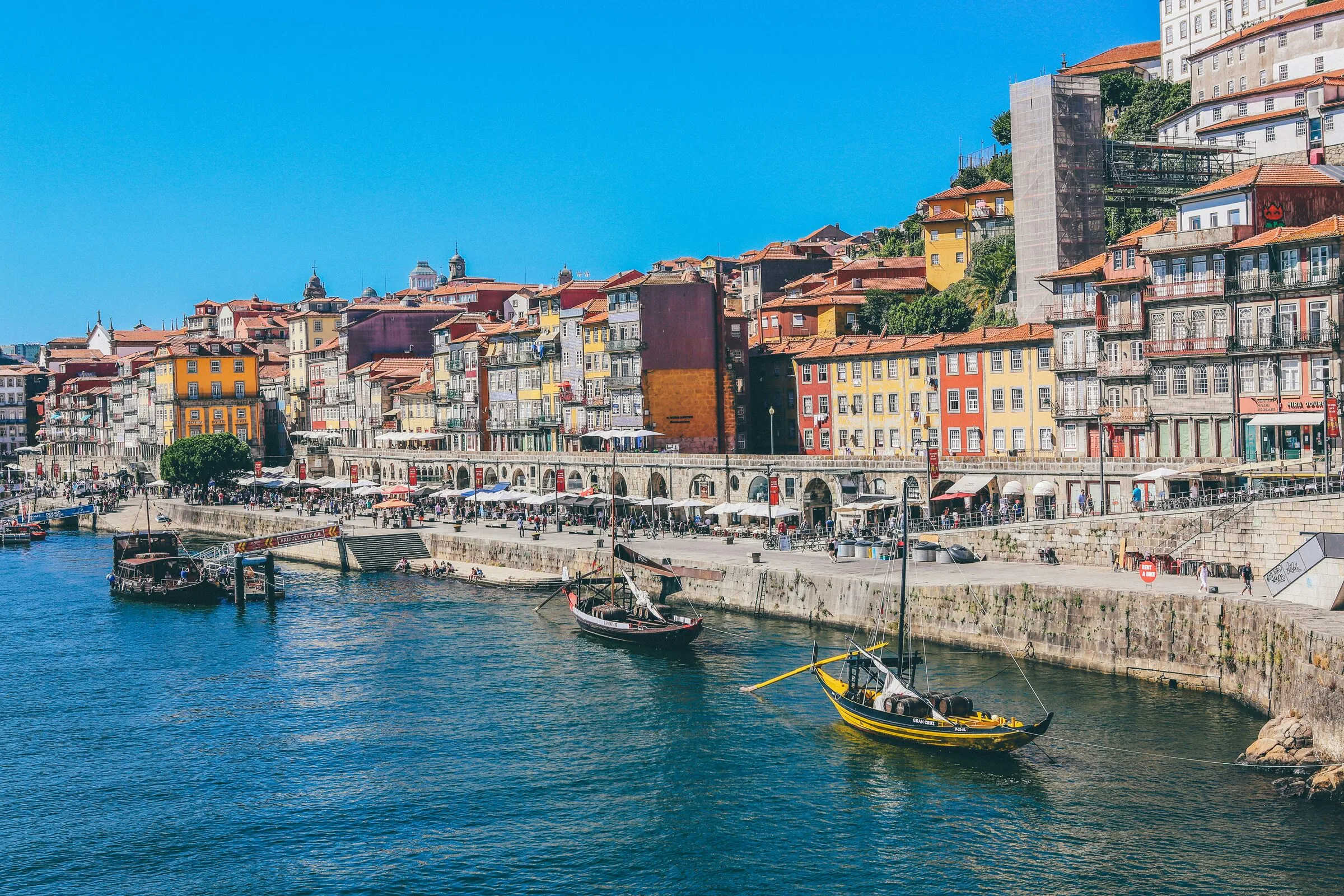
Porto is the city most American travelers don’t know they’re going to love until they’re standing on the Dom Luís I Bridge at sunset, watching the lights come up over the Ribeira tile-clad waterfront, and realizing nobody warned them this was coming. The city is one of the most architecturally distinctive in southern Europe — narrow streets of tile-fronted buildings, an Atlantic-fed river that’s wider and more dramatic than the Tagus in Lisbon, an entirely different vibe from the Iberian capitals because it isn’t capital-energy, it’s port-city-energy — and it’s the world’s port-wine capital because the wine takes its name from the place. (Specifically, from the port of Porto, where the casks were shipped out for two centuries.)
Done correctly, Porto is one of the most rewarding mid-sized cities in Europe — the UNESCO World Heritage Old Town (Ribeira) survives essentially intact, the port-wine cellars across the river in Vila Nova de Gaia are open for tours and tastings, the small-streets-and-azulejo-tile architectural language defines a coherent city character, and the Douro Valley wine country an hour east is one of the great wine regions in Europe and the source of the river-cruise itineraries that originate here. Add two of the most photographed sites in any travel-Instagram feed (the Livraria Lello bookstore and the São Bento railway station), an extraordinarily concentrated fado music tradition, and the kind of grilled-fish-and-port-wine evening that costs a fraction of what the same meal costs in Paris, and Porto earns more than the standard one-night cruise-embarkation pause.
Most clients come to me asking about Porto in three contexts: as the embarkation city of a Douro river cruise (the most common — every Douro sailing starts or ends in Porto, and the city deserves at least two pre- or post-cruise nights), as the northern anchor of a multi-city Portugal sweep (Lisbon →︎ Porto →︎ optional Douro Valley days, three or four nights each), or — much rarer, and the version I most want to plan for — as a standalone three-or-four-night Porto-and-Douro week with day trips into the wine country.
Here’s how I think about it.
At a Glance
| Best time to visit | May–June and September–October. The Atlantic-coast humidity is forgiving, the Douro Valley vineyards are at their best in spring greens or harvest-gold, and the cruise schedule is in full swing. September is the vindima (grape harvest) in the Douro — the most distinctive month if your dates align. Avoid mid-July through August — peak cruise-bus surge. |
| How long to stay | Two full nights minimum if Porto is a pre- or post-cruise pause, three or four nights for a real city visit, five-plus if you’re combining with a day trip or overnight in the Douro Valley. |
| How to get there | Porto Airport (OPO) is 11 km north; the Metro Line E runs to Trindade in 25 minutes for under EUR 3. From Lisbon — the Alfa Pendular high-speed train runs Lisbon to Porto in 2h45m and is meaningfully better than the regional flight once you count airports. |
| Currency / language | Euro. Portuguese is official; English is widely spoken in tourist-facing settings, less so in older neighborhoods. Bom dia and obrigado/obrigada (gendered — obrigado if the speaker is male, obrigada if female) carry you a long way. |
| One thing most guides won’t tell you | The Livraria Lello bookstore — yes, the famous one, the J.K. Rowling-allegedly-inspired one — now requires a timed-entry ticket purchased in advance, and the shop has been a tourist conveyor for years. Pre-book the earliest morning slot if you want the bookstore experience instead of the elbows-and-crowd one. The shop deducts the ticket cost from any book purchase, so the visit is functionally free if you buy something. |
Why I Send Travelers Here
Because Porto, planned correctly, is the most rewarding mid-sized European city most clients haven’t been to yet. The UNESCO Old Town walks itself; the port-wine cellars across the river are a half-day of guided tasting with stories that go back 300 years; the Douro Valley an hour east is one of the most dramatic terraced-wine landscapes on earth; the Atlantic seafood is honest and inexpensive; and the city’s character — gritty-becoming-polished, working-class-river-port-with-tile-fronted-bones — is unlike any other Iberian capital.
It’s also the origin city of every Douro river cruise running today (AmaWaterways, Viking, Avalon, Uniworld, and the smaller specialty lines). The Douro is meaningfully different from the Danube — fewer ports per day, more time on the river itself, a single concentrated wine-and-landscape focus rather than the multi-country cultural sweep. The version of those cruises that includes a real Porto stay before or after the sailing is the version I plan for clients. One night in Porto as the cruise embarkation pause is the most common avoidable mistake on a Douro itinerary.
I send couples here for honeymoons that want a wine-and-river version of southern Europe (Hotel Yeatman alone justifies the trip — it’s a 2-Michelin-star wine hotel with infinity pools overlooking the Douro). I send Iberian-sweep clients for the Lisbon →︎ Porto multi-city arc that combines the Tagus capital with the Douro origin city. And I send river-cruise clients for the Douro itineraries that need a real Porto framing rather than a 12-hour gangplank pause.
Every recommendation below comes through the lens of how I plan Porto for the clients I send, the hotel relationships I rely on in Porto and Vila Nova de Gaia, and a clear point of view about which version of the city earns your time.
Where I’d Anchor
Three anchoring patterns cover almost any traveler’s reason for being in the city:
Central Porto / Baixa. The Old Town quarters around Praça da Liberdade, Aliados, and the Avenida dos Aliados central boulevard. Walking distance to the São Bento railway station, the Clérigos Tower, the Livraria Lello, and the descent into the Ribeira. Stay here on a first visit — most of the city’s headline sights are within 15 walking minutes.
Ribeira (the riverside Old Town). The UNESCO-listed waterfront district along the Douro, the most photographed quarter in Porto. Tile-fronted buildings, narrow medieval lanes, riverside restaurants. Quieter at night than central Porto, dramatic in the morning light. Smaller hotel selection but the most atmospheric base for travelers who want their Porto walk-in to feel cinematic.
Vila Nova de Gaia (across the river). The opposite bank of the Douro from Porto proper — technically a separate municipality, practically a continuous cityscape — where the port-wine cellars cluster (Sandeman, Taylor’s, Graham’s, Croft, Ferreira, Cálem). Stay here for the panoramic-view-back-at-Porto version, especially if a port-wine focus is part of the trip’s purpose.
For the Vila Nova de Gaia panorama pick — and the most distinctive luxury property in the city — The Yeatman at Rua do Choupelo is the call. The Relais & Châteaux property sits on a hill amidst the working port-wine cellars, with panoramic views over Porto’s Old Town and the Douro River from every spacious room and private terrace. Seven acres of grounds, indoor and outdoor infinity pools, and Restaurant Ricardo Costa — the on-site fine-dining room with two Michelin stars, one of the genuinely best dinner reservations on the Iberian Peninsula. On my rate at the property, the amenity layer is meaningful and doesn’t book direct — pairing the right room category to your dates is the discovery-call conversation, and the specifics tend to land at check-in rather than appear in advance.
For the central Porto heritage flagship pick, Infante Sagres on Praça D. Filipa de Lencastre is the call. The 1951 grand-dame Portuguese hotel — part of Small Luxury Hotels of the World — completed a comprehensive 2023 refurbishment of guest rooms, façade, lobby, and reception. Eighty-five rooms and suites, central walking position, and the kind of intimate-luxury atmosphere that has made the Infante a literal landmark in Porto since the 1950s. On my rate at the property, the amenity layer is real and quiet — and the inclusion package here is among the strongest of any Porto property I work with, deepened further on longer stays. The specifics get walked through on the discovery call.
For the iconic Praça da Liberdade flagship — the most central possible Porto location — InterContinental Porto-Palacio das Cardosas is the alternative. The hotel occupies one of Porto’s most iconic 18th-century buildings on the city’s main square, refurbished by interior designer Alex Kravetz, with a façade that anchors the central Porto image and a location walking distance to Clérigos Tower, the Lello bookstore, and the Ribeira descent. On my rate at the property, the amenity layer is real and quiet — calibrated to your dates and the room category, deepened materially on longer stays, and broadly applicable across F&B, parking, laundry, and the spa. The specifics get walked through on the discovery call.
Want one of these stays? Start a discovery call — I’ll pull live availability, walk through suite categories, and confirm which amenities apply to your dates. And the small extra at check-in — a welcome note from me, the kind of touch the standard amenity package doesn’t list — is part of how I deliver these stays.
What I’d Do With Three Days
Adjust to taste. The three-day version is the right length for Porto plus a Douro day; the two-day version is the cruise pre/post pause that compresses the must-sees.
Day One — The Old Town and the Ribeira
Start at São Bento railway station before 10 a.m. — the entrance hall is covered in 20,000 azulejo tiles depicting scenes from Portuguese history, and it’s one of the most photographed train station interiors in Europe. Allow 20 minutes. Walk to the Livraria Lello with your pre-booked timed-entry ticket — the bookstore that’s allegedly inspired Hogwarts (J.K. Rowling lived in Porto for two years; she has confirmed and denied the connection at different times, and the shop happily leans into the ambiguity). The interior staircase is the photo. Buy a book; the ticket cost is deducted from the purchase.
Walk to the Clérigos Tower — 18th-century baroque tower, 225 steps to the top, panoramic Old Town view — and through the small streets toward the Igreja de São Francisco (Gothic exterior, Baroque interior dripping in over 200 kilograms of gold leaf). Lunch in the Ribeira along the riverside — Adega São Nicolau (heritage Portuguese, old-tile interior, in business since the 1950s) or Cantinho do Avillez (modern Portuguese by celebrated chef José Avillez).
Afternoon: walk the Ribeira embankment along the Douro, then cross the Dom Luís I Bridge (Gustave Eiffel’s apprentice Théophile Seyrig designed it — the upper deck is for the metro and pedestrians, the lower for cars, and the upper-deck walk gives you the iconic view back at Porto’s tile-clad waterfront).
In Vila Nova de Gaia, take a port-wine cellar tour — Taylor’s is the most-recommended-overall (1692 founding, hilltop location with a panoramic terrace, the tasting includes the rare Tawny ports), Graham’s is the family-friendly choice with the polished modern visitor center, Sandeman is the most-photographed (the Don, the cape, the hat). One cellar is enough for a half-day; two becomes a port wine-saturated afternoon.
Sunset back across the bridge into Porto, dinner at Antiqvvm (1-Michelin-star modern Portuguese in a converted palace) or back at The Yeatman if you’re staying.
Day Two — A Day in the Douro Valley
The Douro Valley is one hour east of Porto and is the most dramatically terraced wine landscape in Europe — UNESCO-listed since 2001, with vineyards climbing the steep schist slopes above the river. The day-trip shape:
Hire a car and driver for the day — driving the Douro yourself with port-wine tasting on the schedule is exactly the trip not to do unmedicated. Visit two wineries (the right number; three is too many). Strong picks: Quinta do Vallado (small, modern, family-run, contemporary architecture), Quinta de la Rosa (riverside, casual, lunch on the terrace), Quinta do Crasto (the panoramic-infinity-pool-and-vineyards photograph everyone takes). Lunch at one of the quintas between visits — the Douro fattorias make their own meals from estate produce.
If the day allows, take a river cruise on the Douro — small-group, two-hour panoramic boat trip from Pinhão or Régua. The Douro Valley from the river is a fundamentally different visual experience than from the road, and most travelers don’t realize how meaningful the difference is until they’re on the water.
Back to Porto in the late afternoon. Dinner at Belos Aires in Foz (riverside, Atlantic seafood) or DOP (Chef Rui Paula’s modern Portuguese in central Porto).
Day Three — Foz, the Sea, and Fado
Slow morning. Coffee at Café Majestic on Rua Santa Catarina — Porto’s Belle Epoque literary café, J.K. Rowling reportedly wrote parts of the early Harry Potter chapters here, the Art Nouveau interior is the photograph.
Late morning to Foz do Douro — the residential neighborhood at the mouth of the Douro where it meets the Atlantic. Walk the Avenida do Brasil coastal promenade, lunch at Cafeína (mid-century-modern Portuguese), and stand at the Felgueiras Lighthouse at the actual Atlantic edge — the river ends, the ocean starts, the sound is the rest of the day.
Afternoon: depending on stamina, the Serralves Foundation (modern art and gardens, the Álvaro Siza-designed museum is one of Portugal’s best contemporary buildings) or back to the Old Town for shopping along the Rua das Flores (artisan shops, design boutiques, the small-business version of Porto’s commercial life) and the Mercado do Bolhão (the recently restored historic market).
Dinner with fado music — Casa da Mariquinhas in Foz or Casa de Mateus in central Porto for the traditional fado dinner experience. The music is Portugal’s national soul; the version you encounter in Porto is more melancholic-Atlantic than the brighter Lisbon variant.
By day three, Porto makes its own recommendations.
Specific Things I’d Tell You About
The São Bento railway station is one of the most photographed interiors in Europe. Twenty thousand azulejo tiles covering the entrance hall, depicting scenes from Portuguese history (the Battle of Valdevez, the Battle of Aljubarrota, royal weddings, the conquest of Ceuta). The station is still working — don’t try to walk the platforms, but the entrance hall is open to the public during operating hours. Five minutes, free, the kind of photograph that doesn’t need editing.
The Livraria Lello has the timed-entry system for a reason. The bookstore — the one with the swooping red staircase that Wes Anderson’s color palette would approve of — became a tourist destination roughly the moment Harry Potter took off, and the shop has been managing crowd flow since. Pre-book the earliest morning slot. The shop deducts the ticket cost from any book purchase, so a single book makes the visit free. Buy a book.
The port-wine cellars across the river in Vila Nova de Gaia have been operating in continuous production since the 17th century. The British wine merchants who established the trade — Croft (1588), Taylor’s (1692), Sandeman (1790), Graham’s (1820), and several others — built the cellar buildings on the south bank specifically because the cooler, more humid microclimate suited port-wine maturation. The cellars are still functional production facilities, not just visitor centers. The tour at Taylor’s includes barrels that have been aging Tawny port for more than fifty years.
The Dom Luís I Bridge is genuinely a Gustave Eiffel-school structure. Théophile Seyrig — Eiffel’s former business partner — designed it; the bridge opened in 1886, three years before the Eiffel Tower. The upper deck carries the Metro and pedestrians; the lower deck carries cars. Walk the upper deck at sunset with the wind off the Atlantic, the tile-fronted Ribeira on one bank and the port-wine cellars of Vila Nova de Gaia on the other. It’s the iconic Porto hour.
The Douro Valley is the world’s first demarcated wine region (1756). Sixty-one years before Champagne. The Marquês de Pombal (the same prime minister who rebuilt downtown Lisbon after the 1755 earthquake) demarcated the region the following year as part of his economic reorganization of Portugal. The terraced schist-slope vineyards have been producing port wine continuously since the early 17th century. It’s not just a wine region; it’s the wine region by the standard of regulatory history.
Café Majestic is the Belle Epoque literary café, and Rowling reportedly wrote there. Rua Santa Catarina, opened 1921, original Art Nouveau interior, marble tables, mirrored walls. J.K. Rowling lived in Porto from 1991 to 1993, taught English here, and reportedly drafted parts of the early Harry Potter chapters at Majestic. The café happily leans into the connection. The pastries are honest; the coffee is fine; the room is the destination.
What I’d Skip
Restaurants on the Ribeira with multilingual menus and pushy hosts. Same tourist-tax pattern as every European city in this library. The good Ribeira restaurants — Adega São Nicolau, Cantinho do Avillez — don’t need to advertise that hard. Walk one street back from the immediate riverside, in any direction.
Driving anywhere in central Porto. The Old Town is essentially pedestrian, the metro and trams are excellent, and parking is genuinely difficult. Hire a car and driver only for the Douro Valley day-trip days; within Porto itself, walk or take the metro.
Trying to do the Douro Valley as a half-day. It’s a full day or it’s not worth it. The drive each way is 60–90 minutes, the wineries don’t reward rushing, and the Douro from the road is not the same Douro as from the river. Plan it as a full day or skip it on this trip.
The big-bus port-wine cellar tour in Vila Nova de Gaia. The included cruise-day group tours of the cellars are bus-conveyor experiences. Book the small-group or private tour at Taylor’s, Graham’s, or Croft, even if you’re on a cruise itinerary that includes the bus version. The difference is meaningful.
Climbing the Clérigos Tower if you have any knee or fitness questions. 225 steps in a narrow stone staircase. The view is the view, but the panorama from the Miradouro da Vitória (a free street-level overlook on the way down toward Ribeira) is materially the same view without the climb.
For River Cruisers (Douro)
If your Porto trip is the embarkation or disembarkation city of a Douro river cruise — almost every Douro itinerary starts or ends in Porto — the most important call you’ll make is adding a real Porto stay before or after the sailing, not treating the city as a 12-hour embarkation pause. One night in Porto as the cruise embarkation pause is the most common avoidable mistake on a Douro itinerary. Two nights pre- or post-cruise is the floor; three is the right pace.
The Douro is materially different from the Danube — fewer ports per day, more time on the river itself, a single concentrated wine-and-landscape focus rather than a multi-country cultural sweep. The cruise lines that operate the Douro (AmaWaterways, Viking, Avalon, Uniworld, plus smaller specialty operators) each handle the same physical river differently, and the right-itinerary-for-the-right-traveler conversation lives on the Rivers & Small Ships specialty page.
If you’re considering pairing a Douro sailing with the Danube or another European river-cruise itinerary in the same year — that’s a meaningful arc that I plan for clients with specific year-long European-river-cruise interest. Discovery call below.
For Honeymooners
Porto is the underrated southern-European honeymoon city. Less crowded than Paris, more atmospheric than central Rome, and with the wine-and-river setting that delivers the romantic-Iberian version of the trip without the cost of a Côte d’Azur honeymoon. Anchor at The Yeatman on the Vila Nova de Gaia hilltop for the full panoramic-views-and-2-Michelin-star experience, or at Infante Sagres in central Porto for the heritage-grand-dame experience with the included lunch-or-dinner inclusion.
The honeymoon evening, in my read, is dinner at Restaurant Ricardo Costa at The Yeatman (the 2-Michelin-star tasting menu, the panoramic Porto view from the windows, the Douro lit beneath you), followed by a slow walk through the Vila Nova de Gaia port-wine streets and back across the Dom Luís I Bridge under the lights. The setup does the work.
If you want me to design the full Iberian honeymoon — Porto plus Lisbon plus optional Douro Valley days plus optional Madeira extension — that’s exactly the kind of planning I do. Start a discovery call.
For Iberian Multi-City Travelers
Porto is the northern anchor of the Lisbon →︎ Porto multi-city Portugal arc. The high-speed Alfa Pendular train connects Lisbon to Porto in 2h45m and is the right way to do the trip. Three nights each is the floor; four is the right pace if you want to fold in either a Sintra day (from Lisbon) or a Douro Valley day (from Porto).
The classic Portugal week: Lisbon for three nights (city plus a Sintra or Cascais day), Porto for three nights (city plus a Douro Valley day), with optional add-on for a Douro river cruise in between (3-night, 4-night, or 7-night sailings available, all originating in Porto). The 10-day version of this trip is one of the most rewarding southern-European arcs I plan for clients.
For travelers extending further into Iberia — Spain is reached most easily from Porto via overland rail to Madrid (about 8 hours, with a change at Salamanca) or by short-haul flight; the Lisbon-to-Madrid sleeper-train option also exists. If you want me to design a full Iberian Peninsula sweep — Portugal plus Spain — that’s the kind of itinerary I plan for clients with two-week Iberian time. Start a discovery call.
Plan Porto With Me
If you’re thinking about Porto as a Douro river cruise pre/post anchor, as the northern half of an Iberian multi-city trip, or as the standalone three-or-four-night Porto-and-Douro week it deserves to be — that’s exactly the kind of planning I do. A 30-minute discovery call is where it starts. No fee, no pressure. Just the city, your timeline, and what you actually want to feel when you stand on the Dom Luís I Bridge at sunset and watch the lights come up across the Douro.
Book Your Free Discovery Call →︎
Last updated: April 2026. I keep this guide current. If a hotel I recommend slips, a restaurant changes hands, or access to a site shifts, the page changes. Travel changes. The work doesn’t stop when the page goes live.
Plan this trip with me.
A 30-minute discovery call is where it starts. No fee, no pressure.
Book a Discovery Call