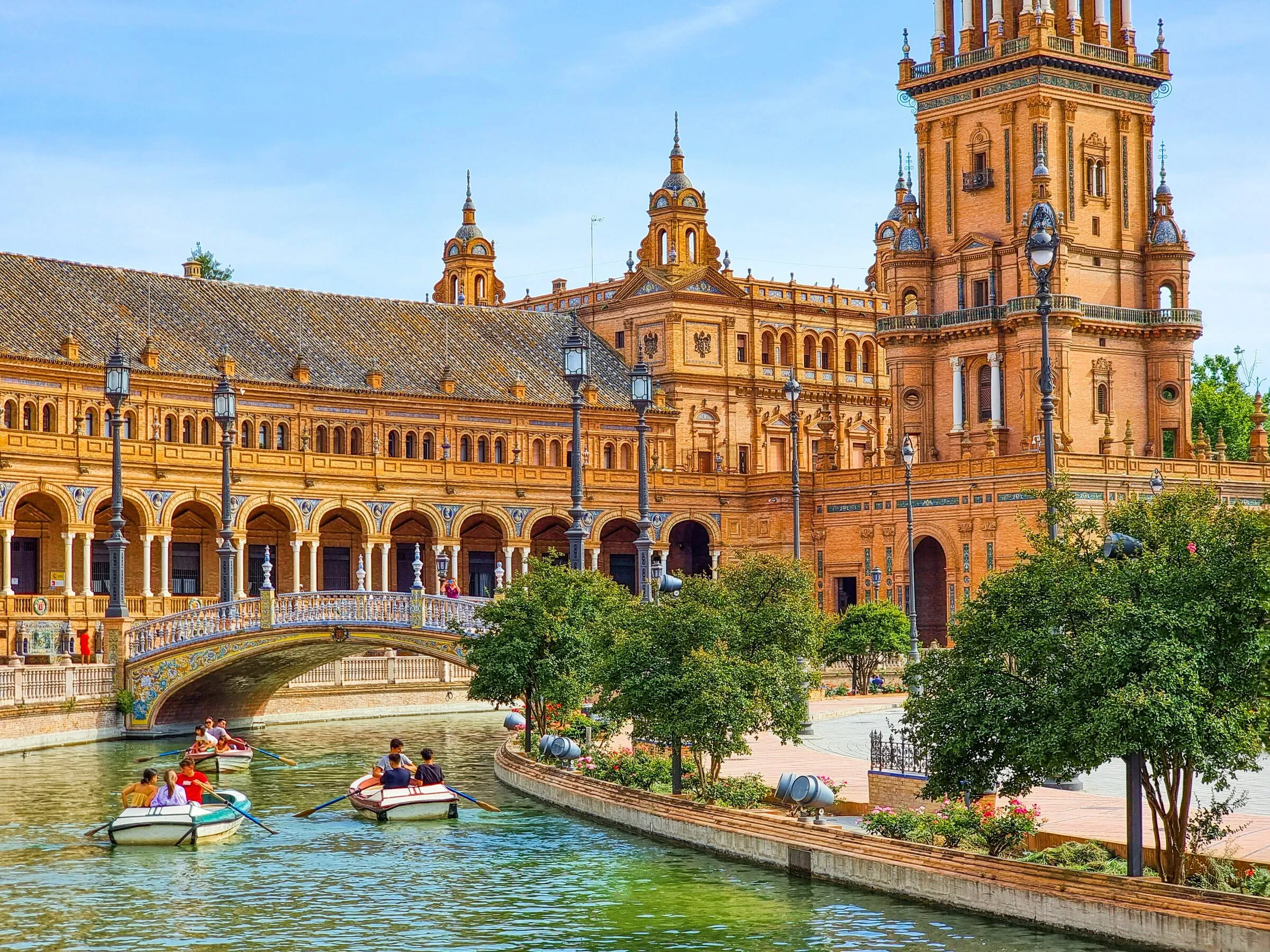
Seville is the Spanish city that most travelers don’t immediately think of, but when they arrive, they understand it was the right choice. It sits on the Guadalquivir River in Andalusia, which means it’s steeped in Islamic history (eight centuries of Al-Andalus rule), in Christian reconquest history (the Cathedral is built on the site of the former Great Mosque), in Spanish Golden Age history (Christopher Columbus sailed from here), and in centuries of Sephardic Jewish life — one of the deepest Jewish communities in medieval Iberia.
The Cathedral (built from the Mosque’s remains) holds the tomb of Columbus and is one of the great Gothic structures in Europe. The Alcázar Palace (a mixture of Islamic and Christian architecture, rebuilt and renovated by successive rulers) is extraordinary. The Barrio Santa Cruz (the historic Sephardic Jewish quarter, now a tourist-friendly maze of narrow lanes and white-washed buildings) is atmospheric and complicated — it preserves the geography of the Jewish community while serving primarily as a tourist neighborhood.
The Jewish heritage here is both deep and interrupted: Seville held one of Spain’s largest Jewish communities until the 1492 expulsion (or forced conversion) decree. After that, the converso (converted Jew) and Marrano (secret Jew) communities maintained hidden practice for centuries. The contemporary Jewish population is small, but the Sephardic history is deeply present.
Most clients come to me asking about Seville in three contexts: as part of a larger Iberian Spain sweep, as a stop on a broader Jewish Heritage journey, or as a standalone Andalusian experience.
Here’s how I think about it.
At a Glance
| Best time to visit | April–May and September–October. Spring is warm and the orange blossoms are in bloom. Autumn is clear and warm without the brutal summer heat. Avoid June–August — the heat is oppressive (95–110°F regularly) and the city is crowded. November–February is mild but rainy and some attractions have reduced hours. |
| How long to stay | Two–three days minimum for the city itself. Three–four days if adding Córdoba (1.5 hours away) or Granada (2.5 hours away). |
| How to get there | Seville Airport (SVQ) is 8 km east of the city — 20–30 minutes by bus or taxi. Direct flights from major European hubs and some U.S. gateways via Madrid or other European cities. By train: direct rail from Madrid (2.5 hours, modern and fast), from Barcelona (5.5 hours with possible connection), from Córdoba (45 minutes). |
| Currency / language | Euro. Spanish is official; English is widely spoken in tourist areas, less so in residential neighborhoods and older bars. Buenos días (hello) and gracias (thank you) are appreciated. |
| One thing most guides won’t tell you | The Barrio Santa Cruz is beautiful and very touristy — the actual contemporary neighborhood is just as worth exploring. The narrow lanes and white-washed streets are atmospheric, but the authentic Seville is in the neighborhoods beyond the tourist core. Spend time in both. |
Why I Send Travelers Here
Because Seville is one of the three great Andalusian cities (with Granada and Córdoba), each with distinct character — and because the Sephardic history is layered and significant.
Medieval Seville was one of Spain’s most important Jewish centers — the community included philosophers, poets, merchants, and scholars. The city was multicultural: Christian, Muslim, and Jewish communities coexisted, though with formal segregation. The Barrio Santa Cruz preserves the geography of the Jewish quarter (though few original buildings survive). After the 1492 expulsion, many Jews fled to Portugal; those who stayed became conversos (outwardly Christian, secretly practicing Judaism). The Inquisition operated in Seville with particular virulence, hunting conversos and suspected secret Jews. The contemporary city honors this history in museums and monuments, though less visible than in Lisbon or Amsterdam.
The broader Seville context: the Cathedral is among the greatest Gothic structures in the world. The Alcázar is a masterpiece of mixed Islamic and Christian architecture. The Plaza de España is a 1920s fantasy of Spanish grandeur. The flamenco culture is genuine and central to daily life (not performance art, but lived culture). The food scene (gazpacho, pescaito, espetos, jamón) is distinctly Andalusian.
I send travelers here as part of an Iberian sweep (Madrid →︎ Córdoba →︎ Seville →︎ Granada, the arc of Islamic and Christian Spain), as a Sephardic history stop on a broader Jewish Heritage journey, as a destination for travelers interested in Andalusian culture, and as a flamenco experience (if flamenco matters to you, Seville is the place).
Every recommendation below assumes you want to engage with all of these layers — history, architecture, food, culture.
Where I’d Anchor
Barrio Santa Cruz (the Jewish Quarter). The historic heart, walkable to the Cathedral, the Alcázar, and the major sites. Stay here for convenience and atmosphere.
Triana (across the river). The bohemian, flamenco-centered neighborhood west of the river — connected to the old city by three bridges (Puente de Isabel II is the iconic central crossing). This is where the working-class culture and flamenco tradition actually live, with the Mercado de Triana as the neighborhood hub, surrounded by tapas bars and restaurants. Better for a second visit or if you want to move beyond pure tourism.
Encarnación-Regina, La Macarena, El Arenal. Each neighborhood has distinct character — La Macarena (around the Alameda) is lively and local; Encarnación-Regina has its own energy; El Arenal (centered on the bullring) is storied and atmospheric. Walking beyond Santa Cruz into these neighborhoods shows the actual Seville.
For the historic-luxury flagship in Santa Cruz — Hotel Alfonso XIII (the name is the address: it’s one of Spain’s most famous hotels, 1929 opening, Neo-Mudéjar architecture, about 150 rooms, sitting directly across from the Cathedral) is the call. On my rate at the property, the amenity layer is meaningful and doesn’t book direct — calibrated to your dates and the suite category, deepened materially on the higher suite tiers. The specifics get walked through on the discovery call.
For the Santa Cruz boutique-luxe alternative — Hotel Casa 1800 Seville (24 rooms, housed in a restored 18th-century palace in the heart of Santa Cruz, intimate and elegant) offers the experience of staying in converted historic architecture. On my rate at the property, the amenity layer doesn’t book direct, and the specifics — calibrated to your dates and room category — get walked through on the discovery call.
For the Las Casas de la Judería alternative — (37 rooms, housed in three interconnected 18th-century palaces in the Barrio Santa Cruz, focusing thematically on the Jewish quarter’s history) puts you directly in the heritage narrative. On my rate at the property, the amenity layer doesn’t book direct, and the specifics — calibrated to your dates and room category — get walked through on the discovery call.
For the Triana contemporary alternative — SEVILLA Design Hotel (40 rooms, in Triana, contemporary design, closer to working-class flamenco culture) offers the neighborhood-living experience. On my rate at the property, the amenity layer is calibrated to your stay rather than itemized in advance, and we walk through it on the discovery call.
Want one of these stays? Start a discovery call — I’ll help you choose between Santa Cruz heritage (Alfonso XIII, Casa 1800, Las Casas) and Triana contemporary (Sevilla Design) based on what you’re after.
What I’d Do With Three Days
Day One — Cathedral, Alcázar, and Barrio Santa Cruz
Start at the Cathedral (Catedral Metropolitana) — one of the world’s greatest Gothic structures. Construction began in 1402 and the scale is extraordinary: the tallest altarpiece, the longest nave, and ornately carved exterior gates throughout. Built on the site of the former Great Mosque, the Giralda minaret (built 1184) survives and is now the cathedral bell tower — a stunning mixture of Islamic and Christian architecture. Inside, the Tomb of Christopher Columbus is one of the cathedral’s highlights; the DNA traces match bones of Columbus’s brother and confirm his remains are housed here. Climb the Giralda for the city views. Allow 1.5–2 hours.
Lunch in or near the Barrio Santa Cruz.
Afternoon: the Alcázar — a palace begun in the 14th century, mixing Islamic architecture with Christian re-styling across centuries. The gardens are alone worth the visit. Allow 1.5–2 hours. Then walk through the Barrio Santa Cruz — the narrow white-washed lanes that were the Jewish quarter. The geography is authentic; most buildings are not original. The experience is atmospheric and touristy at the same time.
Dinner in Santa Cruz or walking toward the river for a different neighborhood view.
Day Two — Plaza de España, Flamenco, and Evening Culture
Morning: Plaza de España — the 1920s fantasy architecture, semi-circular layout, tile-covered buildings. Sit and let the scale work on you. This is pure spectacle and worth experiencing on its own terms.
Lunch at a café on the plaza or nearby.
Afternoon: Museo de Bellas Artes (fine arts museum, strong Spanish collection) or Archivo de Indias (the archive of Spanish conquest and colonialism, housed in a beautiful 16th-century building) — depending on your interest.
Evening: Flamenco. Seville’s flamenco culture is live and real, not just performance for tourists. Go to a small tavern (peña) where locals gather for music and dance, or see a performance in a dedicated flamenco venue. The experience of watching flamenco in Seville is different from watching it elsewhere.
Day Three — Córdoba or Slower Seville
Option A: Córdoba Day-Trip. 45 minutes by train northeast, Córdoba is the third great Andalusian city — home to the Great Mosque (Mezquita), one of the world’s most extraordinary Islamic monuments (later converted to a cathedral but retaining its hypnotic interior with over 800 columns creating repeating arches). The city also has significant Jewish history and heritage sites. The Barrio Judío (Jewish Quarter) and the Synagogue of Córdoba are major sites. The city was a center of medieval Spanish learning — philosophers, scholars, and poets from all three faith traditions worked and lived here. A full-day excursion makes sense.
Option B: Slower Seville. Return to the Barrio Santa Cruz, walk lanes you missed, sit in plazas, eat well, experience the city at the pace it asks for. Visit a small museum you missed. Watch the light change on the Cathedral at different hours.
Option C: Triana deeper-dive. Walk the bohemian neighborhood across the river, visit the flamenco museums, eat in small taverns, experience the working-class Seville that the tourist core doesn’t show.
Specific Things I’d Tell You About
The Cathedral is one of the world’s greatest Gothic structures and deserves real time. It’s vast, and the architectural and artistic details reward slow looking. The Giralda (the Islamic minaret, now the bell tower) is one of the most distinctive structures in Spain. Climb it — the views and the experience of being inside the tower are extraordinary.
The Alcázar is a masterpiece of mixed Islamic and Christian architecture. Each ruler added, subtracted, and modified. The resulting palaces and gardens show the evolution of aesthetic preferences across centuries. Spend time in the gardens — they’re as important as the buildings.
Flamenco is live culture in Seville, not performance art. Yes, tourist flamenco venues exist. But the real experience is finding a small tavern (peña) where locals gather to play music and dance without an audience. The Seville flamenco scene is serious and worth engaging with if you’re interested in the form.
The Barrio Santa Cruz is touristy and atmospheric at the same time. The geometry of the narrow lanes preserves the medieval Jewish quarter layout. The white-washed buildings and tourist shops dominate now. But walking the same lanes where the community once lived — knowing the history while moving through the contemporary tourism — adds layers of meaning.
Seville’s food is distinctly Andalusian and excellent. Gazpacho (cold soup, essential in summer), pescaito (fried fish), espetos (grilled sardines, a beach food), jamón ibérico (air-cured ham) — these are the tastes of Andalusia. Eat them directly in small restaurants and bars, not in tourist-focused establishments.
What I’d Skip
Plastic flamenco performances for tourists in large venues. If flamenco matters to you, go to a small tavern where locals gather or find a genuine peña. The performance-art version is entertainment, not culture.
The heavily touristed tapas bars in the core of Santa Cruz with inflated prices. Walk one block away and the quality improves dramatically.
Driving anywhere in central Seville. The city is largely walkable (distances are substantial but manageable), the public transit is okay, and traffic is bad. Walk or take a taxi/metro.
For Travelers Following Jewish Heritage
Seville’s Jewish history is ancient and interrupted. The medieval community was one of Spain’s largest and most culturally significant. The 1492 expulsion (or forced conversion) ended formal Jewish life. The converso and Marrano communities that resulted maintained hidden practice for centuries, many eventually emigrating to the Ottoman Empire, the Netherlands, or the Americas.
The Barrio Santa Cruz preserves the geography of the medieval Jewish quarter. The Sephardic legacy is honored in museums and memorials, though less visibly than in Lisbon or other Sephardic diaspora cities.
The Casa de la Judería hotel thematically centers on the Jewish quarter’s history and is worth considering for that reason alone.
I’m developing a Jewish Heritage trip for 2026 — Seville is a secondary city (the focus is on Central and Eastern Europe), but the Sephardic Andalusian story is a future natural extension. Reach out if you’d like early-interest information.
For the longer thinking on how I work this thread — what makes it different from other heritage travel, what it earns, and what it doesn’t try to be — read the pillar essay: Jewish heritage travel.
For Iberia Multi-City Travelers
Seville is the Andalusian anchor of any Spain sweep. The standard arc is Madrid →︎ Córdoba →︎ Seville →︎ Granada (three nights each, all train-connected, all distinct character). This is one of the most rewarding European multi-city itineraries I design — Islamic architecture, Christian architecture, Jewish heritage, contemporary culture, flamenco, food, all mixed together.
The Seville →︎ Lisbon connection (direct flight, 1.5 hours, or train via Madrid if you want overland) creates a broader Iberian peninsula arc with both Sephardic Andalusian and Portuguese converso history.
For Slow Travelers
Seville rewards slowness. Stay four or five days rather than three. Walk without an itinerary. Sit in plazas. Eat well. Go to a flamenco bar at night. Experience the city’s pace and energy.
Plan Seville With Me
If you’re thinking about Seville as part of an Iberian Spain sweep, as a stop on a Sephardic history journey, as an Andalusian experience, or as a destination for flamenco and food — that’s exactly the kind of planning I do. A 30-minute discovery call is where it starts. No fee, no pressure. Just the city, your timeline, and what you actually want to experience when you’re standing in the Cathedral or walking the lanes of the Barrio Santa Cruz or listening to flamenco in a small tavern at night.
Book Your Free Discovery Call →︎
Last updated: April 2026. I keep this guide current. If a museum shifts hours, a restaurant changes hands, or Seville continues its transformation, the page changes. Seville changes. The work doesn’t stop when the page goes live.
Plan this trip with me.
A 30-minute discovery call is where it starts. No fee, no pressure.
Book a Discovery Call