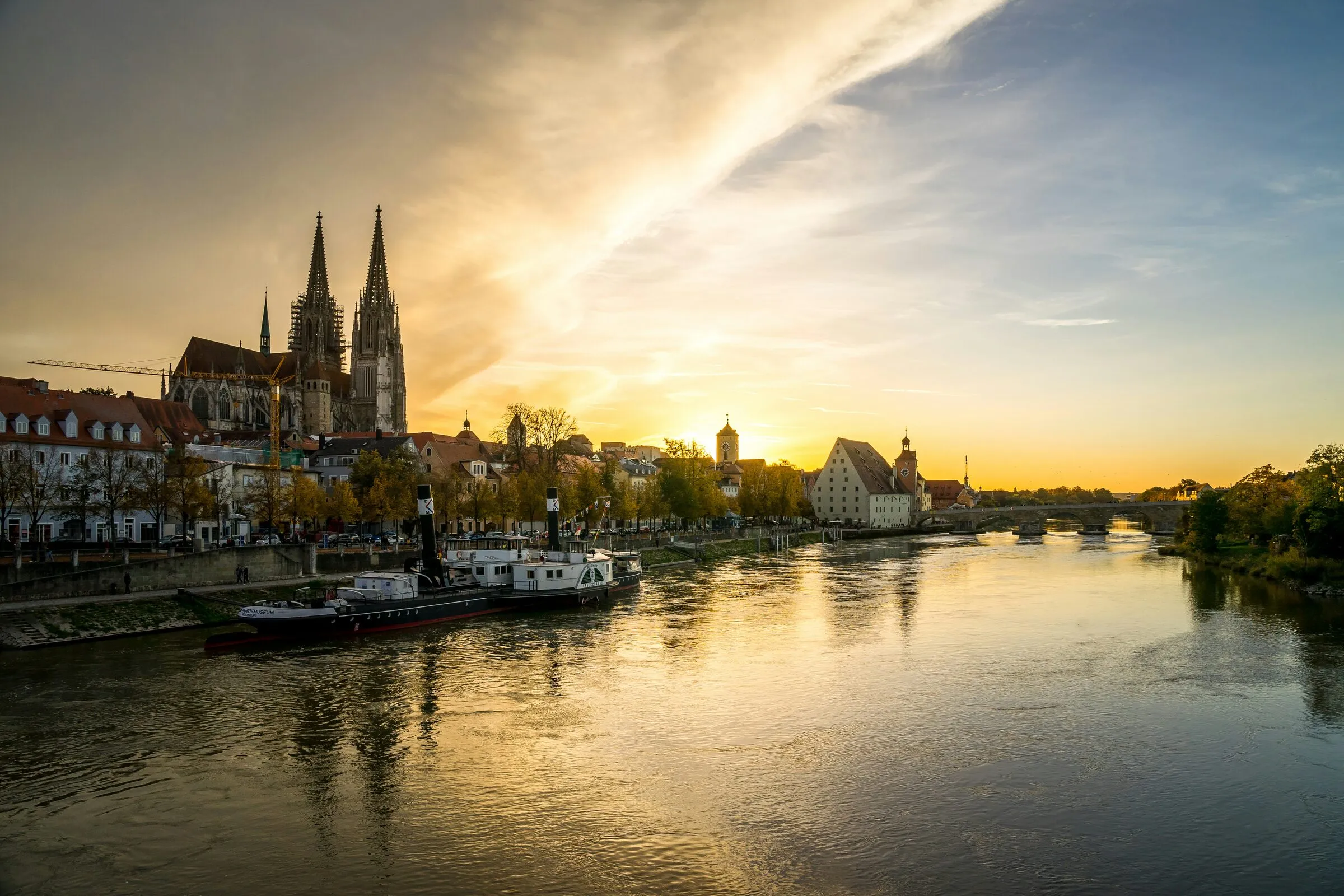
There is a particular quality to the Danube in the weeks before Christmas — the banks lit by market stalls, the lamplight softened by cold air, the ship moving through Slovakia in the dark with no sound except the river itself. I know this the way you know something after you’ve lived inside it for a week. I sailed the AmaReina Budapest to Nuremberg in November 2024, alone over Thanksgiving, because I wanted to put the year down for a minute and find out what river cruising actually felt like from the inside. The Danube is the one that converted me. It keeps converting people I send.
At a Glance
| Best season | Late November through December for Christmas markets; April–May for spring bloom; early September before peak crowds |
| Typical duration | 7 nights (cruise) + 2–3 nights pre-cruise Budapest or Prague + 1 night post-cruise Nuremberg/Munich |
| Classic routing | Budapest →︎ Bratislava →︎ Vienna →︎ Krems/Dürnstein →︎ Linz →︎ Passau →︎ Nuremberg (or reverse) |
| Operator I recommend | AmaWaterways — specifically for the balance of included excursions, stateroom quality, and the culinary program |
| One thing most guides won’t tell you | Bratislava gives you an hour on most itineraries. That’s enough to walk the old town, but not enough to find the wine bar in the courtyard behind St. Martin’s Cathedral. Ask for a later independent option. |
Why I Plan This River
The Danube runs through the center of Central Europe the way a spine runs through a body — everything either leans toward it or was built because of it. Budapest didn’t choose the riverbank by accident. Neither did Vienna. Neither did the medieval walled city of Regensburg or the fortified villages of the Wachau valley, where the vineyards stack up above the floodline because someone, centuries ago, understood exactly how high the water rises.
What I find compelling about the Danube as a planning assignment is that it rewards preparation. The river itself is the event — but the pre-cruise hotel in Budapest, the timing of the departure, the choice of excursion on the Austrian stretch, the one extra night in Vienna — those are the decisions that make the trip feel like it was designed for you specifically rather than for the full ship. I built mine that way. I build the ones I plan for clients the same way.
I’m in motion in this category — AmaWaterways sailings, supplier conferences, conversations with the people who build these itineraries. The Danube in December is what I’d recommend as a starting point for most first-time river cruisers. It almost never disappoints.
The Ship I’d Book
AmaWaterways — the AmaSonata, AmaViola, or AmaReina on this stretch, depending on season and cabin availability.
AmaWaterways earns its reputation on the Danube for a specific reason: the balance between included programming and space for independent movement. The bikes aboard are a genuine amenity — the Wachau valley is one of the better cycling stretches in Central Europe, and the ship times its port calls to let you ride alongside the river and meet the ship downstream. That’s not a feature on every line.
The culinary program is better than the category average. The included wines rotate by country of port — Austrian Grüner Veltliner in the Wachau, Slovak Welschriesling outside Bratislava, German Silvaner on the Franconian stretch near Nuremberg. It’s the kind of detail that sounds small until you’re drinking the right wine in the right place and it’s exactly right.
For Christmas market sailings specifically, the cabin I’d target is a French balcony stateroom — the fold-down railing gives you the market light and cold air without going up to the Sun Deck. The ambiance is worth the upgrade from an entry-level cabin.
The Ports
Budapest — Two nights here before you board, minimum. The river is the city’s organizing principle; walking from Pest to Buda across the Chain Bridge at dusk, with the Parliament building lit across the water, is one of the better free things available in any European city. The ruin bars of the Jewish Quarter deserve one evening. The thermal baths deserve one morning. Don’t rush the arrival.
Bratislava — The old town is compact and walkable and genuinely beautiful. The Slovak capital gets underestimated because it’s sandwiched between Budapest and Vienna on the itinerary; most passengers give it a quick loop and head back to the ship. Stay a beat longer. The St. Martin’s Cathedral neighborhood and the castle above the river are worth the extra hour.
Vienna — Plan for a full day here; most itineraries dock overnight. The Ringstrasse at dusk, the Naschmarkt on a slow morning, the Staatsoper if there’s a performance. Vienna closes earlier than you’d think — the city is not performing for you. The kaffeehäuser are open all day, though. Spend time in one.
Dürnstein / Wachau Valley — This is the stretch where the river does its best work. Terraced vineyards, ruined castles above limestone cliffs, apricot orchards that supply half of Austria’s dried-fruit market. The cycling option here is the one I’d take. The town of Dürnstein is small enough that the main street takes ten minutes to walk; the hill above the town takes twenty minutes to climb and gives you the view that ends up in everyone’s photos.
Passau — Three rivers converge here: the Danube, the Inn, and the Ilz. The Dom St. Stephan has the world’s largest cathedral pipe organ — five organs, nearly 18,000 pipes, played by a single organist. The old city is built on a narrow peninsula between the Danube and the Inn, which means you’re always close to water. It’s where the ship crosses from Austria into Germany; something shifts in the light.
Nuremberg — The Christmas market here is among the most celebrated in Germany and, for my money, the best. The Hauptmarkt fills with wooden stalls selling Lebkuchen and Bratwurst and mulled wine served in small ceramic mugs you keep as souvenirs. The Kaiserburg above the city, the medieval walls still intact, the restored old town — Nuremberg carries a complicated history with unusual grace.
Before You Board / After You Disembark
Budapest arrival (recommended: 2 nights pre-cruise): I have specific hotels I love for the pre-cruise Budapest stay — both options in the Pest center walkable to the riverbank and the Jewish Quarter, and one option on the Buda side for travelers who want the elevated view. The right property for your trip depends on what you want the first two days to feel like. That’s the conversation we’d have.
Post-cruise options: Most itineraries end in Nuremberg or Passau, with transfers to Munich. If the timing works, one night in Munich before flying home — or continuing to Prague — is worth building in. I’d send you to a specific neighborhood for the night, not the airport area.
The Extension
The Danube itinerary stands alone as a complete trip. But for travelers who want more of Central Europe, the natural extensions are:
Prague — Fly into Prague first, spend two nights, train or transfer to Budapest for the pre-cruise stay. Prague and Budapest together with the Danube connecting them is one of the more coherent Central European itineraries available.
Vienna — Some travelers want more Vienna than the overnight port call gives them. Flying home out of Vienna adds a night or two in the city after disembarking and feels like a proper send-off.
Salzburg — A side trip from Passau or a post-cruise stop on the way to Munich. Mozart and The Sound of Music country for travelers who want it; architecture and old city walks for everyone else.
What I’d Skip
The excursion buses. AmaWaterways includes excursions, and they’re well-run — but the included group bus option for a port like Vienna or Budapest is not the way to experience those cities. On a discovery call I’d walk through which excursions I’d book versus which I’d skip in favor of time on your own.
Over-programming the ship days. River cruise days at sea are short, and the temptation is to fill every port hour. Some of the best moments I had on the AmaReina were an hour in a deck chair watching Slovakia go past with a glass of Austrian white. Let the ship be the thing sometimes.
Rushing Dürnstein. Most passengers do a quick loop of the village and get back aboard. The cycling option through the valley alongside the ship is the experience you came for — take it.
Plan This River With Me
The Danube is the trip I’d recommend to almost anyone who’s curious about river cruising and hasn’t taken the leap. It converts. Thirty minutes on a call and I can tell you the timing, the cabin, the hotel, and the moments worth protecting.
Last updated: May 2026 · Guide reflects AmaWaterways fleet and itinerary availability as of this date. Routing, ports, and seasonal programming may vary.
Plan this trip with me.
A 30-minute discovery call is where it starts. No fee, no pressure.
Book a Discovery Call