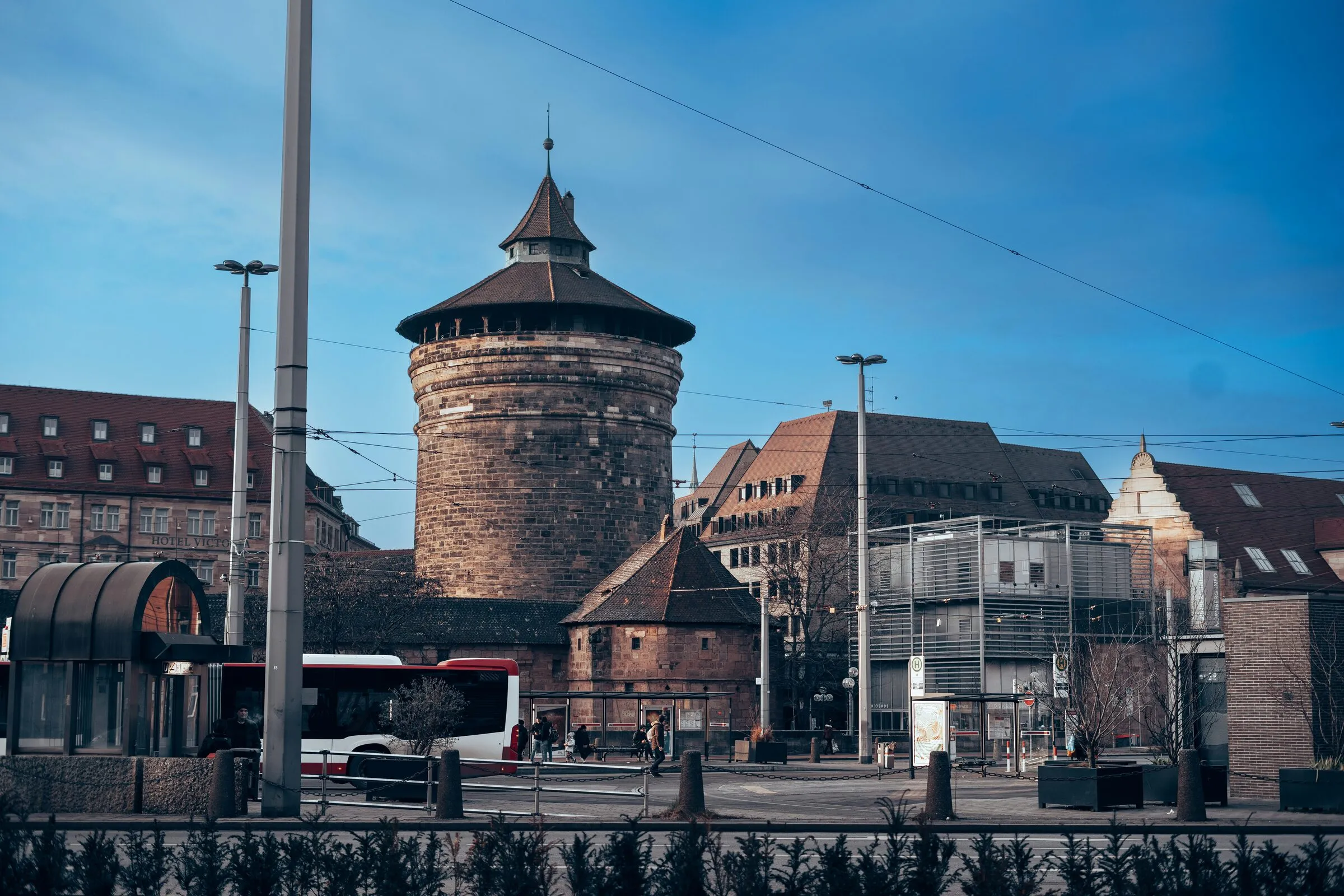
Nuremberg is the city most Danube cruisers don’t quite know what to do with. The cruise itinerary lands here as the western terminus — the AmaWaterways, Viking, Avalon, and Uniworld Danube sailings that started in Budapest end in Nuremberg, and the disembarkation day is structured around airport transfers more than the city itself. Travelers walk away with the impression that Nuremberg is the place where the cruise ends, rather than Nuremberg is a city. Both versions are true; the second is the one this guide is built around.
Done correctly, Nuremberg is Bavaria’s second-largest city and one of the most architecturally complete medieval Old Towns in Germany — the Altstadt (Old City) is a walled medieval quarter with the Pegnitz River running through it, the Imperial Castle (Kaiserburg) on the high ground, and a tangle of small streets, baroque churches, and gabled houses. The city was almost entirely destroyed in a January 1945 Allied bombing raid that flattened 90% of the medieval core; the post-war reconstruction was meticulous and the rebuilt Old Town now looks essentially indistinguishable from the pre-war original. Most travelers don’t realize until they read the small bronze plaques.
Nuremberg also carries one of the heaviest 20th-century histories of any European city. The Nazi Party Rally Grounds on the city’s southeastern edge were Hitler’s primary venue for the annual Party rallies (1933–1938), filmed by Leni Riefenstahl in Triumph of the Will and visible in newsreel footage from the period. The post-war Allied Nuremberg Trials were held in the same city — a deliberate choice, in the same Palace of Justice that survived the bombing. The contemporary Documentation Centre built on the unfinished Congress Hall of the Rally Grounds is one of the most rigorous museums on the rise of Nazi Germany anywhere in Europe. You don’t visit Nuremberg without the city handing you that history, and the city has done the work to hand it well.
Most clients arrive in Nuremberg as the disembarkation city of a Danube river cruise — typically a half-day in port before transfers to the airport for flights home, OR a 1–2 night extension before continuing to Prague or Munich. The standard half-day version gets the medieval Old Town walking tour, the Imperial Castle, and a sandwich lunch before the airport transfer. The version that earns the disembarkation week adds the Documentation Centre at the Rally Grounds and at minimum one extra night in the city.
Here’s how I think about it.
At a Glance
| How most travelers arrive | Danube river cruise — Nuremberg is the western terminus of nearly every Budapest-to-Nuremberg or reverse-direction Danube itinerary, with the cruise dock approximately 4 miles outside the city center (cruise lines provide shuttle buses to the Old Town). |
| How long in port | Most disembarkation days allocate 4–6 hours before airport transfers. A pre- or post-cruise overnight is highly recommended to absorb the city properly. |
| Best time to visit | May–September for the Old Town and the Imperial Castle. Late November through Christmas Eve is iconic — the Nuremberg Christkindlesmarkt in the Hauptmarkt is one of the most famous Christmas markets in the world (documented from the 1600s, possibly older), and the city’s medieval Old Town is essentially built for the lit market hour. |
| Currency / language | Euro. German is official; English is widely spoken in tourist-facing settings. Bavarian-Franconian dialect colors the local German. |
| One thing most guides won’t tell you | The cruise dock is not in the Old Town — it’s roughly 4 miles outside, in an industrial-zone Danube-Main canal port. The included shuttle takes you to the medieval core; if you skip the shuttle and walk, you’ve added an hour each way to a port day that can’t afford it. Take the shuttle. Use the saved time for the Old Town and (if you have it) the Documentation Centre. |
Why Travelers Stop Here
Because Nuremberg, planned correctly, is the most substantive Bavarian city on a Danube cruise itinerary — significantly larger and more architecturally complete than Regensburg or Passau, with a 20th-century history that requires its own dedicated half-day. The medieval Old Town is genuinely worth the walking; the Imperial Castle is one of the most dramatic Bavarian fortifications; the Documentation Centre on the Rally Grounds is one of Europe’s most thoughtful museums on the period it covers; the Christkindlesmarkt during Advent is one of the great Bavarian winter spectacles.
It’s also where Erik’s Danube journal post — the AmaReina trip — concluded, with the Christmas-markets afternoon at the Hauptmarkt as one of the lasting hours of the trip.
I send Danube cruisers here happily, and for travelers building a longer Bavarian or Central European arc, Nuremberg is the natural northern-Bavarian add-on between Munich (166 km south) and Prague (300 km east). The Munich-Nuremberg-Prague rail-and-road corridor is one of the easiest extensions to bolt onto a Danube cruise that ends here.
What I’d Do With Two Days
If you’re staying overnight in Nuremberg — the most-recommended shape for a Danube disembarkation — the two-day rhythm rewards a deeper pace than the standard half-day port can offer. You can have the medieval Old Town and the Documentation Centre, with time to absorb both without the sprint. Day one anchors the city center; day two deepens into the 20th-century history.
Day One — The Altstadt Walking Pace
Morning: shuttle from the cruise dock to the Old Town. Most ships’ included shuttles drop you near the Hauptmarkt (main market square) or the Lorenzkirche in the southern Old Town. Walk the medieval lanes unhurriedly — the buildings look 600 years old (because they’re meticulously rebuilt to look like buildings that were 600 years old), and the small shops, sausage stands, and gabled merchant houses settle in around you over an hour.
Late morning: the Hauptmarkt and the Frauenkirche. The Hauptmarkt is the central market square, anchored by the Schöner Brunnen (“Beautiful Fountain”) — the 62-foot Gothic-spire fountain from 1385, with a famous gold ring embedded in the wrought-iron fence. Turn the gold ring for good luck — this is the local tradition, and visitors do it. The Frauenkirche church on the Hauptmarkt’s east side has a 16th-century mechanical clock on its façade (the Männleinlaufen) that performs at noon daily — the seven Electors of the Holy Roman Empire bow to Emperor Charles IV. Be in the square at noon for the show.
Lunch in the Old Town. Nuremberg sausages (Nürnberger Rostbratwürste) are the local specialty — small, finger-thick grilled bratwurst, served three or six to a plate with sauerkraut and rye bread mustard. Bratwurst Röslein near the Frauenkirche is the heritage choice (since 1431); Bratwursthäusle bei St. Sebald near the Sebalduskirche is the local pick. Eat the sausages. They are different from any other German bratwurst, and they’re protected by EU geographic-indication regulation specifically to make sure they only come from here.
Early afternoon: the Imperial Castle. Walk uphill (or take a brief taxi if the legs are tired) to the Kaiserburg — the medieval Imperial Castle that crowns the Old Town. The Castle was the official residence of Holy Roman Emperors for two centuries; the Sinwellturm (Sinwell Tower) climb gives you the panoramic Old Town view. Allow 90 minutes for the basic loop. The view of the medieval city from the tower is the photograph most travelers remember longer than the Tower itself.
Optional late afternoon: the Albrecht Dürer House or a second coffee. The preserved 1420 home of the painter (1471–1528) where Dürer lived and worked from 1509 until his death is a 45-minute audio-guided experience in the painter’s own studio. Or simply return to one of the small Altstadt cafés and sit for a second coffee before dinner.
Dinner back in the Old Town. The Marktplatz restaurants (Bratwursthäusle, Sebald) are legitimate heritage venues, not tourist tax.
Day Two — The Documentation Centre and the Deeper City
Morning: a slower walk through the Altstadt. A second morning walk reveals details — the Jungfrauenadler coat of arms on the Schöner Brunnen and throughout the city, the medieval tower defenses visible if you look up, the small shopfront crafts and details that settle in only on the second day. Walk the Sebalduskirche neighborhood and the Lorenzkirche south-side corridor. Coffee at a neighborhood café, not in the tourist square.
Mid-morning to early afternoon: the Documentation Centre. Take the U-Bahn or a taxi to the Documentation Centre on the former Nazi Party Rally Grounds (about 15 minutes east of the Old Town). The permanent exhibition documents the rise of National Socialism, the Nuremberg rallies, and the post-war Trials in the same city. Allow at least two hours; this museum carries genuine emotional weight, and the exhibition is rigorous. No photography in most exhibits. Free audio guide in multiple languages. Plan a quiet afternoon afterward — the museum is not a checklist experience, it’s a historical reckoning, and the city’s commitment to that reckoning is part of why Nuremberg earns a deeper visit.
Late afternoon: the Christkindlesmarkt (seasonal) or the Neues Museum. If your visit falls between late November and Christmas Eve, the Nuremberg Christkindlesmarkt in the Hauptmarkt is one of the most famous Christmas markets in the world (running since the 1530s). The lit-up Old Town at dusk during Advent is one of Bavarian winter spectacles.
If you’re visiting outside Advent season, the Neues Museum on Klarissenplatz is the surprise most travelers miss — the State Museum for Art and Design with the major Bavarian collection of post-WWII modern art and contemporary design, in a 2000-built glass-and-steel building. Quiet, modern, almost no tourists, and a real alternative when the heavier museum has carried enough weight for the day.
Dinner in the Old Town. After a day with the Documentation Centre’s weight, a quiet dinner in a smaller Altstadt restaurant — somewhere on Sebalduskirche or in the quiet side lanes — feels right.
A note on pacing: Don’t try to do the Documentation Centre and the deep Old Town walking in a single tightly-compressed day. The museum alone is two hours, and the Old Town deserves at least two unhurried hours of walking. The two-day version lets you distribute the weight properly and actually absorb the city rather than rushing between experiences.
Specific Things I’d Tell You About
The Christkindlesmarkt is one of the most famous Christmas markets in the world. Documented from the 1600s, the Nuremberg Christmas market is one of the most famous in Germany. The market opens the Friday before Advent and runs through Christmas Eve; the city’s medieval Old Town is essentially designed for the lit-market evening hour, with the gabled houses, the Schöner Brunnen, and the Frauenkirche all illuminated. If your Danube cruise dates fall in Advent, plan one extra night here to be in the city for the market evening, not just the cruise day.
The Schöner Brunnen has a gold ring you turn for good luck. Genuinely. The wrought-iron fence around the 1385 Gothic-spire fountain has a single gold ring (well, gilded ring) integrated into the lattice. Turning it three times is the local custom for granting wishes. Tourists do it; locals do it; it’s one of those small ritual moments that the Old Town earns by virtue of having kept the same fountain in the same square for 640 years.
Look for the Jungfrauenadler — Nuremberg’s eight-hundred-year coat-of-arms curiosity. The city’s great seal features an imperial eagle with the standard wings, beak, claws, and lower body — but with a human female head, torso, and arms attached where the eagle’s neck would normally be. The figure has been on Nuremberg’s seal since at least the 13th century, and the lore around its origin is one of the great medieval-art-history accidents: heraldry historians believe medieval painters working from earlier portraits of a curly-haired Holy Roman Emperor misread the imperial curls as feminine hair, then reimagined the figure as half-woman half-eagle, and the misreading crystallized into the city’s official symbol for the next eight centuries. The Jungfrauenadler shows up on the Schöner Brunnen, on the Hauptmarkt buildings, on the city gates, in the Town Hall, and inside the Albrecht Dürer House. Once you spot it once, you start seeing it everywhere. A heraldic curiosity Nuremberg has lived with comfortably since before Germany existed as a country.
Nuremberg sausages are protected by EU law. Nürnberger Rostbratwürste are short, finger-thick grilled bratwurst that can only be called by that name if produced within Nuremberg city limits according to the medieval recipe. The protection is comparable to the Champagne-or-Prosecco regional designation. They are not just “small bratwurst”; they are a different sausage, and the difference is meaningful. Order three or six on a tin plate with sauerkraut.
Look up at the towers — the medieval defensive features are still there. Nuremberg’s medieval city walls are among the most intact in Germany, and the gate towers (the Tiergärtnertor and Königstor are the easiest to read up close) preserve two specific defensive details most travelers walk past without noticing. The Pechnasen — literally “pitch noses,” the openings angled out from the upper tower walls — are where defenders poured boiling pitch or hot oil down on attackers at the gate below. The long vertical slits running down the outer walls are archer ports, where bowmen stood and shot through narrow openings without exposing more than the tip of an arrow. Walk the section of wall between the Tiergärtnertor and the Castle to see both features in working order. Nine hundred years of medieval defense planning, visible if you remember to look up.
The Documentation Centre on the Nazi Party Rally Grounds is one of the most rigorous Holocaust-and-Nazi-history museums in Europe. Built into the unfinished Congress Hall that Albert Speer designed for Hitler (and which was never completed), the museum’s permanent exhibition Fascination and Terror covers the rise of the Nazi movement, the Rally Grounds’ role in propagating it, and the city’s post-war reckoning. Two hours minimum, free audio guide, no photography in most exhibits. This museum is the work the city has done to confront its own history, and it’s worth the time it takes.
The Albrecht Dürer House is one of the only Renaissance-painter house museums in Europe with a working studio reconstruction. Dürer lived and worked at Albrecht-Dürer-Strasse 39 from 1509 until his death in 1528; the house was bombed in WWII but rebuilt to original specifications. The studio on the upper floor is reconstructed with period printing presses, easels, and pigments — and on summer Saturdays, an actor in period dress demonstrates Dürer’s woodblock printing process.
The Neues Museum is the surprise most cruise visitors miss entirely. The State Museum for Art and Design sits on Klarissenplatz, between the Hauptbahnhof and the Königstor gate — literally on the route most cruise shuttles drop passengers, and almost nobody stops. The 2000-built glass-and-steel building (Volker Staab, architect) holds the major Bavarian collection of post-WWII modern art and contemporary design, and Sunday admission is roughly one euro — the long-standing Bavarian state-museum tradition that makes it one of the genuine bargains in central European art-going. Forty-five unhurried minutes inside on a Sunday port-day is the kind of stumbled-into hour that earns a trip on its own. Quiet, modern, almost no tourists, and a real alternative to the Documentation Centre when the heavier museum is more weight than the day can carry.
What I’d Skip
Walking from the cruise dock to the Old Town. It’s 4 miles each way through industrial canal areas. Take the included shuttle the cruise line provides; the saved hours are worth the morning’s planning.
Trying to do the Documentation Centre and the deep Old Town walking in a single 5-hour port day. The Documentation Centre alone is two hours, and the Old Town deserves at least two unhurried hours of walking. Pick one if you only have a half-day; add an overnight if you want both.
Restaurants on the Hauptmarkt with multilingual menus and pushy hosts. Same tourist-tax pattern as every European city in this library. The good Nuremberg sausage spots — Bratwurst Röslein, Bratwursthäusle bei St. Sebald, Goldenes Posthorn — don’t need to advertise; they’re heritage destinations and they’re crowded for the right reasons.
The Toy Museum unless you have children with you or a specific interest. Nuremberg has been a center of European toy manufacturing for centuries (it’s where the modern Christmas-market toy tradition comes from), and the Toy Museum is genuinely good — but with limited time on a port day, the Castle and the Documentation Centre have stronger claims.
For Travelers With an Overnight or Pre/Post Cruise Stop
If you’re staying — and I’d argue most travelers should — Nuremberg is well-served by hotels in the Old Town, though none are in the partner program. Le Meridien Grand Hotel Nuremberg at the train station is the Marriott-tier convenient choice; Hotel Drei Raben in the Old Town is a heritage boutique. For travelers who want a Grand Hotel base for the broader Bavarian region, anchor in Munich and day-trip to Nuremberg via direct ICE rail (1h05m) — same approach I use for Lucerne from Bern.
The deeper conversation about Danube cruise extensions — and whether a Nuremberg-Prague continuation fits your trip — lives on the Rivers & Small Ships specialty page. The most common cruise-extension routings out of a Nuremberg disembarkation are: Nuremberg →︎ Prague (3.5h direct bus or rail), Nuremberg →︎ Munich (1h ICE rail), or both as a longer post-cruise Bavarian-Czech week.
Plan Your Danube With Me
If you’re thinking about a Danube river cruise that ends in Nuremberg, a Nuremberg overnight pre- or post-cruise, or the Munich-Nuremberg-Prague Bavarian-Czech extension, that’s exactly the kind of planning I do. A 30-minute discovery call is where it starts. No fee, no pressure. Just the river, your timeline, and the version of the Bavarian terminus most cruise itineraries don’t allow you to fully see.
Book Your Free Discovery Call →︎
Last updated: April 2026. I keep this guide current. If access to a site shifts or a cruise-line itinerary changes, the page changes. Travel changes. The work doesn’t stop when the page goes live.
Plan this trip with me.
A 30-minute discovery call is where it starts. No fee, no pressure.
Book a Discovery Call