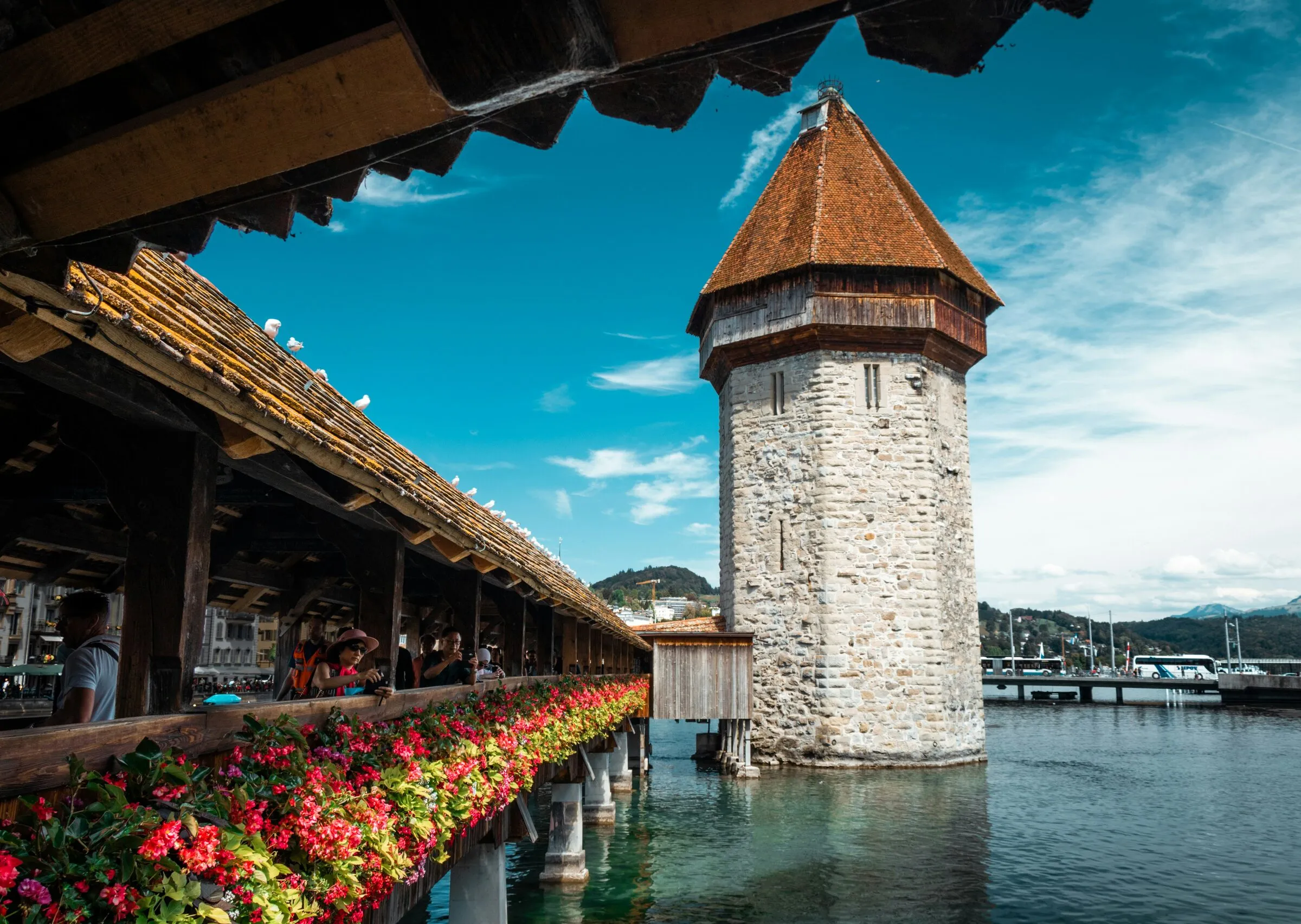
Lucerne is the city most travelers pin as the centerpiece of their Switzerland trip, and that’s the framing I’d push back on first. Lucerne is one of the most photogenic small cities in Europe — the Kapellbrücke covered bridge with its painted ceiling panels, the medieval Museggmauer wall and its nine remaining towers, the Lion Monument carved into a cliff face, the lake itself with the Bernese Alps to the south — and a single full day there delivers most of what travelers are flying for. The mistake isn’t visiting Lucerne. The mistake is treating Lucerne as a base instead of as the highlight day-trip it deserves to be.
This is the one city in this destination library where I’ll tell you something most other guides won’t: for most multi-city Switzerland trips, the better base is Bern. Bern is forty minutes to Interlaken, an hour to Lucerne, an hour to Zurich, an hour to Lake Geneva, and an hour to Basel — it sits in the middle of the country with the entire alpine network as its day-trip orbit. Lucerne is at the eastern end of that network and harder to use as a hub. More on that strategy in the Multi-City Switzerland section below.
That said: if Lucerne is your single Switzerland city, or if Lake Lucerne and the Bürgenstock heights are the point of the trip, this guide is built for that visit. Most clients come to me asking about Lucerne in three contexts: as a single Swiss-isle stop on a broader European itinerary (one or two nights, the iconic photo, Mount Pilatus or Rigi for the alpine view), as a Lake-Lucerne resort honeymoon (Bürgenstock or one of the smaller lakeside hotels, three or four nights), or as a day trip from a Bern base during a multi-city Swiss week.
Here’s how I think about it.
At a Glance
| Best time to visit | Late May–early July and September. Long days, lake-and-mountain weather, the wildflowers up at the alpine excursions are the best version of themselves. Avoid mid-July through August — cruise-bus surge plus high prices. December has the Lucerne Christmas market along the lake, with the Alps as backdrop, and the lit Kapellbrücke at night is genuinely magic if you can take the cold. |
| How long to stay | One full day is enough to see Lucerne’s Old Town and key sights. Two nights is the right length if you’re combining with Mount Pilatus or Rigi. Three-plus if you’re basing at Bürgenstock for a lake-resort honeymoon. |
| How to get there | Zurich Airport (ZRH) is the closest international gateway, 1 hour by direct train; trains run every 30 minutes. From Bern — 1 hour by train. From Geneva — 3 hours. From Milan — 3 hours by train (the Gotthard Pass route is one of the great train rides in Europe). |
| Currency / language | Swiss Franc (CHF). German-language region; English is widely spoken in tourist-facing settings. Grüezi is the Swiss-German hello — a very Swiss-specific greeting that earns immediate small smiles from locals because tourists rarely use it. |
| One thing most guides won’t tell you | Switzerland is expensive. Restaurant entrées routinely run CHF 35–60 (USD 40–70). The Swiss budget for restaurants is materially higher than the Italian, French, or German budget. Plan accordingly — and don’t flinch at the bill. |
Why I Send Travelers Here
Because Lucerne, planned correctly, is one of the most efficient single-day delivery experiences in central Europe. The medieval Old Town, the painted bridge, the Renaissance squares with frescoed facades, the Lion Monument, the lake views at the Schweizerhof embankment, and the cable-car-up-Mount-Pilatus excursion that delivers the Bernese-Alps view for a single afternoon’s effort — the photo-album-of-Switzerland is largely shot in and around Lucerne, and a one-or-two-night visit captures most of it.
It’s also one of the cities on Rachel’s European sabbatical, and it pairs naturally with the alpine-Bavaria arc that runs through Munich — Munich →︎ Lucerne →︎ Zurich is a classic central-European train sweep that rewards a measured pace.
I send travelers here as the alpine-Switzerland highlight day of a broader trip — the Lake Lucerne lake cruise, the cable car up Pilatus or Rigi, the Old Town walk, dinner with the lake at sunset. I send couples for Bürgenstock-base honeymoons when the lake-and-mountain resort experience is the trip, not a stop on it. And I send some clients here for a one-night drop-in as part of a multi-city week that’s anchored elsewhere — most often Bern, as discussed below.
Every recommendation below comes through the lens of how I plan Lucerne for the clients I send, the hotel relationships I rely on in Lucerne-area, and a clear point of view about which version of the lake-and-mountain experience earns your time and which version is built for tour buses.
Where I’d Anchor
Two distinct anchoring patterns cover almost any traveler’s Lucerne trip:
The Old Town (Altstadt), in the city itself. Walking distance to the Kapellbrücke, the Spreuerbrücke, the painted-facade squares (Weinmarkt, Hirschenplatz, Kornmarkt), the Lion Monument, and the lake embankment. Stay here if Lucerne is a one-or-two-night city stop and your time is best spent in the medieval core.
Bürgenstock Heights, on the cliff above Lake Lucerne. A 1,800-foot rise across the lake from Lucerne, reached by lake ferry plus the historic Bürgenstock Funicular (Switzerland’s first electric railway, restored). Stay here for a lake-and-mountain resort honeymoon or anniversary week — this isn’t a base for sightseeing Lucerne, it’s a destination unto itself, and most guests never feel the need to come down to the city at all.
For the Old Town in-city pick, Mandarin Oriental Palace, Luzern at Haldenstrasse 10 is the call. The property sits on the lake embankment, a stone’s throw from the medieval Old Town and the Kapellbrücke, with views of the Bernese Alps from the city’s most spacious suites. Executive Chef Gilad Peled runs the restaurant program — modern French at Colonnade, the lively MOzern Bar & Brasserie, the eight-seat Japanese Minamo, and Mediterranean at Quai 10. On my rate at the property, the amenity layer doesn’t book direct, applicable broadly across MOzern, Quai 10, and Colonnade. The specifics — calibrated to your dates and the suite category — get walked through on the discovery call.
For the Bürgenstock cliff-resort experience, Bürgenstock Hotel & Alpine Spa at Bürgenstock 17 is the alternative anchor. The 140-acre integrated resort has been a legend since 1873 — Audrey Hepburn was married here, Charlie Chaplin lived nearby and stayed regularly, Sophia Loren and Carlo Ponti made it their home for years. The newly-built central hotel opened September 2017 and sits at the heart of the resort: ten restaurants and bars, a 110,000-square-foot Alpine Spa with views over the lake, hiking trails, a nine-hole golf course. Arrivals can come up by limousine or — far more memorably — by a shuttle boat from Lucerne to the base of the cliff, then up the Bürgenstock Funicular (Europe’s highest outdoor elevator runs from the same property) for the first scenic view of one of the most spectacular mountain-and-lake panoramas in Europe. On my rate at the property, the amenity layer is calibrated to your stay rather than itemized in advance — what applies depends on dates and the room category, and we walk through it on the discovery call.
Want one of these stays? Start a discovery call — I’ll pull live availability, walk through suite categories, and confirm which amenities apply to your dates.
What I’d Do With a Day or Two
The one-day version is the realistic Lucerne pass-through for most multi-city Switzerland travelers; the two-day version deepens to include an alpine excursion or a slower lake rhythm. This timing works best as part of a Bern-based itinerary — one night in Lucerne, day-trip out from Bern (1 hour by train), return for dinner.
Day One — The Old Town Meditative Pace
Arrive on an early-morning train (if day-tripping from Bern, depart Bern at 8 a.m., arrive Lucerne by 9 a.m.). Avoid the cruise-ship surge by starting at the Spreuerbrücke (the second covered bridge, fewer tourists, the Dance of Death ceiling panels are the greater artistic work than the more-famous Kapellbrücke).
Walk slowly — this isn’t a photo-grab-and-move structure. The Spreuerbrücke’s 67 medieval paintings (1626–1635) depict Death meeting people from every social rank: the knight, the peasant, the priest, the king. Look at each one. The artistic program took decades to complete; the visit deserves at least 30 unhurried minutes.
Cross back into the Altstadt proper. Walk the painted-facade squares — Weinmarkt, Hirschenplatz, Kornmarkt — and the small galleries and shops that don’t exist in any other Swiss city. Lunch at Ristorante Galliker (classic Swiss-Italian, the local choice, less crowded than the Kapellbrücke-side cafés) or at a café overlooking the Reuss River.
Afternoon: Kapellbrücke itself — now that you’ve done the Spreuerbrücke properly, the Kapellbrücke’s more-famous painted panels (mostly 17th-century originals, some reconstructions from the 1993 fire) land differently. Walk it slowly. Note the Wasserturm water tower at the midpoint — the octagonal structure that’s been there since 1386. Walk all the way across; most tourists photograph from the center and leave. Walk the full crossing.
Optional: the Sammlung Rosengart (a 20-minute walk from the Kapellbrücke, a quietly remarkable private collection of major Picasso, Klee, Cézanne, Matisse pieces — almost never crowded, the kind of hour you think about later).
Late afternoon: the Lion Monument — Mark Twain’s “most mournful and moving piece of stone in the world.” Walk to it from the Old Town (it’s north of the center, carved into a cliff face to honor the Swiss Guards killed at the Tuileries in 1792). The solemnity of the piece — the pierced lion, the broken shield, the small formal park surrounding it — hits harder than the photo prepares you for. Sit on the bench for five minutes. This isn’t a quick stop.
Walk back via the Museggmauer (the medieval wall with its nine surviving towers). The Zytturm tower has a 1535 clock; the view from the wall back down into the Old Town is the gentle version of the alpine vista you’re not doing today.
Sunset at the Schweizerhof embankment — a glass of wine (Riesling from the Valais, Chasselas from Lake Geneva, or a local lager), the light hitting the Bernese Alps across the water, and the version of Lucerne that earns the trip: quiet, architectural, genuinely Swiss rather than cruise-ship-processed.
Dinner at Stern Lucerne in the Old Town (elevated Swiss cooking in a historic setting) or back to your hotel for a more casual evening. If staying overnight, late-evening walk around the lit Old Town — the bridges lit, the water still, the city yours alone.
Day Two — Mount Pilatus, Rigi, Schilthorn, or the Lake Cruise
Three alpine-excursion options, ranked by my preference for a second day without time pressure:
Mount Pilatus (the most dramatic but busiest). Take a morning ferry from Lucerne docks to Alpnachstad (30 minutes, scenic, part of the experience). Climb the cogwheel railway up the Pilatus grade (originally built 1889 to haul supplies — now a heritage ride with dramatic 48% gradients). Lunch at the summit restaurant (simple but with the view). Descend by cable car through Fräkmüntegg and Kriens back into Lucerne by early afternoon. The full circuit is 5–6 hours; the summit is often crowded by midday. Best for travelers who want the high-alpine experience and don’t mind crowds.
Mount Rigi (the quieter alternative). Ferry from Lucerne east to Vitznau (90 minutes, the scenic route along the lake shoreline with villages and vineyards visible). Cogwheel railway up Rigi (Europe’s first mountain railway, 1871 — historic and less packed than Pilatus). Lunch at the summit, descent by cable car, ferry back to Lucerne. Less crowded than Pilatus, roughly the same timing, similar views. My pick for travelers who want the alpine experience without the midday tour-bus surge.
Schilthorn via Interlaken (the most remote but requires a longer commitment). Train from Lucerne to Interlaken (1 hour), cable cars up through the Lauterbrunnen valley to Schilthorn (9,744 feet, the On Her Majesty’s Secret Service Piz Gloria location). Summit panorama includes the Eiger, Mönch, and Jungfrau in a single 360-degree view. The rotating restaurant still operates. The journey is long (3 hours each way by train and cable car) but the crowds are materially lighter than Pilatus, and the mountain feels genuinely remote. Best for travelers with a full second day and a craving for alpine solitude.
A Lake Lucerne paddle steamer (the no-alpine-exertion alternative). If the weather is poor, clouds are low, or alpine climbing appeals less than water-based scenery: five historic paddle steamers run scheduled routes. The Lucerne-to-Flüelen cruise (3 hours each way at lazy pace, returning by midday) is the canonical route — the Bürgenstock cliffs rising on one side, the Rigi on the other, the narrowing fjord as you approach Flüelen at the southern end (the starting point of the Gotthard rail-and-road route into Italy). Add Mount Rigi as a half-day: ferry to Vitznau, cogwheel up Rigi, cogwheel down to Goldau, ferry back to Lucerne. Still water-and-mountain, less exertion, genuinely enough for a second day.
The right call on Day Two: If weather is clear and you have the energy, pick Pilatus or Rigi and commit to it fully — allow the morning transit, the lunch-hour summit pause, the afternoon descent. Don’t rush it. If weather is poor or crowds deter you, the lake paddle steamer is the underrated Lucerne experience most travelers skip, and it’s genuinely worth the half-day rhythm.
Specific Things I’d Tell You About
The Spreuerbrücke is the better-painted bridge of the two. The Kapellbrücke gets the photo because it’s longer, older, and has the iconic water tower at the midpoint — but the Dance of Death ceiling panels in the Spreuerbrücke (67 paintings depicting Death meeting people from every social rank, painted between 1626 and 1635) are one of the most complete medieval artistic programs in Switzerland. Most travelers walk the Kapellbrücke and never cross to the Spreuerbrücke. Both. Cross both.
The Sammlung Rosengart is the under-the-radar art-museum hour. Picasso met Angela Rosengart when she was a child; he later painted her portrait. Her family’s gallery in Lucerne became the Sammlung Rosengart, and the collection includes major Picasso and Klee pieces alongside Cézanne, Chagall, Matisse, and Monet. Most Lucerne tourists skip it for the lake. The collection is twenty minutes from the Kapellbrücke and a quiet hour you’ll think about later.
The Lion Monument is the only sculpture Mark Twain bothered to write about at length. “The most mournful and moving piece of stone in the world.” The dying lion — pierced by a spear, head bowed on a broken shield — was carved into the cliff face in 1820–21 to honor the Swiss Guards killed at the Tuileries Palace defending Louis XVI in 1792. It’s a five-minute walk north of the Old Town. Free. The kind of thing that hits harder than the photo prepared you for.
The Lake Lucerne paddle steamers are the way to see the lake. Five steamships, all operational, all running scheduled routes through the season. The cruise from Lucerne to Flüelen — three hours each way at a leisurely pace, with the cliffs of the Bürgenstock and the Rigi rising on either side — is the alpine-Switzerland version that ends up in most clients’ photos a year later.
Mount Pilatus has a legend, and the legend is part of the reason to climb it. The mountain takes its name from Pontius Pilate — local folklore claims he was buried here, and his ghost was said to make storms over the lake whenever travelers disturbed his rest. The legend is preserved at the summit. Climb the cogwheel railway and think about Pilate’s ghost; both are part of the experience.
What I’d Skip
Restaurants with multilingual menus on the Reuss embankment. Same tourist-tax pattern as every other city in this library. Walk three blocks deeper into the Old Town instead.
The Glacier Garden (Gletschergarten) and the Bourbaki Panorama unless you have specific interest. Both are valid attractions, both cost money, both eat 90 minutes you could spend walking the lakeshore or the medieval wall instead. If your time in Lucerne is one day, neither makes the cut.
Mount Pilatus as a 3 p.m. arrival. The summit weather closes in faster than you’d expect, and the late-afternoon cogwheel return runs are crowded. Take the morning route up — leave Lucerne by 9 a.m., be at the summit by 11.
The William Tell Express train + cruise package as a same-day return. It’s a long day with multiple transfers, and the package version doesn’t allow much flexibility. If you want the Gotthard Panorama Express (the Lucerne-to-Lugano scenic train), do it as a one-way day with an overnight in Lugano — not as a same-day round trip.
Renting a car if you’re sticking to Lucerne. The Old Town is pedestrian. The lake excursions are by boat. The mountain excursions are by rail. The Swiss Travel Pass (or the Saver Day Pass) covers all of it cheaper than a rental car would, and parking in Lucerne is its own punishment.
For Multi-City Switzerland Travelers
This is the section that contradicts most other Lucerne guides on the internet, and I’ll tell you why. For multi-city Switzerland trips of five days or more, I usually base clients in Bern and visit Lucerne for the day. Here’s the math:
Bern is the Swiss federal capital, a UNESCO World Heritage Old Town in its own right (more architecturally cohesive than Lucerne’s, and far less crowded), and geographically central. From Bern: 40 minutes to Interlaken, 1 hour to Lucerne, 1 hour to Zurich, 1 hour to Basel, 1 hour to Lake Geneva. Switzerland’s high-speed rail is so efficient that day-tripping out of Bern is genuinely faster than relocating hotels every two nights — you skip the packing, you skip the check-in line, you anchor at one excellent property and let the country come to you.
The Bern anchor I’d use is Bellevue Palace, on Kochergasse 3-5 in the center. It’s the official guesthouse of the Swiss Confederation — the Swiss government books visiting heads of state into the same property — and the only Grand Hotel in Bern’s UNESCO World Heritage zone. The Bellevue Bar features in John le Carré’s spy novels (genuinely, not a marketing line). The Brasserie Vue terrace looks out over the river Aare and the Bernese Alps. On my rate at the property, the amenity layer doesn’t book direct, and the specifics — calibrated to your dates and the room category — get walked through on the discovery call.
This is an unapologetically expensive choice — Switzerland is already an expensive country, and a Grand Hotel in the UNESCO Old Town of the federal capital sits at the top of that ladder. The budget math of trying to plan a multi-city Swiss trip with anything less than the right base usually breaks anyway: what you save in hotel rate you spend back in transfer time, daily packing, and the friction of moving every second night. For travelers with the budget to plan Switzerland the way the country earns to be planned, Bellevue Palace is the answer that makes the rest of the math work.
The day-trip pattern from Bern: morning train to Lucerne (1 hour), Old Town walk and lake stroll, lunch by the Reuss, optional Mount Pilatus afternoon, return train to Bern in time for dinner at the hotel. Same pattern works for Interlaken (40 minutes — easier than from Lucerne), Zurich (1 hour), or Lake Geneva. You see more of Switzerland this way than you do staying in any one of these cities.
When shouldn’t you base in Bern? Two cases. First, if your trip is only Lucerne and the Bürgenstock heights — three or four lake-resort nights, no other cities — base on the lake itself. Second, if your trip is Switzerland-as-honeymoon-only (the photo-album version) — Lucerne is where the photo is. Otherwise, my answer is almost always: base in Bern. Day-trip out. A full Bern guide is forthcoming on this site.
For Honeymooners
Lake Lucerne is a quietly excellent honeymoon answer — less crowded than Lake Como, more dramatic than Lake Geneva, and with the alpine-and-water combination that delivers the romantic version of Switzerland in fewer days than most travelers plan for. The classic honeymoon arc: three nights at Bürgenstock above the lake, two nights in Lucerne in the Old Town for the city days, optional add-on two nights in Bern with day trips to Interlaken or the Jungfrau.
The honeymoon dinner, in my read, is at Bürgenstock’s Spices restaurant or one of the smaller lake-edge restaurants in Lucerne — followed by the cliff-side walk back at dusk with the lake silver below. The view does the work; the planning just gets you there.
If you want me to design the full Switzerland honeymoon, or to combine Switzerland with Italy, Munich, or Vienna for a longer European honeymoon — that’s exactly the kind of planning I do. Start a discovery call.
Plan Lucerne With Me
If you’re thinking about Lucerne as a single Swiss-isle stop, as a Bürgenstock honeymoon, or — more often than most travelers expect — as a day trip from a Bern base — that’s exactly the kind of planning I do. A 30-minute discovery call is where it starts. No fee, no pressure. Just the lake, your timeline, and a clear answer to the question most Switzerland visitors get backwards: where to actually base.
Book Your Free Discovery Call →︎
Last updated: April 2026. I keep this guide current. If a hotel I recommend slips, a restaurant changes hands, or access to a site shifts, the page changes. Travel changes. The work doesn’t stop when the page goes live.
Plan this trip with me.
A 30-minute discovery call is where it starts. No fee, no pressure.
Book a Discovery Call