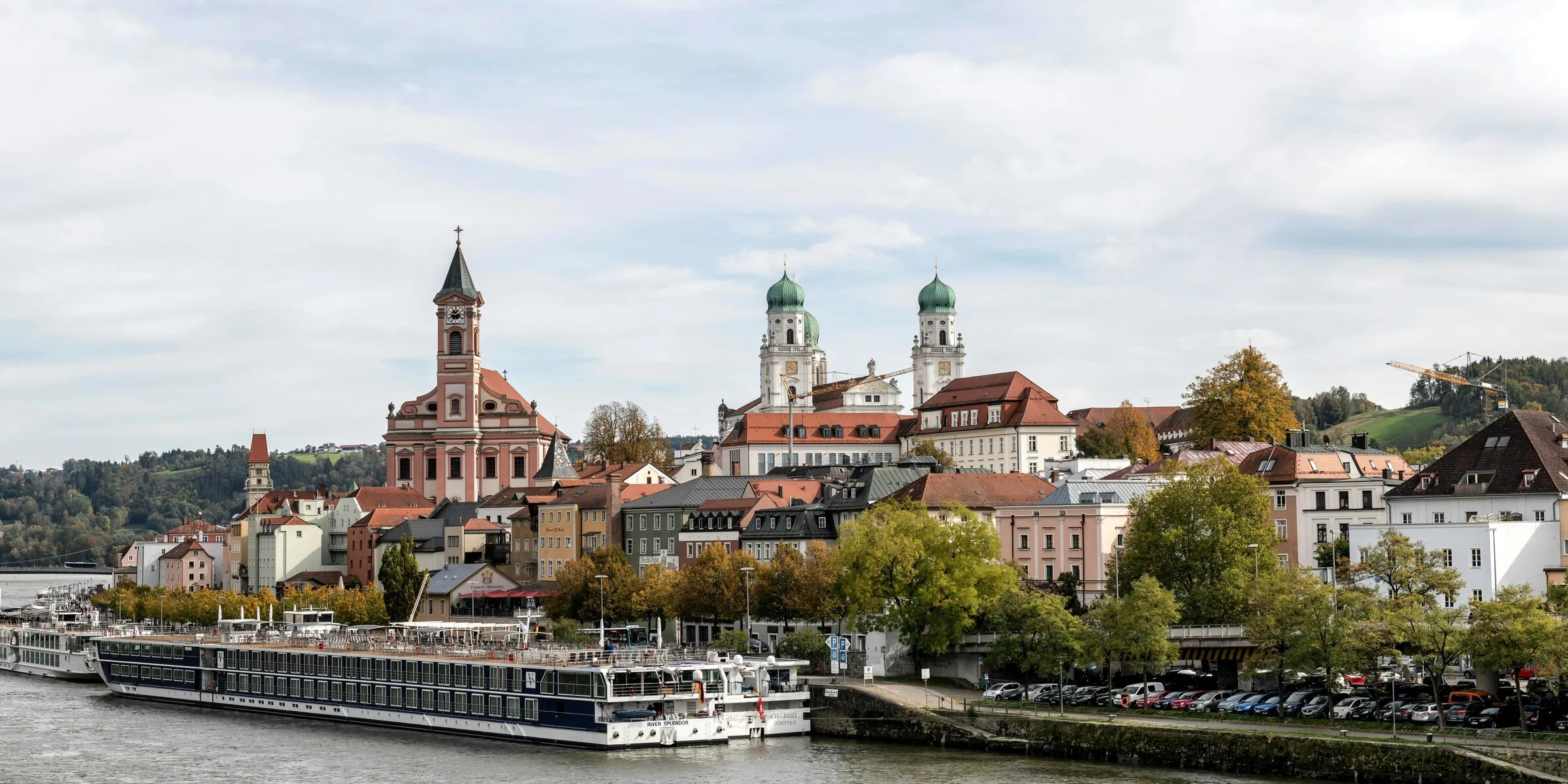
Passau is the Danube port-of-call most clients arrive at expecting little and leave talking about. Tucked into the Bavarian-Austrian border at the exact point where three rivers — the Danube, the Inn, and the Ilz — meet, the town has a confluence-geography that is genuinely uncommon (you can stand at the Ortspitze, the city’s eastern tip, and watch three different colors of water flow into a single river). Add a baroque Old Town that survived enough of WWII to feel old, an Italian-influenced architectural character that traces to the 13th-century Episcopal princes who ruled the city, and the largest cathedral pipe organ in the world — five organs, 17,974 pipes, played by one organist — and Passau earns far more than the half-day most cruise itineraries give it.
Most clients arrive here on a Danube river cruise — Passau is the standard turnaround city for itineraries that loop between Nuremberg and Budapest, and a frequent included port on east-to-west sailings. The standard port-day routine: ships dock at the central waterfront, walk into the Old Town through the Rathausplatz main square, visit St. Stephen’s Cathedral (ideally at noon for the daily organ concert in summer), walk to the Ortspitze for the three-rivers view, optionally climb to Veste Oberhaus castle for the panorama, back to the ship for dinner. Done well, that’s a five-hour port-day that consistently outperforms expectations.
Here’s how I think about it.
At a Glance
| How most travelers arrive | Danube river cruise — Passau is a standard port on virtually every Danube itinerary, and the turnaround city for most Nuremberg-Budapest loops. |
| How long in port | 5–8 hours, often a full daylight stretch. Some itineraries include an overnight. |
| Best time to visit | May–September for the noon St. Stephen’s Cathedral organ concerts (daily except Sunday). The shoulder season is more comfortable than mid-summer. December has the Passau Christkindlmarkt along the cathedral square. |
| Currency / language | Euro. German is official; English is widely spoken in tourist-facing settings. Bavarian dialect colors the local German. |
| One thing most guides won’t tell you | The three-rivers photograph from Veste Oberhaus is the iconic Passau image, but the better view is from the Mariahilf pilgrimage church on the opposite (south) bank of the Inn — across the river, up 321 traditional pilgrim’s stairs (or accessible by road), with the Old Town and the three-rivers convergence laid out beneath you. Most cruise excursions don’t include Mariahilf. Worth the climb. |
Why Travelers Stop Here
Because Passau is the most underrated Danube port — a Bavarian Old Town with strong Italian architectural influence, a cathedral worth the hour for the organ alone, a confluence-geography that exists nowhere else on the river, and a small-town walkability that compresses a satisfying day into a tight area. Travelers arrive expecting another small German river-town and leave with photographs and a sense of the Danube most cruises don’t surface.
It’s also where Passau — like every other Danube cruise port — sits in the full trip report, and where the Christmas market hour at dusk during a December Passau evening is one of the most consistently memorable single-port hours on the entire river.
I send Danube cruisers here happily and without caveat, and for travelers building a longer Bavarian week — Munich is 191 km west, accessible by direct ICE rail in 2 hours — Passau is a viable two-night add-on at the eastern edge of the Bavarian map. It’s also the natural gateway between Bavaria and the Austrian Wachau Valley to the east.
What I’d Do With Your Day in Port
The compact Old Town makes a five-to-eight-hour port day an unrushed walk rather than a sprint. The shape I’d plan:
Morning: walk into the Old Town. From the dock, the main waterfront is a five-minute walk into Rathausplatz (Town Hall Square) and the historic Altstadt. Wander the small lanes — pastel-painted three- and four-story houses with wrought-iron balconies overhanging the streets in a way that feels distinctly Italian (which is no accident — the 13th-century Episcopal bishop-princes who ruled Passau brought Italian craftsmen and architects with them).
Late morning: St. Stephen’s Cathedral. The three green-domed towers are the city’s tallest structures. The interior is dramatic baroque, and the organ is the headline — five separate organs, 17,974 pipes, played by a single organist via a master console. Be inside for the noon organ concert (daily except Sunday and holidays, May–September; 30 minutes; a small ticket fee). The acoustic in this room with this organ is one of the experiences clients describe months later.
Lunch in the Old Town. Bavarian Wirtshaus (tavern) versions of Schweinshaxe, Weisswurst, and pretzels are the easy default; Heilig-Geist-Stiftsschenke is the heritage Bavarian tavern and one of the best options near the cathedral, with a wine cellar that dates to the 14th century.
Afternoon: Ortspitze and Veste Oberhaus. Walk east through the Old Town to Ortspitze at the city’s eastern tip — the parkland point where the Danube, Inn, and Ilz converge. Stand at the railing and look at the water — the three rivers run different colors (the Danube blue-grey, the Inn green-glacial, the Ilz dark-tannin from the Bavarian Forest peat) for a hundred meters before they fully merge. It’s the kind of geographic detail you don’t quite believe until you see it.
For the panorama: climb to Veste Oberhaus — the castle on the high cliff above the Danube, the bishops’ fortified retreat for 600 years, now a museum. Allow 90 minutes for the climb-and-view, or take the shuttle bus during summer hours. The view from the castle terrace down over the Old Town and the three rivers is the iconic Passau photograph.
If you have extra time: Mariahilf. The pilgrimage church on the south bank of the Inn — across the river from the Old Town, atop a steep 321-stair pilgrim’s staircase (or accessible by road) — gives you the better three-rivers view and one of Passau’s quietest hours. Most cruise excursions skip it; the Mariahilf monks have been welcoming pilgrims since the 17th century. Worth the detour for travelers who want the unforced version of the city.
Specific Things I’d Tell You About
The St. Stephen’s organ is the largest cathedral pipe organ in the world. Five separate organs working as one — the Main Organ, Epistle Organ, Gospel Organ, Choir Organ, and Echo Organ — with 17,974 pipes total. The noon concerts during summer (May–September, daily except Sunday) are a 30-minute encounter with what may be the most acoustically extraordinary room you’ll be in on a Danube cruise.
The three rivers don’t fully mix for a hundred meters. Danube blue-grey, Inn green-glacial, Ilz dark-peaty — three colors flowing in three lanes side-by-side from the Ortspitze eastward before they merge. Stand at the point and look downstream; the photograph is real.
Passau looks Italian on purpose. The pastel three- and four-story houses, the wrought-iron balcony railings, the courtyards — a deliberate architectural choice when Italian craftsmen rebuilt the town after fires in the 17th century. The bishops who governed Passau were, for centuries, Imperial princes with cultural ties to northern Italy. The look is genuine.
Mariahilf’s 321 pilgrim’s stairs can be climbed prayed-step-by-step in the traditional pilgrimage manner, or — and this is the version most travelers do — taken by road. The view from the church terrace is materially better than from Veste Oberhaus and the church itself is a quiet baroque interior worth the visit. Most cruise excursions skip Mariahilf. Mention it on the discovery call and we add it to the day.
The Bayerischer Wald (Bavarian Forest) starts here. Passau is the gateway to the Bavarian Forest National Park — Germany’s first national park, with wolves, lynxes, and large stretches of unbroken forest. A pre- or post-cruise day can pair Passau with the forest if your timing allows; from the cruise itself, this is a future-trip note rather than a same-day option.
What I’d Skip
The included “Passau Old Town walking tour” if you have an option to self-walk. Passau is small enough that the Old Town’s main attractions — the cathedral, Rathausplatz, the lanes between them — reward an unhurried 90-minute self-walk more than a guided one. Save the guided alternative for cities with denser histories.
Driving anywhere in central Passau. The Old Town is essentially pedestrian, and parking on the periphery is meaningfully more expensive than the walk in. Cruise dock to Rathausplatz is five minutes on foot.
Skipping the noon organ concert because “you’ll just hear something similar elsewhere.” You won’t. The acoustic in St. Stephen’s with this specific organ is genuinely uncommon. Be in the cathedral at noon.
For Travelers With an Overnight or Pre/Post Cruise Stop
Some Danube itineraries include a Passau overnight; some Bavaria-Austria travelers extend pre- or post-cruise. If you’re staying, Hotel Wilder Mann in the Old Town is the heritage choice (1255, the oldest continuously-operating inn in Bavaria), and Hotel Schloss Ort in the cathedral district is the convenient walkable option. Neither is in my hotel program — for travelers who want a Grand Hotel base for the Bavaria-Danube area, anchor in Munich and day-trip to Passau via direct ICE rail (2h).
The deeper conversation about Danube cruise itineraries that include Passau — and whether your dates fit the noon-organ-concert schedule — lives on the Rivers & Small Ships specialty page.
Plan Your Danube With Me
If you’re thinking about a Danube river cruise that includes Passau, or a Bavarian week that uses Passau as the eastern bookend, that’s exactly the kind of planning I do. A 30-minute discovery call is where it starts. No fee, no pressure. Just the river, your timeline, and the version of Passau most travelers don’t know to plan around.
Book Your Free Discovery Call →︎
Last updated: April 2026. I keep this guide current. If access to a site shifts or a cruise-line itinerary changes, the page changes. Travel changes. The work doesn’t stop when the page goes live.
Plan this trip with me.
A 30-minute discovery call is where it starts. No fee, no pressure.
Book a Discovery Call