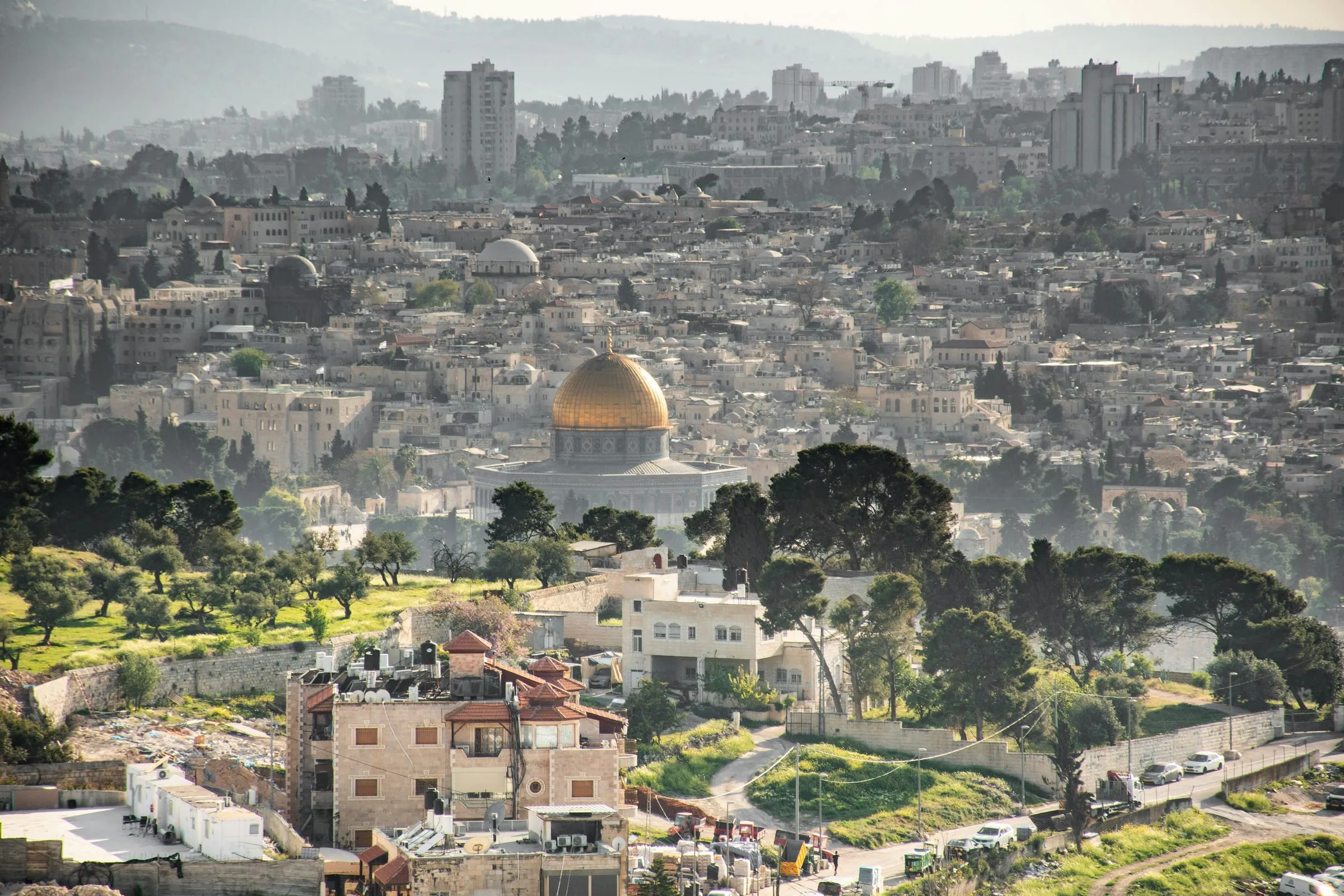
Jerusalem is the city that carries weight that no guidebook quite prepares you for. The physical landscape — the honey-colored limestone, the narrow lanes of the Old City, the light at golden hour falling on ancient walls — is beautiful and immediately recognizable from thousands of years of representation in art and photography. But underneath the beauty is a far more complex layering: the city is simultaneously the sacred center of Judaism (the Temple Mount, the Western Wall, the tomb of King David), Christianity (the Church of the Holy Sepulchre, the stations of the cross, Gethsemane), and Islam (the Dome of the Rock, Al-Aqsa Mosque, the Islamic Museum). It is the capital of modern Israel and home to a vibrant contemporary Jewish culture. It is also a city shaped by conflict, occupation, and profound historical trauma — the Old City walls separate neighborhoods and faiths; the security situation is a practical reality; and the history of the 1948 War of Independence, the 1967 Six-Day War, and the ongoing Palestinian-Israeli situation are inescapable backdrop to any visit.
Done correctly, a Jerusalem visit honors both the sacred layering and the historical complexity without flinching from either. This is not a city for tourists who want simple answers or uncomplicated narratives. It is a city for travelers who want to understand what they’re looking at, who want to encounter faith and history directly, and who are willing to sit with difficult questions.
Most clients come to me asking about Jerusalem in three contexts: as the centerpiece of a solo Jewish Heritage journey (increasingly common — clients wanting to deepen their understanding of Jewish history and contemporary Israeli life), as part of a multi-faith pilgrimage (less common, but powerful when the traveler is intentional about it), or as a stop on a longer Israel-and-Mediterranean arc (Tel Aviv + Jerusalem + maybe a Dead Sea or Galilee extension).
Here’s how I think about it.
At a Glance
| Best time to visit | October–November and March–April. Spring has wildflowers across the hillsides; autumn is clear-skied and cool enough for full-day walking. Avoid mid-July through August — the heat is relentless (95–105°F regularly) and the city floods with tourists on summer vacation. Avoid December–January — winter rains can interrupt days, and the city is crowded with Christmas pilgrims and winter-break travelers. |
| How long to stay | Four full days minimum if Jerusalem is the primary focus. Three days if it’s part of a longer Israel trip (Tel Aviv + Jerusalem). Five-plus if adding Bethlehem, the Dead Sea, or Masada day trips. The Old City alone demands two full days; add another for the museums and western neighborhoods. |
| How to get there | Ben Gurion Airport (TLV), serving Tel Aviv, is 40 km from Jerusalem — roughly 90 minutes by car or sherut (shared taxi). Direct flights from major U.S. gateways to Tel Aviv are common; the car or train transfer to Jerusalem is straightforward. From Tel Aviv by train: the new Jerusalem–Tel Aviv high-speed rail (opened in phases 2018–2019) takes 30 minutes from Tel Aviv Savidor-Central Station to Jerusalem Central Bus Station. By car: 60–90 minutes depending on traffic and security checkpoints. |
| Currency / language | Israeli Shekel (ILS). Hebrew is official; Arabic is widely spoken in Palestinian areas of the Old City. English is widely spoken in Jewish-Israeli contexts, less so in Palestinian quarters. Shalom (hello, goodbye, peace) and todah (thank you) are appreciated. |
| One thing most guides won’t tell you | Security is a practical reality and responsible travel means acknowledging it. The Old City has police presence; certain neighborhoods require awareness. Travel insurance with security-incident coverage is standard, not paranoid. The U.S. State Department maintains current travel advisories; read them. That said, millions of travelers visit Jerusalem annually without incident. The city functions. The key is informed caution, not fear-based avoidance. |
Why I Send Travelers Here
Because Jerusalem, planned correctly, is one of the most historically and spiritually significant cities in the world — and that significance is best honored by travelers who know what they’re looking at and why it matters.
The Western Wall is the holiest site in Judaism, a remnant of the Temple mount’s retaining wall and the closest physical access to the site of the Second Temple (destroyed 70 CE). The Dome of the Rock is an Islamic shrine (not a mosque) — one of the oldest surviving Islamic monuments (completed 691 CE) and the third-holiest site in Islam. The Al-Aqsa Mosque is a separate building on the same Temple Mount compound. The Church of the Holy Sepulchre marks the traditional site of Jesus’s crucifixion and resurrection and is the holiest site in Christianity. All three sit within a few hundred meters of one another in the Old City. The theological, historical, and emotional weight of that proximity is extraordinary.
Yad Vashem — the World Holocaust Remembrance Center — is one of the most important Holocaust memorials in the world. The Museum of the Jewish People at Tel Aviv University (the Diaspora Museum) and the Israel Museum’s Jewish-heritage collections round out the institutional landscape. Beyond institutions, the contemporary Jewish culture in modern Jerusalem — the restaurants, the Hebrew-language theater scene, the intellectual and literary life — is vibrant and worth encountering directly.
I send travelers here as the centerpiece of a Jewish Heritage journey — whether they’re Jewish themselves or non-Jewish travelers seeking to deepen understanding of Jewish history and contemporary life. I send multi-faith pilgrims who want to encounter the sacred sites of multiple religions with intention and care. I send historians and intellectuals who want to understand the Israeli-Palestinian context firsthand, not from a distance. And I send couples and groups for meaningful commemorative trips — marking anniversaries, honoring family heritage, or working through spiritual questions.
Every recommendation below comes through the lens of how I plan Jerusalem for clients who understand it’s not a simple city, who want to understand the complexity, and who recognize that being here is a privilege and a responsibility.
Where I’d Anchor
The Old City itself is where most travelers want to stay — and for a first visit, staying inside the Old City walls is the right call, despite the noise, the crowds, and the tourist density. You wake up inside the 16th-century walls, you can reach the major sites on foot, and the experience of being inside the city after dark (when the day-tourists have left) is the version of Jerusalem most travelers don’t realize they can have.
Old City, Jewish Quarter. The Jewish Quarter is one of four quarters inside the Old City walls (Jewish, Christian, Muslim, Armenian). It’s walkable to the Western Wall, to the Jewish Museum, to the Burnt House archaeological site, and to the major shops and restaurants. This is the right base — proximity to Jewish-heritage sites, still authentic without being actively dangerous, and walkable to everything.
Old City, Christian Quarter. Walkable to the Church of the Holy Sepulchre, the Via Dolorosa (Stations of the Cross), and the Islamic Museum. More residential and less touristy than the Jewish Quarter, but fewer English-speaking amenities and fewer good restaurants specifically geared toward solo or small-group travelers.
Old City, Armenian Quarter. The quietest quarter, with less tourist infrastructure. Stay here if you want maximum authenticity and are comfortable with minimal English-speaking services.
West Jerusalem (Mamilla, Nachlaot, Talbieh, German Colony). For travelers who want more comfort, better restaurants, and an easier relationship with contemporary Israeli life — these upmarket neighborhoods are west of the Old City walls, walkable to Mamilla Mall and to King David Street, with better-known luxury hotels and more reliable dining. The German Colony (south of downtown, centered on Emek Refaim Road) is particularly noteworthy for its concentration of trendy restaurants and cafés — this is where much of Jerusalem’s contemporary dining energy lives. Trade-off: you’re not inside the Old City walls, and you lose the experience of morning-walk-through-ancient-streets that staying inside provides.
For the Old City luxury flagship — and the property with the strongest single location — Mamilla Hotel at Jaffa Gate (the main entrance to the Old City from the western side) is the call. The 194-room hotel sits on the threshold between the Old City and the modern city, with views over the Old City walls and direct pedestrian access into the Jewish Quarter via internal passageways that bypass the main crowds. The building is a modern steel-and-stone construction, not historical, but the location is unbeatable. On my rate at the property, the amenity layer is meaningful and doesn’t book direct — pairing the right room category to your dates is the discovery-call conversation, and the best of it tends to land at check-in rather than appear in the proposal.
For the historic palace luxury pick — and the property with the strongest historical credentials — King David Hotel on King David Street in West Jerusalem (not inside the Old City) has been the address of record since 1931. The hotel overlooked the city from the hilltop perch when it was built; it has hosted every important Israeli figure, international dignitaries, and cultural figures in the decades since. The architecture is Art Deco/Streamline Moderne; the public rooms are grand and the afternoon tea service is an institution. On my rate at the property, the amenity layer is real and quiet — what applies depends on your dates and the suite category, and the specifics are the discovery-call conversation, with a few of the touches designed to land on arrival rather than appear in advance.
For the historic Old-City-inside-the-walls boutique — and the most intimate property for Jewish-heritage focus — Austrian Hospice Hotel in the Christian Quarter (literally a converted Austrian hospice, around 40 rooms across the main building and an adjacent annex, one of the oldest guest properties in the Old City) offers the experience of sleeping inside the 16th-century walls with the oldest continuously-operating hotel infrastructure in the city. Basic by modern luxury standards, but the authenticity and location are irreplaceable. The rooftop terrace overlooks the Old City toward the Temple Mount and the Dome of the Rock. Book through the property directly (not through an OTA).
For the Waldorf Astoria Jerusalem option in West Jerusalem — contemporary luxury (opened 2014, in the restored 1929 Palace Hotel building) on a hilltop overlooking the Old City — the property offers modern five-star amenities with strong views and a more insulated approach (on the property side of the walls rather than inside them). On my rate at the property, the amenity layer doesn’t book direct, and the specifics get walked through on the discovery call.
Want one of these stays? Start a discovery call — I’ll pull live availability on the dates you’re considering, walk through the neighborhood options and what each trade-off entails, and confirm which amenities apply. The decision between inside-the-walls authenticity (Mamilla, Austrian Hospice) and outside-the-walls comfort (King David, Waldorf Astoria) shapes your entire Jerusalem experience, and I’ll help you choose based on what you actually want from the trip.
What I’d Do With Four Days
This is the version I’d send if you asked me to plan a four-day Jerusalem visit tomorrow. Adjust to taste. (The three-day version compresses Day One and Day Two into a single long day.)
Day One — The Old City: Western Wall, Temple Mount, and the Jewish Quarter
Start at the Western Wall at first light — arrive by 6 a.m. if possible, before the crowds and before the heat. The wall is ancient limestone, the holiest site in Judaism, and the experience of standing at the wall in near-silence (the security presence is discreet at dawn) is profoundly different from the midday crowded version. Men and women have separate prayer sections; observe the demarcations and respect the observant worshippers at the wall. If you want to place a written prayer in the wall’s cracks (a common practice), have it written before you arrive.
Walk north from the Western Wall into the Jewish Quarter — the narrow lanes rebuilt after 1967, with the Jewish Museum (the Story of the Jewish People in the Land of Israel exhibition) built partially on archaeological excavations of older structures. Allow two hours for the museum.
Lunch in the Jewish Quarter — Eucalyptus (upscale Mediterranean cuisine, the chef worked for decades in the kitchen before opening) or Lina (the casual Old City hummus institution — operating in the Christian Quarter for decades and consistently named among Jerusalem’s best).
Afternoon: the Temple Mount / Haram al-Sharif complex (access requires separate entry; non-Muslim visitors have restricted hours — typically 8–11 a.m. and 1–3 p.m. on weekdays, closed on Fridays and Sundays and certain Muslim holidays). Pre-check entry requirements and times before your visit; access is sensitive and hours are subject to closure. The Dome of the Rock (the golden-domed shrine completed 691 CE) is one of the world’s great architectural monuments. The Al-Aqsa Mosque is inside the walls. Non-Muslim visitors cannot enter the prayer halls, but the courtyards and the external architectural details are extraordinarily beautiful.
If Temple Mount access is not available, substitute the Church of the Holy Sepulchre (the traditional site of Jesus’s crucifixion, burial, and resurrection, shared among multiple Christian denominations with sometimes-contentious shared governance). The church is dark, labyrinthine, and emotionally powerful. Go early or late to minimize crowds.
Late afternoon: walk the Stations of the Cross (Via Dolorosa) — the traditional path Jesus walked to his crucifixion, marked by 14 stations within the Old City. The route is crowded, but the experience of walking the narrowest lanes of the Old City, with local life (shops, residents, schoolchildren) mixing with pilgrims, is the most vivid version of what the Old City actually is rather than what postcards show.
Dinner in the Old City: Abu Shukri (hummus restaurant, famous enough that most travelers have heard of it — which makes it touristy, but the hummus is genuinely excellent) or back toward the Jewish Quarter for a quieter option.
Day Two — Yad Vashem, the Israel Museum, and the Nachlaot neighborhood
Morning: Yad Vashem — the World Holocaust Remembrance Center. This is emotionally heavy material and deserves at least four hours of your time. The main museum buildings (opened 2005) house the permanent exhibition: six galleries chronologically tracing European Jewish life before the Holocaust, the rise of Nazism, the ghettos, the deportations, the concentration camps, and the liberation and aftermath. The exhibition is intellectually rigorous and emotionally profound — it doesn’t sensationalize or simplify. The Hall of Remembrance is a stark concrete chamber honoring victims by name. The Children’s Memorial is a darkened chamber with candles and recorded children’s names; it is devastating. The outdoor sculpture gardens frame the city below. Plan to spend a full four hours minimum.
Lunch near Yad Vashem (the cafeteria at the museum is serviceable, but not the reason to be there).
Afternoon: the Israel Museum — one of the world’s major art and antiquities museums. The Jewish-heritage sections trace Jewish life and art from ancient Judaea through the diaspora. The Dead Sea Scrolls are housed here (among the world’s most significant archaeological finds). Three to four hours is the right amount for a first visit — focus on the Jewish sections and the scrolls unless you have specific other interests.
Late afternoon: walk through Nachlaot — the bohemian neighborhood west of the Old City, with narrow alleys, artist studios, small galleries, cafés, and the kind of contemporary Israeli intellectual and creative energy the Old City doesn’t show. This is where young Jerusalem lives. Walk it without agenda.
Dinner in Nachlaot or back toward King David Street: Machneyuda (modern Israeli, influenced by the Machne Yehuda market — boisterous, fun, excellent) or Lehem Basar (the “Meat and Eat” steakhouse — meat-focused, old-school Israeli steakhouse energy).
Day Three — Bethlehem Day Trip, or the Mount of Olives and Gethsemane
Option A: Bethlehem (the full day-trip). Twenty minutes south of Jerusalem by car. Bethlehem is in the West Bank — crossed via a security checkpoint. Travel with a guide or organized tour for your first visit (the logistics are straightforward but require security-clearance awareness). The Church of the Nativity marks the traditional site of Jesus’s birth — one of the oldest continuously-operating churches in the world (rebuilt several times, the current structure dates to the 6th century). The Shepherds’ Field is the traditional site where shepherds were told of Jesus’s birth. The Nativity Grotto (the cave beneath the Church) is where Christian tradition locates the manger. The town itself is Palestinian; the market and the street life are vivid and unfiltered. Plan a full day — travel time, site time, lunch time.
Option B: The Mount of Olives and Gethsemane (a full afternoon within Jerusalem proper). The Mount of Olives is the hilltop east of the Old City, with views back across the Kidron Valley to the Temple Mount and the Dome of the Rock. The Garden Tomb marks an alternative site for Jesus’s crucifixion and resurrection (preferred by Protestant traditions). The Church of All Nations (built 1924, overlaid on earlier structures) is built on the traditional site of Jesus’s agony in the garden. The Gethsemane olive grove (with olive trees that are among the oldest documented living trees in the Mediterranean — radiocarbon dating places the oldest at roughly 900 years) is the garden where Jesus prayed before his arrest. These are all within walking distance of one another but involve elevation changes and stepping through multiple threshold spaces — a guide is helpful the first time.
Day Four — Slower Jerusalem, or an Extended Excursion
Option A: The Dead Sea (full day excursion). Ninety minutes from Jerusalem by car. The Dead Sea is the lowest point on earth (1,410 feet below sea level); the water is so salt-laden you float without effort. The Masada fortress (Herod’s mountain palace, 73 CE siege by Rome, loaded with historical and contemporary Israeli meaning) is 30 minutes south of the Dead Sea. This is a long day-trip (6 hours of driving/site time) but powerful — the combination of the geological extremity of the Dead Sea and the fortress archaeology is extraordinary.
Option B: Slower Jerusalem — museums, neighborhoods, reflection. The Bible Lands Museum holds biblical-period antiquities. The Rockefeller Museum (housed in a 1938 limestone building with vaulted galleries) holds Palestinian archaeology and Islamic art. Walk the Old City at a slower pace — sit in a courtyard café, linger in the souks (markets), observe prayer times, listen to the call to prayer from the Temple Mount. Take the Haas Promenade, the panoramic viewpoint that frames the entire Old City and the Temple Mount — stunning day or night, one of the best ways to see the city whole. Let the city work on you rather than checking boxes.
Specific Things I’d Tell You About
The Old City isn’t a monolith — the four quarters have distinct characters. The Jewish Quarter is heavily restored and relatively touristy (rebuilt after 1967 in modern style), but it’s the hub for Jewish-heritage sites. The Christian Quarter is older and darker, with narrower lanes and a more specifically Christian devotional focus. The Muslim Quarter is the largest and most densely populated, with the most active commercial markets and the strongest sense of Palestinian daily life. The Armenian Quarter is the smallest and quietest, a hidden enclave with its own church and community. Walk them separately — the experience of each is entirely different.
Observing prayer times changes the experience of the sacred sites. The Dome of the Rock and Al-Aqsa Mosque are most accessible mid-morning (after dawn prayer, before midday prayer). The Western Wall has separate prayer areas for men and women, and during prayer times the energy shifts. The Church of the Holy Sepulchre is actively used for daily services by the multiple denominations that share it — Greek Orthodox, Catholic, Armenian, Coptic. Encountering these spaces during prayer is far more powerful than visiting empty tourist spaces.
The “security checkpoints” are procedural, not frightening. Entering the Temple Mount requires a security screening (similar to airport security). The barriers and walls throughout the city are politically and emotionally loaded, but the traveler experience is generally straightforward and safe when following local guidance. East Jerusalem (the Palestinian-majority district north of the Old City, centered on Nablus Road and Saladin Street) is best visited in daylight hours and with local knowledge — it’s not dangerous, but it requires awareness of the political context. Trust your guide or the locals around you on navigating sensitive areas.
Yad Vashem requires emotional preparation and time. This is not optional tourism — it’s essential to understanding modern Jewish history and the weight of the Holocaust. But it’s also intense. Plan to spend a full four hours, plan to take breaks, and plan to eat lunch afterward. The exhibition is world-class and respectfully done, but it’s heavy material. Don’t rush it.
The Machne Yehuda market (Shuk Machne Yehuda) is the heart of contemporary Jerusalem. The market is an open-air bazaar covering several blocks, with produce stalls, meat vendors, spice shops, and small restaurants cheek-by-jowl. It’s crowded, noisy, authentically Jerusalem, and the best place to encounter everyday Israeli food culture (fresh juice, Israeli salads, falafel, hummus). Go mid-morning on a weekday to avoid the peak-weekend crush. It closes at sunset Friday and is closed Saturday (Sabbath observance).
Shabbat (the Jewish Sabbath, Friday sunset through Saturday sunset) is a structural rhythm in Jerusalem. Many Jewish-owned businesses close Friday afternoon and don’t reopen until Saturday night. Public transportation doesn’t run on Shabbat (bus service is minimal). Restaurants have split personalities — secular-Israeli restaurants stay open, religious Jewish restaurants close entirely. If you’re visiting Friday–Saturday, plan accordingly — know where you’re eating, know your hotel’s Shabbat meal options, understand that the city’s rhythm slows profoundly once sunset arrives Friday. For many Jewish travelers, experiencing Shabbat in Jerusalem (going to services, joining a family meal, observing the day) is the reason for the trip.
Ein Kerem is a day-trip alternative if you want something slower and more village-like. This picturesque village southwest of Jerusalem has been nurtured since biblical times — olive and almond groves, old Arab houses converted into art galleries and guesthouses, and a tradition connecting it to the birthplace of John the Baptist. It’s beloved by artists and writers, and the pace is entirely different from the Old City intensity. Worth a half-day excursion if you want breathing room.
Western Wall prayer access is gender-segregated and modesty-conscious. The separate men’s and women’s sections are clearly marked. Dress modestly (knees covered, shoulders covered). Women cannot approach the wall during certain prayers. These aren’t arbitrary rules — they reflect Jewish tradition and the fact that you’re in an active prayer space, not a tourist museum. Respect the observant worshippers and the space itself.
What I’d Skip
The “Jerusalem Syndrome” museums (the Chamber of the Holocaust, the Statue of Liberty, the Wax Museum of Jesus). Tourist tax with theatrical production values. The real material — Yad Vashem, the Israel Museum — is far more substantive.
Organized group tours in the Old City unless you have no other option. The tours move too fast and the group energy dilutes the experience. A private guide (arrange through your hotel or through the Israel Museum) is worth the cost.
Eating in the Old City Jewish Quarter restaurants that have menus in multiple languages with inflated prices. The best food is in Nachlaot, near King David Street, or inside the Machne Yehuda market. Walk away from the tourist lanes.
The souvenir shops that sell “authentic local crafts” in the main Old City lanes. They’re mass-produced imports from elsewhere. The real crafts are sold by the makers themselves in smaller side-lanes or at the Machne Yehuda market.
For Travelers Following Jewish Heritage
Jerusalem is the Jerusalem of Jewish heritage — not one of several important cities, but the center of gravity for understanding Jewish history, theology, and contemporary life. The Western Wall is the holiest site; the Temple Mount is the location of the ancient Jewish Temple; the Jewish Quarter holds museums and archaeological sites that trace the Jewish presence here back to antiquity. Yad Vashem is non-negotiable — it’s the essential institutional context for understanding what the Holocaust was and how it shaped modern Judaism and the creation of the State of Israel.
Beyond the institutional sites, the experience of being in a majority-Jewish city (modern Jerusalem, Tel Aviv) after potentially a lifetime in diaspora communities is profoundly disorienting and moving for many Jewish travelers. Hearing Hebrew as the majority language, seeing Jewish symbols and observances everywhere, encountering the complexity of Israeli society and politics directly — this is work that no amount of reading or virtual engagement can replace.
I’m currently developing a co-hosted Jewish Heritage trip for 2026 — Jerusalem is the centerpiece, with additional stops in Budapest, Prague, Berlin, Krakow, Warsaw, Vienna, Rome, and Amsterdam. The trip is designed for travelers (Jewish and non-Jewish) who want to deepen their understanding of European Jewish history, the Holocaust, and contemporary Jewish communities. Reach out if you’d like to be on the early-interest list.
For the longer thinking on how I work this thread — what makes it different from other heritage travel, what it earns, and what it doesn’t try to be — read the pillar essay: Jewish heritage travel.
For Multi-Faith Travelers
If you’re interested in the intersection of Judaism, Christianity, and Islam — in the same city, literally meters apart — Jerusalem is the place to encounter that directly. The Western Wall, the Church of the Holy Sepulchre, and the Dome of the Rock are all sites of profound significance to their respective faiths, and encountering them with intention (with guides who understand the theology and history, not just the tourist facts) is transformative.
A responsible multi-faith pilgrimage requires respect for the sacred, understanding of the history, and willingness to sit with complexity. This is not a casual tourism project. If you’re serious about it, it’s worth building a four–five day Jerusalem visit around guided engagements with leaders from each faith tradition.
For Pilgrims
The Church of the Holy Sepulchre is the destination for Christian pilgrims — the traditional site of Jesus’s crucifixion, burial, and resurrection. The church is shared by multiple Christian denominations (Greek Orthodox, Roman Catholic, Armenian Orthodox, Syriac Orthodox, Coptic, Ethiopian), and navigating the shared governance is part of the experience. The Garden Tomb is the alternative site preferred by Protestant traditions. The Mount of Olives and Gethsemane are the traditional sites of Jesus’s agony before his arrest.
A pilgrimage visit is different from a tourist visit. It’s worth planning around attending services (the times and languages vary by denomination), sitting in silence with the sacred sites, and allowing space for spiritual experience rather than rushing through.
Plan Jerusalem With Me
If you’re thinking about Jerusalem as the centerpiece of a Jewish Heritage journey, as part of a multi-faith pilgrimage, as a solo spiritual exploration, or as a stop on a longer Israel and Mediterranean arc — that’s exactly the kind of planning I do. A 30-minute discovery call is where it starts. No fee, no pressure. Just the city, your timeline, and what you actually want to understand and experience when you’re standing at the Western Wall or inside the Church of the Holy Sepulchre.
Book Your Free Discovery Call →︎
Last updated: April 2026. I keep this guide current. If a hotel I recommend closes, museum hours change, or access to a site shifts, the page changes. Jerusalem changes. The work doesn’t stop when the page goes live.
Plan this trip with me.
A 30-minute discovery call is where it starts. No fee, no pressure.
Book a Discovery Call