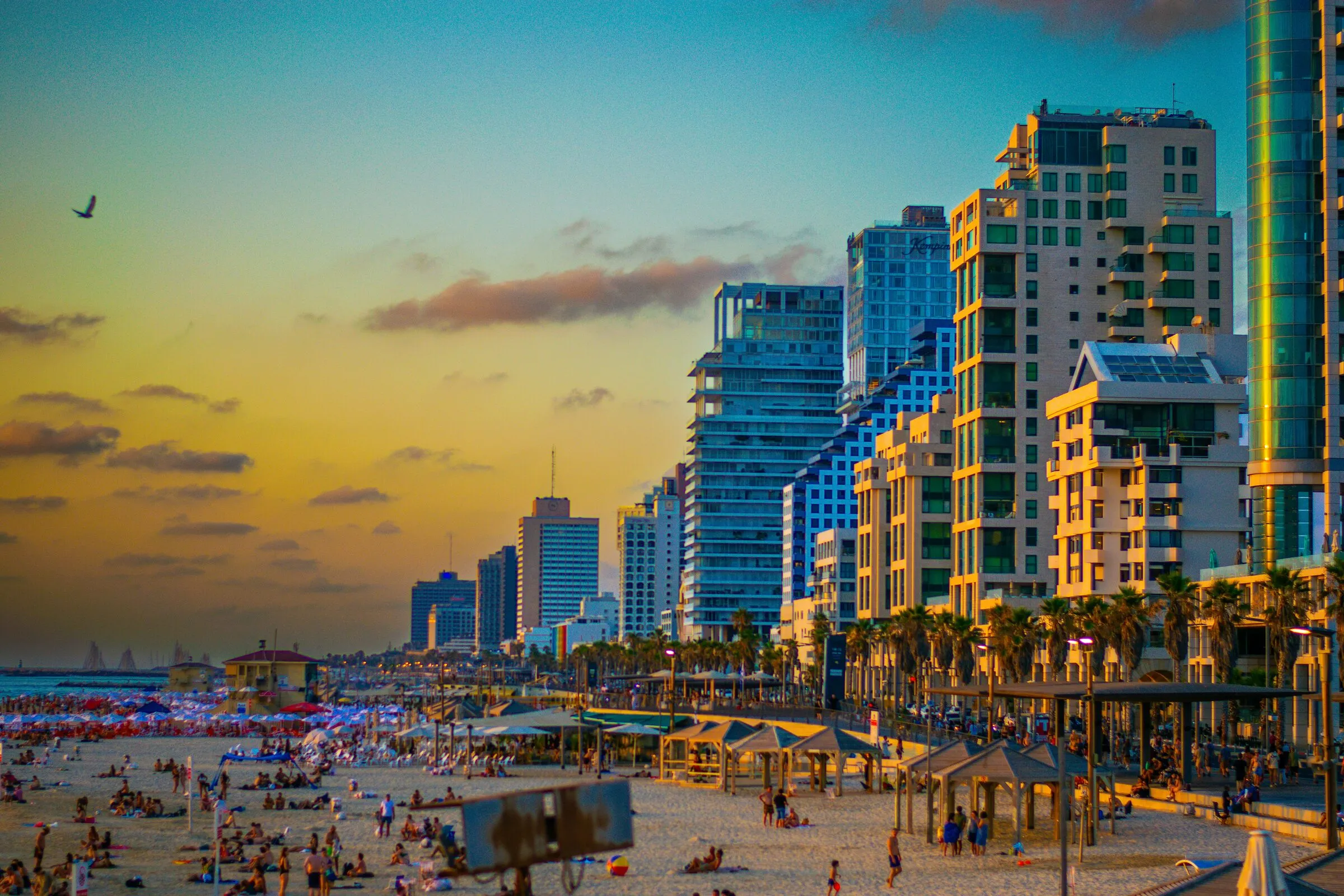
Tel Aviv is the city that most guidebooks don’t quite know how to write about because it refuses to be a single thing. It’s the capital of modern Israel (though Jerusalem holds the government) and the epicenter of Israeli tech, culture, art, dining, and nightlife. It’s a Mediterranean beach city with a 1920s-founded history of modernist urban planning (the Bauhaus architecture is UNESCO-listed). It’s a city with one of the world’s largest Pride celebrations — over 250,000 people annually, a massive LGBTQ+ contingent, and an openly gay culture woven into daily life. It’s also a city shaped by the same Israeli-Palestinian context that shapes the entire country, sitting along the border with the Gaza Strip and maintaining the same security-consciousness and political complexity that defines Israeli life.
But on the surface — the version most travelers encounter first — Tel Aviv is joyful, creative, irreverent, and determined not to be defined by the weight that sometimes presses down on the rest of the country. The beachfront is vibrant. The restaurant scene is possibly the world’s best per capita. The museums are world-class. The nightlife is genuinely excellent. The city feels young and alive in a way that’s immediately palpable — and that’s intentional. Tel Aviv was built on the idea of newness, of starting fresh, of leaving the weight of the past and building something modern and Jewish at the same time.
Most clients come to me asking about Tel Aviv in three contexts: as a weekend or three-day city break (increasingly common — Tel Aviv has direct flights from major U.S. gateways and is being positioned as Europe-lite beach-and-culture destination), as the modern-Israel counterbalance to a Jerusalem heritage visit (clients wanting to see not just historical Judaism but contemporary Israeli Jewish life), or as a stop on a longer Mediterranean or Israel-and-Egypt arc.
Here’s how I think about it.
At a Glance
| Best time to visit | April–May and September–October. Spring is mild and clear; autumn is warm but not brutally hot, and the city recovers from the summer tourist surge. Mid-June through August is Pride season and peak heat — the city is at maximum energy but also maximum crowded and expensive. November–March is rainy and cool — pleasant for walking if you don’t mind a jacket, but the beach culture is less active. |
| How long to stay | Two full nights minimum for a city break (three is better). Four–five nights if combining Tel Aviv with Jerusalem. A week if you want to combine Tel Aviv with surrounding areas (Jaffa, Caesarea, the Dead Sea, Masada). |
| How to get there | Ben Gurion Airport (TLV) is 15 km southeast of Tel Aviv — roughly 30 minutes by car or 45 minutes by train (the direct train to Tel Aviv Central Station is an excellent modern rail experience). Direct flights from New York, Boston, Newark, Miami, and other U.S. gateways. From Jerusalem: train (30 minutes, direct, modern high-speed rail opened 2018) or car (60 minutes). |
| Currency / language | Israeli Shekel (ILS). Hebrew is official; English is widely spoken in most of Tel Aviv (less so in some neighborhoods). Shalom (hello, goodbye) and todah (thank you) are appreciated. |
| One thing most guides won’t tell you | Tel Aviv’s beaches are genuinely good and genuinely social. This isn’t a resort-beach culture (no parasols, no cabanas, no rentals) — it’s a working-city beach where Tel Avivians actually swim, meet, exercise, and live. The beach culture is mixed-gender, mixed-age, and noticeably queer-friendly, which shapes the feel. Go to the beach like the locals do — no sunbathing for 8 hours, but definitely go. |
Why I Send Travelers Here
Because Tel Aviv is the modern Jewish city in a way that no other city quite is. Hebrew is the majority language here; Jewish symbols and holidays are everywhere; the food culture is specifically Mediterranean-Israeli; the energy is specifically Israeli. For Jewish travelers (especially diaspora Jews who’ve never experienced life in a majority-Jewish society), being here is disorienting and moving. For non-Jewish travelers, encountering the city directly shows what contemporary Israel actually is beyond the headlines.
The city is also one of the world’s great food destinations — the chef-led restaurant scene is serious, the street food is excellent, and the wine culture has developed dramatically in the past 15 years. The Bauhaus architecture (the UNESCO-listed 1920s urban planning and modernist buildings) is the most extensive Bauhaus architecture on earth. The art and design scene is internationally significant. The beach culture is something truly different — neither resort nor working-class beach, but something specific to Tel Aviv.
And yes — Tel Aviv is visibly, proudly LGBTQ-friendly in ways that most cities aren’t. The Pride parade is massive. Queer life is openly visible. The city has the largest Middle Eastern Pride celebration and has positioned itself deliberately as LGBTQ+-friendly destination. If that matters to you, it’s worth experiencing.
I send travelers here as the cultural and modern counterbalance to a Jerusalem heritage visit — same country, entirely different energy. I send Jewish travelers who want to experience life in a majority-Jewish context. I send LGBTQ+ travelers who want to experience Pride or simply to experience a city where queer life is prominent and celebrated. I send food-focused travelers who want to spend several days eating through the restaurants and markets. And I send creatives and intellectuals who want to engage with contemporary Israeli culture and ideas directly.
Every recommendation below comes through the lens of how I plan Tel Aviv for clients who understand the city’s complexity and want to experience it as a real place, not as a Middle Eastern themed resort.
Where I’d Anchor
Three anchoring neighborhoods cover most reasons for being in the city:
Rabin Square / Sarona District (Merkaz Ha’Ir, Center City). This is downtown Tel Aviv — the Bauhaus-architecture core, the business district, the easy walking distance to Mendelssohn Street restaurants and Allenby Street shops. The right base for a first visit — walkable to everything, close to the beach, surrounded by restaurants and shops.
Jaffa (Yafo). The ancient port city south of Tel Aviv, built on hills with narrow winding lanes, galleries, artists, and a mix of Israeli-Jewish and Arab-Palestinian residents. Jaffa has the Jaffa Flea Market (a sprawling outdoor market with vintage clothing, antiques, and general chaos), galleries, and the old port area. Better for a second visit or for travelers who want their Tel Aviv experience to feel less polished and more chaotic.
Florentin / Shabazi Street. The bohemian neighborhood south of downtown, with street art, design shops, galleries, and the kind of contemporary Tel Aviv creative energy that feels “real” to younger travelers and artists. Growing rapidly gentrified, but still the neighborhood where Tel Aviv’s creative class actually lives.
Dizengoff Square / Tel Aviv North. The northern neighborhoods (Ramat Hasharom, Ramat Meir) are quieter, more residential, with less tourist infrastructure. Better for travelers who want to slow down and live in the city rather than quickly checking boxes.
For the Bauhaus landmark luxury flagship — and the most historically significant property in Tel Aviv — The Norman (50 rooms and suites across two restored 1920s buildings on Nachmani Street, in the heart of the White City) is the call. It’s one of Tel Aviv’s finest heritage restorations, in the Bauhaus-era core of the city. The property opened in 2014 as a luxury boutique, with the original architectural details preserved. The ground-floor Norman Bistro is one of Tel Aviv’s serious fine-dining rooms. On my rate at the property, the amenity layer is real and quiet — calibrated to your dates and the suite category, with personalized service that’s the hotel’s signature. The specifics get walked through on the discovery call.
For the modern beachfront flagship — and the property with the most contemporary Tel Aviv energy — Mendeli Street Hotel on Mendeli (the epicenter of the restaurant scene) is the alternative. Fifty-seven rooms, rooftop bar, contemporary design, and direct access to Tel Aviv’s dining and nightlife core. On my rate at the property, the amenity layer doesn’t book direct, applicable broadly across the hotel’s restaurants and partner restaurants in the Mendeli dining corridor. The specifics get walked through on the discovery call.
For the Brown TLV boutique-lifestyle option (64 rooms, design-forward, in the Florentin neighborhood’s creative core) — the property for travelers who want to stay where Tel Aviv’s creative class actually lives. On my rate at the property, the amenity layer is calibrated to your stay rather than itemized in advance — what applies depends on dates and the room category, and we walk through it on the discovery call.
For the Setai Tel Aviv ultra-luxury option — a five-star property in a restored landmark building in Jaffa (opened 2018, about 120 rooms, near the sea) with contemporary design and high-end spa and dining. This is the resort-tier answer if you want to be slightly insulated from the street-level energy. On my rate at the property, the amenity layer doesn’t book direct, and the specifics — calibrated to your dates and room category — get walked through on the discovery call.
Want one of these stays? Start a discovery call — I’ll pull live availability, walk through which neighborhood fits your travel style, and confirm amenities. The choice between Bauhaus heritage (The Norman), bohemian creativity (Brown TLV), or beachfront-contemporary (Setai) shapes your Tel Aviv experience fundamentally, and I’ll help you choose based on what you’re actually after.
What I’d Do With Three Days
Adjust to taste. This is the version for a focused city-break; expand it for a longer stay.
Day One — Bauhaus Architecture, Mendelssohn Street, and the Beach
Start with coffee at Sababa or Manta Ray — casual Israeli-style coffee culture (strong espresso, sabich [eggplant sandwich], olive oil). Walk Rothschild Boulevard — the wide 1920s-designed avenue with Bauhaus buildings on both sides, tree-lined and the best introduction to the architectural character of the city. The boulevard runs from Rabin Square down toward Jaffa.
Mid-morning at the Bauhaus Center (on Dizengoff Square, 16 Rothschild Blvd.) — a small museum and resource center dedicated to the Bauhaus movement and its expression in Tel Aviv. The galleries present Tel Aviv as the “Bauhaus architectural capital of the world” — approximately 4,000 buildings in the unique modernist style — UNESCO recognizes the city as a World Heritage site for this architectural heritage. Allow 45 minutes to an hour.
Lunch on Mendelssohn Street (or Shabazi Street if you prefer bohemian-casual) — the nerve center of Tel Aviv’s restaurant scene. Michal Ba’ara (Mediterranean, seasonal, Michelin-starred) or Zakaski (contemporary Mediterranean small plates, fun and less formal) or Cafe Xo (casual daytime, excellent coffee and pastries).
Afternoon: the beach. Hilton Beach is the main urban beach, with facilities and energy. Gordon Beach (just north) has a more local feel. Banana Beach (south near Jaffa) is the historically queer-friendly beach, though the whole city’s beaches are increasingly queer-visible. Swim, walk, sit. This is not resort-beach energy — it’s a working city’s public beach with a mix of families, athletes, and young people. The culture is casual and mix-gender.
Evening: walk Jaffa — the ancient port city south of Tel Aviv. The narrow alleys, the views back toward Tel Aviv’s skyline, the mix of Arab and Jewish residents, the galleries and small cafés. Walk without agenda. Dinner at Abu Hassan (hummus institution, legendary, tiny, cash only, locals’ favorite) or The Old Man and the Sea (upscale Mediterranean seafood, views over the old port).
Day Two — Museums, Markets, and Nightlife
Morning: the Tel Aviv Museum of Art — one of the world’s significant modern and contemporary art museums, with strong Israeli and international collections. Allow two–three hours.
Mid-morning: Carmel Market (Shuk Ha’Carmel) — the open-air produce, spice, and food market covering several blocks. Chaotic, loud, genuinely local (less touristic than Jerusalem’s Machne Yehuda). Fresh juices, Israeli salads, falafel, pickled vegetables. Go mid-morning on a weekday; it’s less crowded and far more authentic.
Lunch at the market or nearby — Magada Cafe (Israeli breakfast/brunch) or anywhere the locals are eating.
Afternoon: depending on interest:
- Beit Bialik (the historic home-museum of Bialik, Israel’s national poet, a cultural institution)
- The Design Museum (Israeli design focus)
- Tel Aviv Museum of Natural History (smaller, quieter option)
- Or simply slow afternoon — a café on Dizengoff Street, a bookstore, a gallery in Florentin.
Evening: Tel Aviv nightlife. The city has serious bars, clubs, and nightlife culture. Barbie Bar (the legendary queer bar, institution since the 1990s) or The Cameri Theater (if there’s a show you want to catch, many productions are in Hebrew but the physical experience is worthwhile). Or Jaffa Nights — dinner at one of the smaller neighborhood spots, a drink at a casual rooftop bar, walking the streets late (the city’s nightlife starts at 10 or 11 p.m., not 9 p.m.).
Day Three — Jaffa Deep-Dive, or an Excursion
Option A: Jaffa, a full day. The old city south of Tel Aviv proper, with the archaeology (buildings dating back centuries), the market (the Jaffa Flea Market is a sprawling chaos of vintage clothing, antiques, and general merchandise), the galleries and artist studios, the port with restaurants. Walk the narrow lanes, climb to the Clock Tower for the panoramic view, sit in a café. This is where the city has the most texture and history.
Option B: Caesarea (a 45-minute drive up the coast). The Roman and Crusader city ruins, beautifully preserved within a modern kibbutz-turned-resort. The Roman Theater is still used for performances; the Crusader City has dramatic arched passageways. This is an excellent half-day trip from Tel Aviv.
Option C: Slower Tel Aviv. Spend the day rereading your favorite café, taking a class (there are yoga, dance, cooking, and art classes all over the city), shopping the Shabazi Street design stores, going to a museum you didn’t make on Day Two, or simply sitting at the beach and reading.
Specific Things I’d Tell You About
The Bauhaus architecture is extensive and remarkably intact. Tel Aviv was built beginning in 1909 as a planned modern Jewish city, designed on a grid pattern. Starting in the 1920s, German-Jewish architects fleeing the rise of Nazism brought Bauhaus and International Style design principles to Tel Aviv — resulting in approximately 4,000 buildings in the unique modernist style, with roughly 200 individual examples representing every phase of the Bauhaus movement. The entire city is a museum of Bauhaus without being precious about it — these are buildings that people live and work in, not buildings under glass. Walk Rothschild Boulevard (the tree-lined avenue bisecting central Tel Aviv) and the side streets of the city center, and you’ll see it everywhere — the clean lines, the functional design, the whitewashed facades. The White City district is the highest concentration of these buildings.
The restaurant scene is legitimately one of the world’s best. This is not hype. Tel Aviv has more Michelin stars per capita than most European capitals, a deep bench of chef-led restaurants in the contemporary-Mediterranean style, and also genuinely excellent street food and casual eating. Eat seriously here — it’s one of the main reasons to be in the city.
Pride season is a specific energy if you’re in Tel Aviv in June. The Tel Aviv Pride Festival (mid-June, several weeks of events culminating in the parade) is the largest Pride celebration in the Middle East, drawing upward of 250,000 people, with a visible LGBTQ+ population and ally infrastructure. The city is visibly, proudly queer in ways that most cities aren’t. If you’re visiting in June, the city is at maximum density and maximum price, but the energy is specific and worth experiencing if you’re interested in LGBTQ+ life and culture.
The beach culture is different from European or American beach cities. There are no parasols, no cabanas, no “sun beds” for rent. The beaches are public and heavily mixed — families, artists, elderly people, young people, mixed-gender couples, queer couples, all in the same space. The social code is informal — bring your own towel, go in the water, come out, hang out, go to a café nearby. It’s genuinely local culture rather than a tourism experience.
Jaffa has a complicated dual identity — Israeli-Jewish and Palestinian-Arab. The old city is a shared space with roots going back to biblical times (Tel Aviv’s link to its ancient past), though increasingly Israeli-Jewish-dominated through gentrification and art-gallery development. The Yemenite Quarter outside the Carmel Market represents a different layer — early settlement by Yemenite Jews. Walk Jaffa with respect and awareness — you’re in a space with contested histories and ongoing Palestinian residency.
The Israeli Wine scene is no longer an afterthought. The Negev and Galilee regions produce genuinely excellent wines — Mediterranean-style reds and whites. Order Israeli wine at restaurants — it’s a point of contemporary Israeli pride and it’s genuinely good. Kosher wine is the largest category, but that’s for observant-dietary purposes, not quality-level only anymore.
What I’d Skip
The Tel Aviv Museum of Art unless you’re genuinely interested in modern and contemporary art. It’s a world-class museum, but it’s not a must-see for the casual traveler. The time is better spent at the beach, at markets, or eating.
Chain restaurants and the tourist-oriented dining on the beachfront boardwalk. The good restaurants are on Mendelssohn, Shabazi, and side streets. Walk three blocks off the main beach promenade and the quality improves dramatically.
Driving anywhere in Tel Aviv unless you’re renting specifically for a Caesarea or Jaffa day-trip. The city is walkable, the public transit is decent, and traffic is genuinely bad. Walk or take a taxi/Uber.
The “Old City” tourism narrative that sometimes gets applied to Jaffa. Jaffa is not a historic Ottoman village suspended in time — it’s a contested contemporary space with ongoing Palestinian residency, Israeli gentrification, tourism infrastructure, and artist communities all mixed together. Encounter it as a real place, not as a picturesque backdrop.
For Travelers Following Jewish Heritage
Tel Aviv is the modern-Jewish city — not the historical-heritage city (that’s Jerusalem), but the contemporary expression of what it means to be Jewish in a majority-Jewish context. Hebrew as the majority language, Jewish holidays as public holidays, Jewish symbols everywhere, the foods and culture and sensibility specifically Israeli-Jewish. For diaspora Jewish travelers, this can be profoundly disorienting and clarifying at the same time.
Beyond the cultural immersion, the Tel Aviv Museum has significant Israeli-Jewish contemporary art collections, and the city’s literary and intellectual scene is deeply engaged with questions of Israeli identity and Jewish theology. The Bauhaus heritage is specifically Jewish — these were German-Jewish architects fleeing Nazism, bringing modernist design to a Jewish-nationalist project.
I’m currently developing a co-hosted Jewish Heritage trip for 2026 — the itinerary centers on Jerusalem but includes Tel Aviv for the contemporary-Jewish-life contrast. Reach out if you’d like early-interest information.
For the longer thinking on how I work this thread — what makes it different from other heritage travel, what it earns, and what it doesn’t try to be — read the pillar essay: Jewish heritage travel.
For Beach-City Travelers
Tel Aviv’s beaches are working public beaches, not resort beaches. The culture is informal, mixed, and genuinely social. Spend time at the beach — swim in the Mediterranean, sit and read, watch the city life, eat at a small beachside café. The beach changes your relationship to the city.
Plan Tel Aviv With Me
If you’re thinking about Tel Aviv as a standalone city break, as a modern-Israel counterbalance to a Jerusalem heritage visit, as a stop on a longer Mediterranean arc, or as your first experience of life in a majority-Jewish society — that’s exactly the kind of planning I do. A 30-minute discovery call is where it starts. No fee, no pressure. Just the city, your timeline, and what you actually want to understand and experience when you’re walking Mendelssohn Street or sitting at the beach watching the Mediterranean sun go down.
Book Your Free Discovery Call →︎
Last updated: April 2026. I keep this guide current. If a hotel I recommend closes, a restaurant changes hands, or access to a site shifts, the page changes. Tel Aviv changes. The work doesn’t stop when the page goes live.
Plan this trip with me.
A 30-minute discovery call is where it starts. No fee, no pressure.
Book a Discovery Call