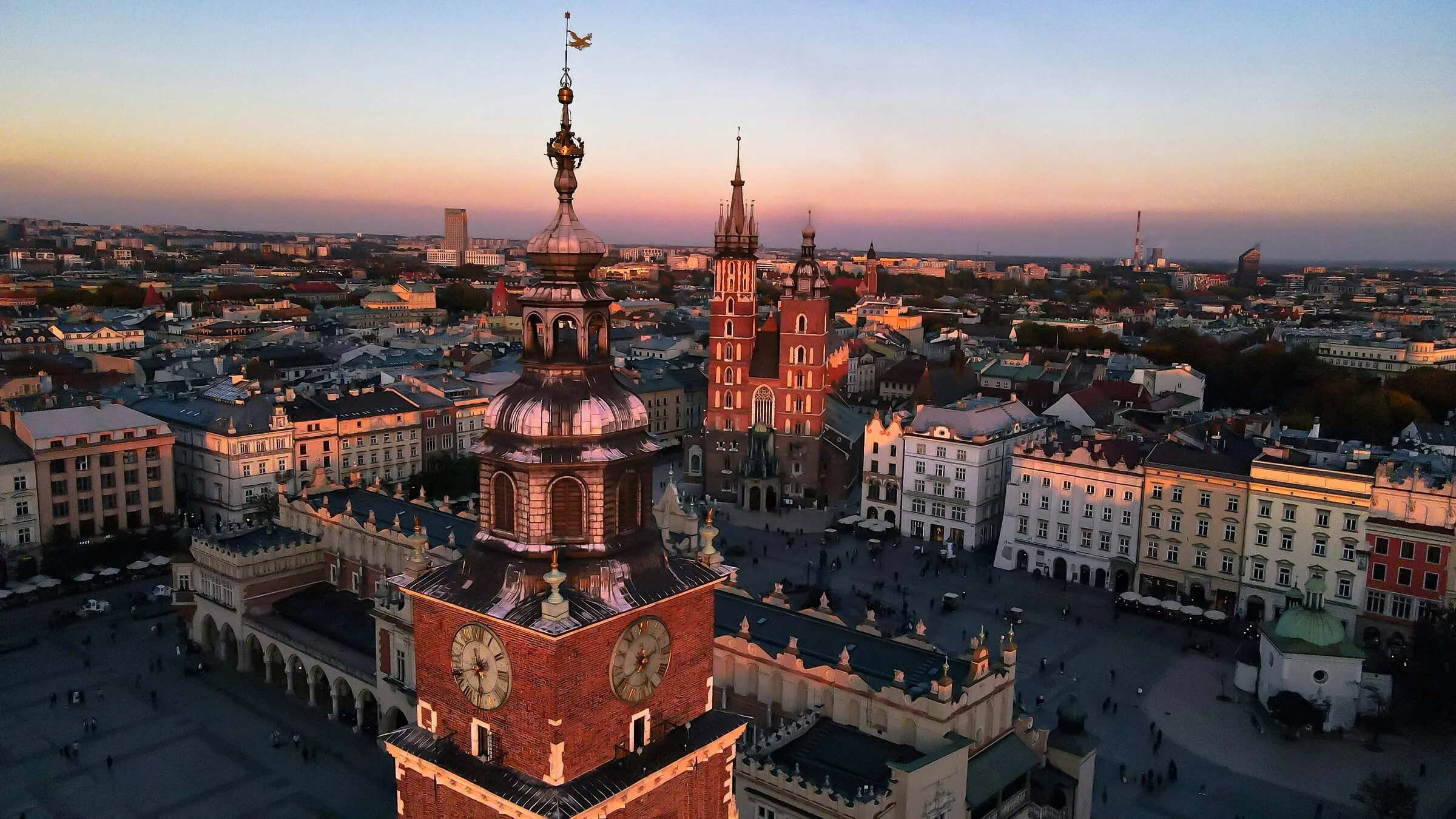
Krakow is the Polish city that most travelers encounter first, and for good reason — the Old Town square is among the most beautiful in Europe, the medieval architecture is intact, and the walking is easy and rewarding. But Krakow’s significance, if you’re here as a Jewish Heritage traveler, rests on different ground: this is where one of Europe’s oldest and deepest Jewish communities was centered, and this is where the Shoah (Holocaust) reached its most systematic industrial expression — Auschwitz concentration camp is 65 km from Krakow, and the city’s relationship to that proximity is inescapable.
Krakow’s Jewish Quarter — Kazimierz — is the neighborhood where the Jewish community lived for centuries, where they built synagogues and community structures, and from which over 65,000 were deported to Auschwitz and other camps between 1941 and 1943. The quarter was cleared, repopulated by Christians during the war, and after 1989 slowly reclaimed as a memorial and cultural space. Today it’s one of the most moving Jewish heritage sites in Europe — not because it’s preserved (it’s not — it’s lived-in and evolving), but because the history is present in every street and building.
Most clients come to me asking about Krakow in three contexts: as the gateway to understanding Polish Jewish history, as the proximity point for Auschwitz, or as part of an Eastern European Jewish Heritage multi-city sweep.
Here’s how I think about it.
At a Glance
| Best time to visit | May–June and September–October. Spring is mild and the city is clearing from winter crowds. Autumn is clear and cool. Avoid mid-July through August — peak heat and tourist surge. November–March is cold and gray, but the city is quieter and more reflective. |
| How long to stay | Three–four days minimum if Auschwitz is part of the visit (one full day for the camp). Four–five days if you want to engage with Kazimierz at a deliberate pace and include Auschwitz. |
| How to get there | John Paul II International Airport (KRK) is 15 km west of the city — 30 minutes by shuttle or taxi. Direct flights from major European hubs. By train: Warsaw to Krakow is 3 hours (direct, good rail experience). From Prague: 7.5 hours with a connection. |
| Currency / language | Polish Zloty (PLN). Polish is official; English is increasingly spoken in tourist areas, less in residential neighborhoods. Dzień dobry (hello) and dziękuję (thank you) are appreciated. |
| One thing most guides won’t tell you | Visiting Auschwitz requires emotional and physical preparation. The site is 65 km from Krakow and the visit is typically 4–5 hours. Plan it as a separate day, eat well beforehand, bring water and sunscreen, and understand that the material is deeply heavy. Many travelers report that visiting Auschwitz shifts their understanding of the Holocaust from historical abstraction to concrete horror. That’s the point. But it’s serious work. |
Why I Send Travelers Here
Because Kazimierz is one of the most layered and emotionally complex Jewish heritage sites in Europe — and because the obligation to witness Auschwitz, if you’re seriously engaging with modern Jewish history, is inescapable.
The Kazimierz Jewish Quarter is where Krakow’s Jewish community lived for centuries, building the Old Synagogue (the oldest Jewish building in Poland, from the 15th century), the Remuh Synagogue, the Temple Synagogue, and dozens of other structures. The quarter was emptied in 1941–42 and the residents deported to Auschwitz. Today it’s been partially rebuilt as a memorial and cultural space, with museums, galleries, restaurants, and a mix of Jewish and Christian residents. It’s actively lived-in, not a museum, which makes the history both present and complicated.
Auschwitz is the largest and most systematically documented Nazi concentration camp — where 1.1 million people were murdered between 1940 and 1945, the vast majority of them Jews. The camp is preserved as a museum and memorial, and visiting it is essential to understanding the Holocaust. It’s also emotionally overwhelming. Most travelers report that visiting Auschwitz is one of the most important but difficult experiences of their lives.
I send travelers here as the centerpiece of a Jewish Heritage journey — particularly those who want to understand the full arc from pre-WWII community life (Kazimierz) through the Holocaust (Auschwitz). I send history students and intellectuals who want concrete understanding of what the Holocaust actually was. I send travelers on multigenerational journeys — returning to ancestral Polish towns or connecting with family history. And I send people working through grief or moral reckoning — there’s something about being in these places that enables processing that reading or viewing alone cannot.
Every recommendation below comes with the understanding that this city’s significance rests partly on beauty (the Old Town, Kazimierz’s architecture) and partly on one of history’s greatest horrors. You can’t separate them.
Where I’d Anchor
Old Town (Stare Miasto). The historic medieval core with the Market Square, the Cathedral, and the walking. Stay here for central position and the architectural beauty.
Kazimierz. The Jewish Quarter, historically and now. Stay here if you want your hotel to be part of the Jewish heritage experience, and for walkable access to the synagogues, museums, and memorials.
For the Old Town flagship — Hotel Stary (37 rooms, housed in a 1920s Art Deco building, elegant and intimate) is the call. On my rate at the property, the amenity layer is meaningful and doesn’t book direct — what applies depends on your dates and the room category, and the specifics get walked through on the discovery call.
For the Old Town pick near Wawel — Hotel Copernicus (on Kanonicza, the city’s oldest street, steps from Wawel Castle — the first Relais & Châteaux in Poland, set in an early-16th-century townhouse with preserved Renaissance frescoes and a pool tucked into the medieval cellars) is the call. On my rate at the property, the amenity layer doesn’t book direct, applicable broadly across F&B and the hotel’s cultural programming. The specifics get walked through on the discovery call.
For the Kazimierz heritage pick — Hotel Rubinstein (a 15th-century townhouse at 12 Szeroka Street, on the main square of the Jewish Quarter, steps from the Old Synagogue and the Remuh) puts you inside Kazimierz’s beating heart, with a rooftop bar over the quarter’s rooftops. On my rate at the property, the amenity layer is calibrated to your stay rather than itemized in advance — what applies depends on dates and the room category, and we walk through it on the discovery call.
Want one of these stays? Start a discovery call — I’ll help you choose between Old Town (Stary or Copernicus) and Kazimierz heritage (Rubinstein) based on where you want your experience anchored.
What I’d Do With Four Days
Day One — Old Town and the Market Square
Start at the Rynek Główny (Main Market Square) — one of Europe’s largest and most beautiful squares, ringed by Renaissance townhouses and the Cloth Hall (Sukiennice) in the center. The Wawel Cathedral and Castle sit on the hill above the square — the royal seat of Polish power. Climb to the castle for the views back over the Old Town.
Lunch in the Cloth Hall or a small side-street café.
Afternoon: walk the medieval lanes, visit the Cathedral Museum, sit in the square and absorb the beauty. Dinner in Old Town or walking toward Kazimierz.
Day Two — Kazimierz Deep-Dive
This is a full-day engagement with the Jewish Quarter’s history and present. Start with the Jewish Museum in Krakow (the permanent exhibition traces Krakow’s Jewish history from the 14th century through 1945 and beyond). Allow 2.5–3 hours. This is necessary context before visiting the synagogues and Auschwitz.
Lunch: Kazimierz Pie Co or Alchemia (café in a former Jewish tenement building, now a cultural space) — simple food, meaningful setting.
Afternoon: walk the synagogues — Old Synagogue (the oldest Jewish building in Poland, from the 15th century, rebuilt as a museum after WWII), Remuh Synagogue (one of the oldest still-active synagogues in Poland, used by the Nazis as a warehouse during the occupation but restored after the war), Temple Synagogue (beautiful interior, still used for services). The Remuh Cemetery preserves one of Europe’s oldest Jewish cemeteries, with tombstones dating back centuries. Observe respectfully; this is active sacred space and memorial. Make time for the Jewish Museum in Krakow if you haven’t already — the permanent exhibition traces the thousand-year history of Jews in Poland and Krakow specifically, from the 14th century through the Holocaust and beyond.
Late afternoon: POLIN Museum is technically in Warsaw, but the equivalent here is the Jewish Quarter’s evolution from memorial to living cultural space — galleries, restaurants, the quiet energy of a neighborhood rebuilding itself.
Dinner: Dawno Temu Na Kazimierzu (traditional Jewish food in a historic Jewish building) or Ariel (both institutions in the quarter, emotionally loaded but necessary).
Day Three — Auschwitz
This is the hardest and most necessary day. Plan a full 5–6 hour block (with travel time from Krakow). Book your Auschwitz slot in advance. Go with a guide if it’s your first visit — the context is essential. The site is enormous, the history is overwhelming, and a guide helps you move through it with intention rather than chaos.
The Auschwitz complex includes Auschwitz I (the original camp, opened 1940) and Auschwitz II-Birkenau (the killing center, opened 1942). You’ll see the barracks, the roll-call grounds, the crematoriums, the execution sites, the prisoner artwork, the photographs. The museum provides historical documentation and context.
This is not tourism — this is witnessing. Allow yourself to feel what you feel. Take breaks. Eat when the visit is done. Don’t go directly to restaurants; go back to your hotel and sit quietly.
Day Four — Slower Krakow or a Day-Trip Option
Option A: The Salt Mines. About 20 km south, the Wieliczka Salt Mines are an underground cathedral carved from salt, with chambers, sculptures, chandeliers — all salt. It’s beautiful and kitschy at the same time. A 2-hour excursion.
Option B: Slower Krakow. Rereading a favorite cafe, walking neighborhoods you missed, sitting with what you’ve experienced, returning to the Main Square at different hours of the day.
Option C: Tarnów or other small Jewish communities. Many smaller Polish towns have restored Jewish quarters or monuments. Tarnów (45 km from Krakow) has a significant Jewish cemetery and heritage sites. This requires a guide and intention.
Specific Things I’d Tell You About
Kazimierz is not a museum — it’s a neighborhood that’s rebuilding itself. After the war, the quarter was repopulated by Christians; after 1989, Jewish organizations, cultural groups, and artists began returning, opening galleries, restaurants, and memorials. Today it’s a mix of memorial space and living neighborhood. The Jewish heritage is present but not dominant — there are Jewish museums, active synagogues, Holocaust memorials, but also Polish families living in restored buildings, contemporary bars and restaurants, and street art. This mixture is complicated and powerful. Don’t expect a preserved “historic Jewish Quarter.” Expect a neighborhood dealing with its history while moving forward.
Auschwitz is not a casual tourist destination. Plan a separate full day. Eat well beforehand. Bring water, sunscreen, and comfortable shoes. The camp is extensive and the walking is substantial. Many visitors report that the emotional weight is heavier than expected. That heaviness is the point — you’re confronting one of history’s greatest horrors. Sitting with that discomfort is the reason to go.
Pacing is essential when visiting multiple heavy sites. If you’re visiting Auschwitz on Day Three, Day Four should be significantly lighter — no additional Holocaust sites, no additional heavy memorials. Let yourself process. Walk slowly through the Old Town. Sit by the Vistula River. Eat good food and return to your body.
The contemporary food scene celebrates Jewish heritage alongside contemporary Polish cuisine. Restaurants serve traditional Jewish dishes alongside modern reinterpretations. This is partly tourism, partly genuine cultural reclamation. Engage with it respectfully.
What I’d Skip
Walking tours that sensationalize the Holocaust or Kazimierz. If you want to understand the history, the museums and memorials do the work respectfully. Tourist-theater versions that dramatize tragedy are exploitation.
Auschwitz visits with large tour groups on rushed schedules. If you’re going, take a smaller guided tour or go with a private guide. The context and pacing matter profoundly.
For Travelers Following Jewish Heritage
Krakow is one of the essential stops on any serious Jewish Heritage journey — not as a “nice Polish city with some Jewish sites,” but as the place where one of Europe’s great Jewish communities was centered and where the Holocaust reached its most systematic expression. Kazimierz and Auschwitz together form the arc of that history.
Visiting Krakow requires emotional honesty. You’re witnessing both beauty (the quarter’s architecture, the community’s cultural achievement) and catastrophic loss (the deportation and murder of over 65,000 Krakow Jews). Holding both simultaneously is the work.
I’m developing a Jewish Heritage trip for 2026 — Krakow is a major stop, and the trip is designed for travelers ready to engage with this history at depth.
For the longer thinking on how I work this thread — what makes it different from other heritage travel, what it earns, and what it doesn’t try to be — read the pillar essay: Jewish heritage travel.
Plan Krakow With Me
If you’re thinking about Krakow as the centerpiece of a Jewish Heritage journey, as a gateway to understanding Polish-Jewish history, as a stop before or after visiting Auschwitz, or as part of an Eastern European multi-city sweep — that’s exactly the kind of planning I do. A 30-minute discovery call is where it starts. No fee, no pressure. Just the city, your timeline, and what you actually want to understand and honor when you’re standing in Kazimierz or walking through Auschwitz.
Book Your Free Discovery Call →︎
Last updated: April 2026. I keep this guide current. If a museum changes hours, a memorial shifts access, or the city continues its ongoing reckoning with its history, the page changes. Krakow changes. The work doesn’t stop when the page goes live.
Plan this trip with me.
A 30-minute discovery call is where it starts. No fee, no pressure.
Book a Discovery Call