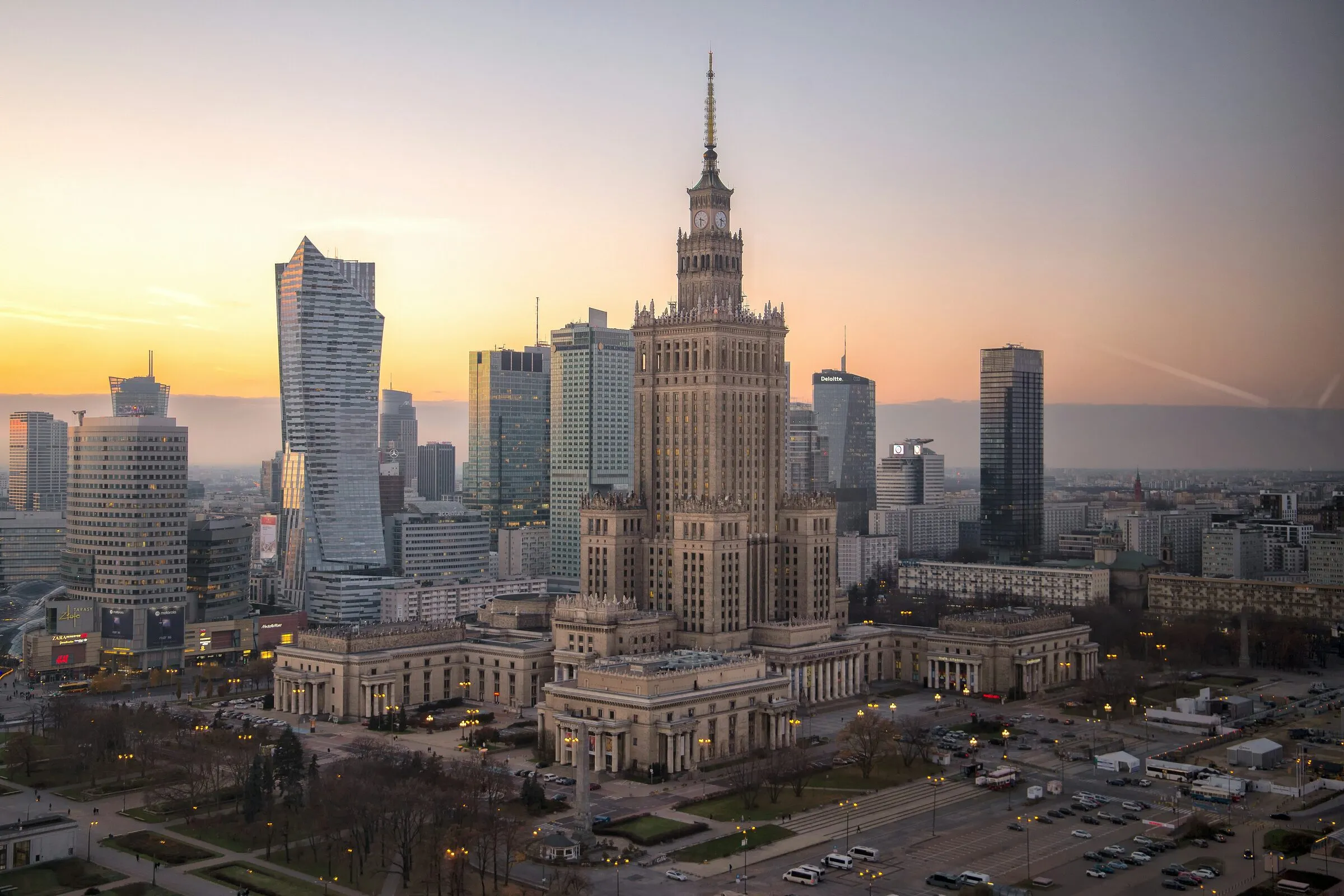
Warsaw is the city that was almost entirely destroyed and rebuilt. In WWII, approximately 85% of the city was demolished — the Nazi systematic bombardment, the Ghetto Uprising (April 1943), the general Warsaw Uprising (August–October 1944), and the Soviet liberation left almost nothing standing. The contemporary Old Town is a carefully reconstructed replica of the pre-war architecture, rebuilt stone-by-stone from photographs and architectural drawings. Walking the rebuilt streets is disorienting — everything is authentic-looking and deliberately inauthentic at the same time.
The Jewish context is central: Warsaw held one of Europe’s largest Jewish populations (380,000 in the 1930s); over 90% were murdered in the Holocaust. The Warsaw Ghetto (the area where all Polish Jews were forced to live) is now a memorial landscape with few original buildings remaining but with plaques, sculptures, and the POLIN Museum marking the history. The Ghetto Uprising (April 1943) is one of the most important acts of Jewish resistance in the Holocaust.
Most clients come to me asking about Warsaw in three contexts: as the centerpiece of a Polish-Jewish Heritage journey, as part of an Eastern Europe multi-city sweep, or as a stop on the way to or from Krakow/Auschwitz.
Here’s how I think about it.
At a Glance
| Best time to visit | May–June and September–October. Spring is mild and the city is emerging. Autumn is clear and cool. Avoid mid-July through August — peak heat and tourists. November–March is cold and gray, but the city is quieter and more reflective (appropriate for the memorial-heavy itinerary). |
| How long to stay | Three–four days minimum for the major sites. Four–five days if engaging with the POLIN Museum deeply and adding Warsaw Uprising sites. |
| How to get there | Warsaw Chopin Airport (WAW) is 10 km south of the city — 20 minutes by shuttle or taxi. Direct flights from major European and U.S. hubs. By train: Krakow to Warsaw is 3 hours (good modern rail service). From Berlin: 6.5 hours (with a possible connection). Warsaw is a major European rail hub. |
| Currency / language | Polish Zloty (PLN). Polish is official; English is increasingly spoken in tourist areas, less in residential neighborhoods. Dzień dobry (hello) and dziękuję (thank you) are appreciated. |
| One thing most guides won’t tell you | The Warsaw Old Town is not “authentic” pre-war architecture — it’s a reconstruction. This is not a negative; the reconstruction is meticulous and historically accurate. But walking the streets knowing they are deliberate reconstructions from photographs and drawings adds a layer of meaning. This is a city dealing with its own erasure and reconstruction. |
Why I Send Travelers Here
Because Warsaw holds one of the most important Jewish heritage stories on earth — and because the city’s approach to memorial and reconstruction is one of the most honest in the world.
The Warsaw Ghetto was the largest ghetto in occupied Europe (380,000 Jews packed into 1.3 square miles). Conditions were catastrophic: overcrowding, starvation, disease. Over 100,000 died of disease before the deportations began. Between July and September 1942, over 300,000 were deported to Treblinka and murdered. In April 1943, the remaining ~55,000 rose up in armed resistance — the Ghetto Uprising — knowing they would lose, choosing to fight rather than be silently deported. The uprising lasted 27 days. Nearly all were murdered.
Today the Ghetto area is memorial landscape — the POLIN Museum (opened 2014) traces 1,000 years of Polish-Jewish history with extraordinary depth and honesty. The Monument to the Ghetto Uprising stands where the uprising began. Plaques and sculptures mark the former streets and buildings.
The broader city context: Warsaw itself was almost entirely destroyed (85% of buildings) and deliberately rebuilt — the Old Town is reconstruction, neighborhoods were redesigned after 1945, the Soviet-era apartment blocks dominate, and contemporary construction is everywhere. The city is a three-dimensional case study in how societies deal with catastrophic erasure and rebuild themselves.
I send travelers here as part of serious Jewish Heritage journeys — understanding the Warsaw Ghetto, the Ghetto Uprising, the pre-war Polish Jewish community, and the post-Holocaust reconstruction is essential. I send history students and intellectuals who want to understand urban destruction and rebuilding. I send travelers on multi-city Polish-Jewish journeys — Warsaw to Krakow to Auschwitz is the arc that many follow. And I send people working through historical trauma and remembrance.
Every recommendation below assumes you’re here to engage seriously with this history.
Where I’d Anchor
Old Town (Stare Miasto). The reconstructed medieval core — beautiful and deliberately inauthentic, which adds meaning. Walking the rebuilt streets knowing they’re reconstructions is part of the experience.
Ghetto Area (Muranów). The memorial landscape where the Ghetto once stood. Staying here puts you geographically in the history.
Powiśle / Krakowskie Przedmieście. The neighborhood south of Old Town, quieter and more residential.
For the Old Town flagship — Raffles Europejski Warsaw (101 rooms, a historic Belle Époque hotel rebuilt after WWII, with the story of survival written into the architecture) is the call. On my rate at the property, the amenity layer is meaningful and doesn’t book direct — what applies depends on your dates and the room category, and the specifics get walked through on the discovery call.
For the historic alternative — Hotel Bristol Warsaw (206 rooms, one of Warsaw’s oldest luxury hotels, rebuilt after WWII, still carrying pre-war elegance) is the companion piece. On my rate at the property, the amenity layer doesn’t book direct, and the specifics — calibrated to your dates and room category — get walked through on the discovery call.
For the contemporary-boutique alternative — H15 Boutique Hotel (9 rooms, in a renovated Art Nouveau townhouse in the Powiśle neighborhood, intimate and contemporary) offers a smaller-scale experience. On my rate at the property, the amenity layer is calibrated to your stay rather than itemized in advance, and we walk through it on the discovery call.
Want one of these stays? Start a discovery call — I’ll help you choose based on whether you prefer Old Town rebuilding (Raffles, Bristol) or contemporary boutique (H15).
What I’d Do With Four Days
Day One — Old Town and Early Ghetto Context
Start at the Old Town Square — the reconstructed medieval core. It’s stunning and deliberately inauthentic, rebuilt after the 1944–45 destruction. The Cathedral stands at the edge. Walk the narrow reconstructed lanes and understand that this is architectural memory, not original stone.
Lunch in the Old Town.
Afternoon: walk toward the Ghetto Memorial Area — the streets are now residential (called Muranów, the rebuilding of the ghetto area after the war), but the geography marks where the wall once stood. The Monument to the Heroes of the Warsaw Ghetto Uprising is the most iconic memorial, commemorating the Jewish resistance that culminated in the April 1943 uprising. Walk the memorial district — street plaques mark the former ghetto boundaries, and the Lost Traces walking tour (with street addresses of important places and events from the ghetto era) guides the geography. See the area before visiting POLIN; the geography gives context.
Dinner near the Ghetto area or back in Old Town.
Day Two — POLIN Museum (Full Day)
The POLIN Museum is one of the world’s most important Jewish museums. The permanent exhibition traces 1,000 years of Polish-Jewish history — pre-medieval through contemporary. The museum doesn’t shy away from tragedy, but frames it within a broader story of culture, creativity, and resilience. The building itself (by Finnish architect Rainer Mahlamäki) uses light, space, and architecture as narrative elements.
Allow 4–5 hours minimum for the permanent exhibition. The Ghetto Uprising exhibition is on the fourth floor — this is emotionally intense material. The documentation, testimonies, and photographs trace the uprising’s history. Take breaks. The museum has a café. POLIN is located opposite the Monument to the Heroes of the Warsaw Ghetto Uprising — you’ll see it as you approach — a powerful entry into the experience.
Lunch or dinner in the museum café or nearby.
Late afternoon: sit quietly somewhere if you need to process.
Day Three — Warsaw Uprising Sites and Broader City
Morning: the Warsaw Uprising Museum and the Pawiak Prison Museum (separate from POLIN, focused on the broader August–October 1944 uprising where the entire city rose up against Nazi occupation, knowing they would lose). The Uprising Museum is in a former power station and uses the building’s industrial space as part of the narrative. The Pawiak Prison held political prisoners and offers additional context on resistance and repression. Allow 2–3 hours combined.
Lunch.
Afternoon: walk the Krakowskie Przedmieście (the main south-running street, with Polish Romantic heritage), visit the National Museum (art and Polish history), or simply walk neighborhoods. The city’s reconstruction narratives are everywhere — new buildings next to pre-war survivors next to Soviet-era blocks.
Dinner in Powiśle or back toward Old Town.
Day Four — Choice Day
Option A: Treblinka Memorial. About 80 km northeast of Warsaw, the Treblinka Concentration Camp Memorial is where over 300,000 from Warsaw (including 300,000+ from the Ghetto) were deported and murdered. It’s one of the most important memorial sites. Requires a full day with travel time. Emotionally very heavy.
Option B: Warsaw Uprising Tour or Day-Trip. The uprising touched the entire city. A guided tour of the key sites and neighborhoods affected adds context. Or visit Praga (the neighborhood east of the Vistula that wasn’t flattened) to see what pre-war Warsaw architecture can look like when it survived.
Option C: Slower Warsaw. Museums you missed, neighborhoods you didn’t reach, sitting with what you’ve learned, reading in cafés, a final walk through Old Town and the Ghetto area.
Specific Things I’d Tell You About
The POLIN Museum is extraordinary and emotionally rigorous. This is one of the world’s most important Jewish museums — not because of the artifacts, but because of the historical and emotional honesty of how the exhibition is framed. The Ghetto and Holocaust are contextualized within the larger story of Polish-Jewish culture and resilience. The building itself (by Rainer Mahlamäki) uses architecture as narrative. Spend time here. This is essential.
The Warsaw Uprising (August–October 1944) is distinct from the Ghetto Uprising (April 1943). The Ghetto Uprising was Jews in the Ghetto resisting deportation and murder. The Warsaw Uprising was the broader city rising up against Nazi occupation in 1944, knowing the Soviets were approaching but also knowing the Germans would devastate the city in response. Over 200,000 died. The city was 85% destroyed. Understanding both uprisings requires understanding Warsaw’s traumatic WWII history.
The Old Town reconstruction is historically accurate and deliberately inauthentic. Every building was rebuilt from photographs and architectural drawings after the 1944–45 destruction. Walking streets you know are reconstructions — knowing what was destroyed and what was carefully rebuilt from documentation — adds a layer of meaning that “authentic medieval streets” wouldn’t have.
Pacing and emotional preparation are essential. POLIN is heavy. The Uprising sites are heavy. The geographic reminders of what was destroyed are heavy. Don’t try to do multiple memorial sites in a single day. Spread the experience across the city days and allow for processing time.
What I’d Skip
Casual walking tours that sensationalize the Uprising. The museums and memorials do the historical work respectfully. Tourist-theater versions that dramatize tragedy are exploitation.
Driving anywhere in central Warsaw. The city is walkable (distances are large but manageable by public transit), the metro is excellent, and traffic is bad. Walk or take the metro.
For Travelers Following Jewish Heritage
Warsaw is essential to understanding modern Jewish history — specifically the destruction of European Jewry. The POLIN Museum is one of the world’s most important Jewish institutions, and the Ghetto Uprising is one of the most significant acts of Jewish resistance in the Holocaust.
Visiting Warsaw requires emotional honesty and pacing. You’re confronting the erasure of 380,000 people and the reconstruction of a city that tried to move forward.
I’m developing a Jewish Heritage trip for 2026 — Warsaw is a significant stop, designed for travelers ready to engage with this history at depth.
For the longer thinking on how I work this thread — what makes it different from other heritage travel, what it earns, and what it doesn’t try to be — read the pillar essay: Jewish heritage travel.
Plan Warsaw With Me
If you’re thinking about Warsaw as a standalone Jewish Heritage city, as part of a Polish-Jewish multi-city journey, as a stop on an Eastern European sweep, or as context for understanding the Warsaw Ghetto and Uprising — that’s exactly the kind of planning I do. A 30-minute discovery call is where it starts. No fee, no pressure. Just the city, your timeline, and what you actually want to understand and honor when you’re standing at the Ghetto Uprising Memorial or inside the POLIN Museum.
Book Your Free Discovery Call →︎
Last updated: April 2026. I keep this guide current. If a museum shifts hours, a memorial changes access, or the city continues its ongoing transformation and reckoning with its history, the page changes. Warsaw changes. The work doesn’t stop when the page goes live.
Plan this trip with me.
A 30-minute discovery call is where it starts. No fee, no pressure.
Book a Discovery Call