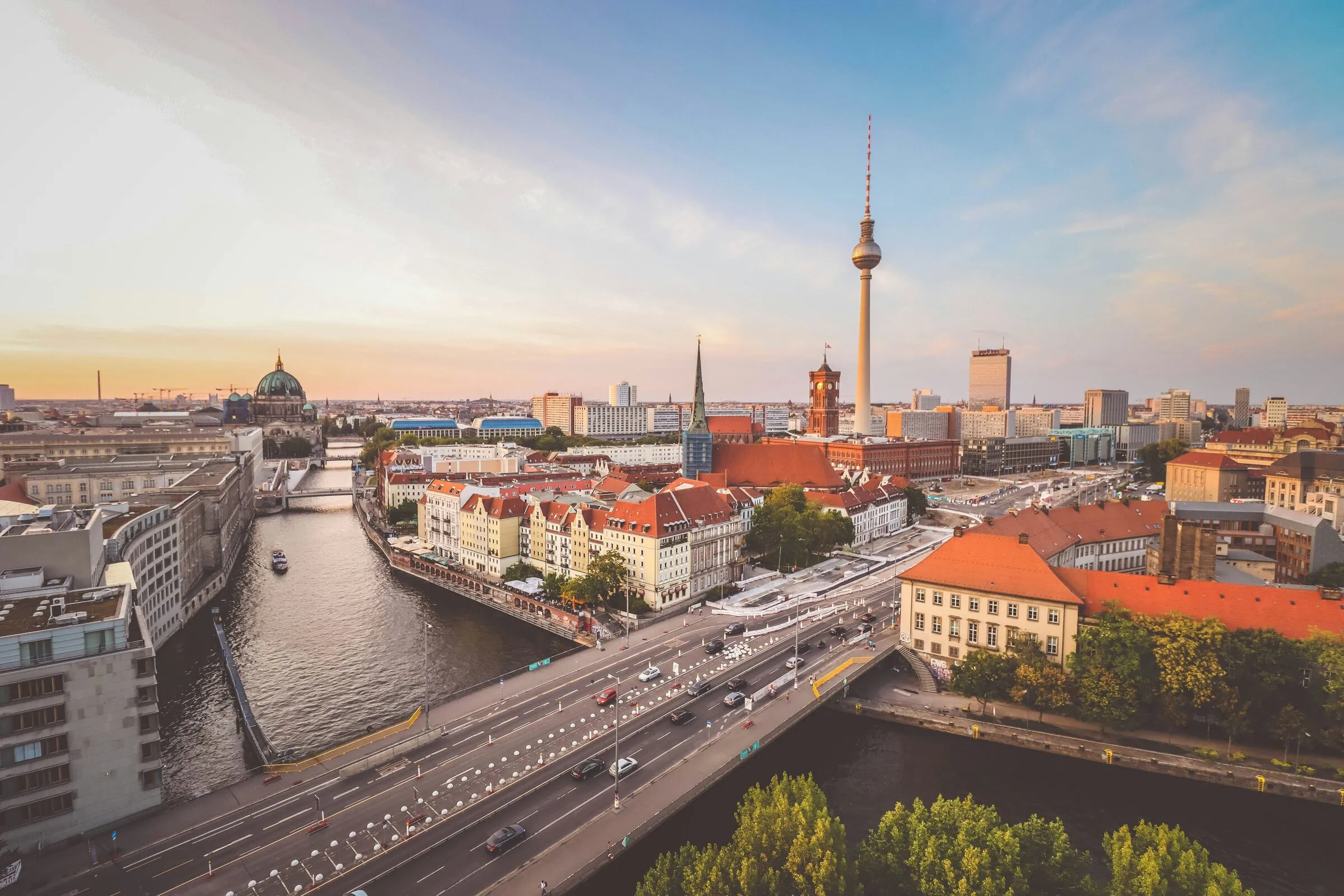
Berlin is the city that forces you to reckon with history in a way that most European capitals don’t. It’s not hidden in churches or museums — it’s in the streets. The Stolpersteine (stumbling stones) embedded in sidewalks commemorate murdered Jews deported from those exact addresses. The remaining wall segments stand as sculptures marking the division of the city. The architecture itself tells a story: pre-WWII Prussian grandeur, Nazi-era buildings, Soviet-bloc brutalist housing, post-1989 reconstruction, and hypercontemporary glass-and-steel development all visible in the same walking distance.
The city was devastated in WWII (bombing, the siege, the Soviet advance), divided after the war (West Berlin was an island of West Germany surrounded by East Germany), became the symbol of Cold War division, and reunified in 1989 with the fall of the wall. The contemporary city is the result of all of that — memorials to the Holocaust and Nazi atrocities everywhere, Cold War sites preserved and marked, and a deliberate post-reunification effort to confront the past rather than hide it.
There is also a vibrant contemporary culture here — one of Europe’s great art scenes, a strong music and nightlife culture, a major LGBTQ+ population and the second-largest Pride in Europe, excellent restaurants and food culture, green spaces and lakes, and a general sense that Berlin is a city still figuring out what it is.
Most clients come to me asking about Berlin in three contexts: as a city of historical and memorial significance (the Holocaust, the Cold War, the Nazi era), as a contemporary cultural and LGBTQ+ destination, or as part of a Central European multi-city sweep.
Here’s how I think about it.
At a Glance
| Best time to visit | May–June and September–October. Spring is warm and the lakes are usable. Autumn is clear and cool. Late July is Berlin Pride / CSD (second-largest in Europe, 500,000+ people) — the city is at maximum energy and maximum price. July–August is warm but crowded and many locals leave. November–February is cold and gray — museums are less crowded and the city is quieter. |
| How long to stay | Three–four days minimum for the major sights. Five–six days if you want to engage with memorials, museums, and neighborhoods at a deliberate pace. The Memorial to the Murdered Jews and Yad Vashem-equivalent depth of engagement takes a full day minimum. |
| How to get there | Berlin’s major airport is Brandenburg (BER), southeast of the city; the old Tegel and Tempelhof airports have both closed. Direct flights from major U.S. gateways. The train system is excellent — direct rail from Prague (4h), Warsaw (6h), Vienna (10h via stops). Berlin is a major European rail hub. |
| Currency / language | Euro. German is official; English is widely spoken in tourist-facing settings, cafés, and restaurants, less so in residential neighborhoods and older venues. Guten Tag (hello) and danke (thank you) are appreciated. |
| One thing most guides won’t tell you | Berlin is huge. The city proper is 900 square kilometers and split into 12 districts. Most tourists focus on Mitte (the historic center), Kreuzberg (bohemian south), and Charlottenburg (western palace area). Don’t try to do the whole city. Pick your neighborhoods and stay walking-distance to them. |
Why I Send Travelers Here
Because Berlin is one of the most historically significant cities in the world — and the German approach to Holocaust and Nazi-era memorialization is the most honest and most substantial of any nation. The city doesn’t hide its history; it confronts it directly.
The Memorial to the Murdered Jews of Europe is one of the world’s major Holocaust memorials — 2,711 concrete stelae covering a full city block, designed by Peter Eisenman to evoke a disorienting sense of loss and grief. The Yad Vashem equivalent is the Memorial and Museum Sachsenhausen, a preserved Nazi concentration camp just outside Berlin that operated from 1936–1945. The Jewish Museum Berlin is one of the world’s great museums — Daniel Libeskind’s building is architecture as emotional experience, and the permanent exhibition traces the history of Jews in Germany from the Middle Ages forward.
Beyond the Holocaust memorials: the remains of the Berlin Wall are preserved as the East Side Gallery (a mile-long section covered in street art and murals); the Checkpoint Charlie, Brandenburg Gate, and Reichstag are Cold War landmarks; the Kaiser Wilhelm Memorial Church (a bombed church left deliberately damaged as an anti-war memorial) is the city’s most iconic structure. The city is a three-dimensional history book.
I send travelers here as the centerpiece of a Jewish Heritage journey — not instead of Israel, but as the context for understanding modern Jewish history and the Holocaust. I send history students and intellectuals who want to understand the 20th century. I send Cold War history enthusiasts. I send LGBTQ+ travelers who want to experience one of Europe’s great queer cities. And I send artists and creatives who want to experience the Berlin art scene and street culture directly.
Every recommendation below comes through the lens of how I plan Berlin for travelers who understand that this city’s weight is part of its power.
Where I’d Anchor
Mitte (City Center). The historic heart, where the Brandenburg Gate, Reichstag, and major museums cluster. Walkable to everything on the tourism radar. Stay here for the central position, but understand that it’s the most touristy neighborhood.
Kreuzberg (South). The bohemian, artsy, politically activist neighborhood south of Mitte — street art, galleries, smaller restaurants, alternative nightlife, and strong Turkish immigrant community. Stay here if you want to experience “real Berlin” and are comfortable with grittier streets and less English.
Charlottenburg (West). The quieter, more residential neighborhood with Charlottenburg Palace and upmarket shopping. Less touristy, more comfortable, smaller walkable area.
For the Mitte historic-luxury flagship — and the property with the most architecturally significant setting — Hotel de Rome on Behrenstrasse (housed in an 1889 Prussian bank building with a three-story neoclassical atrium, 146 rooms, rooftop pool with Reichstag views) is the call. On my rate at the property, the amenity layer is meaningful and doesn’t book direct — pairing the right room to your dates and confirming what applies is the discovery-call conversation, and the rest tends to show up at check-in rather than read as a feature list.
For the contemporary-luxury flagship with the strongest Cold War history connection — Hotel Adlon Kempinski on Unter den Linden (the famous street, overlooking the Brandenburg Gate, 382 rooms, operating since 1907 through WWII, the Cold War, and post-reunification) is the alternative. The hotel was in West Berlin during the Cold War; the views are unmatched. On my rate at the property, the leverage is real and quiet — the amenity layer is calibrated to your specific stay rather than itemized in advance, and a few of the touches are designed to land at check-in.
For the Kreuzberg alternative — Soho House Berlin (contemporary design, 40 rooms, in the heart of the bohemian neighborhood, membership-style club feel) offers the experience of staying where Berlin’s creative class actually lives. On my rate at the property, the amenity layer doesn’t book direct, and the specifics get walked through on the discovery call — what applies depends on your dates and how long you stay.
Want one of these stays? Start a discovery call — I’ll help you choose between historical-Mitte (Hotel de Rome, Adlon) and contemporary-bohemian-Kreuzberg (Soho House) based on what you’re after.
What I’d Do With Four Days
Day One — Mitte Historic Core and the Memorial to the Murdered Jews
Start at the Reichstag (the parliament building) with a pre-booked time-slot for the glass dome designed by Norman Foster — the views over Berlin and the architecture (the dome itself merits up-close inspection) are unmatched. The building itself carries weight: the Nazis set it on fire in 1933 to blame the communists; it was later stormed by Russian troops in 1945 (you can still see graffiti they left behind). From there, walk to the Brandenburg Gate and south to the Memorial to the Murdered Jews of Europe — 2,711 concrete stelae (designed by Peter Eisenman) covering a full city block. Walk slowly through the memorial. Allow 45 minutes to an hour. The design is intentional: the paths are disorienting, the blocks are at varying heights, the experience builds emotional weight as you move through it. Underground is an information center with names and documentation. This is not a casual tourist stop. Treat it with respect.
Lunch in Mitte — Markthalle (food market with stalls) or a small café.
Afternoon: the Jewish Museum Berlin — Libeskind’s building is architecture as emotional experience. The permanent exhibition traces Jewish history in Germany from the Middle Ages through the contemporary period. Allow three hours minimum. The Holocaust exhibition is emotionally intense. Pace yourself and take breaks.
Evening: walk the neighborhood. Dinner in Mitte or back toward Kreuzberg.
Day Two — Cold War Sites and the Wall
Morning: East Side Gallery — the longest remaining section of the Berlin Wall (about 1 mile), now covered with street art and murals. The walk is powerful and surreal — you’re literally walking along what was, for 28 years, a barrier dividing the city and the continent. Allow 90 minutes.
Mid-morning: Checkpoint Charlie (the famous Cold War crossing point) — this is now heavily touristy, with actors in Soviet uniforms posing for photos. The actual Checkpoint Charlie is underwhelming. The meaningful version is understanding what it was.
Lunch in the neighborhood.
Afternoon: Sachsenhausen Memorial and Museum (30 km north of Berlin, a 45-minute train ride). This is a preserved Nazi concentration camp — one of the most important Holocaust-era sites. Plan a full afternoon and emotionally prepare yourself. The camp operated from 1936–1945 and held political prisoners, Jews, Soviet POWs, and others. The barracks, the crematorium, the execution sites are preserved. The museum provides historical context. This is not tourism — this is confronting historical trauma. Allow 3–4 hours minimum.
The train back to Berlin arrives early evening. Dinner quietly, emotionally still processing.
Day Three — Museums and Neighborhoods
Morning: the German Historical Museum (the permanent exhibition traces German history from the Middle Ages through reunification — comprehensive and serious) or the Pergamon Museum (ancient architecture, Egyptian and Islamic art — lighter than the historical museum).
Lunch.
Afternoon: walk Kreuzberg — the bohemian neighborhood with street art, galleries, Turkish restaurants, and the energy of “real Berlin.” No major sights, just atmosphere. Or walk Prenzlauer Berg (the charming, gentrified former-East Berlin neighborhood with independent cafés and shops).
Evening: slower pace. Dinner at a neighborhood restaurant. Walk the streets at dusk.
Day Four — Choice Day
Option A: Charlottenburg Palace and gardens — the major palace west of Mitte, with rooms, gardens, and surrounding museum complex. A full-day excursion.
Option B: The Berlin Wall Memorial (Gedenkstätte Berliner Mauer) — a different memorial site (northeast of Mitte) with the preserved wall section, museum, and meditation space. Less touristy than East Side Gallery, more intentional. The memorial includes an excellent layout of the “death strip” — the space between the inner and outer walls with its 300+ checkpoints and security apparatus — that made the division physically tangible.
Option B-alt: Soviet War Memorials — two significant memorials: the marble memorial in Tiergarten near the Brandenburg Gate (built with marble taken from Hitler’s chancellery, with two Red Army tanks reported to be the first to enter Berlin in 1945); and the larger, more somber memorial in Treptower Park housing 5,000 Soviet soldiers buried in mass grave beneath a tall Red Army soldier statue.
Option C: Slower Berlin — museums you missed, neighborhood walking, reading in a café, second visit to a favorite site.
Specific Things I’d Tell You About
The Stolpersteine are everywhere and their presence is significant. These are small brass plaques embedded in sidewalks, installed directly in front of addresses where Jews (and other targeted groups) lived before deportation and murder. They give names and dates. You’ll encounter them as you walk through daily neighborhoods, seeing the normal life of a block interrupted by the names of people who were murdered. It’s a deliberately uncomfortable memorial strategy — you stumble on them, you look down, you see the name. The impact is profound.
The Memorial to the Murdered Jews and Sachsenhausen require emotional preparation and pacing. These are not optional tourism. If Jewish heritage is part of your reason for visiting Berlin, these are the essential sites. But they are heavy material. Don’t visit both on the same day. Give yourself psychological space between them. Eat well, sleep, process.
The Berlin Wall was real. Checkpoint Charlie is now touristy, but the wall itself was a literal barrier dividing families, the city, and a continent. The East Side Gallery murals are art, but they’re painted on the actual structure that divided the city. That weight doesn’t disappear.
Berlin’s LGBTQ+ culture is visibly prominent. The city has multiple Pride events (the main parade in late July is the second-largest in Europe), queer-specific bars and nightlife, and a general culture where LGBTQ+ life is visible and celebrated. Schöneberg (with historic gay bars operating since the 1970s) and Kreuzberg have the strongest queer presence, though the city overall is queer-friendly. The historic bars survived the Cold War and continue to anchor the contemporary scene.
The restaurants are excellent and notably diverse. The city’s food culture reflects its immigrant communities (Turkish, Middle Eastern, Vietnamese, Eastern European). The Michelin-starred restaurants are serious, but the street food and casual eating is where Berlin’s food culture is most visible.
What I’d Skip
Checkpoint Charlie’s actor-filled tourist theater. The site has historical significance, but the contemporary experience is commercialized. The East Side Gallery is a far more meaningful wall experience.
“Nazi Berlin” walking tours that sensationalize or dramatize. If you want to understand the history, the museums and memorials do the work respectfully. The tourist-theater versions of “Nazi Berlin tours” are exploitation.
Driving anywhere in central Berlin. The city is walkable, the U-Bahn and S-Bahn (subway and light rail) are excellent, and traffic is bad. Walk or take the train.
For Travelers Following Jewish Heritage
Berlin is the city where modern anti-Semitism culminated in the Holocaust, and where memorialization and historical reckoning have been most substantial. The Memorial to the Murdered Jews, the Jewish Museum, the Stolpersteine, and Sachsenhausen form the essential arc for understanding this history.
Visiting Berlin as a Jewish traveler — encountering the places where the Jewish community was destroyed and where the best memorialization efforts exist — is profound work. Many Jewish travelers report that visiting Berlin is essential to understanding their own identity and history, even (or especially) if they have no family connection to Germany.
The contemporary Jewish community in Berlin has been rebuilding since the 1990s — the New Synagogue (rebuilt after WWII destruction) is active, and there’s a growing cultural scene. But the overwhelming weight is historical loss.
I’m developing a Jewish Heritage trip for 2026 — Berlin is a major stop, and the trip is designed to engage with these sites and histories with intention and care.
For the longer thinking on how I work this thread — what makes it different from other heritage travel, what it earns, and what it doesn’t try to be — read the pillar essay: Jewish heritage travel.
For Cold War History Travelers
The Berlin Wall, Checkpoint Charlie, the division of the city, and the reunification are the defining Cold War story. Walk the East Side Gallery, visit the Wall Memorial, stand at Checkpoint Charlie and imagine the barrier that was there. The contemporary city itself tells the Cold War story in its architecture and layout.
For LGBTQ Travelers
Berlin is one of Europe’s great queer cities — Schöneberg has historic gay bars; Kreuzberg has contemporary queer culture; the Berlin Pride Festival / CSD (late July) is the second-largest in Europe with 500,000+ people. The city has multiple LGBTQ+ museums and cultural institutions.
Late-July Pride visits are at maximum price and maximum density, but the energy is specific and worth experiencing if Pride culture matters to you.
Plan Berlin With Me
If you’re thinking about Berlin as the centerpiece of a Jewish Heritage journey, as a Cold War history exploration, as a contemporary cultural destination, or as part of a Central European multi-city arc — that’s exactly the kind of planning I do. A 30-minute discovery call is where it starts. No fee, no pressure. Just the city, your timeline, and what you actually want to understand and confront when you’re standing in the Memorial to the Murdered Jews or walking the Wall.
Book Your Free Discovery Call →︎
Last updated: April 2026. I keep this guide current. If a memorial changes access, a museum shifts hours, or the city continues its constant reconstruction, the page changes. Berlin changes. The work doesn’t stop when the page goes live.
Plan this trip with me.
A 30-minute discovery call is where it starts. No fee, no pressure.
Book a Discovery Call