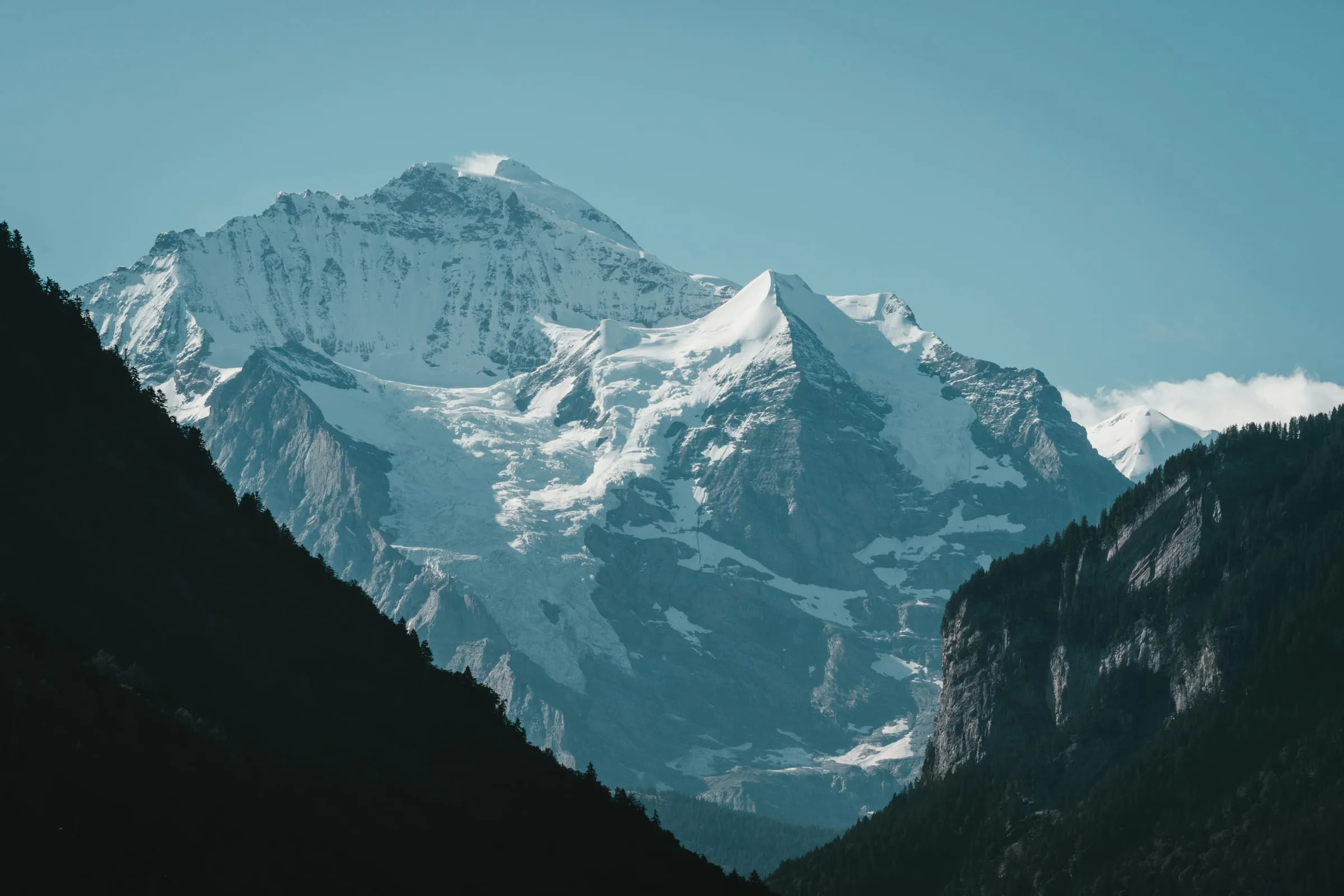
Interlaken has a planning problem that almost no other Swiss town has: travelers know its name, can’t quite picture what it offers, and end up using it as a one-night transit pause between Bern and somewhere they think will be more interesting. The framing is wrong on every level. Interlaken — the town between two lakes, Lake Thun to the south and Lake Brienz to the north — is the staging area for the Bernese Oberland, and the Bernese Oberland is the alpine region most travelers, once they’ve spent four days in it, decide is the version of Switzerland they wish they’d planned the whole trip around. The Eiger, the Mönch, and the Jungfrau form a continuous wall visible from the Interlaken waterfront. The Jungfrau Railway burrows up through the Eiger’s interior to Jungfraujoch — 3,454 meters, glacier access, the longest glacier in the Alps spread out at your feet — without anyone needing to climb anything. And the small mountain villages above the valley — Wengen, Mürren, Grindelwald, Lauterbrunnen — deliver a category of romance that the more famous Swiss alpine anchors can’t quite match because they’re working in a different register.
Most clients come to me asking about the region in three contexts: as a three-to-four-night honeymoon anchor (Interlaken for the Grand Hotel, the Jungfrau region for the day-trips, the soft-infrastructure version of an alpine trip), as a day-trip from a Bern base in a multi-city Swiss week (forty minutes by train, the most efficient way to fold the Alps into a Bern-anchored itinerary), or as a first-time Alpine introduction for travelers new to mountain travel — the region’s infrastructure is the most transparent in the country, the trails are the most clearly marked, the cable cars work the most predictably, and nothing in the experience asks for fitness or expertise the traveler doesn’t have.
Here’s how I think about it.
At a Glance
| Best time to visit | Late June through mid-September for full operations — every cable car running, Jungfraujoch fully open, mountain restaurants fully staffed, the meadow flowers at peak. December through March for skiing in Wengen, Mürren, and Grindelwald. Avoid May and late October–November — shoulder seasons here mean partial closures and weather instability. |
| How long to stay | Three nights minimum if Interlaken is the anchor; four to five nights to genuinely use the region (Jungfraujoch day, Lauterbrunnen Valley day, mountain-village overnight, Interlaken slow day). Seven nights if you’re basing in the region rather than day-tripping in. |
| How to get there | Direct train from Zurich in 2 hours, from Bern in 50 minutes (the 40-minute number some sources quote is the express; expect closer to 50 in practice), from Lucerne in 2 hours via the scenic Brünig Pass. The Brünig Pass route from Lucerne is itself one of the country’s underrated train rides. |
| Currency / language | Swiss Franc (CHF). German is the cantonal language; the Bernese-German dialect lingers in the older valleys but English is universal. |
| One thing most guides won’t tell you | The town of Interlaken is the base camp, not the destination. The romance lives up the mountain, in the four small alpine villages above the valley — Wengen, Mürren, Lauterbrunnen, and Grindelwald — each with a distinct character. Travelers who base in Interlaken for the hotel and day-trip up are doing it correctly. Travelers who never leave Interlaken’s pedestrian street miss the whole region. |
Why I Send Travelers Here
Because the Bernese Oberland is the Swiss alpine region that delivers the most for the smallest fitness ask. Three iconic peaks frame the valley — the Eiger at 3,970 meters, the Mönch at 4,107 meters, the Jungfrau at 4,158 meters — visible from almost every Interlaken hotel terrace, every Jungfrau-region cable car, every meadow walk. Glacier access is by train, not by climb: the Jungfrau Railway runs from Kleine Scheidegg up through the interior of the Eiger (with viewing windows cut into the north face along the way) to the Jungfraujoch saddle at 3,454 meters, where the Aletsch Glacier — the longest in the Alps — opens up beneath you. No altitude course, no rope work, no fitness required beyond a willingness to ride two cogwheel trains for two-and-a-half hours each way. The whole experience feels like cheating, and it isn’t.
The region’s second register is the small mountain villages above the valley floor. Wengen sits car-free at 1,274 meters on a meadow shelf above Lauterbrunnen, reached only by cable car, and runs at the slow rhythm of a place that decided about a hundred years ago not to let the cars in. Mürren is higher and quieter still — 1,638 meters, equally car-free, on the opposite valley wall — and its Schilthorn cable car climbs to the Piz Gloria summit at 2,970 meters, which most travelers know as the rotating-restaurant location from the Bond film On Her Majesty’s Secret Service. Grindelwald is the larger and more accessible alpine-village option, with the Eiger’s north face filling the sky directly above the town. Lauterbrunnen sits on the valley floor proper — the famous narrow valley with seventy-two waterfalls dropping from the cliffs on either side, the geography that inspired Tolkien’s Rivendell. Each of the four delivers a different version of the same alpine register; the choice between them is the conversation the discovery call is built for.
I’m a traveling travel agent — I sit with vendors at industry conferences, I keep my supplier relationships current, I know the circles you can’t book through a search bar. Like Zermatt, the Bernese Oberland is one of the regions I plan through consortium relationships rather than a personal property line, and I’ll be straight about that distinction on the discovery call rather than overclaim a relationship I don’t have.
I send travelers here for soft-infrastructure honeymoons — the romance-with-comfort register that contrasts with Zermatt’s romance-with-stakes. I send couples for first-Alps-trips because the region forgives more inexperience than the southern alpine anchors do. I send rare clients for multi-day hut-to-hut hiking because the trail networks above Wengen and Mürren are some of the most rewarding in the country. And I send the most travelers here as the alpine day-trip from a Bern base in a multi-city Swiss week — the easiest, most efficient way to put the Alps in a country-wide itinerary without giving up Bern’s strategic centrality.
Where I’d Anchor
The region’s anchoring decision splits cleanly between base in Interlaken proper (the town at the lakefront, full Grand Hotel infrastructure, day-trip everywhere) and base in one of the alpine villages above (slower, quieter, and the village itself becomes part of the trip). Both are valid; the right answer depends on the traveler.
Interlaken proper — Victoria-Jungfrau Grand Hotel. Built in 1865 on the lakefront with the Jungfrau filling the windows, this is the region’s classic Grand Hotel — the kind of property where couples have returned across generations because nothing has been allowed to change in the ways that would break the experience. Five minutes’ walk from the Interlaken Ost train station for the Jungfraujoch run, central to every regional cable car connection, and with the kind of spa and dining infrastructure that makes the rest day between mountain days feel earned rather than wasted. This is the anchor for the soft-infrastructure honeymoon shape, and it’s what I’d pair with a four-or-five-night Interlaken-base trip.
Wengen — the car-free meadow village above the valley. Reached only by cable car from Lauterbrunnen, Wengen is the small-village version of the trip: a hundred or so chalets and small hotels, no traffic at all, the Jungfrau directly across the valley, and a pace that quiets the trip the moment you arrive. Hotel Beausite and the Hotel Regina are the longstanding anchors here. This is the play for couples who want the trip itself to slow them down — who’d rather wake up on the meadow than ride a cable car up to one. Trade-off: the cable-car rhythm becomes a daily commute, and rainy days at altitude can feel longer than they would in town.
Mürren — higher and quieter still. The harder-to-reach version of Wengen, on the opposite valley wall, with the Piz Gloria / Schilthorn cable car as the headline excursion. Mürren is for the second-Switzerland-trip traveler who already knows the region and wants the most withdrawn version of it — fewer hotels, fewer day-trippers, more weather, more silence.
Grindelwald — the larger, more conventional alpine-village base. Easier to reach (direct train from Interlaken East), more amenities, more restaurants, more of a town than Wengen or Mürren. The Eiger sits directly above the village, which is dramatic in a way the photos undersell. Grindelwald is the right anchor for travelers who want to be in the alpine village register without quite the slowness or the access trade-offs of the higher car-free villages.
I’ll be straight on the relationship layer: Victoria-Jungfrau, the Wengen and Mürren village hotels, and the Grindelwald properties are anchors I plan through my consortium relationships — the room categories and amenity strategy come through those channels rather than a personal GM-level line. The trip still books cleanly — preferred-rate amenities, room-category strategy, on-arrival escalation if anything goes sideways — and the discovery call is where we pull live availability and walk through which one matches your dates.
Start a discovery call — I’ll pull live availability, walk through suite categories at the in-town and village anchors, and confirm which amenities apply to your dates.
What I’d Do With Three or Four Days
Adjust to taste. The three-day version delivers the headline experiences; the four-day version adds either a slower village day or a deeper hike.
Day One — Arrival and lakefront slowness
Arrive by train, settle into the hotel by mid-afternoon, and do not over-schedule the first day. Walk along the Höheweg promenade — the open lakefront stretch with the Jungfrau filling the south view — and pause to watch the paragliders descending from Beatenberg (Interlaken is one of Europe’s busiest paragliding launch points, and the patterns over the lake are one of the small unexpected pleasures of arriving here). Easy lakefront dinner. Bed early — Day Two starts before dawn.
Day Two — Jungfraujoch as the headline day
The signature experience of the region. Catch the early Jungfrau Railway departure from Interlaken Ost (the first train, before the day-tripper buses arrive); two-and-a-half hours up via Lauterbrunnen and Kleine Scheidegg, with the cogwheel section through the Eiger’s interior. At the summit station — 3,454 meters — give yourself three to four hours: the Sphinx Observatory deck for the Aletsch Glacier panorama, the Ice Palace cut into the glacier itself, the short marked walk on the snowfield outside (weather permitting), and lunch at the Top of Europe restaurant. Train back to Interlaken by mid-afternoon. The whole day is almost nine hours; don’t try to add anything else to it. Spa or quiet evening.
Day Three — Lauterbrunnen Valley and a village afternoon
The slower counterpart to the Jungfraujoch day. Train from Interlaken to Lauterbrunnen (twenty minutes), walk the valley floor (the seventy-two-waterfalls geography is genuinely affecting in person — Staubbach Falls is the headline at 297 meters), and take the cable car up to Wengen for a long lunch and a meadow walk. Cable car back down by late afternoon, train back to Interlaken. (For couples who want the deeper version: stay overnight in Wengen on Day Three and catch the morning trains the next day.)
Day Four — The hiking deepen, the Schilthorn day, or departure
Three serious options for a fourth day. The hike-forward play: First above Grindelwald, with the Bachalpsee trail that delivers Eiger reflections in alpine lake water (moderate, three to four hours, lunch at Bachalpsee Restaurant). The Schilthorn play: cable car from Lauterbrunnen via Mürren up to Piz Gloria at 2,970 meters, the rotating restaurant, the Bond-film exhibit, and the panoramic balcony with Mont Blanc visible on a clear day. The departure play: morning walk along the lake, late breakfast, train out to Bern or Zurich. None is wrong.
Specific Things I’d Tell You About
The Jungfraujoch experience is theater, but it’s good theater. The “Top of Europe” branding is marketing — Jungfraujoch is the highest train station in Europe, not the highest point. But the experience itself is genuinely affecting. The Eiger tunnel section, the panorama at the Sphinx deck, the strangeness of standing on a glacier you reached by sitting in a train seat — it earns the trip. Block the whole day for it; don’t try to cram a half-day version.
Lauterbrunnen Valley is the Tolkien valley. Tolkien hiked the valley in the 1910s and the topography of Rivendell came directly out of it. If you’ve read The Lord of the Rings you’ll feel it standing on the valley floor. If you haven’t, you’ll just notice the geography is slightly more dramatic than it has any right to be — the cliff walls are taller, the waterfalls drop further, the meadows feel more open. There’s a reason every major fantasy filmmaker has scouted this valley.
Cable cars and cogwheel railways are how locals move. Schilthorn Bahn, Jungfrau Railway, Männlichen Bahn, the Wengen and Mürren cable cars, the Grindelwald-First gondola — these aren’t novelty rides for tourists. The villages above the valley genuinely depend on them, and that’s why they run on time and stop running in weather rather than half-running through it. The Swiss Travel Pass covers the regional network at a flat rate; for a couple doing two or three major cable-car days across a four-night stay, it usually pays for itself.
Weather is a morning decision here, more than anywhere else in Switzerland. Cloud rises off the two lakes and parks on the alpine wall in patterns that change on the hour. The Jungfrau can be perfectly clear at six in the morning and shrouded by ten. Concierges know this; ask at breakfast what’s realistic today, and don’t rage when the schedule shifts. The local rhythm is plan for the variable — one hard-target mountain day, one floating village-and-spa day to slot against weather.
The mountain restaurants are quietly excellent. Bachalpsee Restaurant above Grindelwald, the restaurant complex at Kleine Scheidegg, the rotating Piz Gloria at the Schilthorn summit, Restaurant Allmendhubel above Mürren — these are real meals at altitude, not concession stands. Reserve a week ahead in season. Bring small cash; not every spot at altitude takes cards reliably.
The Eiger is above you, always visible from Grindelwald. The north face is one of the most famous and historically deadly climbs in the Alps. From Grindelwald, on a clear morning with binoculars, you can sometimes spot climbers on the wall — small, deliberate movements against the gray rock. It adds a register of seriousness to the alpine experience that the rest of the region’s softness sometimes obscures: those are real people doing a genuinely dangerous thing, visible from a coffee table on the valley floor.
What I’d Skip
Interlaken in November or May. Shoulder seasons here are the worst version of this region — partial cable-car closures, half-staffed mountain restaurants, weather that closes the higher routes for days at a time. Wait for late June or hold for December.
Jungfraujoch as a half-day side trip. Travelers sometimes try to compress it into a morning excursion from a Bern base. The math doesn’t work: the round trip from Bern is over five hours of train-and-cogwheel, plus the summit time you actually came for. Either give it a full day or don’t do it.
Walking the Lauterbrunnen Valley floor in heavy rain. The waterfalls are spectacular when it’s been raining — the volumes are dramatic — but the valley itself becomes muddy and the waterfall mist soaks everything. If the morning forecast is solid rain, switch to a Mürren cable-car day instead and let the valley dry out for tomorrow.
Booking cable cars without a weather-flex day. Travelers who arrive with a fixed-schedule itinerary — Jungfraujoch on Tuesday, Schilthorn on Wednesday, First on Thursday — get burned more often than they expect. Build one floating day into the trip that can flex against the morning forecast.
For Honeymooners
The Bernese Oberland is the Swiss region most explicitly built for the honeymoon shape, and the framing here is the one I’d lead with: this is honeymoon work in the pragmatic register the practice handles it in — expert execution, not magic-of-love copy. The Victoria-Jungfrau is the in-town anchor, the Wengen and Mürren village hotels are the slower-tempo alternative, Grindelwald is the easier-access alpine-village option. The cable car at sunset, the dinner with the Jungfrau in the window, the spa appointment timed away from group bookings, the room category that delivers the view that the photos will keep — all of it is structural rather than sentimental, which is why it works. The contrast worth flagging again: travelers choosing between the Bernese Oberland and Zermatt are choosing between romance with infrastructure and romance with stakes. Both are correct; the discovery call is where we figure out which one is yours. The Switzerland honeymoons specialty page makes the long-form case across both registers.
For First-Time Alpine Travelers
The Bernese Oberland is the right Swiss introduction. Infrastructure is transparent — every train and cable car is bilingual, every trail is numbered and color-coded, every mountain restaurant takes English orders. Altitude is high but accessible: you reach 3,454 meters on the Jungfraujoch by train, with the experience built around comfort rather than physical challenge. Hiking ranges from gentle valley-floor walks to serious alpine traverses, and you can scale your own ambition without committing in advance. The villages are preserved without being remote. Most importantly, the region’s smaller-scale alpine register is forgiving in a way that Zermatt’s intensity isn’t — first-time alpine travelers leave Interlaken energized rather than overwhelmed. Start here, then graduate to Zermatt on the second Switzerland trip.
Multi-City Switzerland Pairing
The region pairs cleanly with the rest of the country.
With Bern as the primary base — fifty minutes by direct train, the most efficient way to fold the Alps into a multi-city Swiss week without giving up the Old Town’s centrality. This is the version of Switzerland I plan most often.
With Lucerne as the lake counterpoint — two hours by the scenic Brünig Pass route. Lucerne first, then the Bernese Oberland, then back to Bern or out to Zurich. The contrast between lake-town pace and alpine-village rhythm is the trip.
With Zermatt as the alpine deepen — four hours by train via Brig. Most travelers do one or the other, not both — they’re alpine registers in different keys. Couples who do both are usually on second or third Switzerland trips.
Plan Interlaken & the Jungfrau Region With Me
The Bernese Oberland is the alpine region most rewarded by an advisor who knows the difference between an Interlaken base and a Wengen base, between a Jungfraujoch day and a Schilthorn day, between the village that fits your trip and the one that doesn’t. Start with a 30-minute discovery call — I’ll walk through the anchor decision, the day-by-day shape, and whether the right play for your trip is a four-night Bernese Oberland anchor or a clean one-day visit from a Bern base.
Last updated: April 2026. Hotel relationships and amenity layers calibrated to current consortium rates as of publication; specifics walked through on the discovery call.
Plan this trip with me.
A 30-minute discovery call is where it starts. No fee, no pressure.
Book a Discovery Call