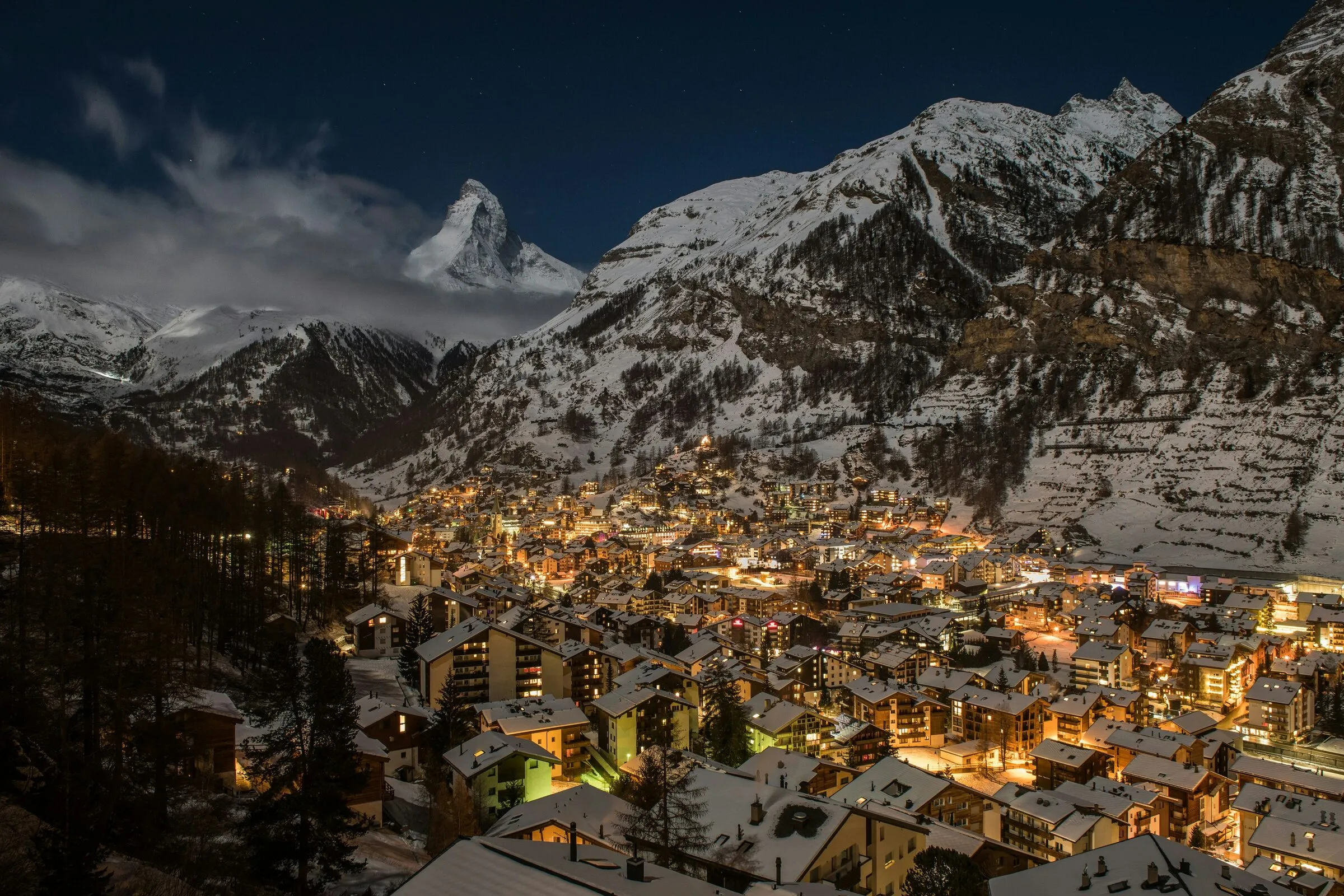
Zermatt is the Swiss anchor that travelers either book as the trip itself or skip entirely. There isn’t much middle ground — and that’s the planning answer most clients need to hear before the rest of the conversation makes sense. The village is car-free by Swiss federal law, sits at 1,616 meters at the closed end of the Mattertal valley, and exists in the daily presence of one of the most insistent mountains on the continent. The Matterhorn isn’t a backdrop here. It’s the shape of every conversation, every hotel terrace, every restaurant window, every morning the weather lifts and every afternoon it doesn’t. Travelers who book Zermatt expecting a casual alpine stop are usually overwhelmed; travelers who book it as the headline of a trip leave changed by it. The country itself sorts those two camps quickly.
Most clients come to me asking about Zermatt in three contexts: as a three-to-four-night honeymoon or anniversary anchor (the most common — a single hotel, the Gornergrat sunrise, mountain-restaurant lunches, the mountain as the whole frame), as the alpine close of a multi-city Swiss week (Bern →︎ Lucerne →︎ Zermatt by scenic train, with the Glacier Express as the optional eight-hour exit), or as a serious hiker’s base for a week of valley-to-altitude routes that builds toward the Hörnli Hut without anyone actually trying to summit. Zermatt rewards intention, and the wrong intention shows quickly.
Here’s how I think about it.
At a Glance
| Best time to visit | Late June through mid-September for hiking — trails fully open, mountain restaurants fully staffed, the Gornergrat sunrise window at its most reliable. December through March for skiing. Avoid late October through early December and April through early June — shoulder seasons here mean partial cable-car closures, unpredictable weather, and the village in low-staff mode. |
| How long to stay | Three nights minimum to get the rhythm — one altitude day, one hiking day, one slow village day. Four to five nights is the version most couples actually want. Longer than seven without expanding to a second region tips into diminishing returns. |
| How to get there | The village is car-free. Most travelers leave the car or rental in Täsch (twelve minutes by frequent shuttle train) or arrive entirely by rail. Train from Zurich is roughly 3.5 hours via Visp; from Geneva roughly 3.5 hours; from Bern roughly 2 hours; from Milan roughly 5 hours via the scenic Brig route. The arrival itself — the slow climb up the valley with the Matterhorn growing in the train window — is part of the trip. |
| Currency / language | Swiss Franc (CHF). German is the cantonal language; Zermatt’s local dialect is its own thing, but English is universal in tourist-facing settings. |
| One thing most guides won’t tell you | The Matterhorn is not a day hike. It is a technical alpine climb requiring rock scrambling, rope work, a registered mountain guide, and three days (one to the Hörnli Hut, one to the summit, one to descend). It kills people every year — usually not because the route is poorly marked but because travelers underestimate it. The smart play, even for experienced hikers, is to walk toward the mountain (to viewpoints, to the Hörnli Hut, to the ridges that frame it) rather than try to top it. |
Why I Send Travelers Here
Because Zermatt is the Swiss village where the mountain itself does the work of the trip. Other Swiss destinations have great hotels, great restaurants, and great views. Zermatt has those, and on top of them it has the Matterhorn — which becomes less iconic and more present the longer you’re there, until it stops feeling like a postcard and starts feeling like a member of the household. You wake up to it. You eat breakfast with it. You watch it shift through five colors at sunset and then catch the moonlight on it from your room. Travelers who want the Alps to be a context for romance go to Lucerne or the Bernese Oberland. Travelers who want the Alps to be the whole point come here.
The car-free village is the second piece. No traffic, no exhaust, no horns. Movement is by foot, by electric shuttle bus, or by cable car, and the pace that creates is fundamentally slower — couples find this romantic, hikers find it clarifying, and almost no one reverts to checking their phone the way they would in a city break. The village runs on five thousand year-round residents and a hospitality industry that’s been doing this since the 1850s; the rough edges have been worn smooth by 175 years of getting it right.
The mountain restaurants are the third piece, and they’re a category most travelers underestimate until they’ve eaten at one. A sit-down, multi-course, wine-paired lunch at 2,000 meters, served by waitstaff in mountain gear, with the Matterhorn shifting in the afternoon light — this is not a niche experience here. It’s how the village eats lunch when it’s outside. The good ones get reserved a week ahead.
I’m a traveling travel agent — I sit with vendors at industry conferences, I keep my supplier relationships current, I know the circles you can’t book through a search bar. Zermatt is one of the destinations I plan through consortium relationships rather than a personal property line — the room categories and amenity strategy come through those channels, and I’ll be straight about that distinction on the discovery call rather than overclaim a relationship I don’t have.
I send travelers here for alpine-intensity honeymoons — the kind of romance with stakes that the Bernese Oberland’s softer infrastructure can’t produce, where the deliberate weight of the mountain is the point. I send couples for second-Switzerland-trip anniversaries when they already know Lucerne or Bern and want the version of the country they missed the first time. I send serious hikers for valley-to-altitude weeks — three to five days of steady walking that builds toward Schwarzsee and the ridges below the Hörnli Hut. And I send rare travelers here as the alpine close of a multi-city week, with the Glacier Express as the eight-hour exit toward St. Moritz or Lucerne.
Where I’d Anchor
There are essentially three anchoring shapes in Zermatt, and the right one depends almost entirely on the trip you’re building.
The classic in-village Grand Hotel — Mont Cervin Palace. Opened 1851, central to the village pedestrian street, direct Matterhorn views from the terrace, and one of the longest continuously operating Grand Hotels in the Alps. This is the anchor for travelers whose Zermatt is about the hotel-and-mountain combination — a hundred meters from the main shopping street, walking distance to every cable car base, the kind of property that has couples returning across decades. The trade-off is that it’s central — you’re staying in the village proper, with the village’s small bustle, not above it.
The modern alternative, 45 minutes east — The Chedi Andermatt. Not in Zermatt — it’s a contemporary spa-led property in Andermatt, an alpine village 45 minutes by train via the scenic route through the Furka Pass. I’d send couples here when the brief is modern luxury, spa-focused, fewer tourists, more tranquility, and when the Matterhorn is less the point than the alpine register itself. Andermatt is also the natural pairing for the Glacier Express, which originates there before continuing to Zermatt or St. Moritz.
The altitude immersion — Riffelalp Resort 2222. Reached only by cogwheel railway from Zermatt up to 2,222 meters, this is the anchor for couples or hikers who want to be in the Alps rather than beside them. Sixty rooms, no cars, no ambient noise except weather, and the kind of dinner-at-altitude rhythm that turns the trip into something closer to a retreat than a vacation. The trade-off is access — every supply run, every village dinner, every cable-car-to-elsewhere requires the cogwheel descent. For the right traveler, that’s the feature, not the bug.
I’ll be straight on the relationship layer: Mont Cervin Palace, The Chedi Andermatt, and Riffelalp are properties I plan through my consortium relationships — the room categories and amenity strategy come through those channels rather than a personal GM-level line at the property. The trip still books cleanly — preferred-rate amenities, room-category strategy, on-arrival escalation if anything goes sideways — and the discovery call is where we pull live availability and walk through which one matches your dates.
Start a discovery call — I’ll pull live availability, walk through suite categories at all three anchors, and confirm which amenities apply to your dates.
What I’d Do With Three or Four Days
Adjust to taste. The three-day version covers the essential rhythm; the four-day version adds either a hiking deepening or a scenic-train day.
Day One — Arrival and the slow first afternoon
Arrive by train. Leave any rental in Täsch and take the twelve-minute shuttle into the village. Check in by mid-afternoon and do not over-schedule the first day — Zermatt is at 1,616 meters and even fit travelers feel the altitude in subtle ways the first night. Walk the village pedestrian street, visit the small Matterhorn Museum (the climbing-history exhibition is genuinely interesting and takes about an hour), and have an unhurried dinner. Bed early.
Day Two — The altitude day
The defining Zermatt day. Take the Gornergrat cogwheel railway up to 3,089 meters — the trip that delivers the Matterhorn’s broadside view alongside the Monte Rosa massif and the Gorner Glacier. The early-morning departure (first train, before the day-trip crowds arrive) is the better play if you can manage it. Spend two hours at the summit station, walk the short ridge trails, eat lunch at one of the mountain restaurants on the way down, and ride the cogwheel back to the village in the early afternoon. Spa hour or village walk before dinner. (For travelers without altitude concerns, Klein Matterhorn at 3,899 meters — Europe’s highest cable car — is the alternative. Skip it if you have any altitude sensitivity; Gornergrat delivers the same emotional payoff with two-thirds the effort on your lungs.)
Day Three — The hiking day or the slower village rhythm
Two paths, both legitimate. The active version: the Five Lakes Walk (a four-hour moderate route between Stellisee, Grindjisee, Grünsee, Moosjisee, and Leisee, with Matterhorn reflections at most of them and a mountain-restaurant lunch at the trail’s natural midpoint). The slower version: a leisurely cogwheel ride to Sunnegga, a gentle two-hour walk along the panoramic balcony trails, lunch at a mountain restaurant, and an unhurried afternoon in the village — bookstore, café, cheese shop, bath. Neither is the “right” answer; the right answer depends on which Zermatt you came for.
Day Four — The deepen, the scenic train, or departure
If you have a fourth day: a sunrise return to Gornergrat (the early light on the Matterhorn is the photo of the trip), or a half-day at Schwarzsee with a hike toward the Hörnli Hut viewpoint, or — for the multi-city week — a same-day departure on the Glacier Express toward St. Moritz or backward toward Andermatt and Lucerne. If you’re ending the trip here, the morning village rhythm is its own goodbye: bakery, lakefront, train.
Specific Things I’d Tell You About
Altitude affects people in unpredictable ways. Zermatt at 1,616 meters is already high; cable cars reach into the 3,000s and 4,000s. Some travelers feel nothing. Others get a headache, mild nausea, or a disrupted first night’s sleep. The standard mitigation is the same everywhere: arrive a day early, rest the first afternoon, hydrate constantly, eat simple food, hold off alcohol on day one. Most people acclimate within twenty-four hours. If you have any history of altitude sensitivity, skip Klein Matterhorn entirely and stay on Gornergrat’s 3,089-meter ceiling.
Weather closes mountains and changes hourly. Cloud cover can shroud the Matterhorn by ten in the morning after a clear sunrise, and cable cars close in wind without much warning. The local culture around this is flexibility — your hotel concierge knows the daily window at breakfast and will tell you what’s realistic today rather than what was realistic yesterday. Travelers who arrive expecting the Instagram-perfect Matterhorn photo on a fixed schedule are sometimes disappointed; travelers who plan one hard-target day for the mountain and one floating spa-and-village day for the weather almost always get both.
Mountain restaurants are reservations, not walk-ins, in season. Schwarzsee Restaurant, Chez Vrony, Findlerhof, Edelweiss Point at Gornergrat — these are the meals you’ll remember from the trip. Reserve a week ahead in summer; show up unbooked at one in the afternoon and you’ll eat sandwiches you packed yourself. Bring small cash; not every spot at altitude takes cards reliably.
The light on the Matterhorn is the photograph nobody warned you about. Sunrise from Gornergrat lights the east face gold for about fifteen minutes before the rest of the sky catches up. Sunset from the village turns the snow pink. Afternoon clouds part suddenly — the local saying is “the mountain shows itself when it wants to.” If photography matters to you, plan one early-rise day for sunrise at altitude and one late-light evening at the village’s iron pedestrian bridge over the Matter Vispa river.
Winter is a different country. October through May, Zermatt becomes a serious ski resort — the vertical is over 2,000 meters, the snow is reliable thanks to the glacier coverage, and the après-ski rhythm has its own character. If you ski, the winter version of this trip is the one to plan first. If you don’t ski, summer is when the village is most fully itself.
What I’d Skip
Zermatt in April or November. Shoulder season here is a planning trap — partial cable-car closures, unstable weather, half-staffed restaurants, mud underfoot on lower trails, snow on upper trails, and the village in low-energy mode. Wait for late June or hold for December.
Klein Matterhorn if you have any altitude sensitivity. 3,899 meters is real altitude, and the cable car gets you there in twenty minutes from a starting altitude that already had you breathing harder than usual. Gornergrat at 3,089 meters delivers most of the emotional payoff with a fraction of the physiological strain.
An attempt at the Matterhorn summit without a registered mountain guide and a real climbing skills base. This is the line in the guide I’d put in a frame. The mountain kills people every year — almost always travelers who underestimated it, not climbers who knew what they were doing. If you’re seriously considering the climb, do a multi-day skills course first and book through Zermatt Mountain Guides. Most travelers should hike toward the mountain, not at it.
More than seven days in Zermatt without a second region. After about five days the village tips into diminishing returns for non-skiers and non-serious-hikers. The combination that works: three or four nights here, then the Glacier Express to St. Moritz, or a train back to Lucerne or Bern for the rest of the week. The Switzerland country guide walks through the multi-city sequencing.
For Honeymooners
Zermatt honeymoons are the alpine-intensity version of the trip — the deliberate-weight register, the Matterhorn as witness, the silence of a car-free village at midnight, the dining-at-altitude rhythm that quiets the noise of a wedding week. This is honeymoon work in the pragmatic frame the practice handles it in: an expert-execution job, not a magic-of-love job, and Zermatt is the country’s strongest answer for couples who want romance with actual stakes. Mont Cervin Palace is the classic anchor; Riffelalp at 2,222 meters is the immersion play; The Chedi Andermatt is the modern-luxury-and-spa alternative for the couple whose brief leans toward Aman-style minimalism. The Switzerland honeymoons specialty page makes the long-form case for all four anchors across the country.
The contrast worth flagging: travelers choosing between Zermatt and the Bernese Oberland are choosing between romance with stakes (Zermatt’s deliberate intensity) and romance with infrastructure (the Jungfrau region’s softer accessibility). Both are valid. Most couples have a clear instinct about which one is theirs once the framing is named.
Multi-City Switzerland Pairing
Zermatt slots cleanly into longer Swiss itineraries when the sequence is right.
With Bern as the urban open — three nights in Bern, the day-trip to Lucerne or the Bernese Oberland, then the four-hour scenic train down to Zermatt for three nights, returning either via Brig or via the Glacier Express east. This is the multi-city Switzerland week that hangs together best.
With Lucerne as the lake-and-mountain alternative bookend — three nights at Bürgenstock or Mandarin Oriental Palace on the lake, then the train down to Zermatt for three nights of intensity. The contrast between lake-quiet and mountain-presence is the trip.
With the Glacier Express toward St. Moritz or Andermatt — the eight-hour scenic-train route is its own day in the itinerary, not just a transfer. First-class is worth it for the window seat and the meal service. The train is the destination on that day.
Plan Zermatt With Me
Zermatt is one of those Swiss anchors where the difference between a trip that lands and a trip that misses comes down almost entirely to base-property choice, season, and how the weather days are buffered. The Matterhorn rewards intention; it punishes the rushed. Start with a 30-minute discovery call — I’ll walk through which anchor (and which week) actually matches who you are as a traveler, and I’ll be honest if a different version of Switzerland is the better trip.
Last updated: April 2026. Hotel relationships and amenity layers calibrated to current consortium rates as of publication; specifics walked through on the discovery call.
Plan this trip with me.
A 30-minute discovery call is where it starts. No fee, no pressure.
Book a Discovery Call