One standard, two landscapes
Most scenic trains ask you to choose between the view and the comfort. These don’t. The idea underneath both of these journeys is the same, and it’s a good one: run the train only in daylight so you never miss the country, put you in a glass-dome coach where the windows curve up over your head, feed you food that tastes like where you are, and then — this is the part people get wrong — hand you off to a hotel at night. You do not sleep on these trains. There are no berths, no rocking-to-sleep romance. You watch the landscape all day, sleep in a real bed, and re-board in the morning. For this kind of country, it’s the right model, because the whole reason to be here is to see.
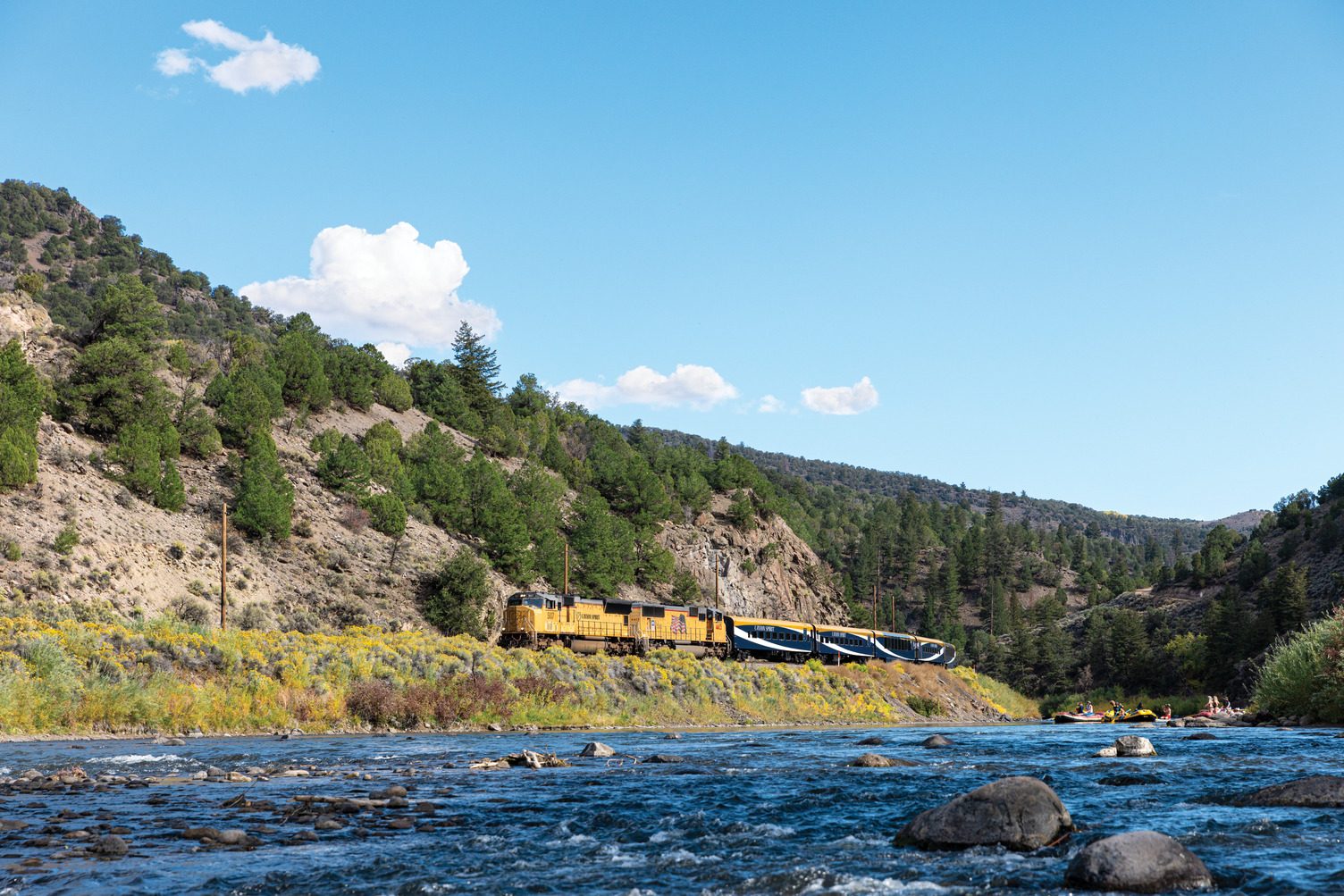
The two journeys sit under one parent company, The Armstrong Collective, and they share that standard exactly. What they don’t share is the view out the glass. One runs through the red-rock Southwest — the Colorado Rockies giving way to Utah’s desert canyons. The other runs through the Canadian Rockies — glaciers, alpine lakes, and mountain passes. Same company, same care, two completely different masterpieces. The whole question underneath a scenic-rail trip usually turns out to be a simple one: which landscape do you want out the window?
The daylight lane
The glass-dome journeys — run in daylight, a hotel at night. Canyon Spirit through the red-rock Southwest, and Rocky Mountaineer through the Canadian Rockies. Both brand families are live below.
The heritage lane
Everything above is one school of scenic rail — daylight, glass domes, a real bed at night. There’s a second school, and I plan it just as happily: the golden-age heritage train, where the carriage is the destination and the romance is in the details — a private cabin, a dressing-for-dinner kind of evening, a route run purely for its own sake. That’s Belmond’s world, and it’s the other half of what “rail journeys with Erik” means.
The Venice Simplon-Orient-Express from Venice to Paris. The Royal Scotsman through the Highlands. The British Pullman for a single perfect day. The sleeper trains that stitch a whole Peru circuit together. A completely different feeling from the domes of the Southwest — slower, more formal, more about the train than the window — and exactly right for a certain kind of traveler. This collective grows from here, too: the great scenic trains of Europe and beyond earn their place on this page over time.
Where I sit, honestly
I should say this plainly, because it’s the right thing to say first on a page like this: I haven’t ridden either of these trains yet. What I bring today isn’t a ride report — it’s the read. I know the routes, the service tiers, what’s actually worth the money and what isn’t, which direction and how many days, and — the part I care about most — how to build the trip around the train so the journey becomes the opening chapter of something bigger, not the whole book. The train companies earn the trust on the rails; my job is to point you at the right one and plan the days on either end. If I ride the Rockies to the Red Rocks this fall, this page gets a first-person chapter. Until then, you get the honest curator’s version — which is the version worth having when you’re deciding whether a trip like this is yours.
Who rail-with-Erik is for
The traveler who thinks the journey is the point.
If a great day means moving slowly through country you couldn’t reach any other way — a drink in your hand, your bags already at the hotel — this is your kind of trip. If a great day means covering ground fast to get to the “real” trip, it isn’t.
The milestone, the anniversary, the multigenerational trip.
A train removes the thing that exhausts a big-family trip — the driving, the logistics, the who-navigates argument. Everyone just looks out the window. This is a natural fit for a celebration or multigenerational trip, and for a honeymoon or milestone where the getting-there should feel like part of the gift.
The national-parks lover who’s done with the rental car.
Both landscapes are wild places you can reach without roughing it — the wild-places-without-the-hardship lane I plan a lot of. You’re delivered to the red rock or the Rockies; the hiking happens on the days built around the train.
Who it isn’t for.
Travelers who want to get there fast — every one of these journeys is the slow way, on purpose. And travelers for whom budget is the deciding factor — this is a considered splurge, and it should feel like one.