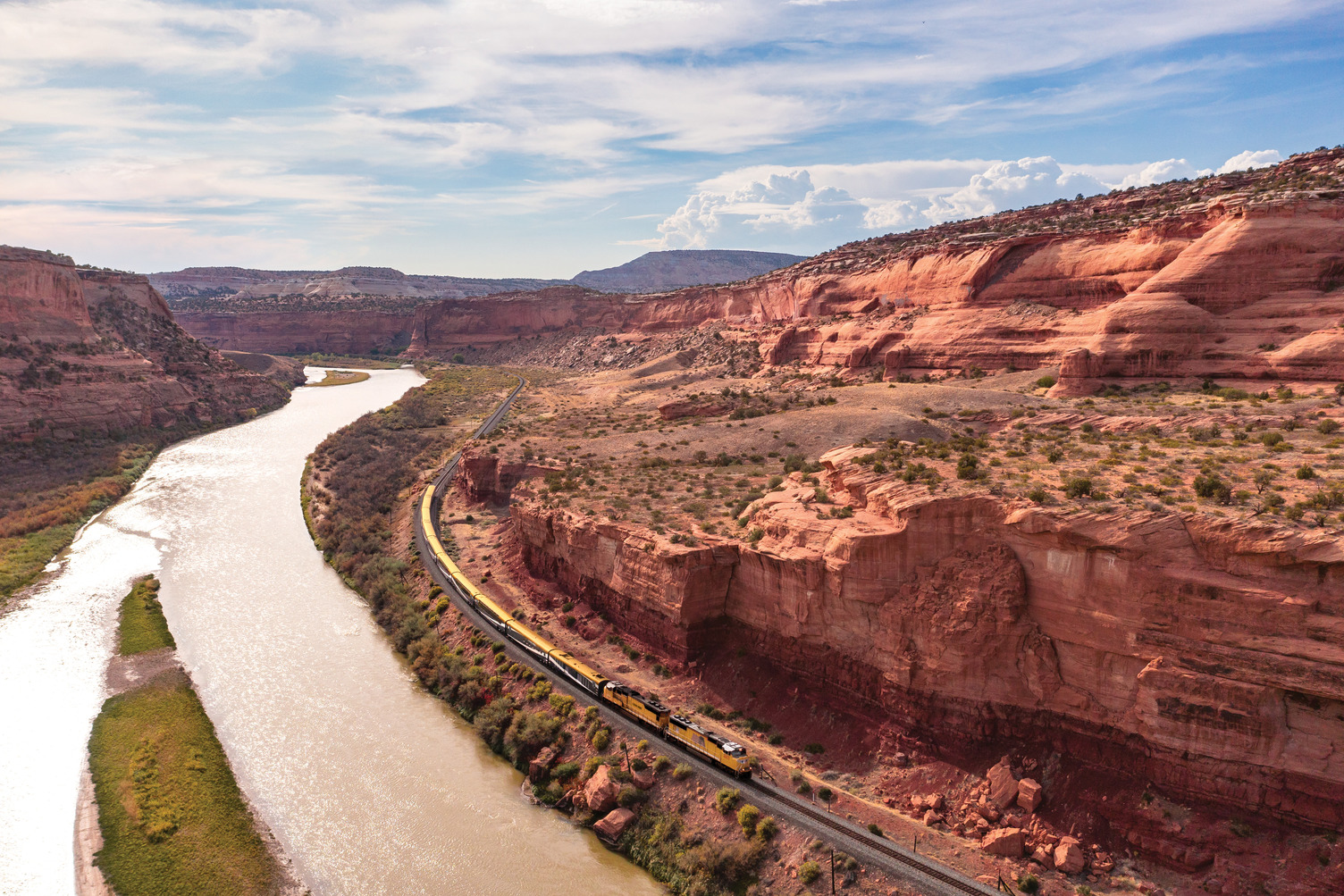
People come to a train like this from one of two directions.
Either they’ve done the big national-park road trip — the rental car, the trailhead parking lots, the “we drove four hours to see the thing and then drove four hours back” — and they’re ready for someone else to do the driving while they actually look out the window. Or they’ve never thought of the American Southwest as a rail trip at all, and the idea lands like a small revelation: you can watch the Colorado Rockies turn into Utah’s red rock from a glass dome, with a drink in your hand and your bags waiting at the hotel.
Either way, they find their way to me asking the same question everyone asks about a train that costs what this one costs: Is it worth it?
Here’s what I actually tell them.
The short version
Canyon Spirit is worth it for a specific kind of traveler: the one who believes the journey is the point, not the interruption between two points. If a great day means covering ground fast so you can get to the “real” trip, this isn’t your train. If a great day means moving slowly through country you couldn’t reach any other way — canyons that have no road, only rail and river — this is exactly your train.
It is a premium product at a premium price, and it earns most of that price in two currencies: access and ease. You’ll see landscape that no car can take you to, and you’ll do it without lifting a bag or planning a single logistic. What you won’t get is speed, and you won’t get a bargain. Knowing that going in is most of the decision.
First, the name — because it changed
If you researched this trip even a year ago, you found it under a different name: Rocky Mountaineer’s U.S. route. In 2026 that route got its own identity and became Canyon Spirit, a distinct brand under the same parent company, The Armstrong Collective. Rocky Mountaineer® still exists — it runs the Canadian Rockies routes, which I’ll come back to — but the Denver-to-red-rocks train is Canyon Spirit now.
I mention it because the rename matters for you practically: you’ll still find old write-ups, old photos, and old forum threads filed under “Rocky Mountaineer Denver to Moab.” They’re describing the same corridor. Just know you’re reading about the same train under its former name.
What it actually is
Canyon Spirit is a daylight-only luxury train. That’s the single most important thing to understand about it, and it’s the thing people most often get wrong.
You do not sleep on this train. There are no sleeper cabins, no berths, no rocking-to-sleep-on-the-rails romance. The train runs during the day so you never miss the scenery, and at night you check into a hotel. Your luggage is taken ahead and meets you there. The next morning you re-board and keep going. It’s the opposite model from a European sleeper or an overnight Amtrak — and for this landscape, it’s the right one, because the whole reason to be here is to see, and you can’t see the Colorado River canyons through a dark window at 2 a.m.
The route runs two ways worth knowing:
- The two-day journey: Denver →︎ Glenwood Springs →︎ Moab. Two full days of daytime rail with an overnight in Glenwood Springs in the middle, plus time on either end in Denver and Moab. This is the classic.
- The three-day journey: Denver →︎ Salt Lake City (or the reverse), with overnights in Glenwood Springs and Moab, added as a route extension. More train, more country, and it hands you off in a different city.
The season runs roughly April through November — spring through late fall, when the light is long and the desert isn’t at its harshest.
The scenery — which is the entire argument
I don’t recommend a train for the seats. I recommend it for what’s outside the glass. And on this route, the case makes itself.
You leave Denver and climb into the Rockies, crossing the Continental Divide through the Moffat Tunnel — 6.2 miles bored straight through the spine of the mountains at 9,200 feet. You come down the western slope through Byers Canyon and then the towering red walls of Glenwood Canyon, cut by the Colorado River over some three million years, where the track hugs the cliff a thousand feet below the rim. From there the train does the thing no car can: it follows the Colorado River into country with no road beside it. The showpiece is Ruby Canyon, on the Colorado–Utah line — deep-red sandstone the train threads right through the center of, twenty-five miles of it, reachable only by rail or by water. (Watch for the hand-painted “Utah | Colorado” marker on the canyon wall where you cross the state line.) Then, presiding over the Grand Valley, Mount Garfield and the Book Cliffs — a sandstone rampart that runs nearly two hundred miles — before the descent into Moab. On the three-day version there’s a bonus stretch: Price Canyon, carved by the Price River, dividing the Book Cliffs from the Wasatch Mountains on the climb toward Salt Lake City.
Moab is the payoff, and it’s why this trip is more than a train ride. You are set down at the doorstep of Arches and Canyonlands — two of Utah’s “Mighty 5” national parks — with the red-rock desert in every direction. The train is how you arrive; the parks are what you came for.
That’s the part most people underrate. Canyon Spirit isn’t a closed loop that returns you to your car. It’s the spine of a trip, and the days you build around it in Moab are where the memories actually get made. This is the piece I care most about when I plan it — the train is the easy part; the trip around the train is where an advisor earns their keep.
Signature vs. Premier — the one real choice onboard
Everyone rides in the same kind of car: a custom single-level glass-dome coach, with oversized dome windows curved at the top so the view runs up over your head, reclining pre-assigned seats, and an open-air viewing platform you can step out onto. Your bags are handled for you and meet you at the hotel, and a complimentary motorcoach shuttles you between the train and town at each stop — the logistics simply disappear, which is a large part of what you’re paying for.
The decision you actually make is service level:
- Signature is the all-inclusive base, and it is genuinely all-inclusive: meals served at your seat with a Southwest-leaning menu, snacks, beer and wine and spirits, up to three dedicated hosts per car who narrate the passing country, luggage handled, and your mid-trip hotel nights included. For most people, Signature is the trip.
- Premier is the upgrade, and what it really buys you is space: access to a separate lounge car with a bar, a more elaborate dining experience with paired wines, signature cocktails, a second open-air platform, and even an extra restroom. It’s the “we want room to spread out and linger over the meal” tier.
My honest read: Signature is the one I’d put most couples on. Premier is worth it if lingering is the vacation for you — if you’d genuinely use a lounge car and a longer, wine-paired lunch rather than just pay for the idea of one. It’s a real upgrade, not a trap, but it’s a preference call, not a necessity.
What it costs (and how to read the number)
For the 2027 season, per person in USD:
- Two-day Denver–Moab, Signature: $1,739–$1,809.
- Two-day Denver–Moab, Premier: $2,739–$2,809.
- Three-day Denver–Salt Lake City, Signature: $2,439–$2,529.
- Three-day Denver–Salt Lake City, Premier: $3,439–$3,529.
Premier runs about $1,000 more per person than Signature either way. The price swings with the calendar and the direction — shoulder-season and westbound departures sit at the top of each range, high-summer and eastbound ones at the bottom. The fare covers the rail journey and the mid-trip hotel night (Glenwood Springs on the two-day; Glenwood Springs and Moab on the three-day), plus onboard gratuities; taxes, any extra nights you add in Denver or Moab, park tours, and airfare are separate. Rates are set for 2027 and can move, so I confirm the exact number for your dates before anything is booked.
Here’s how I’d read that number honestly: for pure miles-per-dollar, a train will never beat a car or a flight, and I’m not going to pretend otherwise. What you’re buying is the access to canyons with no road, two or three days of somebody else handling every logistic, all-in food and drink, and a way of traveling that a certain traveler finds restorative in a way that driving never is. If those things are worth it to you, it’s worth it. If they aren’t, no amount of scenery makes the math work — and I’ll tell you that plainly rather than sell you a trip you’ll quietly regret.
Who it’s for — and who it isn’t
It’s for you if:
- You believe the way you get somewhere is part of the trip, not a tax on it.
- You want the national parks without the rental car, the driving, or the logistics — you want to be delivered to the red rock.
- You’re marking something — an anniversary, a milestone birthday, a multigenerational trip where a road trip would exhaust the grandparents and the grandkids both. This is a natural fit for a milestone or celebration trip, and it sits comfortably in the wild-places-without-roughing-it lane I plan a lot of.
- You’d rather sip a glass of Colorado wine and watch Ruby Canyon go by than white-knuckle I-70 through Glenwood Canyon yourself.
It’s not for you if:
- You want to get there fast. This is the slow way on purpose.
- You were hoping to sleep on the train. You won’t — it’s daylight rail and hotels at night.
- Budget is the deciding factor. This is a considered splurge, and it should feel like one.
- You want to hop off the train and immediately hike. The train is about the window and the towns; the hiking happens on the days you build around it in Moab.
Or should you look north instead?
One honest fork before you book. If what’s really pulling at you is scenic luxury rail more than the Southwest specifically, its Canadian sister has a claim worth hearing.
Rocky Mountaineer® — same parent company, same daylight-only, hotels-at-night philosophy — runs the Canadian Rockies routes between Vancouver, Banff, Lake Louise, and Jasper, spring through fall, with its own service tiers (SilverLeaf and the bi-level GoldLeaf glass-dome). It’s the older, more established name, and the landscape is glaciers-and-alpine rather than red-rock-and-desert.
So the real question underneath “is Canyon Spirit worth it?” is often “which landscape do I want out the window?” Red rock and the Colorado River, or glaciers and the Canadian Rockies. There’s no wrong answer — they’re two different masterpieces by the same house. That’s exactly the kind of fork I like to talk through on a call, because the right one depends entirely on the trip you’re actually taking.
What I’d do
If you’re drawn to the red rock: I’d take the journey that gives you real time in Moab on the back end, match your service level to how much you actually like lingering, and build the days around Arches and Canyonlands so the train becomes the opening chapter of a trip, not the whole book. If you’re drawn to glaciers: we point north and have a different conversation.
Either way, the train is the easy part. The trip around it is the part worth doing well — and that’s the part I’d love to plan with you.
Curious which rail journey fits the trip you’re actually taking? Let’s talk it through — no pressure, just a conversation about what you want out the window.
Plan your trip with me.
A 30-minute discovery call is where it starts. No fee, no pressure.
Book a Discovery Call