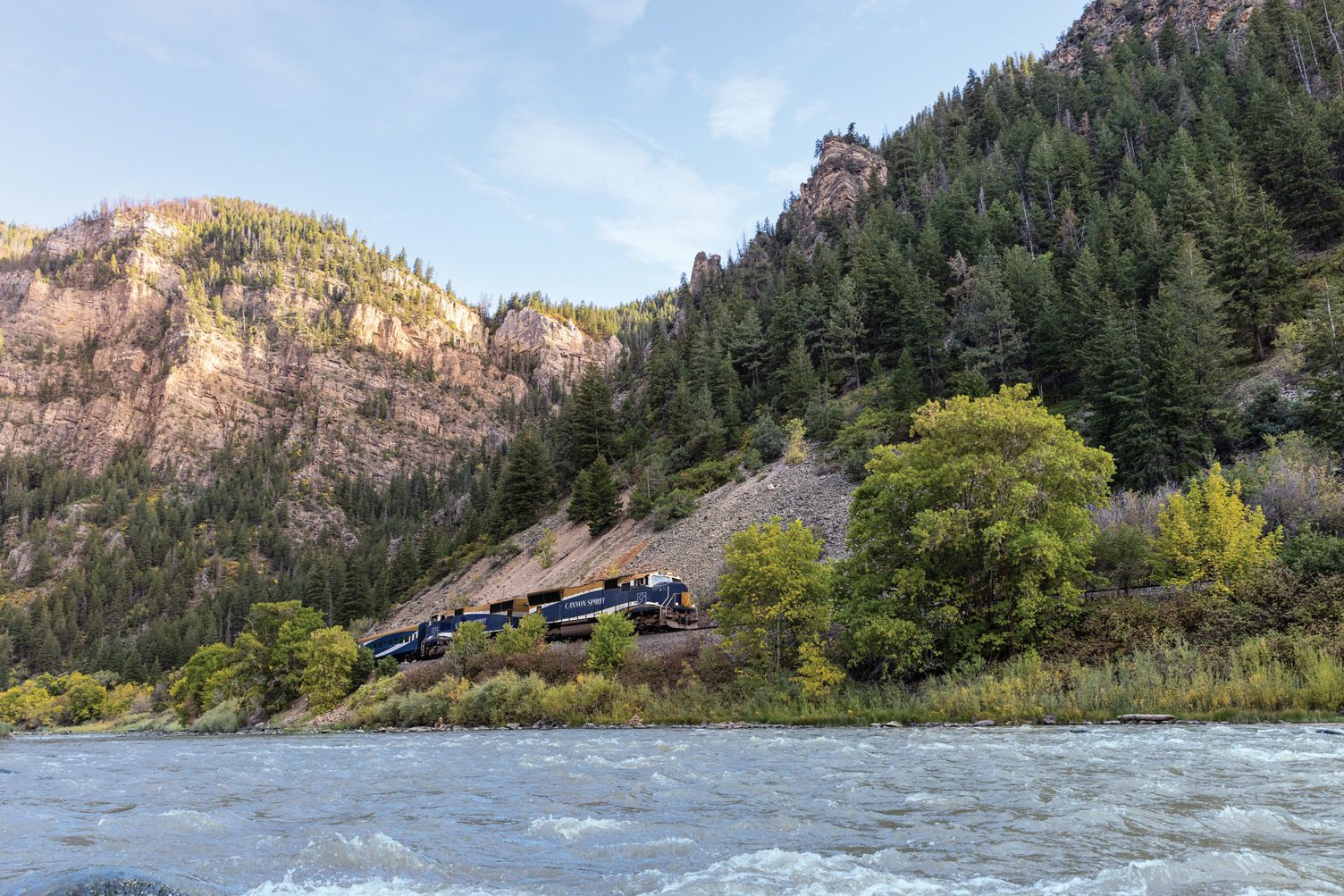
First, the name — because it changed
If you looked into this trip even a year ago, you found it as Rocky Mountaineer’s U.S. route. In 2026 that route got its own identity and became Canyon Spirit — a distinct brand under the same parent company, The Armstrong Collective. Rocky Mountaineer® still exists; it runs the Canadian Rockies routes. But the Denver-to-red-rocks train is Canyon Spirit now. I mention it up front because it matters practically: you’ll still find old write-ups and forum threads filed under “Rocky Mountaineer Denver to Moab,” and they’re describing the same corridor under its former name.
What it actually is
Canyon Spirit is a daylight-only luxury train, and that’s the single most important thing to understand about it. You do not sleep onboard. There are no sleeper cabins, no berths — the train runs during the day so you never miss the scenery, and at night you check into a hotel while your luggage is taken ahead to meet you there. It’s the opposite of a European sleeper, and for this landscape it’s the right model, because the whole reason to be here is to see the Colorado River canyons in daylight, not through a dark window.
The pitch, in the brand’s own words, is “an elevated train journey through the untamed beauty of the American Southwest” for well-traveled couples — the gateway to America’s most iconic national parks, the Mighty 5 and beyond. The season runs roughly April through November, when the light is long and the desert isn’t at its harshest. The flagship route, Rockies to the Red Rocks, runs Denver to Moab through Glenwood Springs — that’s the trip most people mean when they say Canyon Spirit, and it has its own page.
Signature vs. Premier — the one real choice onboard
Everyone rides in the same kind of car: a custom single-level glass-dome coach, with oversized windows curved at the top so the view runs up over your head, reclining pre-assigned seats, and an open-air platform you can step out onto. Your bags are handled for you, and a complimentary motorcoach shuttles you between the train and town at each stop. The decision you actually make is service level.
Signature — the all-inclusive base.
Genuinely all-inclusive: meals served at your seat with a Southwest-leaning menu, snacks, beer and wine and spirits, dedicated hosts narrating the passing country, luggage handled, and your mid-trip hotel nights included. For most couples, Signature is the trip.
Premier — the upgrade, and what it buys is space.
A separate lounge car with a bar, a more elaborate dining experience with paired wines and signature cocktails, a second open-air platform, even an extra restroom. Premier is worth it if lingering is the vacation for you — if you’d genuinely use a lounge car and a longer, wine-paired lunch. It’s a real upgrade, not a trap, but it’s a preference call, not a necessity.
The single-level dome, and why it’s a feature
One detail worth knowing, because it’s the kind of thing that reads as a downgrade until you understand it. Canyon Spirit runs a single-level dome car — not the taller, bi-level dome you may have seen on the Canadian trains. That isn’t a lesser choice; it’s a requirement of the route. The tunnels between the Rockies and the red rock have clearance restrictions that a bi-level coach simply can’t fit. So the train is purpose-built low and wide, with the dome glass doing the work. It’s also the cleanest way to understand how Canyon Spirit differs from its Canadian sister: Rocky Mountaineer® splits its service into the bi-level GoldLeaf and the single-level SilverLeaf, and “which service is worth it” is a Rocky Mountaineer question. Canyon Spirit’s question is simply Signature or Premier.
What it costs, and how I’d read the number
I keep hero pricing off a page like this on purpose, because the number moves with the calendar and the direction of travel, and the honest answer is “it depends on your dates.” For orientation: for the 2027 season, the two-day Denver–Moab journey runs in the high-$1,000s per person in Signature and roughly a thousand dollars more in Premier; the longer three-day journey to Salt Lake City sits a step above that. Those are agent-portal quotes for the 2027 season — they can move, so I confirm the exact figure for your dates before anything is booked, and nothing is truly held until a deposit is placed.
Here’s how I’d read it honestly: for pure miles-per-dollar, a train will never beat a car or a flight, and I won’t pretend otherwise. What the fare buys is access to canyons with no road, two or three days of someone else handling every logistic, all-in food and drink, and a way of traveling a certain traveler finds restorative in a way driving never is. If those things are worth it to you, it’s worth it. If they aren’t, no amount of scenery makes the math work — and I’ll tell you that plainly.
Who Canyon Spirit is for
It’s for you if the journey is the point.
You want the national parks without the rental car and the driving; you’d rather watch Ruby Canyon go by with a glass of Colorado wine than white-knuckle the interstate yourself; you’re marking something — an anniversary, a milestone, a multigenerational trip where a road trip would exhaust everyone.
It’s not for you if you want to get there fast.
This is the slow way, on purpose. You won’t sleep on the train, budget shouldn’t be the deciding factor, and the hiking happens on the days you build around it in Moab — not the moment you step off.