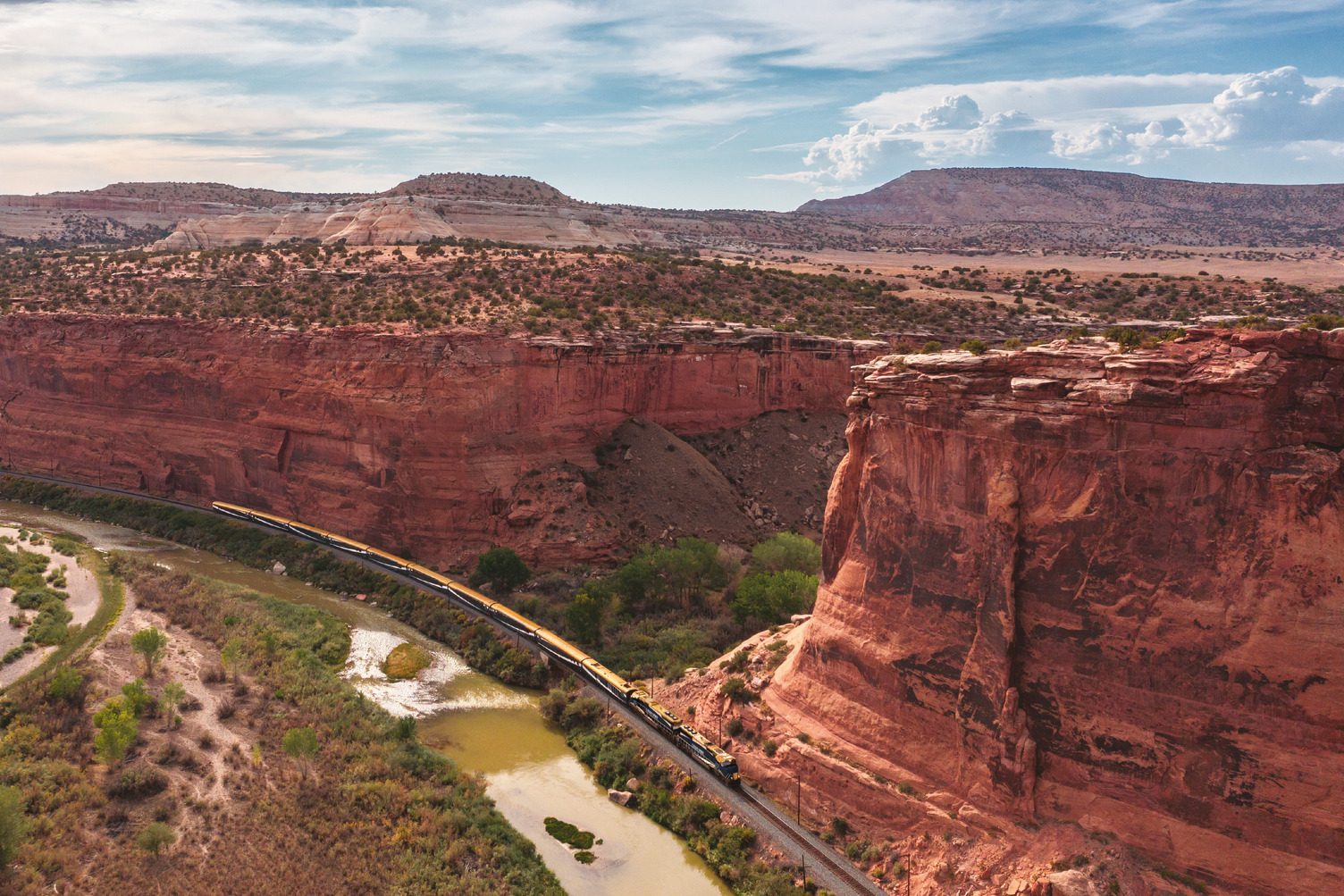
A glass-dome Canyon Spirit train threads a deep red sandstone canyon beside a river, the desert stretching to distant mesas beyond — the Rockies to the Red Rocks route.

Rockies to the Red Rocks.

The flagship — and the reason I built this pillar. Denver to Moab by daylight rail: across the Continental Divide, down the Colorado River into canyons with no road, and out into Utah’s red rock at the doorstep of two national parks. The train is the how; the trip around it is the why.

Book a Discovery Call

You may know it by another name

If you researched this trip even a year ago, you found it as Rocky Mountaineer’s U.S. route. In 2026 it got its own identity and became the Rockies to the Red Rocks route under the Canyon Spirit brand — same train, same corridor, new name. I say so up front because the old name still turns up in write-ups and forum threads filed under “Rocky Mountaineer Denver to Moab.” They’re describing this exact journey. Just know you’re reading about it under its former name.

The shape of the route

The classic run is the two-day journey, Denver to Moab, through Glenwood Springs — two full days of daytime rail with an overnight in Glenwood Springs in the middle, plus time on either end in Denver and in Moab. There’s a longer three-day journey that extends to Salt Lake City with overnights in both Glenwood Springs and Moab. And there’s the fuller guided package — the one the brand codes OT2OCD — that wraps the rail journey inside a Denver-to-Denver loop with hotels and park time built in. Which of those is right for you is exactly the kind of thing a call sorts out; the rail journey underneath them all is the same, and it’s the part worth walking through here.

The journey, day by day

Denver →︎ Glenwood Springs →︎ Moab — the two-day run, and the arc I’d point most travelers to first.

Day one

Into the Rockies

You leave Denver and climb into the mountains, crossing the Continental Divide through the Moffat Tunnel — 6.2 miles bored straight through the spine of the range at 9,200 feet. Down the western slope you come through Byers Canyon and then the towering walls of Glenwood Canyon, cut by the Colorado River over some three million years, where the track hugs the cliff a thousand feet below the rim. You step off in Glenwood Springs for the night.

Overnight

Glenwood Springs

A hot-springs town on the Colorado, and the natural pause in the middle of the route — a real bed, a proper dinner, your luggage waiting for you. The train doesn’t run at night for a reason: there’d be nothing to see. So you sleep, and re-board in the morning for the better half.

Day two

Into the red rock

This is where the route does the thing no car can. The train follows the Colorado River into country with no road beside it — the showpiece is Ruby Canyon, on the Colorado–Utah line, twenty-five miles of deep-red sandstone reachable only by rail or by water. (Watch for the hand-painted state-line marker on the canyon wall.) Then Mount Garfield and the Book Cliffs — a sandstone rampart that runs nearly two hundred miles — before the descent into Moab.

Then

Moab, and the parks

Moab is the payoff, and it’s why this is more than a train ride. You’re set down at the doorstep of Arches and Canyonlands — two of Utah’s Mighty 5 — with red-rock desert in every direction. The train is how you arrive; the parks are what you came for, and the days you build here are where the memories actually get made.

The Canyon Spirit train curves through high-desert sage country with snow-dusted peaks on the horizon.
At a glance

The Rockies to the Red Rocks, in four lines.

Denver →︎ Moab
Through Glenwood Springs, overnight mid-route
Two or three days
The classic run, or the extension to Salt Lake City
The Divide
Across the Continental Divide at 9,200 feet
Arches + Canyonlands
Set down at the doorstep of the Mighty 5

What’s best seen by train

The case for the rails makes itself on this route, because so much of the best of it has no road at all. The stretches worth staying in your seat for: the Moffat Tunnel and the Continental Divide crossing; Byers Canyon and the Colorado on the western slope; the thousand-foot walls of Glenwood Canyon; the roadless run along the Colorado River into Ruby Canyon and its deep-red sandstone; and Mount Garfield presiding over the Grand Valley with the Book Cliffs behind it. On the three-day extension there’s a bonus: Price Canyon, dividing the Book Cliffs from the Wasatch on the climb toward Salt Lake City. This is what the glass dome is for.

The trip around the train — the part I care about most

Here’s where an advisor earns their keep, because the train is the easy part. Resellers will sell you the rail journey; the press will review the train. Almost nobody plans the trip around it — which parks, how many days in Moab, when to catch Delicate Arch without the crowd, whether Dead Horse Point is worth the morning, how much Denver to give the front end. That’s the editorial work I do: the train becomes the opening chapter, and the red-rock days on the back end become the trip you actually remember. Canyon Spirit isn’t a closed loop that returns you to a rental car; it’s the spine of something bigger, and building the something-bigger is the job.

When to go

The season runs roughly April through November, and departures run weekly through early November — so a shoulder-season fall trip, when the light is long and the desert has cooled, is wide open and often the loveliest way to ride it. As for cost: I keep hero pricing off the page because the number moves with your dates and direction, but for orientation the two-day Signature journey runs in the high-$1,000s per person for the 2027 season, with Premier about a thousand more. Those are agent-portal quotes for the 2027 season — they can move, so I confirm the exact figure for your dates before anything is booked, and nothing is truly held until a deposit is placed.

Keep reading

Plan it together

Let’s build the Rockies to the Red Rocks.

A 30-minute discovery call. We’ll pick the two-day or the three-day journey, match your service level to how you like to travel, and build the Moab days around the train so the whole thing plays as one trip — not a train ride with a rental car on either end.

Book a Discovery Call