The bookEvelyn Waugh wrote Brideshead Revisited in six months between December 1943 and June 1944, on leave from the army after a parachute jump went badly — which is to say he wrote the most sumptuous English novel of the war while the war was still on, and you can taste the hunger in it. It’s a book about a vanished house, a vanished class, and a faith the narrator spends four hundred pages insisting he doesn’t have. Charles Ryder falls in love with a family before he falls in love with any of its members. Every reader I know has argued about what the ending means. That argument is the point.
But the chapter that earns this trip is the one at sea. Charles and Julia, years on, both marriages quietly finished, find themselves on a transatlantic liner in a storm — her husband elsewhere, his wife flattened in a cabin below. The ship pitches, the public rooms empty out, and the two of them have the whole vast thing to themselves. It’s the best writing about ocean travel I know in English, and it works because Waugh understood something structural: a crossing is a suspension. No ports. No arrivals. Nowhere to be. Just weather, and time, and whoever you’re standing next to when the floor moves.
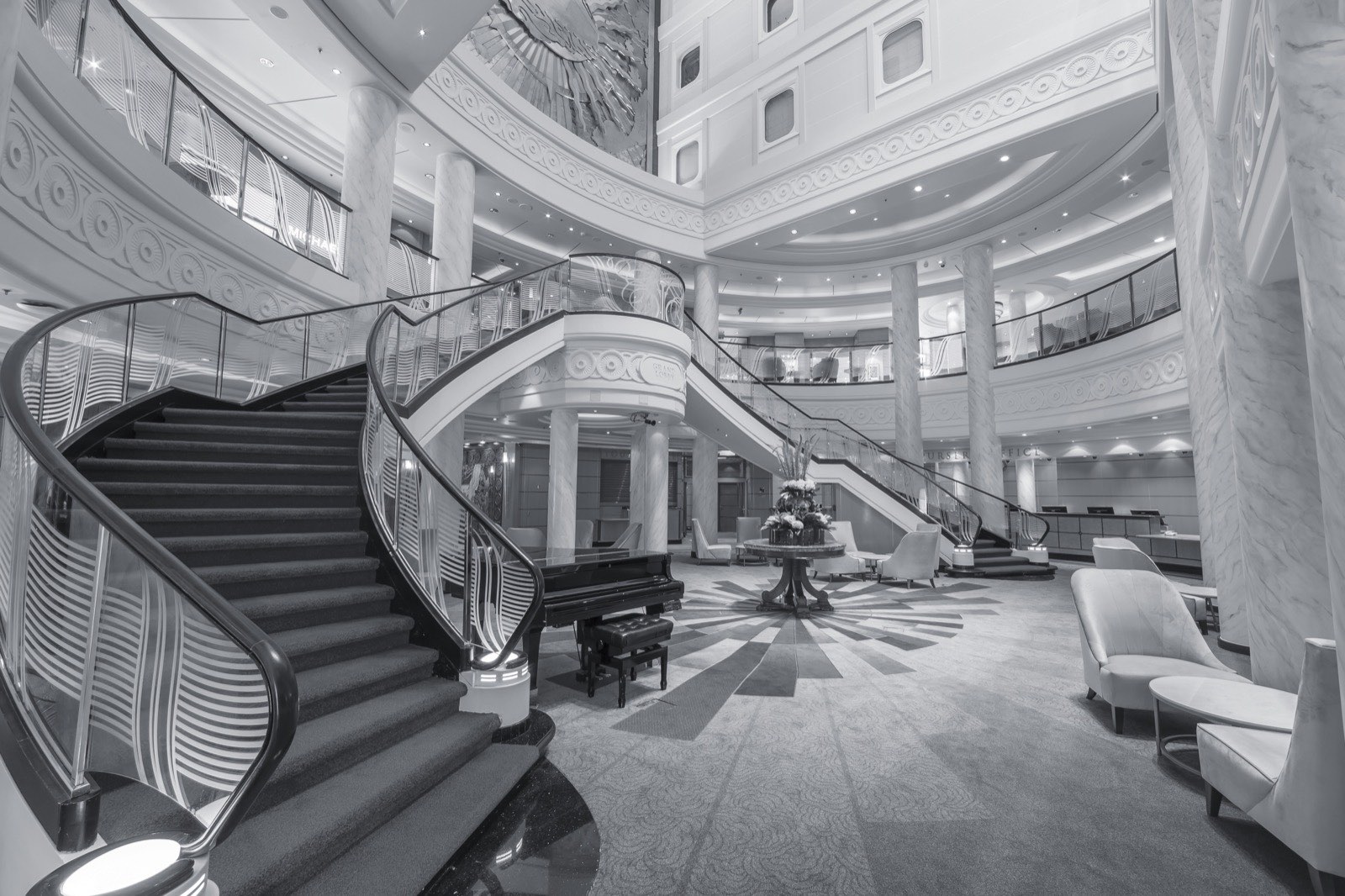
Waugh never names the ship. He didn’t have to — in the thirties there was only one kind of vessel that scene could happen on, and by rights there shouldn’t be one left. There is one left.
The routeThe crossing itself is the trip: seven or eight nights depending on the sailing, New York to Southampton or the reverse, on the only ocean liner still running the North Atlantic as scheduled transport rather than a holiday.
- Board with a book you’ve been saving. This is the entire premise. Six days, no ports, no excursion desk, no decisions. People who haven’t finished a novel in their adult lives finish two out here.
- The library. More than eight thousand books behind glass-fronted shelves, right at the front of the ship with the sea in the windows. She was built with the largest library at sea, and it’s almost always the quietest room aboard. Go on day one, before everyone else finds it.
- The planetarium. Illuminations is the largest planetarium at sea. The seats recline, the dome comes down, and you lie back in the dark with the Atlantic somewhere beneath you. On my crossing the night-sky show was narrated by Lupita Nyong’o; Chase was asleep inside five minutes, I watched every second, and we were both right.
- The ballroom. A sprung floor, an orchestra, and the formal nights that make people who swore they wouldn’t dance, dance. Waugh’s Julia would have been insufferable about it and would not have missed one.
- The weather. You want the North Atlantic to misbehave at least once. Stand at a forward window when it does and read the storm chapter while it’s happening. I cannot arrange this. I can only tell you to hope for it.
- The clocks. Going east she takes an hour off you most nights, so the time change arrives a night at a time instead of in one brutal leap. You walk down the gangway already on English time. It’s the most practical argument for the whole exercise and nobody ever leads with it.
I sailed her eastbound out of Brooklyn on the third of January, 2025, with my husband, Chase — deep winter, the connoisseur’s crossing and the one most people skip. The Atlantic that month was a relentless grey that folded sky and water into one continuous thing; it rained most days and snowed for much of it, real snow collecting on the promenade rails. And she was simply impervious to it. Warm corridors, warm bars, warm dining rooms. The wildness outside made the warmth inside feel earned in a way a hotel room never does. Somewhere mid-ocean the captain came over with our coordinates — we were passing the site where the Titanic went down, and the ship went quiet, people gathering at the rail in the cold. Another night they staged The Importance of Being Earnest onboard: Wilde, mid-Atlantic, in January, which I found appropriate then and find more appropriate now that his last address turns out to be a room you can sleep in.
I booked us an inside cabin, deliberately — my practice on a ship I haven’t sailed is to book the baseline and learn what entry level actually buys. Here it buys plenty. Cunard’s Grill Suites are a different register of the same voyage, and the Atlantic is identical from both. Cross at the tier you can do without flinching.
I read everything I'd been meaning to read for six months.
The glass and the biteEvery night of that crossing ended in the Chart Room, the quiet bar built around the history of ocean navigation, where a server named Eunice learned our names by the second evening and had the drinks down before we sat. What she brought us was something called a Midnight Over the Atlantic, and I have to be honest: I never found out what was in it, and I’ve decided not to. The bite is the Verandah’s bread — rosemary and garlic butter, rolls I still think about at home for no reason and at no occasion. At home: build something dark and stirred, warm bread in the oven, and read the storm chapter in one sitting.
If you need a copy: Brideshead Revisited — the 75th-anniversary edition. From Bookshop.org, whose profits go to independent bookstores. It’s an affiliate link — I earn a small commission and it costs you nothing.
The invitationRead it together. Live it together. Here is the quiet truth about a crossing: it’s the easiest group trip I know. One embarkation, one unpacking, one week where nobody can leave — and the formal nights that turn a book club into an occasion. Nobody says “I went on a cruise.” They say “I crossed.”
I’m going back, and this time there’s room for company: seven nights, departing New York on July 7, 2028, into Southampton on the morning of the fourteenth — the details are here. Bring the book. Bring the seven people who argue with you about books. There is genuinely no better place on earth to finish a four-hundred-page novel about a house you’ll never own. Here’s how the group version works — and if you’d rather talk it through first, cabin tier and all, that’s the call.
Plan your trip with me.
A 30-minute discovery call is where it starts. No fee, no pressure.
Book a Discovery Call