The book. Where’d You Go, Bernadette is a very funny novel that is secretly about a woman being slowly erased, and it gets away with the trick because Maria Semple built it out of paperwork — emails, faxes, school newsletters, a psychiatrist’s invoice — assembled by a fifteen-year-old trying to work out what happened to her mother. Bernadette Fox was a genuinely great architect once. Then she moved to Seattle, stopped building, and turned into a woman feuding with a neighbour about blackberry vines and outsourcing her errands to a virtual assistant in India. The comedy is immaculate. The grief underneath it is why people press the book on each other.
And the engine of the whole thing is a trip. Bee gets straight A’s and cashes in the promise: she wants the family to go to Antarctica. From that moment the book is about a woman coming apart at the prospect of a holiday — and specifically, at the prospect of the Drake Passage. That detail is why I love this book professionally as well as personally. Semple understood that the thing standing between most people and the trip of their life is not money and not time. It’s a two-day stretch of water they’ve read about on the internet at midnight.
The joke is that Antarctica is where Bernadette finally becomes herself again. She gets there alone — having fled her own intervention — and ends up sneaking off a ship onto a research station because a scientist mentioned a building that needed designing, and for the first time in twenty years somebody needed her to build something. The place doesn’t calm her down. It wakes her up. That is the argument this whole series is making, and Semple got there first: the going is not a reward for the life. Sometimes it is the thing that hands the life back.
The route. Ten to twelve days, November through March, and the season you choose changes the trip more than the ship does.
- Ushuaia, one night before. The end of Argentina, mountains straight into the channel, and a town that exists in a permanent state of departure. Eat well here (see below) — it’s your last proper restaurant for a fortnight.
- The Drake, two days. Bernadette’s nemesis. Sometimes it’s the Drake Lake and sometimes it’s the Drake Shake, and either way it’s a border you feel yourself cross. You read, you sleep hard, you watch albatrosses do the one thing they’re perfect at. Modern stabilised ships and modern medication have made this a very different experience from the one your midnight reading suggests.
- Or skip it — genuinely. Here is the practical answer to Bernadette’s exact fear, and it’s the single most useful thing in this post: you can fly the Drake. A charter from Punta Arenas to King George Island puts you on the ship in about two hours. It costs more and it saves four days, and it is weather-dependent in a way a ship is not — those charters do get held. When Semple wrote the book it was one small operator and a rumour. Four of them sell it now.
- Which is not a contradiction with the title. The Drake is the whole point precisely because it is the thing in the way. For one person it’s the initiation and the trip is lesser without it; for another it is the entire reason they’ve spent fifteen years not going. Working out which one you are — and then either honouring it or routing around it — is the actual job, and it’s the conversation I’d want to have with you first.
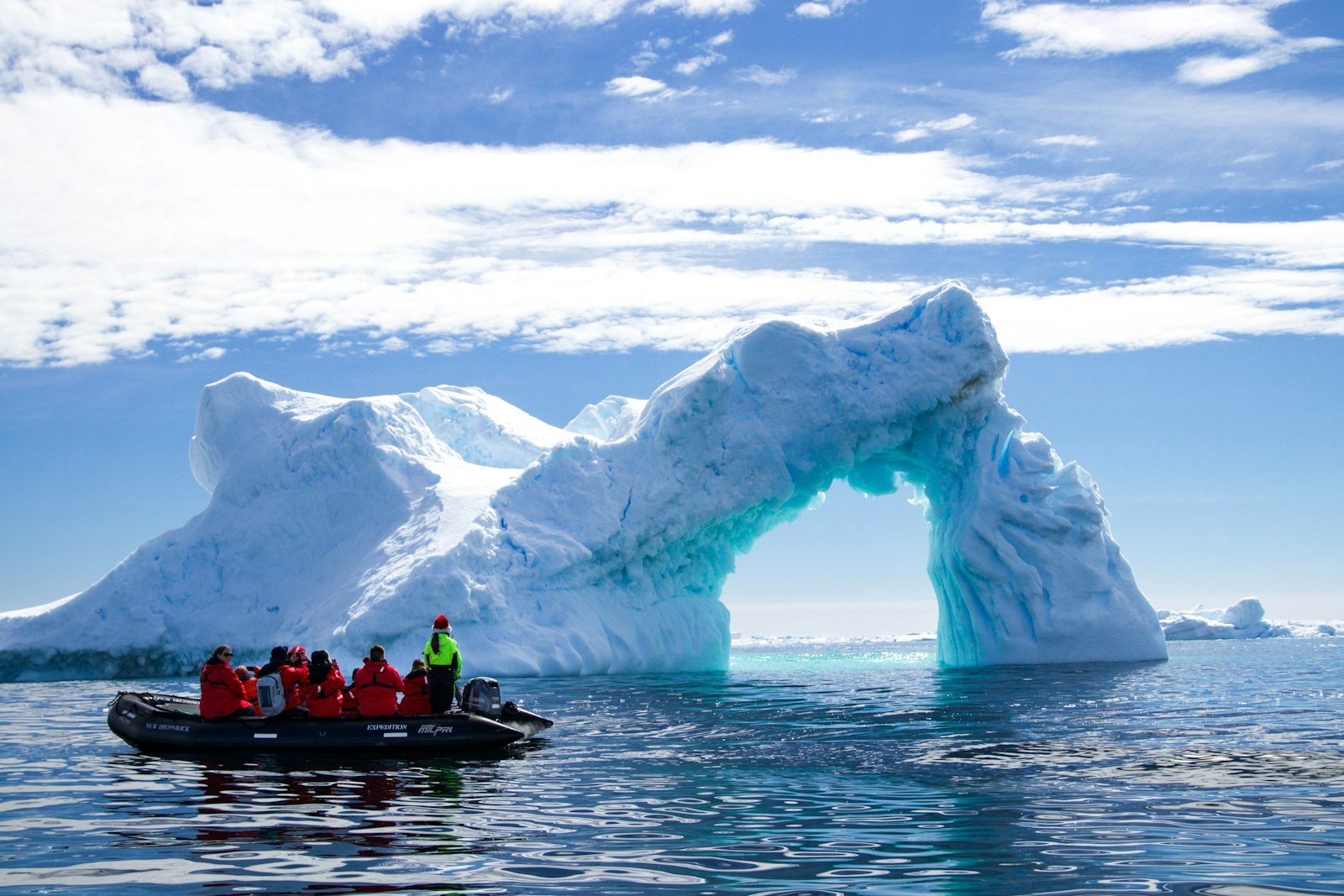
- The Peninsula, five or six days. Landings twice a day, weather permitting and it often doesn’t — which is correct and part of it. Penguin colonies loud enough to hear before you see them. Ice in blues that don’t photograph. Whales in the late season, chicks in the middle one, unbroken snow in the early one.
- The zodiac hours. Everyone remembers the landings. The thing people describe afterward is a small boat cut engine-off among brash ice with nobody speaking. Ask for that on purpose.
- Back through the Drake, changed. The return crossing is when people start talking. Something about ten days where the only thing asking anything of you is the weather. The ships carry satellite internet now — most of them, most of the time — which means the disconnection is a choice you make rather than one the ocean makes for you. Make it anyway.
The glass and the bite. A whisky poured over a chunk of glacier ice hauled aboard that morning — it fizzes faintly as air trapped for thousands of years lets go in your glass, and no bar on land can do it. And before you sail: centolla, the king crab pulled out of the Beagle Channel, eaten in Ushuaia the night before departure, which is the correct way to spend your last evening with a tablecloth. November through January is when it has the most meat in it; the season closes on the first of March, so a late departure gets the frozen version. At home: whisky, the biggest ice cube your freezer will make, and the first fifty pages — you’ll be laughing out loud early and you won’t see the ending coming.
If you need a copy: Where’d You Go, Bernadette — from Bookshop.org, whose profits go to independent bookstores. It’s an affiliate link — I earn a small commission and it costs you nothing.
The invitation. Read it together. Live it together. Antarctica is not the obvious book-club trip and that’s exactly why it works: it’s the trip people talk about for a decade and never book, and a group is the thing that finally makes it happen. Somebody in your club has wanted this since they were nine. Somebody else is Bernadette about the water — and now there’s an answer for them. Here’s how hosting your own group trip works. Season, ship, and whether you sail or fly the Drake are all one conversation — and it starts here.
Plan your trip with me.
A 30-minute discovery call is where it starts. No fee, no pressure.
Book a Discovery Call