The book. In January 1929, a blizzard buried the Orient Express in the countryside near Çerkezköy, west of Istanbul, and held it there for the best part of a week — a train full of wealthy strangers, stuck in a snowdrift, with nothing to do but look at each other. Agatha Christie did not have to invent the premise of Murder on the Orient Express. She just had to add a body.
Published in 1934, it’s the purest thing she ever built. Twelve suspects, one carriage, one corpse, no possibility of an outside hand — and a solution so audacious that people who have never read a page of Christie know it, which ought to ruin the book and somehow doesn’t. Read it anyway. The pleasure isn’t the reveal; it’s watching Poirot conduct interviews in a stationary train while snow piles against the windows and everybody lies with tremendous politeness.
There’s a darker seam under it, too. The crime the whole thing hangs on is drawn from the Lindbergh kidnapping — barely a year old when she wrote, and still unsolved when the book reached shelves. Christie is usually filed under cosy. She wasn’t. She was writing about a country that had failed to deliver justice, and about what people do when the system doesn’t.
A word on the legend, since you’ll meet it. The Pera Palace in Istanbul keeps Room 411 as the Agatha Christie Room — period furniture, a replica typewriter, the whole shrine — and the story that the novel was written there is repeated absolutely everywhere, including by the hotel. It is also entirely undocumented, and her own estate’s account points instead to a dig house at Arpachiyah in northern Iraq, where she spent the 1933 season with Mallowan. The book is dedicated from there. So: the room is not where it happened. Stay in it anyway. Some pilgrimages are improved by being slightly fictional, and she of all people would have appreciated a well-constructed alibi.
The route. Istanbul at one end, Paris at the other, and the Venice Simplon-Orient-Express — Belmond’s train, not to be confused with the separate Orient Express brand Accor has been reviving on other rails — doing the middle. With the enormous caveat that this particular run goes twice a year, one departure in each direction, and sells out a long way in advance.
- Istanbul, three nights before. Not a stopover — a proper stay. The Bosphorus by public ferry rather than tour boat, Hagia Sophia early (it’s a working mosque now: upper gallery only, and it closes around each of the five prayers), and one afternoon lost entirely in the Grand Bazaar with no shopping list. It’s shut on Sundays, which catches people out.
- Sirkeci Station. The original European terminus — though not from the beginning. The first Orient Express of 1883 only got as far as Giurgiu, where passengers were handed to a Danube ferry and then a Black Sea steamer; the through train didn’t run until 1889, and this station opened in 1890 to receive it. Which is its own kind of romance: the legend took seven years to catch up with the timetable. The railway museum inside is closed for a long restoration as I write this — worth checking, because when it reopens it’s ten minutes that change how the rest of the trip feels.
- The train, three nights of the six days. The Istanbul–Paris run is five nights all in — three of them aboard, and two in hotels, in Bucharest and Budapest, because the train stops properly rather than simply passing through. 1920s and ’30s wagons-lits carriages, restored: marquetry, brass, a steward who learns how you take your coffee by the second morning. Cabins are small by design and dressing for dinner is not optional, which sounds like a burden and turns out to be the best part — everyone is in on it.
- What’s actually included on the long run. City time in Bucharest and Budapest, a cruise on the Danube, and Peleș Castle in the Carpathians, which is the most gloriously over-decorated building in Romania and which Orient Express passengers were already visiting in 1883.
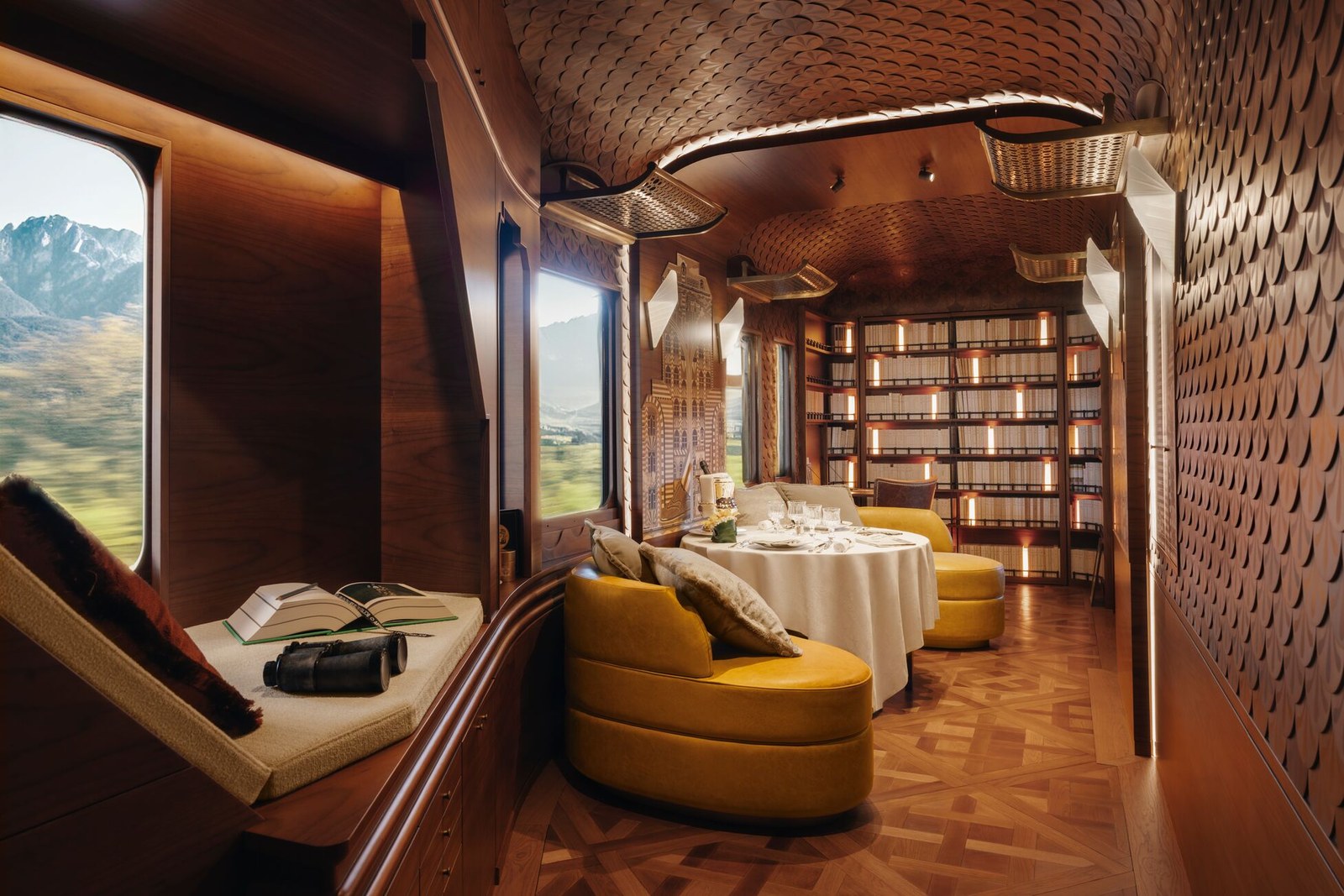
- A note on the photograph at the top of this page. That library, and the book left open on the window seat, is inside L’Observatoire — the train’s single private carriage, and the most expensive thing on it. There is no shared library car; the train has three restaurant cars and a bar. I’m telling you because a picture that good deserves an honest caption, and because the gap between the carriage in the photograph and the cabin most people book is exactly the kind of thing I’d rather you heard from me first.
- Paris to finish, or Venice if you take the far more available Paris–Venice run instead — which is a single night rather than six days, costs about a fifth, and delivers ninety percent of the feeling. If the twice-yearly run isn’t in the cards, this is not a consolation prize. It’s the sensible version.
- On the money, plainly: the long run is one of the most expensive things you can do in European travel, and I’m not going to pretend otherwise. It buys six days of a kind of travel that essentially stopped existing in 1977, when the last direct Paris–Istanbul service pulled out of the Gare de Lyon. Whether that’s worth it is a real question with a real answer, and the answer is different for different people.
The glass and the bite. A coupe of champagne in the bar car while the pianist works and the landscape does something unrepeatable outside — this is the drink the entire train is engineered around, and you should have it before dinner on the first night, not the last. And a simit from a street cart in Istanbul before you board: a ring of dough dipped in grape molasses and rolled in sesame before baking, crisp outside and soft in the middle, eaten on a ferry deck with a glass of tea for about the price of nothing. At home: something cold and fizzy, snow if you can arrange it, and the whole novel in one evening — it’s short, and stopping halfway is a crime she’d have solved in a chapter.
If you need a copy: Murder on the Orient Express — from Bookshop.org, whose profits go to independent bookstores. It’s an affiliate link — I earn a small commission and it costs you nothing.
The invitation. Read it together. Live it together. Twelve suspects, and most book clubs are a good deal smaller than that. This is the trip for the group that has read every mystery going and wants one where the setting does half the work — and it’s a genuinely great milestone trip, because a train has something a hotel never will: it arrives. You get to walk out onto a platform somewhere and be somebody who did that. Group logistics, solved here. And because the calendar on this one is the binding constraint rather than the budget — two departures a year, and next season’s dates are the ones to watch — talk to me early.
Plan your trip with me.
A 30-minute discovery call is where it starts. No fee, no pressure.
Book a Discovery Call