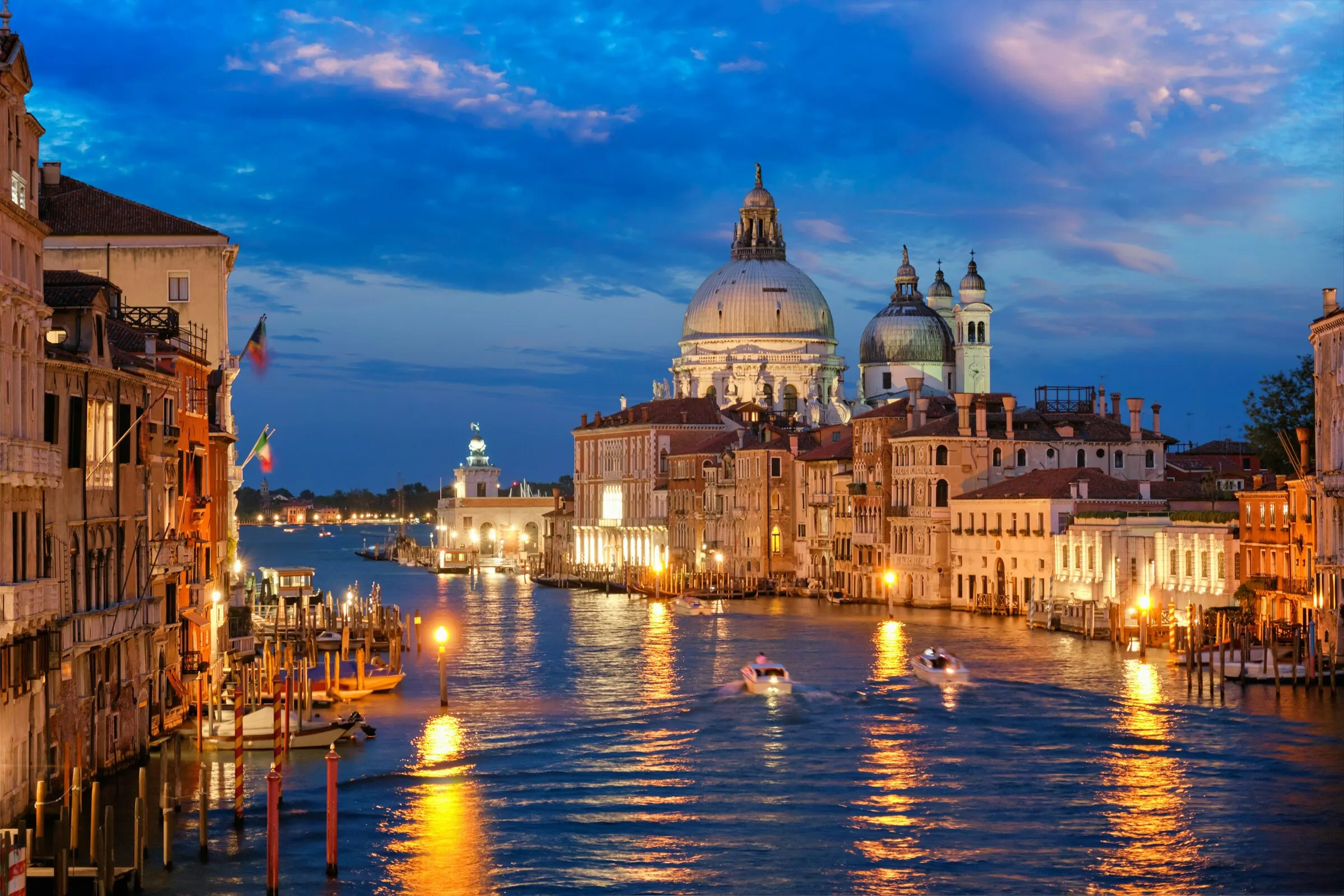
Most river cruises arrive in Venice by bus from Marco Polo Airport. Uniworld’s S.S. La Venezia arrives by water — through the lagoon, into the canal system, to a dock that puts you inside the city before the excursion briefing has finished. That’s not a marketing line. It’s the thing that makes this a categorically different product from every other Venice itinerary in the river cruise market.
The Po River connects Venice to the interior of northern Italy — the Veneto, Emilia-Romagna, the food and wine and art geography that the Venice itinerary usually treats as a day trip. The ship makes it a sequence: lagoon and canals first, then the river west through a landscape that’s been producing great things quietly for centuries.
At a Glance
| Best season | April–June and September–October — the shoulder seasons that give you Venice without the summer crowds; the autumn light on the Po valley is exceptional |
| Typical duration | 8 nights (standard Uniworld itinerary) — Venice arrival and departure with the river passage between |
| Classic routing | Venice →︎ Chioggia →︎ Porto Viro (Po Delta) →︎ Ferrara →︎ Mantua (Mantova) →︎ Cremona →︎ Venice or reverse; some itineraries include Ravenna by excursion |
| Operator I recommend | Uniworld — specifically the S.S. La Venezia, a boutique ship purpose-built for the lagoon and the Po’s navigational constraints |
| One thing most guides won’t tell you | The Po Delta is a UNESCO biosphere reserve and one of the most important birding areas in Italy — a completely different visual register from the canal city to the west. Most passengers are surprised that the transition from Venice to wild delta wetlands takes less than a day on the water. |
Why I Plan This River
The Italy that river cruising accesses is the Italy that land-based itineraries schedule as day trips and then compress. Ferrara — Renaissance grid city, Este dynasty architecture, one of the better pasta traditions in Emilia-Romagna — gets four hours on a land tour and a full day from a Po anchorage. Mantua — the Gonzaga city of palaces and lakes, where Virgil was born and Monteverdi staged the first opera — gets the same. Ravenna, with the finest Byzantine mosaics outside Istanbul, is a side excursion that takes ninety minutes and no crowds because everyone else is in Venice.
What Uniworld does on this itinerary is build a ship small enough to do what the river requires. The S.S. La Venezia carries 126 passengers — intimate by ocean standards, the right size for the Po’s width and the Venetian canal clearances. The vessel design is Venetian in its reference points: the interior reflects the city rather than generic European river cruise aesthetics, which matters when the dock is in Venice and you’re trying to feel like you arrived rather than transferred.
I plan this for Italy travelers who have done Rome and Florence and want to understand the rest of the country — the northern tier that isn’t on the standard circuit. And for river cruisers who have done the Danube or the Rhine and want Europe done at that pace but in the Italy context.
The Ship I’d Book
Uniworld — the S.S. La Venezia
The La Venezia exists because the Po and the Venetian lagoon required a ship built specifically for their conditions — the low bridges, the shallow delta channels, the clearances of the Grand Canal. Uniworld built it specifically for this itinerary, and the investment shows.
The onboard design references Venice — Murano glass, Venetian fabrics, artwork sourced from local artisans — in a way that’s specific rather than decorative. The ship doesn’t look like a hotel that could be anywhere; it looks like Venice had a point of view about what a ship should feel like and acted on it.
The Uniworld product in general sits at the higher end of the river cruise category — the all-inclusive model, the smaller passenger counts, the culinary programming that reflects the ports — and on this specific itinerary, the food and wine component is the best version of that investment. Emilia-Romagna is the source of Parmigiano-Reggiano, Prosciutto di Parma, Aceto Balsamico Tradizionale, and the fresh pasta tradition that everything else is being measured against. The ship’s kitchen takes that seriously.
The Ports
Venice — The ship docks in Venice, which changes the relationship between passenger and city. No bus from the airport, no vaporetto from the cruise terminal — the canal city from the canal. Spend time here on both ends: the city before the river passage and the city again on return have different weights because you’ve been somewhere else in between.
St. Mark’s Basilica, the Doge’s Palace, the Rialto — the obvious list is obvious for a reason. The less obvious additions: the Dorsoduro neighborhood for the Gallerie dell’Accademia’s Venetian painting collection, the Giudecca island for the view back at the city’s south face, the Cannaregio ghetto (the first Jewish ghetto in the world, established 1516) for the history that the architectural tour usually skips.
Chioggia — The “little Venice” at the southern end of the lagoon — a fishing city on its own canal grid that operates as a working port rather than a tourism economy. The fish market at dawn is one of the better experiences on the itinerary. The lagoon crossing to reach Chioggia from Venice is the moment the landscape changes and you understand you’re not in the same geography anymore.
Po Delta — The river mouth, now a protected biosphere reserve — wetlands, delta channels, flamingos, herons, the kind of birdwatching that ornithologists schedule trips around. The light here is horizontal and wide and nothing like the canal city. An afternoon on a skiff through the delta channels is the most quietly beautiful part of the itinerary.
Ferrara — The Este family city — Renaissance urban planning, the Castello Estense at the center of the grid, the cathedral with its Lombard Romanesque facade. The city built a wall around itself in the fifteenth century that’s largely still standing; the bike ride along the top of the wall is a twenty-minute loop with a fifteen-year-old perspective shift about what a fortified city actually felt like to live in.
Mantua (Mantova) — Surrounded on three sides by artificial lakes fed by the Mincio River — the Gonzaga used the water as a moat and turned the result into a city of Renaissance palaces. The Palazzo Ducale is the main event: the Camera degli Sposi, with Mantegna’s trompe-l’oeil ceiling fresco, is one of the great rooms in Italian art. Mantua is also where Monteverdi premiered L’Orfeo in 1607 — the first opera, performed in a palace that still stands. Walk through it with that in mind.
Cremona — The violin city. Stradivari, Guarneri, and Amati all worked here in the same few city blocks in the seventeenth and eighteenth century, and the instrument-making tradition has never entirely left. The Violin Museum holds the oldest playable Stradivari and makes the case, in a building that smells like varnish and wood shavings, that Cremona is worth knowing about for reasons that have nothing to do with the tourist circuit.
Ravenna (excursion) — The Byzantine capital of the Western Roman Empire, accessible by excursion from the Po anchorage. The mosaics at the Basilica di San Vitale and the Mausoleo di Galla Placidia are the specific destination — the blues and golds and the figures that don’t quite belong to any later tradition because they predate what we think of as art history. Dante is buried here; he wrote the Commedia here in exile. Both facts are useful context for walking through the city.
Before You Board / After You Disembark
Venice pre-cruise (2 nights): The ship docks in Venice, and the pre-cruise hotel should be in Venice proper — not Mestre, not the airport area. The right hotel is in the Cannaregio or Dorsoduro neighborhoods, where the city operates for the people who live in it rather than the people who visit it. I have a short list. The right property depends on what you want those two nights to feel like.
Post-cruise Venice (1 night): Coming back to Venice from the river with the Po valley and the delta and the interior cities in context — the city reads differently on return. One night is right. Use it for the things you didn’t prioritize at the beginning.
The Extension
Bologna — The Po itinerary puts you near Bologna without necessarily stopping there. For food travelers who want to understand Emilia-Romagna at full depth: fly home from Bologna, spend two nights, eat at the market and the trattorie and the place your Bolognese contact tells you about. The ragù served in the city where it was invented is a different argument than the one you’ve had at home.
The Dolomites — For travelers who want the mountain half of northern Italy alongside the river half: two nights in the Dolomites on either end of the cruise — Cortina, the Alpe di Siusi, or the Val di Fassa — is the contrast that makes the Po valley’s flatness and abundance feel like what it is: a landscape optimized for growing things, bounded on all sides by peaks.
Lake Como / Lake Garda — The northern lakes are within reasonable distance of the Po itinerary’s western ports. Adding one lake after disembarkation — a night at Bellagio on Como, or a night in Gardone Riviera on Garda — turns the river cruise into a northern Italy survey that covers the cathedral cities, the food geography, the water, and the Alps.
What I’d Skip
Venice in July and August if you have any flexibility. The acqua alta flooding risk is lower in summer, but the crowds are maximum. The same city in late September or early October is a different proposition — the cruise ships have thinned, the light is different, and the locals are visible again.
The Doge’s Palace without a small-group or private tour. The standard queue is two to three hours in peak season. The Secret Itineraries tour — the one that goes through the magistrates’ chambers and the prison where Casanova was held — requires advance booking and goes places the standard ticket doesn’t. Worth the logistics.
Plan This River With Me
Venice and the Po is the Italy trip I’d recommend to the traveler who thinks they’ve done Italy and wants to find out what they missed. Thirty minutes on a call and we figure out the timing, the Venice hotel, and whether the Dolomites or Bologna is the right bookend.
Last updated: May 2026 · Guide reflects Uniworld S.S. La Venezia programming as of this date. Itinerary routing and port calls may vary by departure date.
Plan this trip with me.
A 30-minute discovery call is where it starts. No fee, no pressure.
Book a Discovery Call