Choosing Your AmaWaterways Cabin: French Balcony, Twin Balcony, and the Suites
The cabin you book on a river cruise matters more than the cabin you book on a regular ocean cruise. River ships are smaller — about 162 passengers on the standard AmaWaterways European fleet. The ship is gorgeous, but you’ll spend a real percentage of your trip in your cabin: morning coffee, afternoon downtime between excursions, the slow evening hours after dinner watching the river slide past.
So choose carefully. The category you book sets the tone of the trip.
Here’s the honest breakdown of every AmaWaterways European-fleet cabin category — what each tier actually gets you, where to splurge, where to save, and which cabin I’d book for the kind of trip you’re planning.
The Deck Layout (the part that matters)
The standard AmaWaterways European ships — AmaReina, AmaSofia, AmaCerto, AmaLea, AmaKristina, AmaMora, and the rest of the fleet built in the 2010s and 2020s — share a similar three-deck layout.
Piano Deck (lowest) — water-line cabins with a fixed window. River view, but no balcony. The water is right there outside your window — peaceful, intimate, but you can’t open the window or step outside.
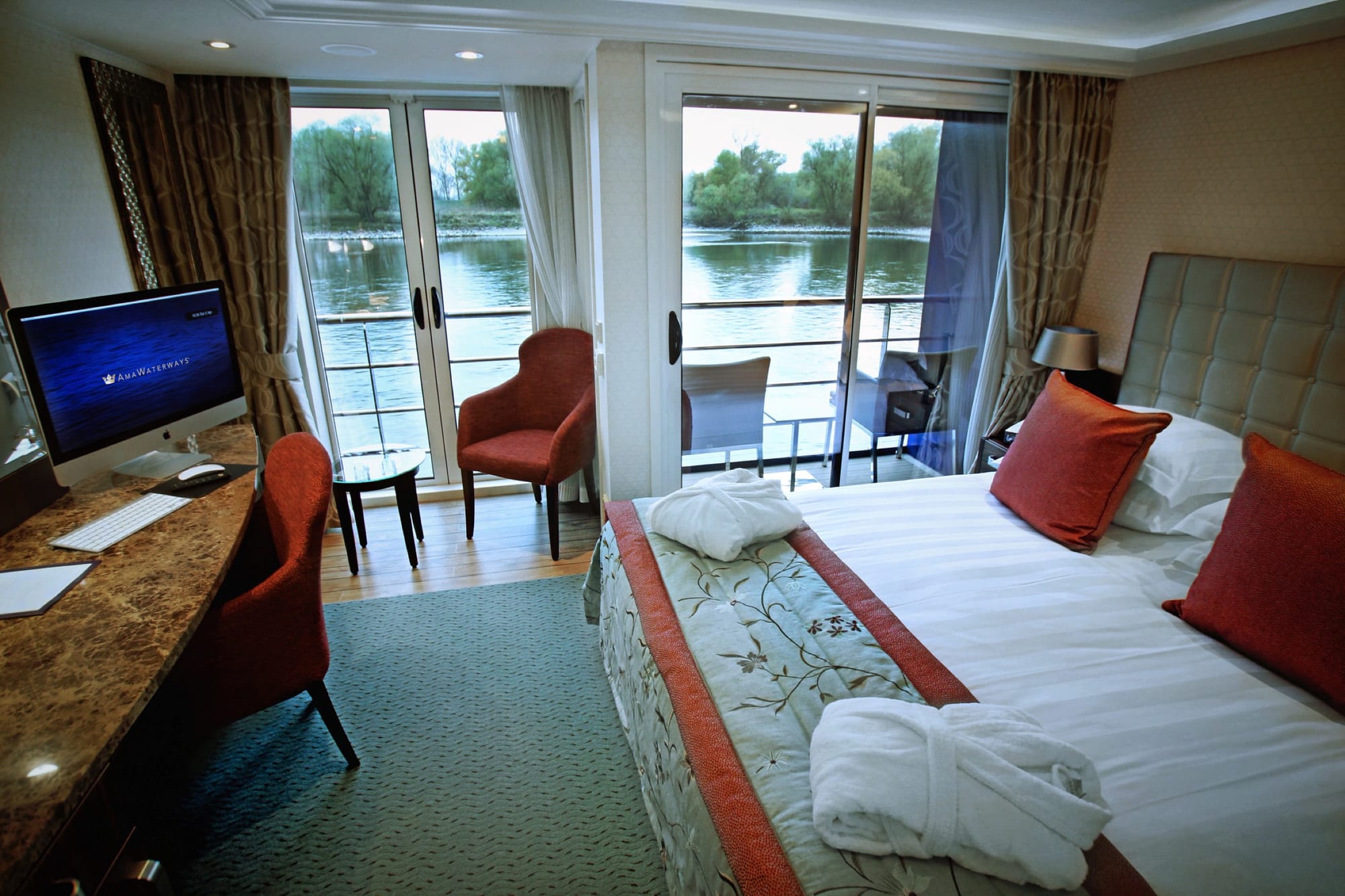
Cello Deck (middle) — French Balcony cabins. Floor-to-ceiling sliding glass door that opens to a railing. You can stand in your cabin doorway with the air on your face, but there’s no walk-out platform.
Violin Deck (top) — Twin Balcony cabins. Both a French balcony AND a small walk-out balcony with a chair and a small table. This is the AmaWaterways signature.
Suites and Junior Suites — typically also on the Violin Deck, with larger square footage and the full balcony combo.
The category letters (E, D, C, B, A, AA, BB, etc.) shift slightly between ships, but the deck logic is consistent across the European fleet. AmaMagna is the exception — wider ship, different layout, more suite-tier cabins. We’ll come back to that.
Category by Category — What You Actually Get
Category E and D (Piano Deck — Window staterooms)
The entry-level cabins. Fixed window, water-line view, smallest square footage in the standard fleet. Perfectly comfortable bed, decent bathroom, the same dining and excursions and onboard experience as every other cabin on the ship.
What you give up: The balcony. You can’t open the window or step outside. On a river cruise, where the scenery slides past slowly and the slow looking is half the point, that’s a real loss.
Who it’s for: Travelers on a tight budget who want to do the river cruise and don’t mind sacrificing the balcony. Solo travelers booking with a single supplement who want to keep the cost manageable. Travelers who genuinely don’t think they’ll spend much time in the cabin.
My honest take: If the budget allows, the upgrade to a French Balcony is worth it. The view from a fixed window is good. The view from an open door is the trip.
Category C (Cello Deck — French Balcony)
The middle category and the floor I’d consider the actual minimum for most travelers. Floor-to-ceiling sliding glass door, opens to a railing, lets in air and a real view. You can sit on the bed, slide the door open, and the cabin essentially becomes part of the river.
What you get: The view, the air, a comfortable cabin in the 160-square-foot range, real shower with real water pressure, decent storage.
What you give up: The walk-out balcony — the actual outdoor space with a chair.
Who it’s for: Most first-time river cruisers. Travelers who want the river-view experience without the Twin Balcony premium. Couples on a moderate budget.
My honest take: This is the cabin most clients ultimately book, and it’s a good choice. You don’t need the Twin Balcony to have a beautiful trip. But if you’re going to be sitting outside in the morning with coffee — and many of my clients end up doing exactly that — then read the next category.
Category B and A (Violin Deck — Twin Balcony)
The signature AmaWaterways cabin. Both a French balcony AND a small walk-out balcony with a chair (sometimes two) and a small table. Larger square footage than the French Balcony category. Higher deck, so the views are slightly elevated.
What you get: The whole experience. Coffee on the actual outdoor balcony in the morning. Sunset wine on the balcony in the evening. The walk-out is small — this is a river ship, not a Cunard suite — but it’s real, and it changes the rhythm of the day.
What you give up: A few hundred dollars per person versus the French Balcony category.
Who it’s for: Couples who plan to use the cabin as a downtime space, not just a place to sleep. Honeymooners. Anyone celebrating something. First-timers who want to do the trip right the first time.
My honest take: This is the category I book for myself and the one I recommend most often. The Twin Balcony is the AmaWaterways product. The walk-out balcony, even small, transforms the cabin from a hotel room into a private outdoor space.
Category AA (Junior Suite)
A step up in square footage, still on the Violin Deck, still with the Twin Balcony combo. Larger sitting area, more storage, slightly more luxurious bath fixtures.
Who it’s for: Travelers who want a bit more room without the full suite premium. Couples who want a real sitting area separate from the bed for downtime.
My honest take: A nice category if the budget allows. The square footage upgrade is real and useful for couples who want a separate place to sit. But you don’t need it for the trip to feel luxurious.
Category SS and OS (Suite and Owner’s Suite)
The top tier. Full suite layout, larger balcony (sometimes wraparound), more square footage, better bath fixtures, premium amenities. On the AmaMagna, the suite tier is meaningfully larger than the European-fleet equivalents.
What you get: Genuine luxury, real space, the best cabin location on the ship.
Who it’s for: Honeymoons where the cabin needs to be part of the celebration. Milestone trips. Travelers for whom the cabin is a meaningful percentage of the experience.
My honest take: Worth it for the right occasion. Not necessary for a great trip — the Twin Balcony delivers most of what makes river cruising special. But if this is your honeymoon, your 25th anniversary, or the trip you’ve been waiting for, the suite is the version you’ll remember.
The AmaMagna Exception
The AmaMagna is a different ship — double-width, 196 passengers, more suite-tier cabins, four restaurants, a pickleball court, a water sports platform. The cabin categories are larger across the board, and the suite options are more abundant.
If you’re considering the AmaMagna specifically (sails the Danube, currently the only ship of its kind in the European fleet), the cabin math shifts. Even the “lower” categories are larger than the standard European-fleet cabins, and the suites are genuinely spacious. Worth knowing.
The Solo Traveler Note
AmaWaterways is genuinely solo-friendly compared to most river cruise lines. The single supplement (the extra you pay to occupy a cabin alone) varies by sailing, but Ama runs reduced single supplement promotions on a regular cadence — sometimes as low as 25% over the per-person fare instead of the standard 100%.
For solo travelers, my advice: don’t book your cabin until I’ve checked whether the sailing you want has a reduced single supplement promotion live. The savings can be substantial.
Ama doesn’t have dedicated solo studio cabins (the way Norwegian does on its ocean ships), but the reduced-supplement model handles the same problem.
Honeymoons, Anniversaries, and Milestone Trips
The cabin category is part of the celebration. For these trips specifically:
- Twin Balcony (Category B or A) is the floor. Not the French Balcony. The walk-out matters here.
- Junior Suite or Suite is the splurge worth making if the budget allows.
- AmaMagna with a suite-tier cabin is the move if you want the most space and the most distinctive ship in the fleet.
For honeymoons, I’ll also coordinate with the Ama team for in-cabin amenities (champagne, fruit plate, sometimes flowers) — not as a marketing promise but as a quiet note added to your reservation. That’s the kind of detail an advisor handles that the booking engines don’t.
What I’d Book for You — A Quick Heuristic
- First-time river cruiser, moderate budget: Category C (French Balcony, Cello Deck)
- First-time river cruiser, willing to splurge: Category B or A (Twin Balcony, Violin Deck)
- Returning river cruiser who knows what they want: Twin Balcony, Junior Suite if available
- Honeymoon or milestone trip: Twin Balcony minimum, Suite if budget allows
- Solo traveler: Watch the single supplement promotions; book whatever cabin tier those promotions surface in
- Multi-generational with parents and kids: Connecting Twin Balcony cabins (limited inventory — book early)
- AmaMagna sailing: The wider ship justifies a larger cabin tier; lean toward suites here
The Booking Window
AmaWaterways cabins for the most popular itineraries (Romantic Danube, Magnificent Europe, Christmas Markets, Tulip Time) book six to twelve months out. Twin Balcony and Suite-tier cabins go first. If you’re planning twelve months ahead, you have your pick. Six months ahead, you’re working with what’s left.
Where I Come In
I book Ama cabins for clients constantly. The category math, the deck preferences, the specific cabin numbers that have slightly better positioning, the timing of single-supplement and shipboard-credit promotions — all of that is the kind of detail that turns a fine cabin into the right cabin.
Ready to talk about which AmaWaterways sailing and which cabin category fits your trip? Let’s set up a discovery call and figure it out together.
For more on AmaWaterways specifically, see Why I Recommend AmaWaterways. For the bigger first-timer question, The Best AmaWaterways Itinerary for First-Timers covers where to start.
Plan your trip with me.
A 30-minute discovery call is where it starts. No fee, no pressure.
Book a Discovery Call