Most Alaska advice tells you which month to go. That is the wrong unit. Inside a single month the trip changes completely, and the received wisdom about which month is better turns out to be wrong in at least three places.
Here is the honest version, built from NOAA climate normals, National Park Service data and Alaska Department of Fish and Game reporting rather than from brochures.
The one-line answer: earlier buys weather, later buys wildlife — and the weather it buys is far smaller than people think, while the wildlife it costs is total.
The weather case is weaker than you’ve been told
Juneau, NOAA 1991–2020 normals:
| Rainfall | Days with rain | Average high / low | |
|---|---|---|---|
| June | 3.82 in | 16.7 | 62 / 47 °F |
| July | 5.14 in | 18.5 | 64 / 50 °F |
| August | 6.41 in | 19.4 | 63 / 49 °F |
| September | 9.15 in | 22.3 | 56 / 44 °F |
June is drier by volume. By frequency — which is what actually shapes a day ashore — it buys you under two fewer wet days across an entire month. Daily rain probability moves from roughly 55% in mid-June to 58% in late July. What changes between June and July is how hard it rains, not how often.
And “June is sunnier” is trade lore, not data. Cloud cover at Juneau runs 70% in June against 72% in July. At Glacier Bay it is 67% and 66% — that is, marginally cloudier in June. I have heard that line repeated confidently for years and there is no dataset behind it.
The genuine weather boundary is later than the argument implies: the wet season starts around 19 August at Juneau and 24 August at Glacier Bay. July is not the wet season. September is.
Worth saying that the operators are straight about this part. UnCruise’s own guidance puts it the same way — “April, May, and June are Alaska’s driest months, though it’s still Alaska, so don’t ditch your rain gear” — which matches both the NOAA normals and the Park Service. The folklore I’m arguing with is the trade’s, not theirs.
Daylight is not a decision variable at all. Juneau gets 18h17m at the solstice and still 16h57m in late July. Nobody should trade a wildlife window for fifty minutes of light.
Salmon are the binding constraint, and they set the whole calendar
This is the one that reorganizes everything, because salmon are what bring the bears to the water where you can see them.
Mid-June is too early. There is no reliable stream spectacle before roughly the second week of July and no reliable peak before the last week of it.
- ADF&G’s Juneau-area reporting puts the pink and chum peak “around the end of July to the first of August,” with late July through September as the optimal freshwater period.
- Steep Creek at the Mendenhall sees sockeye and coho start mid-July and run into October.
- The Chatham Strait seine fleet — the corridor between Chichagof, Baranof and Admiralty — sees first pink openings in late June, with a general start around 4 July.
Week by week, for planning: 13–27 June, nothing. Late June into 4 July, marginal. 4–11 July, the first defensible week, and that is marine and hatchery activity rather than a creek. 11–18 July, the earliest reliable stream-side run. 18 July onward, the strongest weeks in the range.
Here is the part I say out loud to every client: you cannot promise a salmon run. The fish decide. What you can do is stack the odds, and the way you stack them is the week you pick. Anyone who guarantees you a particular scene on a particular date is selling you something they do not control.
One genuinely useful thing if you are choosing between years rather than weeks: odd years are the strong pink cycle in Southeast Alaska, per NPS. 2027, 2029 and 2031 are the good ones. That is worth knowing before you fix a year.
Bears are three different animals depending on the week
This is where the month-level advice fails hardest, because there is a gap in the middle of the summer that nobody warns you about.
Early to mid June — bears are on the sedge flats and tidal beaches, digging clams. Open ground, visible from the water at range. This is genuinely excellent and it is the strongest argument for an early trip.
Late June to mid July — the dispersal gap. Bears scatter inland for greens and berries. It is the weakest bear window of the summer and it sits directly on top of the late-June and early-July departures, which are the ones people book thinking they have chosen the sensible middle.
Mid July onward — back on the creeks with the fish. ADF&G runs Pack Creek on a permit season from 1 June to 10 September, with the managed peak 5 July to 25 August and close viewing described as mid-July to mid-August. Over 95% of visitors in that window see a bear.
UnCruise lands in the same place from the other direction: “the best time to see bears in Alaska is typically during peak season, from late July through September,” because by then the bears are “especially active along streams and rivers during the annual salmon runs.” Two independent sources, one answer — which is about as close to a safe recommendation as Alaska wildlife gets.
So: if bears are the reason you are going, early June or mid-July onward. The gap between them is the one stretch of summer I would actively steer around.
Whales: sell the whales, never the bubble-netting
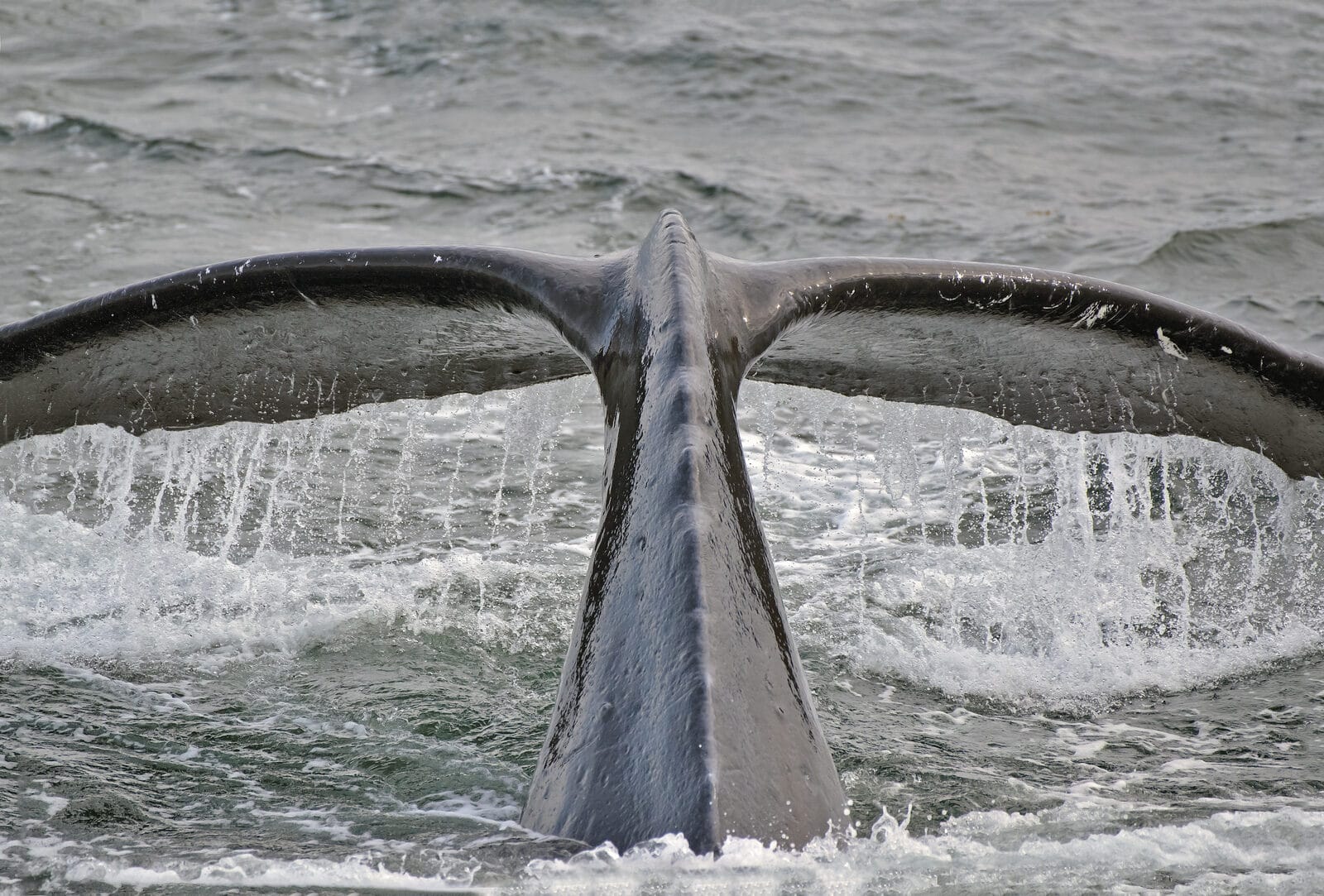
Humpbacks are reliably present across the whole June-to-August range — the NPS survey season runs 1 June to 31 August, and Point Adolphus concentrates them all summer. If whales are what you want, almost any week in the range delivers.
Bubble-net feeding is different and it cannot be sold on a date. NPS monitoring shows it is herring-driven and varies year to year; their 2024 resource brief records fewer sightings than 2023, spread across 14 June to 1 August with no seasonal concentration at all. “July is the month for it” is unsupportable. I have cut that line from a client page for exactly this reason.
Treat bubble-netting as a gift if it happens. Never as a reason to choose a week.
The crowd intuition is backwards inside the park
This is the finding that most often changes someone’s plan, because it removes a cost they thought they were paying.
Glacier Bay’s daily vessel quota is set in federal regulation and it is identical from 1 June to 31 August: two cruise ships, three tour vessels, six charter vessels, twenty-five private vessels and one ferry, every day of that window.
Going early does not buy you a quieter park. It buys you a quieter Juneau. The park itself is exactly as busy on 5 June as on 5 August. If genuine quiet is what you are after, the season that delivers it is May or September, not early summer.
One thing not to let yourself be sold
If someone shows you Johns Hopkins Inlet, ask when you would be there. It is closed to all vessels, kayaks included, from 1 May to 30 June for harbour seal pupping, and closed to cruise ships through 31 August. UnCruise’s own published Glacier Bay itineraries name Margerie and Lamplugh — not Johns Hopkins.
It is a beautiful place and it is not on the trip. Better to know that now than to go looking for it from the deck.
So which week?
If bears are the point — early June, or 18 July onward. Not the fortnight in between.
If salmon and the whole ecosystem that follows them is the point — mid-July at the earliest, late July for the strongest odds, and an odd-numbered year if you have the flexibility.
If weather is the point — May and early June are genuinely the driest, and the gain is smaller than the marketing suggests. Take it if you want it; don’t pay wildlife for it.
If quiet is the point — May or September. Not early summer, which buys you nothing inside the park.
If it’s your first time and you want the broadest week — mid-to-late July does the most things at once: fish running, bears back on the creeks, whales present, daylight still long, and the wet season not yet started.
Then the itinerary question sits on top of this one, and it has its own fork — not every sailing with Glacier Bay in the name goes into Glacier Bay.
And if what you actually want is Alaska in winter, under the aurora rather than over the salmon, that is a completely different trip — Fairbanks in late winter, and I plan it on your dates.
If you want help choosing the week rather than the month, that is a thirty-minute conversation.
Everything UnCruise in one place — the fleet, the five destinations, who it suits — is on my UnCruise page.
Sources: NOAA NCEI 1991–2020 monthly and daily normals (Juneau, USW00025309); US Naval Observatory sun data; National Park Service Glacier Bay weather, salmon, wildlife-viewing and boating regulations, including Neilson et al. 2024 humpback resource brief; Alaska Department of Fish and Game Southeast sport fishing reports, seine management plans and Pack Creek bear-viewing guidance; 36 CFR 13 Subpart N. Compiled September 2026.
Plan your trip with me.
A 30-minute discovery call is where it starts. No fee, no pressure.
Book a Discovery Call