The book. In the autumn of 1979 José Saramago got in a car and drove around his own country, and the book he made of it — Journey to Portugal, published in 1981, seventeen years before the Nobel — is the strangest and best travel book I know. Strange because he refuses to say “I.” He calls himself the traveller, third person, the whole way through: the traveller stops, the traveller is unimpressed, the traveller argues with a stone. It should be unbearably precious. Instead it does something no first-person travelogue manages — it turns the writer into just another thing in the landscape, no more important than the chapel or the river or the man who won’t give him directions.
And he isn’t sentimental about Portugal, which is why you trust him about it. He goes to the famous places and finds them fine. He goes to a village nobody has written about and stands in front of a wooden Christ for four pages. That’s the lesson the book keeps teaching: the good thing is rarely the advertised thing, and you find it by slowing down until it can catch up with you. Read fifty pages before you go and you will travel differently for the rest of your life. I mean that literally, and I don’t say it about many books.
Take it up the Douro, because the Douro is where his method pays the biggest dividend — a landscape that looks like scenery from the road and turns into two thousand years of human labour the second you look properly.
The route. Porto in, the river up, seven or eight nights, ideally in the shoulder season when the terraces have colour and the crowds have gone home.
- Porto, two nights first. Don’t cruise straight out. Ribeira at dusk, the port lodges across the water in Vila Nova de Gaia, and one long dinner where you order the thing you can’t identify. Livraria Lello is genuinely beautiful and genuinely a scrum — a crimson staircase under a stained-glass ceiling, and a timed ticket you now have to book days ahead. Book it properly or skip it, and if you skip it, walk five minutes to São Bento station instead: twenty thousand blue azulejos across the atrium, no ticket, nobody queuing. Then let Saramago be your bookshop.
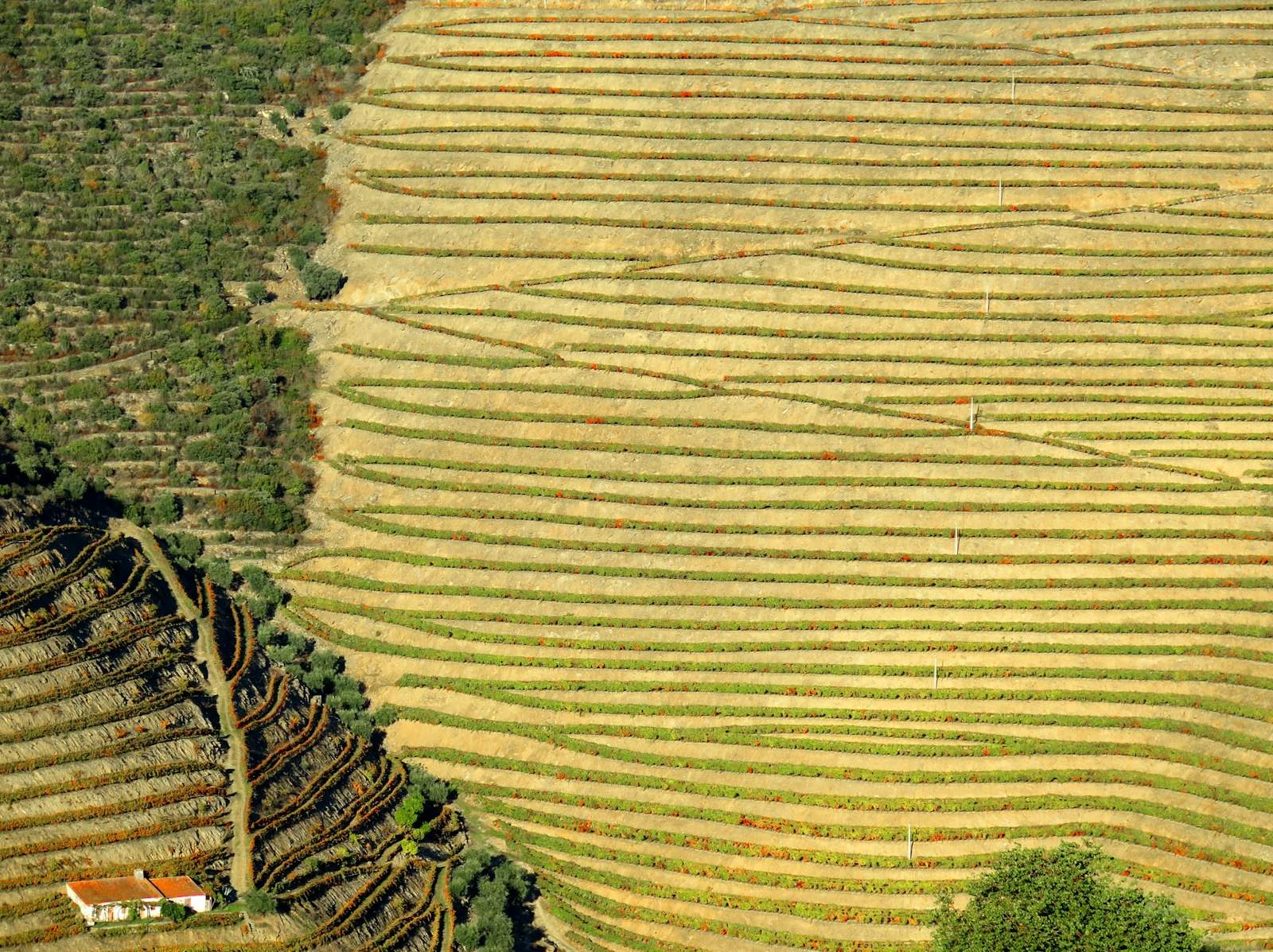
- Up the river, slowly. A Douro sailing is the honest way to take this valley, because the river is the road here — it always was, and the terraces were built facing it. The gorge tightens, the locks lift you a hundred and twenty-five metres over the course of the week, and the vineyards go up the slopes at an angle that looks like a mistake until someone explains the schist.
- Pinhão. Get off at the station and stand in it for ten minutes. Twenty-four azulejo panels, a little over three thousand tiles, installed in 1937, showing the harvest and the flat-bottomed rabelo boats that once carried the barrels downstream. It is a train station doing the work of a museum, for free, and Saramago would have written it beautifully.
- A quinta, and the 1756 story. This is the part people don’t know: in 1756 the Marquis of Pombal drew a boundary around this valley, and over the five years that followed his men set 335 granite pillars into the hillsides to mark it. Older lines exist on paper — Chianti drew one in 1716, Tokaj in 1730 — but Pombal’s was the first drawn with a regulator attached: grapes graded, prices set, exports policed, the whole apparatus. UNESCO still dates the regulation of port to that year. The pillars are still out there. Ask to be shown one.
- Lamego. The staircase up to Nossa Senhora dos Remédios is six hundred-odd steps of baroque theatre, and the town below it makes the best thing you’ll eat all week (see below).
- The train, if you have the day. The Linha do Douro from Régua east hugs the water so closely it feels like a dare. One of the great rail rides in Europe and almost nobody outside Portugal has heard of it — though it takes engineering closures, so it’s worth checking the current timetable rather than assuming.
- UNESCO listed the whole thing in 2001 as a cultural landscape — the evolving, still-worked kind, which is bureaucratic language for the only correct idea about this place: it is not a view, it is a workplace that happens to be beautiful.
The glass and the bite. White port over ice with tonic and a strip of lemon peel — the aperitif the Portuguese actually drink and the tourists usually walk straight past on their way to the ruby. And bôla de Lamego, a savoury bread baked around cured ham and chouriço, eaten in slices, ideally standing up somewhere with a view of the terraces. At home: white port is easy to find and criminally cheap for what it is. Pour it, open the book, and let the traveller take you somewhere he refuses to oversell.
If you need a copy: Journey to Portugal — from Bookshop.org, whose profits go to independent bookstores. It’s an affiliate link — I earn a small commission and it costs you nothing.
The invitation. Read it together. Live it together. This is the wine-club trip and the book-club trip at the same time — a river narrow enough to feel private, a ship small enough that your group is the room, and a valley where the tasting is a conversation with the family who farms it rather than a queue. If your club has ever ended a meeting by pouring one more glass and nobody left, you already have the roster. Here’s how hosting your own works. When you want to look at a season and a shape, that’s the conversation.
Plan your trip with me.
A 30-minute discovery call is where it starts. No fee, no pressure.
Book a Discovery Call