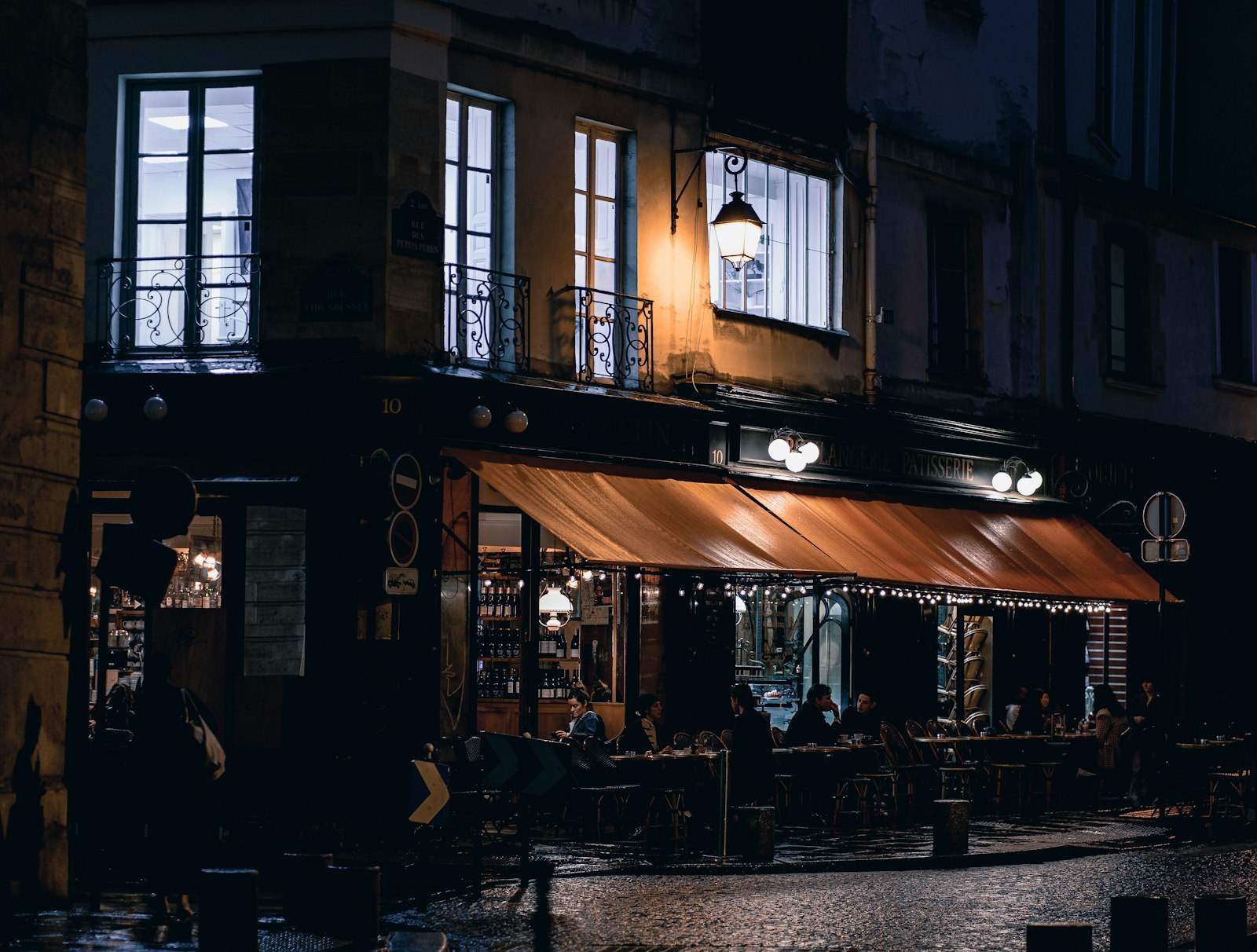
The book. James Baldwin left New York in November 1948 with forty dollars and no French, twenty-four years old, because he had worked out that staying would kill him — as a Black man, as a gay man, as a writer who needed distance from the country he’d spend the rest of his life explaining to itself. He landed in Paris broke and stayed the better part of a decade.
Giovanni’s Room came out of that decade, in 1956, and it is still a slightly shocking book — not for the content but for the nerve. Baldwin’s second novel, after the one that made his name, and he made every commercially disastrous choice available to him: he set it in France, he made the narrator a white American, and he wrote about two men in love with a directness nobody was publishing in 1956. He was advised, in so many words, to burn it. He published it instead, and it has not stopped selling in the seventy years since.
It’s short — a hundred and fifty-nine pages. It’s told from a house in the south of France across a single night, looking back at a rented room in Paris and the man who was in it, and he tells you on the first page what the morning is going to bring. And the thing it’s actually about is not desire — it’s cowardice: what it costs a person to refuse their own life, and who else pays. There isn’t a wasted sentence. You can read it between Charles de Gaulle and your hotel and you will be no use to anyone for the rest of the day.
A hard thing, said plainly, so you don’t go looking: the house he lived in for his last seventeen years, at Saint-Paul-de-Vence, is not there. A developer bulldozed two-thirds of it in 2014 for a cluster of luxury villas, the campaign to save it failed, and as I write this in 2026 nothing has been put up in its place — no plaque, no marker, nothing. The village’s own tourist office still describes the house in the present tense, which is how a reader ends up driving to Provence to look at a building site. There’s no grave in France either; he’s buried at Ferncliff, in New York, beside his mother. What survives is Paris. So Paris is where we go.
The route. Four nights, walking, mostly Left Bank — this is a trip made of addresses and hours rather than sights.
- Saint-Germain, base yourself here. Baldwin’s Paris was a set of cheap hotel rooms in these streets, written in cafés because the rooms were unheated. Stay within ten minutes of the boulevard and walk everything.
- Café de Flore, second floor. Not the terrace — the terrace is for being photographed. He worked upstairs, and most of his first novel was written at these tables, though he had to go to a Swiss mountain village to finish it, which tells you what Paris was for and what it wasn’t. Order a coffee, take a table, stay two hours. Nobody will hurry you; that’s what the coffee is actually buying.
- Le Select, Montparnasse. A different room and a different mood, open late, and the one most associated with the writing of Giovanni’s Room itself. Go at eleven at night, not at noon.
- Brasserie Lipp and Les Deux Magots, once each, in the spirit of completeness — he met Richard Wright at the Magots on his first night in the city and fell out with him, years later, at Lipp. Then stop doing famous cafés and start doing anonymous ones, which is closer to how he actually lived.
- The river, after dark. The novel’s geography is a night geography: quais, bridges, the walk home you take the long way because you don’t want to arrive. Do that walk. It’s free and it’s the best thing on this list.
- Les Halles — knowing it’s gone. The old market, the all-night belly of Paris where the novel’s late hours happen — oysters and white wine at five in the morning — was pulled down in the early seventies. Standing where it was, reading what it was, is its own kind of visit. Baldwin would have had something withering and correct to say about what replaced it.
- One day off-book. Musée d’Orsay, or the Marais, or nothing. This trip needs one day where you don’t hold the book.
The glass and the bite. A whisky, neat, at a café table at an hour when the room has mostly emptied out — Baldwin’s was Johnnie Walker Black, and by the accounts of people who sat up with him it was rarely far from the typewriter. And a croque monsieur at a zinc counter, made with too much cheese by someone who has made forty thousand of them. At home: it’s a two-evening book at most. Pour one, read to the end of the first section, and stop where he tells you what’s going to happen — he tells you on the first page, and you won’t believe him.
If you need a copy: Giovanni’s Room — from Bookshop.org, whose profits go to independent bookstores. It’s an affiliate link — I earn a small commission and it costs you nothing.
The invitation. Read it together. Live it together. Book clubs: this one produces the best meeting of the year, every time, because everyone arrives angry at David and nobody agrees about why. Take that argument to the cafés where it was written and it becomes a different conversation entirely — a weekend can do more for a group of friends than a year of monthly meetings. Here’s how the group version works. And if it’s a trip for two, or for one — that’s the call.
Plan your trip with me.
A 30-minute discovery call is where it starts. No fee, no pressure.
Book a Discovery Call