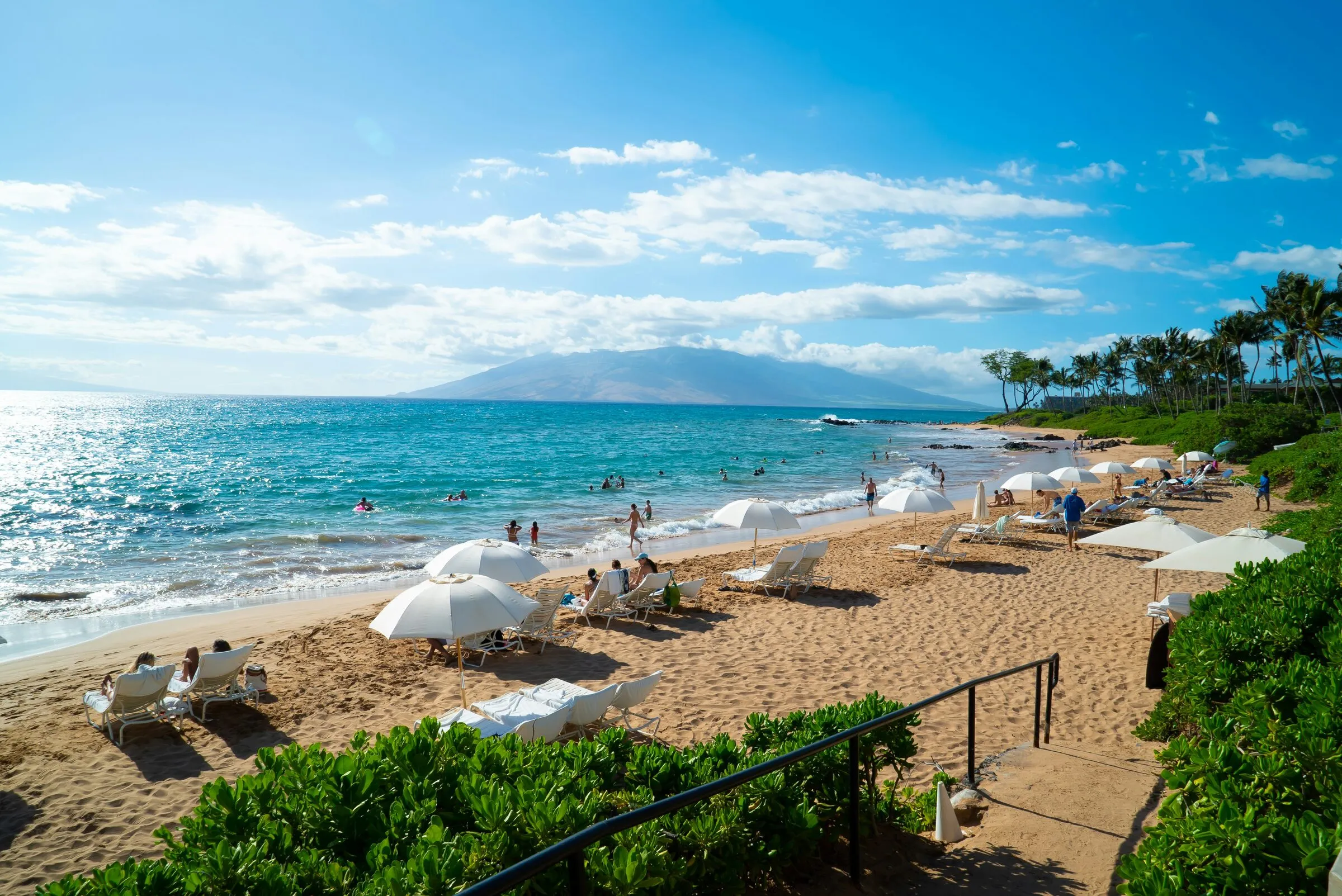
Maui is the Hawaiian island most American travelers default to — and that’s the planning answer most clients need to hear before the rest of the conversation makes sense. The island carries the canonical Hawaiian visual frame the brochures keep promising: long white-sand beaches, calm leeward bays, the dramatic Haleakala summit at 10,000 feet, the sugarcane fields and upcountry ranches, the twisting Road to Hana with its waterfalls and bamboo forests, and the wintering humpback-whale population in the channels offshore that delivers December-through-April whale-watching at a reliability no other US destination matches. It’s also the second-most-visited Hawaiian island after Oahu, which means Maui is not a hidden destination — and the planning answer for travelers who want quiet has to start with that reality. The island rewards the visit, but it also requires the right base, the right pacing, and the right honest framing about what’s possible and what isn’t.
Done correctly, Maui is the version of Hawaii where the resort program plus the natural drama combine to deliver a complete trip without ever feeling like you’ve under-experienced any one thing. Wailea on the south coast is one of the country’s strongest single luxury-resort districts — five major resorts on a manicured beachfront stretch with championship golf, a coastal walking trail, and the consistent dry-sun-and-tradewind weather that makes Hawaiian-honeymoon math easy. Kapalua and Ka’anapali on the west coast deliver alternative luxury-and-resort registers with their own distinctive landscapes. Hana on the east coast — three hours of switchback driving from Kahului — delivers the small-and-remote Hawaiian register most travelers don’t realize the island still contains. The Haleakala sunrise (with the proper National Park reservation), the Road to Hana day, the late-winter whale watching, and the upcountry food-and-farm circuit are the four headline experiences that make a Maui trip feel like a real visit rather than a beach week. (The August 2023 Lahaina wildfire is a real factor in any 2026 Maui trip — the historic whaling town is in active rebuilding, with parts of the West Maui resort district reopened on a phased schedule. I’ll be straight on the current state on the discovery call rather than skip the topic.)
Most clients come to me asking about Maui in three contexts: as a five-or-seven-night standalone Hawaiian honeymoon (the most common — Wailea or Kapalua base, the Haleakala-and-Hana excursions for the bigger landscape, the resort rhythm carrying the rest), as the resort half of a multi-island Hawaii pair (Maui for the variety, paired with Lanai for the privacy close, Big Island for the geological drama, or Kauai for the scenic finish), or as a winter whale-watching anchor (December through April, when the offshore channels host one of the most reliable humpback populations in the Pacific).
Here’s how I think about it.
At a Glance
| Best time to visit | Late April through early June and mid-September through early December — lower humidity, fewer crowds, and the in-water visibility on the south-coast snorkel sites is at its best. Late December through mid-April is the trade-off period: the whale-watching season is genuinely extraordinary, but the Christmas-and-spring-break weeks bring peak crowds and peak prices. Avoid late August through mid-September when the humidity peaks and the trade winds slacken. |
| How long to stay | Five nights minimum to do Maui justice — the resort base, one full Haleakala-or-Road-to-Hana day, one upcountry day, one slow beach day, one whale watching or activity day. Seven nights is where the island actually rewards the visit. Longer than ten days without expanding to a multi-island pair tips into diminishing returns. |
| How to get there | Kahului Airport (OGG) on the central north coast is the main commercial gateway with direct flights from most US west-coast cities and a growing roster of east-coast direct service. Twenty-five minutes from Kahului to Wailea; thirty-five to Kapalua; forty-five to Ka’anapali; three hours via the Road to Hana to Hana proper (or twelve minutes by helicopter). The smaller Kapalua Airport (JHM) on the west side handles inter-island commuter flights only. |
| Currency / language | US Dollar. English is universal. Maui has a meaningful Native Hawaiian cultural presence and the local pronunciation of place names matters — Haleakala is hah-leh-AH-kah-lah, Lahaina is lah-HIGH-nah, Wailea is wai-LAY-ah. Practice before arrival; locals notice and appreciate. |
| One thing most guides won’t tell you | The 2023 Lahaina wildfire context is a real factor in 2026 Maui travel and most guides skip it. The historic whaling town’s main commercial street (Front Street) was largely destroyed; the rebuilding is in early-to-mid stages with limited dining and shopping reopened. The West Maui resort districts of Ka’anapali and Kapalua were not directly damaged and are operating normally; travelers staying there have full access to the resorts’ programs. The Lahaina-specific shopping-and-dining stretch is in transition and will be for several more years. Plan around the active state, not around the pre-fire one. |
Why I Send Travelers Here
Because Maui, planned correctly, is the Hawaiian island that delivers the most complete version of the standard Hawaii fantasy without compromising on any of the experiential layers. Wailea on the south coast is one of the few places in the United States where the luxury-resort program — beachfront pool, championship golf, multi-restaurant property, full spa, the kind of resort-as-destination experience travelers think they’re booking — actually delivers as advertised. The Wailea Coastal Walk that runs the entire length of the resort district (1.5 miles of paved oceanfront path with the West Maui Mountains in view) is the kind of small-quiet pleasure that single-property destinations don’t deliver. The Haleakala sunrise — the dormant 10,000-foot volcano summit looking down through the cloud sea, the sun rising over the cinder cones — is one of the genuinely moving experiences in the US National Park system. The Road to Hana — the 64-mile twisting east-coast drive past 600 curves and 50-plus bridges, with waterfalls, bamboo forests, and the black-sand Wai’anapanapa Beach as way-points — is the canonical scenic-Hawaiian-drive experience. And the December-through-April humpback-whale population in the Maui-Molokai-Lanai channels is one of the most reliable and accessible whale-watching destinations in the world.
The resort district choice is what makes the trip work, and Maui has four genuinely distinct options. Wailea (south coast) is the contemporary-luxury district with the best calm-water beach access, the most consistent sun, and the deepest dining range. Kapalua (northwest) is the slightly-cooler upscale alternative with the most dramatic landscape (cliff-side resort frames, the Plantation Course as one of the world’s best golf courses) and a quieter resort-walk rhythm. Ka’anapali (west) is the larger, more-traditional resort district with a longer beach and a more-active resort-town feel. Hana (east) is the small-and-remote alternative for travelers whose Maui brief is we want to leave the resort district entirely.
I’m a traveling travel agent — in motion, in the rooms where this work happens. The Maui hotel relationships I keep work through my preferred-partner channel and my Marriott / Hyatt consortium access. The amenity layers at the major Maui resorts come through those channels rather than direct GM-level lines, and I’ll be straight about that distinction on the discovery call.
I send travelers here for five-to-seven-night standalone honeymoons when the brief is complete-Hawaii-experience — Wailea or Kapalua base, the Haleakala-and-Hana days, the whale-watching morning if the season is right. I send couples for the multi-island Hawaii anchor when Maui carries the resort variety and a sister island carries either the privacy close (Lanai) or the dramatic content (Big Island, Kauai). I send rare clients for a Hana-side retreat when the brief is we want to disappear and the small Hana-Maui Resort is genuinely the right answer. And I send winter travelers for the whale-watching anchor when the season is the deciding variable.
Where I’d Anchor
Maui’s anchoring decision splits across four districts, and the right pick depends on the trip’s character. Here’s the framing I’d offer for each.
Wailea (south coast) — the contemporary-luxury anchor. The most dependable Maui-honeymoon answer for travelers whose brief is we want sun and beach and the resort doing the work. The five-resort district sits on a 1.5-mile manicured oceanfront with the coastal walk connecting them, the consistent leeward weather (Wailea is one of the driest spots in Hawaii), and the deepest concentration of restaurants, golf, and amenities on the island. Anchor properties:
- Andaz Maui at Wailea Resort (Mokapu Beach, 15 acres, the contemporary-design pick with five pool environments, a 14,000-square-foot spa, and Morimoto Maui by Chef Masaharu Morimoto). LEED-certified, recently award-recognized at the top of the Hawaiian luxury rankings.
- Grand Wailea, A Waldorf Astoria Resort (the iconic Wailea anchor — the canyon-pool, the spa, the comprehensive resort-program register that delivers the standard “luxury Hawaiian honeymoon” fantasy as advertised).
- Fairmont Kea Lani, Maui (Polo Beach, all-suite-and-villa property — the right pick when the brief calls for more space than the standard luxury room and access to the full Wailea district amenity program).
Kapalua (northwest) — the upscale-and-dramatic anchor. A smaller resort district at the island’s northwest corner, slightly cooler and significantly more dramatic in landscape than Wailea, with the West Maui Mountains rising directly behind and three of the country’s best beaches (D.T. Fleming, Kapalua Bay, Slaughterhouse). The Plantation Course at Kapalua hosts the PGA Tour’s annual season-opener and is one of the world’s best resort golf courses. Anchor properties:
- The Ritz-Carlton, Maui, Kapalua (the headline Kapalua anchor — recently renovated, on the cliff above D.T. Fleming Beach, with the Banyan Tree restaurant as one of the island’s most-rated dining rooms).
- The Resort at Kapalua Bay (the smaller-scale alternative — directly on Kapalua Bay, residential-style suite-and-villa accommodations, an option I love for travelers wanting Kapalua’s quieter rhythm).
Ka’anapali (west) — the larger-resort-district anchor. Three-mile-long beach with a paved walking path connecting six major resorts. Larger-scale, more-active register than Wailea or Kapalua. The 2023 Lahaina fire affected the historic Lahaina town just south of Ka’anapali, but the Ka’anapali resorts themselves were unaffected and continue operating normally. Anchor properties:
- Hyatt Regency Maui Resort and Spa (the canonical Ka’anapali anchor — half-acre swimming pool with rope bridges, sunset luau, the kind of full-amenity resort rhythm that delivers the standard Hawaii fantasy at honeymoon-grade quality).
- Sheraton Maui Resort & Spa (on Black Rock — the lava-cliff promontory with the daily sunset cliff-diving ceremony — and the only Ka’anapali resort with direct beach access at Black Rock).
- The Westin Maui Resort & Spa, Ka’anapali (the contemporary-Westin program — multi-pool complex, the recently-renovated dining, accessible-luxury register).
Hana (east) — the small-and-remote anchor. Three hours of Road-to-Hana driving from Kahului, or twelve minutes by helicopter — Hana is a small east-coast town in a tropical-rainforest microclimate, and the only meaningful luxury accommodation is the recently-renovated Hana-Maui Resort (Hyatt Destination Hotels). The anchor for travelers whose Maui brief is we want to leave the resort district entirely and we want the slow Hawaiian-rural experience the rest of the island has lost. Honeymoon-grade for couples who specifically want this register; not the match for travelers expecting Wailea-style amenities.
I’ll be straight on the relationship layer: the Wailea, Kapalua, and Ka’anapali anchor properties are anchors I plan through my preferred-partner channel and Marriott/Hyatt consortium access. The room categories and amenity strategy come through those relationships rather than direct GM-level lines. The trip still books cleanly — preferred-rate amenities, room-category strategy, on-arrival escalation if anything goes sideways — and the discovery call is where we pull live availability and walk through which district (and which property within it) matches your dates.
Start a discovery call — I’ll pull live availability across the four resort districts, walk through the Wailea-vs-Kapalua-vs-Ka’anapali decision for your trip, and confirm which amenities apply to your dates.
What I’d Do With Six Days
Adjust to taste. The six-day version is the standalone-Maui brief; the seven-or-eight-day version adds the slower mornings or the Lanai add-on.
Day One — Arrival and resort settling
Arrive at Kahului. Transfer to your anchor property by mid-afternoon (twenty-five to forty-five minutes depending on district). The first afternoon is for the resort itself — pool, beach, spa appointment if you’ve booked one. Dinner at the resort’s signature restaurant. The Maui sunset is the best sunset in the Hawaiian chain by general consensus; whichever district you’re in, plan to be on the beach or the resort terrace at sunset hour — this isn’t a tourist cliché, it’s a real and consistent visual experience.
Day Two — The Haleakala sunrise day
The defining Maui experience for the right traveler. The 10,023-foot summit of the dormant Haleakala volcano sits in Haleakala National Park; the sunrise viewing has required reservations since 2017 (book exactly 60 days out at recreation.gov, or arrange via the resort concierge). The drive from Wailea or Kapalua starts at 3 a.m. for an arrival by 5:30 a.m. before sunrise; pack warm layers (the summit can be in the 30s F at sunrise even in summer); the experience itself takes about ninety minutes from arrival to sun-fully-up. Then the slow drive back down through the upcountry — breakfast in Kula at Kula Lodge or breakfast at Grandma’s Coffee House in Kēōkea — and back to the resort by mid-morning for the rest of the day at leisure. Travelers who don’t want the 3 a.m. start can do the sunset version instead — same summit, different light, no reservation required. Same emotional payoff at half the sleep deprivation.
Day Three — The Road to Hana day
The full-day east-coast scenic drive. Sixty-four miles, roughly two-and-a-half hours each way, with eight to ten worthwhile stops along the route. The signature stops: the Twin Falls trailhead at the route’s start, the Garden of Eden Arboretum, the Wailua Falls roadside viewpoint, the black-sand Wai’anapanapa Beach State Park (reservation required — book 14 days out), Hana town itself for lunch (Hana Burger Joint or the Hana Hotel restaurant), and the Pools at ‘Ohe’o Gulch (formerly the Seven Sacred Pools) past Hana in the Kīpahulu district of Haleakala National Park. Don’t try to do the full loop back via the unpaved Pi’ilani Highway south of Hana — the road is poorly maintained, rental contracts often prohibit it, and the tow-out cost is real. Drive there and back the same way; the views work both directions. Back to the resort by 6 p.m. exhausted but with the headline Maui-driving experience completed.
Day Four — The Lahaina-Kapalua-or-snorkel day
Adjust based on which district you’re in and which experiences you’ve prioritized. The snorkel-day version: Molokini Crater half-day boat tour from Ma’alaea Harbor (Pacific Whale Foundation or Trilogy Excursions are the established operators) — the partial-submerged volcanic crater offshore of Maui’s south coast is one of the most-protected and best-visibility snorkel sites in Hawaii, with consistent eighty-foot visibility and reef-fish populations that haven’t been over-grazed by the kind of close-shore tourism that’s degraded other Hawaiian sites. The Lahaina-area version: for travelers in West Maui, a half-day visit to the active Lahaina rebuilding (Banyan Tree Park has reopened, several restaurants are operating in the lower town, the post-fire context is genuinely worth understanding firsthand) plus an afternoon on Kapalua Bay or D.T. Fleming Beach. The whale-watching version (December-April only): a half-day humpback whale-watching cruise from Ma’alaea or Lahaina — Maui Adventure Cruises and Pacific Whale Foundation are the operators with the best naturalist programs.
Day Five — The slower upcountry day
The third Maui register most travelers don’t experience. Drive up to Makawao (the Hawaiian-paniolo cowboy town) and Kula (the upcountry farming district) for a slower morning. Stops: the Surfing Goat Dairy for cheese tastings, Ali’i Kula Lavender Farm for the gardens and the lavender lemonade (genuinely good, not gimmicky), O’o Farm for the lunch tour (a lunch grown entirely from the farm that morning, served on the property — book two weeks ahead). Lunch at Hali’imaile General Store (the upcountry destination restaurant) or the O’o Farm tour version. Back to the resort by mid-afternoon. This is the “Maui as actual Hawaii rather than as resort district” day, and it’s underrated.
Day Six — Free day or departure
The unscheduled day — beach morning, late breakfast, spa appointment, sunset cocktails. Or — for travelers extending the trip — the morning departure to your second Hawaiian island. The five-day Maui brief works either as a standalone or as the first half of a multi-island pair (most commonly with Lanai via the Expeditions ferry from Lahaina, a 45-minute crossing).
Specific Things I’d Tell You About
The 2023 Lahaina wildfire context is real and travelers should understand it. The August 8, 2023 fire destroyed the historic core of Lahaina town, including most of the Front Street commercial stretch and approximately 2,200 structures across the broader Lahaina area. The rebuilding has been slower than many travelers expect — building permits, debris removal, and infrastructure restoration are multi-year processes. The West Maui resort districts of Ka’anapali and Kapalua were not directly affected by the fire and are operating their full programs. The Lahaina-specific shopping, dining, and historic-site experiences are in transition. Some operators have reopened in temporary locations; the Banyan Tree (the 150-year-old historic landmark in central Lahaina) survived and the surrounding park has reopened. The right framing is acknowledge the context, support the rebuilding by visiting respectfully, and don’t expect the pre-fire Lahaina experience for several more years.
Haleakala sunrise reservations are required and they matter. The National Park Service implemented timed-entry reservations for sunrise viewing in 2017 to manage the crowds. Reservations open exactly 60 days in advance at recreation.gov and sell out within hours during peak season. The hotel concierges can sometimes secure last-minute spots through resort-specific allocations; build the reservation into your booking timeline, don’t leave it to arrival week. Sunset at Haleakala requires no reservation and is genuinely as moving — for travelers whose schedules don’t allow the 3 a.m. start, the sunset version is what I’d steer toward.
The Road to Hana is genuinely a full-day experience and rushed travelers consistently regret the rush. The sixty-four-mile drive looks short on paper. In practice, between the 600 curves, the 50-plus single-lane bridges, the periodic slow-traffic queues at the popular stops, and the generally cautious pace required by the road conditions, the drive itself takes 2.5 to 3.5 hours each way. Adding eight or ten worthwhile stops adds another four to five hours on the ground. Plan for 12 hours total, leave the resort at 7 a.m., expect to return after dark, and don’t try to add any other excursion to the same day. Some travelers split the experience by overnighting in Hana itself at the Hana-Maui Resort — that’s the slower, better version of the trip when the schedule allows.
Whale season is December through April and the in-water encounters are reliable in February-March. Humpbacks migrate from Alaska to the Hawaiian channels for breeding and birthing in the winter months. The Maui-Lanai-Molokai channels host one of the densest populations of any wintering humpback ground in the world. The boat tours run from Ma’alaea Harbor and Lahaina Harbor; the 2-hour morning tours have the highest sighting rates. In-water snorkel encounters (specifically permitted, regulated, and with operators trained in NOAA Marine Mammal Protection compliance) are a different and more intense experience available through the rare specialized operators — discovery-call conversation when this is specifically the brief.
The upcountry food-and-farm circuit is the underrated Maui afternoon. Most travelers who do Maui exclusively as a beach-and-resort trip miss the upcountry. Makawao, Kula, and the surrounding farms deliver an entirely different Hawaiian register — the paniolo cowboy heritage, the small farms growing pineapple and lavender and goat cheese and protea flowers, and the upcountry restaurants where the food is local-grown rather than mainland-shipped. One half-day in upcountry materially improves the whole trip’s understanding of what the island actually is.
What I’d Skip
Maui in late August through mid-September if you want comfortable conditions. The summer humidity peaks, the trade winds slacken, and the pool-and-beach time becomes harder than it needs to be. Spring and fall windows are materially better.
A two-night Maui visit as part of a multi-island sprint. The island is large enough geographically that two nights almost always means one day on the resort, one day on Haleakala or Hana, no upcountry, no whale watching, no second resort district visit. Either give Maui five nights minimum, or skip it for this trip.
The full Pi’ilani Highway loop south of Hana. Driving the unpaved southern half of the Hana road back to Wailea looks attractive on a map and is consistently a bad idea in practice. The road quality varies, rental cars are typically prohibited from the route, and the tow-out cost when something goes wrong is real. Drive there and back the same way.
Sunset luau as the cultural-context experience without other context. The luau at Old Lahaina (when it reopens in its rebuilt form) or at Wailea’s beachfront resorts is genuinely entertaining, but travelers who expect it to deliver real Hawaiian cultural depth are sometimes disappointed by what’s essentially a high-quality dinner-and-show production. Pair the luau with the Kahanu Garden’s Pi’ilani Heiau visit (the largest temple complex remaining in Polynesia, on the way to Hana) for genuine cultural-historical context.
Buying souvenirs labeled “Made in Hawaii” at the airport. The airport gift shops sell mostly imported goods that don’t reflect the island’s craft economy. The upcountry farms, the Makawao town shops, and the Hawaiian Quilt Collection (at the Wailea shopping district) carry the real local-made goods. Plan a half-hour for one of these instead of the airport sweep.
For Honeymooners
Maui honeymoons are the complete-Hawaii version of the trip — the brief where the resort program plus the natural drama plus the variety combine to deliver the vacation most American travelers picture when they say “Hawaiian honeymoon.” This is honeymoon work in the pragmatic register the practice handles it in: the property choice (Wailea or Kapalua usually carries it), the Haleakala-and-Hana days deliver the experiences couples remember years later, the whale-watching morning anchors a winter trip, and the consistent leeward weather makes the trip’s daily rhythm easier than most other Hawaiian options. The Honeymoons specialty page makes the long-form case across all the practice’s anchor destinations; for the Maui-specific honeymoon brief, Wailea is the default answer (Andaz, Grand Wailea Waldorf, or Fairmont Kea Lani), with Kapalua as the alternative when the brief leans more dramatic-and-quiet, and Hana-Maui Resort as the niche pick when the brief is genuinely-remote.
The contrast worth flagging: travelers choosing between Maui and the Big Island for a Hawaiian honeymoon are choosing between resort-and-beach-led (Maui’s softer, more-amenity-rich shape) and geological-drama-led (the Big Island’s experiences-first shape). Both are valid. Travelers choosing between Maui and Kauai are choosing between resort-program-led (Maui) and scenery-led (Kauai). The discovery call is where we figure out which one is yours.
Multi-Island Hawaii Pairing
Maui pairs cleanly with the other Hawaiian islands.
With Lanai as the privacy close — three or four nights at Wailea or Kapalua, three or four nights on Lanai via the Expeditions ferry from Lahaina (45 minutes, the most atmospheric inter-island transfer in Hawaii). This is the single best two-island Hawaii combination most travelers don’t know exists. The Maui side carries the variety; the Lanai close carries the genuine quiet. The full long-form play lives in the Hawaii state hub.
With the Big Island as the geological counterpart — three or four nights on the Big Island for the volcano-and-mountain content, three or four nights on Maui for the resort-and-beach finish. The two-island combination that delivers the most varied Hawaiian trip.
With Kauai as the scenic close — Maui first for the resort variety, Kauai second for the dramatic-scenery finish. Less common than the Maui-Lanai or Big-Island-Maui pair but works for couples who want resort program plus natural scenery as the trip’s two pillars.
Standalone five-or-seven nights — the right play when Maui is specifically the brief. The island earns the focused visit, and the absence of inter-island flights means more nights actually on the ground.
Plan Maui With Me
Maui is the Hawaiian island where the difference between a trip that lands and one that misses comes down almost entirely to the resort-district choice (Wailea vs. Kapalua vs. Ka’anapali vs. Hana), the Haleakala-and-Hana sequencing (separating those into two distinct days, not combining), and the season (avoiding peak August humidity, embracing the December-April whale window when it fits). The island rewards intention; it punishes the rushed and the over-scheduled. Start with a 30-minute discovery call — I’ll walk through the resort district decision, sequence the Haleakala-and-Hana experiences for your trip’s rhythm, and tell you honestly when a different Hawaiian island (or pair) is the better answer for what you’re describing.
Last updated: May 2026. Hotel relationships and amenity layers calibrated to current Signature consortium and Marriott/Hyatt preferred-partner rates as of publication; specifics walked through on the discovery call. The Lahaina rebuild context is current as of publication and evolves continuously — discovery-call conversation for the active state at booking time.
Plan this trip with me.
A 30-minute discovery call is where it starts. No fee, no pressure.
Book a Discovery Call