The Big Island is the Hawaiian island that doesn’t quite fit the standard Hawaii fantasy — and that’s the planning answer most clients need to hear before the rest of the conversation makes sense. Hawaii in the popular imagination is a single visual: white-sand beach, palm trees, the canonical Maui or Waikiki frame. The Big Island carries that imagery only on its western Kohala Coast, and even there the beaches are flanked by black lava fields rather than continuous tropical forest. The rest of the island is something different: thirty-thousand-foot volcanoes (most of their height submerged) rising from the Pacific floor, active lava flows reshaping the south coastline daily, the only place in the United States where you can drive from sea-level snorkeling to nine-thousand-foot alpine summit observatories in two hours, and the only Hawaiian island where the geological drama itself is the headline rather than the beach.
Done correctly, the Big Island is the version of Hawaii where the landscape carries the trip. The Kohala Coast on the northwest side delivers the resort program travelers expect from luxury Hawaiian travel — five major beachfront resorts on a forty-mile coastline, championship golf, beach-and-pool rhythms, the postcard sunset. The interior of the island is something else entirely: Mauna Kea (the world’s tallest mountain measured from base, with summit observatories that anchor a half-night astronomy excursion most travelers never do), Hawaii Volcanoes National Park (the active volcanoes and the lava-flow viewing platforms), Hilo on the east coast (rainforest, waterfalls, the rural Hawaiian town that resembles old Hawaii most closely), and the Hāmākua Coast cliffs where the rainforest meets the ocean in a way that makes the whole island feel like four different countries stitched together.
Most clients come to me asking about the Big Island in three contexts: as the standalone five-or-seven-night Hawaiian visit (the most common when geological drama is the brief — Kohala Coast resort base plus the full-day Volcanoes National Park excursion plus the Mauna Kea evening plus the half-day Kona coffee and historic-sites loop), as the geological half of a multi-island Hawaii trip (Big Island for the volcano-and-mountain content, Maui or Kauai for the resort-and-beach close), or as a wellness-and-retreat anchor when the brief is quiet, expansive, contemplative — the Kohala Coast resorts deliver this register particularly well at the slower-shoulder times of year.
Here’s how I think about it.
At a Glance
| Best time to visit | Late April through early June and mid-September through early December. Lower humidity on the Kohala side, tradewinds at their most consistent, and the Volcanoes National Park weather (which sits at 4,000-foot elevation and runs cool-and-damp by default) is at its most cooperative. Avoid mid-December through early January unless Christmas-week is specifically the brief — peak holiday rates double, and resort beaches run busy. |
| How long to stay | Five nights minimum to do the Big Island justice — Kohala Coast base, one full day at Volcanoes National Park, one Mauna Kea evening, the Kona half-day. Seven nights is where the island actually rewards the visit, with the slower beach mornings and the optional Hilo overnight. Longer than ten without expanding to a multi-island pair tips into diminishing returns. |
| How to get there | Two airports. Kona (KOA) on the Kohala-adjacent west side is the resort gateway — direct from most US west-coast cities, and a 25-minute drive to most Kohala Coast resorts. Hilo (ITO) on the east side is the smaller airport, useful for travelers basing in Hilo or doing a Volcanoes-first arrival. Most travelers fly into Kona, base on Kohala, and day-trip the rest of the island. |
| Currency / language | US Dollar. English is universal; Hawaiian language signage is increasingly visible across the state, and learning aloha (hello / love / spirit) and mahalo (thank you) carries you a long way. |
| One thing most guides won’t tell you | The Big Island is large enough that driving distance is a real planning constraint. Kohala Coast to Volcanoes National Park is 2.5 to 3 hours each way — this is a full-day excursion, not a half-day. Kohala Coast to Hilo is the same. The temptation to “just drive over and see it” almost always under-budgets the time, and travelers end up rushing the headline experiences. Plan around the geography, not against it. |
Why I Send Travelers Here
Because the Big Island is the Hawaiian island where the natural drama is the trip’s spine, not its backdrop. Hawaii Volcanoes National Park — Kīlauea has been erupting almost continuously since 1983, with the active flow patterns shifting day to day — is one of the small handful of National Parks anywhere where the landscape is visibly being created in front of you. The summit caldera, the lava-tube walks, the steam-vent boardwalks, and the night-time glow from the active vent are experiences that read like geology textbook footage in person, in a way no other US National Park does.
The Mauna Kea evening is the second-tier-but-genuinely-extraordinary excursion most Big Island travelers don’t know about. The summit at 13,803 feet hosts thirteen international observatories — some of the best astronomical seeing in the Northern Hemisphere — and the visitor station at 9,200 feet runs nightly stargazing programs after sunset. The drive up requires either a hotel-arranged tour vehicle (the road above 9,200 feet is gravel and four-wheel-drive-required for the final 4,800 vertical feet) or one of several professional astronomy-tour operators who run summit-to-stargazing-to-dinner trips. Couples who do this almost always rate it as one of the trip’s defining experiences.
The Kohala Coast itself is the resort spine — a forty-mile stretch of west-side coastline where the four major luxury resorts (Mauna Lani Auberge, Fairmont Orchid, Mauna Kea Beach Hotel, Westin Hapuna Beach) anchor most luxury Big Island stays. The beaches here are smaller than Maui’s Wailea or Kapalua but materially less crowded, the resort architecture is lower-density and lower-rise, and the sunset light against the black lava fields is one of the genuinely distinctive sights in the Hawaiian chain. This is where I’d anchor almost any Big Island trip.
I’m a traveling travel agent — in motion, in the rooms where this work happens. The Big Island hotel relationships I keep work through my preferred-partner channel and my Four Seasons consortium access. The amenity layers at the Kohala Coast properties come through those channels rather than direct GM-level lines, and I’ll be straight about that distinction on the discovery call.
I send travelers here for standalone Hawaiian honeymoons when the brief is geological-drama-plus-resort-rhythm — the Kohala Coast base anchors the trip, and the Volcanoes National Park day plus the Mauna Kea evening become the experiences couples talk about for years. I send travelers for multi-island Hawaii as the dramatic-half of the trip pairing — Big Island first, Maui or Kauai second. And I send rare clients for a Kona-side base when the trip is sport-fishing-and-coffee-led rather than resort-led (the Kona side has its own boutique-property charm, but it’s a different shape from the Kohala-Coast luxury register).
Where I’d Anchor
The Big Island’s anchoring decision splits cleanly between the Kohala Coast (luxury resort coast, where I’d send most clients) and the Kona side (more casual, sport-fishing and coffee-region oriented), with the eastern Hilo / Volcano side reserved for travelers whose trip is specifically built around the rainforest-and-volcanoes side of the island. Almost all luxury Big Island trips anchor on the Kohala Coast.
The Kohala Coast resort spine — four luxury anchors. These four properties stretch along forty miles of west-side coastline north of Kona Airport. Each has a distinct register, and the right pick depends on the brief.
- Mauna Lani, Auberge Collection. The contemporary-luxury anchor. Recently renovated under the Auberge program, with the Hālau open-air village center as the hospitality heart of the resort, ancient Hawaiian fishponds preserved on the property, and the celebrated CanoeHouse oceanfront restaurant. This is the pick for travelers whose Big Island brief is modern luxury with cultural-and-ecological depth.
- Fairmont Orchid. The cultural-immersion anchor. The Hui Holokai Beach Ambassadors program (outrigger canoes, traditional Hawaiian crafts, sea-turtle protection) is a meaningful differentiator from the resort norm, and the Spa Without Walls (open-air spa pavilions in the resort’s tropical gardens) is one of the best Hawaiian spa experiences. Five-sacred-mountains setting, sheltered white-sand beach, 36 holes of championship golf framed by black lava.
- Mauna Kea Beach Hotel, Autograph Collection. The classic-Hawaii anchor. Hawaii’s first luxury resort (opened 1965 under Laurance Rockefeller’s original vision), recently completed a $200-million-plus multi-phase renovation that preserves the property’s mid-century-modern design while updating every room and adding a new spa, adults-only infinity pool, and reimagined dining. The Rockefeller Art Collection still on display. Robert Trent Jones Sr. golf course. This is the pick for travelers whose Hawaiian frame is the iconic Rockefeller-era Pacific resort — the one with the longest unbroken provenance.
- The Westin Hapuna Beach Resort. The sister property to Mauna Kea Beach (shared resort district), on the half-mile crescent of Hapuna’s white-sand beach — consistently rated one of America’s best beaches. Arnold Palmer-designed Hapuna Golf Course; adult-exclusive infinity pool; four reimagined dining venues. Slightly more casual register than Mauna Kea Beach itself, with the same beach access and a more contemporary aesthetic.
The Kona-side alternative — Outrigger Kona Resort & Spa. South of Kona Airport, a coastal property in a less-resort-dense area with a different register from the Kohala Coast. Useful when the trip is sport-fishing-and-coffee-led (Kona’s calm-water deep-sea fishing is the best in Hawaii; the Kona coffee region drives are an afternoon’s loop). Not the anchor for a luxury honeymoon brief; useful for the Big Island trip where Kona town’s character is the spine.
I’ll be straight on the relationship layer: Mauna Lani Auberge, Fairmont Orchid, Mauna Kea Beach, and Westin Hapuna are anchors I plan through my preferred-partner channel — the room categories and amenity strategy come through those relationships rather than a personal GM-level line at any of the four properties. The trip still books cleanly — preferred-rate amenities, room-category strategy, on-arrival escalation if anything goes sideways — and the discovery call is where we pull live availability and walk through which one matches your dates.
Start a discovery call — I’ll pull live availability across the four Kohala Coast anchors, walk through which property matches your honeymoon brief, and confirm which amenities apply to your dates.
What I’d Do With Five Days
Adjust to taste. The five-day version is the standalone-Big-Island brief; the seven-day version adds slower beach mornings and the optional Hilo overnight.
Day One — Arrival and Kohala settling
Arrive at Kona Airport, transfer to your Kohala Coast resort by mid-afternoon. Settle in. The first afternoon is for the resort itself — pool, beach, spa appointment if you’ve booked one. Dinner at the resort’s signature restaurant. The Kohala Coast at sunset, with the black lava in the foreground and the ocean catching the light, is a particular sight that’s worth being present for on day one rather than missing because you were unpacking.
Day Two — The Volcanoes National Park day
The defining Big Island day. Plan it as a full day, leaving the resort by 8 a.m. and returning to the resort after dinner — the drive is 2.5 hours each way and the park itself rewards a four-to-five-hour visit. Stop in Hilo for lunch on the way in or out (the Suisan Fish Market for poke is the classic move, or Hilo Bay Café for a sit-down lunch). At the park: the Crater Rim drive, the Thurston Lava Tube walk, the sulfur banks and steam vents, the Halema’uma’u Crater overlook, and — if the active vent is in a viewing-friendly state — the Chain of Craters Road descent to the active flow. The park’s Volcano House lodge has the only restaurant inside the park; the Lava Rock Café in Volcano village (just outside the park) is the local lunch alternative. Dinner back at the resort or at the Volcano Garden Arts café if you’re staying overnight in Volcano (which I’d recommend if your trip allows for it).
Day Three — The Mauna Kea evening
A slower morning at the resort. Late afternoon: the Mauna Kea summit-to-stargazing tour, arranged through the resort or through Mauna Kea Summit Adventures / Hawaii Forest & Trail. The tour shape is consistent: pickup at the resort around 2 p.m., transit up to the visitor center at 9,200 feet for sunset above the cloud line (one of the most dramatic sunsets you’ll see anywhere on earth — the cloud sea below the summit catches the light), then either the four-wheel-drive ascent to the summit observatories for sunset over the dome cluster (weather and altitude permitting), or stargazing at the visitor center after sunset with the tour operator’s telescopes. Dinner is built into most tours as a hot meal at the visitor center. Back to the resort by 11 p.m.
Day Four — The Kona-and-coffee half day
A half-day loop south to Kona town for the historic sites and coffee region. Pu’uhonua o Hōnaunau (the Place of Refuge — a sacred Hawaiian sanctuary preserved by the National Park Service) is the headline historic site, with restored Hawaiian temples and the dramatic seawall against the Pacific. The Kona Coffee Belt drive runs through the upland coffee farms — Greenwell Farms and Kona Coffee Living History Farm both run morning tours that explain the volcanic-soil-plus-mountain-mist conditions that make Kona coffee distinctive. Lunch in Kona town at Da Poke Shack or Huggo’s. Back to the resort by mid-afternoon for spa, beach, or pool. Dinner at the resort.
Day Five — Free day or departure
A free day for the resort rhythm — beach morning, lunch at the pool, late-afternoon spa, sunset cocktails. Or — for travelers extending the trip — the morning departure to your second Hawaiian island. The five-day Big Island brief works either as a closed-loop standalone or as the front half of a multi-island pair.
Specific Things I’d Tell You About
Kīlauea’s eruption status changes the trip in real time. The volcano has been more or less continuously active for forty years, but the visible eruption (lava you can actually see, glow visible from the visitor overlook at night) shifts on monthly and weekly cycles. The Hawaii Volcano Observatory (USGS) maintains a daily eruption-status page that’s the right pre-trip check; the resort concierges also keep current. Travelers who arrive expecting the Lonely Planet 2015 lava-flow-into-the-ocean experience are sometimes disappointed when the current activity is summit-only. The right framing is: the park rewards the visit regardless of vent status, and any active glow is a bonus.
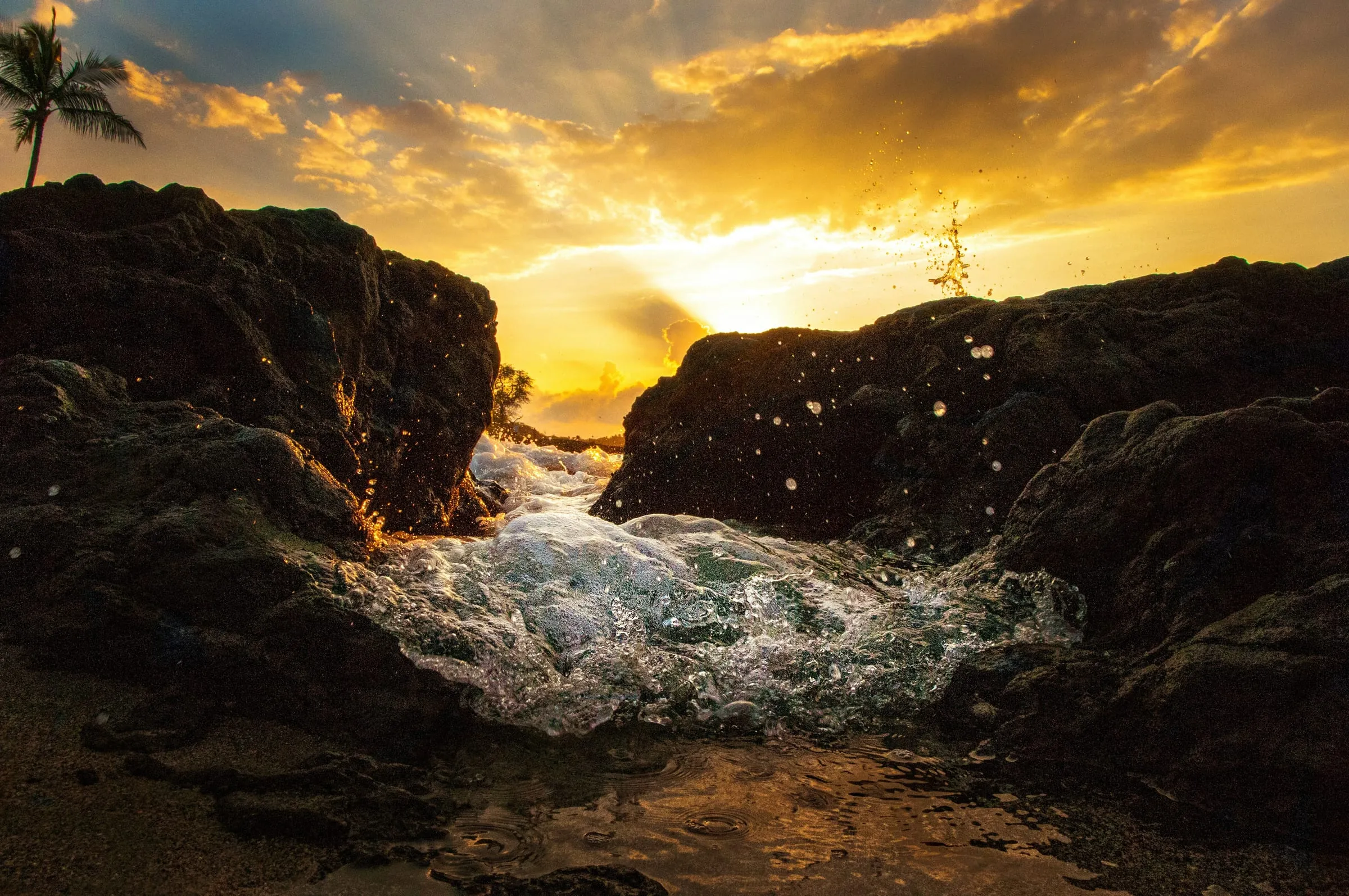
The sunset over Kohala Coast lava fields is the photograph nobody warned you about. Most travelers know the Hawaiian-sunset framing — palm trees, white sand, the iconic green flash. The Kohala Coast version is different: the black lava catches the late light in a way that turns the ground itself amber-and-gold, and the contrast against the ocean is more dramatic than the standard tropical-sunset frame. The walking paths between resorts are quiet at sunset hour. Bring the camera; this is one of the small unexpected pleasures of basing here.
Mauna Kea altitude is real. The summit sits at 13,803 feet. Even the visitor station at 9,200 feet is high enough that travelers feel it — mild headache, slight nausea, sleep disruption that night. The standard mitigation: don’t fly into Kona that morning and drive up the same day, eat a real meal before the ascent, hydrate aggressively, hold off alcohol on the day of the tour. The tour operators run a forty-five-minute acclimatization stop at the visitor station before any summit ascent for exactly this reason. Travelers with cardiovascular conditions or recent dive histories should skip the summit and stay at the visitor center for stargazing — the experience is genuinely unimpaired at 9,200 feet.
The Hāmākua Coast drive is the underrated half-day. Most travelers do Kohala-to-Volcanoes via the southern route (through Kona). The northern route via the Hāmākua Coast — through the rainforest cliffs above Hilo, with stops at Akaka Falls and the Waipi’o Valley overlook — is the genuinely scenic alternative, and most travelers don’t know to ask. If you have a sixth or seventh day on the island, this is the loop to add. Lunch at the Tex Drive-In in Honokaʻa is the local move; the malasadas are the right finish.
Snorkeling on the Kohala Coast is highly variable by surf conditions. Anaeho’omalu Bay, Kahaluu Beach Park, and Kealakekua Bay (Captain Cook Monument) are the consistent picks. The resort beaches are calm-water-friendly when the surf is down; less so when the trades are blowing. Ask the concierge for the daily condition update; don’t plan a rigid snorkel itinerary — flex it against the morning forecast.
What I’d Skip
A two-night Big Island visit as part of a “Hawaii sampler” multi-island sprint. The Big Island is large enough geographically that two nights almost always means one day on the resort, one day on Volcanoes National Park, no Mauna Kea, no Kona, no Hāmākua — and the headline experiences each fit individually but don’t combine into a coherent trip. Either give the Big Island five nights minimum, or skip it for this trip.
The drive from Kohala Coast to Volcanoes National Park as a half-day excursion. Five-hour round-trip drive plus the park itself is six-to-eight hours minimum on the ground. The “we’ll just go for the morning and be back for dinner” version of this excursion ends with travelers arriving back at the resort exhausted at 9 p.m. having seen only a third of the park. Plan it as a full day or skip the park entirely — the half-day version is the worst of both worlds.
The Big Island in late summer (mid-July through mid-August) without specifically wanting heat. Kohala Coast humidity peaks in late summer, and the leeward conditions can run uncomfortably hot. The interior (Mauna Kea, Volcanoes) stays cool, but the resort time becomes harder than it needs to be. Spring and fall are materially better.
Snorkeling tours that promise “swim with manta rays” without specific operator vetting. Manta-ray night snorkeling off the Kona coast is a legitimate experience — there are responsible operators who run it well. There are also less-responsible operators who over-fill the dive site. Ask the concierge for the resort’s vetted recommendation; don’t book the cheapest option.
For Honeymooners
Big Island honeymoons are the version of Hawaii where the landscape itself becomes the romantic infrastructure — the volcanic drama, the Mauna Kea sunset, the black-lava-against-ocean light, the long Kohala Coast resort mornings — rather than a softer beach-and-resort frame. This is honeymoon work in the pragmatic register the practice handles it in: an expert-execution job, not a magic-of-love job, and the Big Island delivers it through experiences couples remember (the Volcanoes National Park day, the summit stargazing) rather than through the postcard-Hawaii visuals. Mauna Lani Auberge and Fairmont Orchid are the two anchors I’d most often pair with a Big Island honeymoon brief; Mauna Kea Beach Hotel is the one I love for travelers whose brief is classic-Hawaii heritage rather than contemporary luxury. The Honeymoons specialty page makes the long-form case across all the practice’s anchor destinations.
The contrast worth flagging: travelers choosing between the Big Island and Maui for a Hawaiian honeymoon are choosing between geological-drama-led (the Big Island’s experiences-first shape) and resort-and-beach-led (Maui’s softer, more-active-hotel-program shape). Both are valid. The discovery call is where we figure out which one is yours.
Multi-Island Hawaii Pairing
The Big Island pairs cleanly with the other Hawaiian islands when sequencing is right.
With Maui as the resort-and-beach close — three or four nights on the Big Island for the geological content, three or four nights on Maui for the softer beach close. This is the most common multi-island Hawaii honeymoon shape; the Big Island’s intensity sets up the Maui rest naturally.
With Kauai as the nature-deepen — three nights on the Big Island for the volcano-and-mountain content, four nights on Kauai for the rainforest-and-coastline depth. The two-island combination that travelers who already know Hawaii find most rewarding.
With Lanai as the privacy close — Big Island first for the geological content, Lanai close for the small-island-quiet finish. The contrast is the trip.
Standalone five-or-seven nights — the right play when the Big Island is specifically the brief. The island earns the focused visit, and the absence of inter-island flights means more days actually on the ground.
Plan the Big Island With Me
The Big Island is the Hawaiian island where the difference between a trip that lands and one that misses comes down almost entirely to base-property choice (Kohala Coast over Kona for most luxury briefs), how the Volcanoes-and-Mauna-Kea days are paced, and whether the trip is standalone or paired. The island rewards intention; it punishes the rushed and the over-scheduled. Start with a 30-minute discovery call — I’ll walk through which Kohala Coast anchor matches your trip, sequence the Volcanoes and Mauna Kea days for the best rhythm, and tell you honestly when a different Hawaiian island is the better answer for what you’re describing.
Last updated: May 2026. Hotel relationships and amenity layers calibrated to current Signature consortium rates as of publication; specifics walked through on the discovery call.
Plan this trip with me.
A 30-minute discovery call is where it starts. No fee, no pressure.
Book a Discovery Call