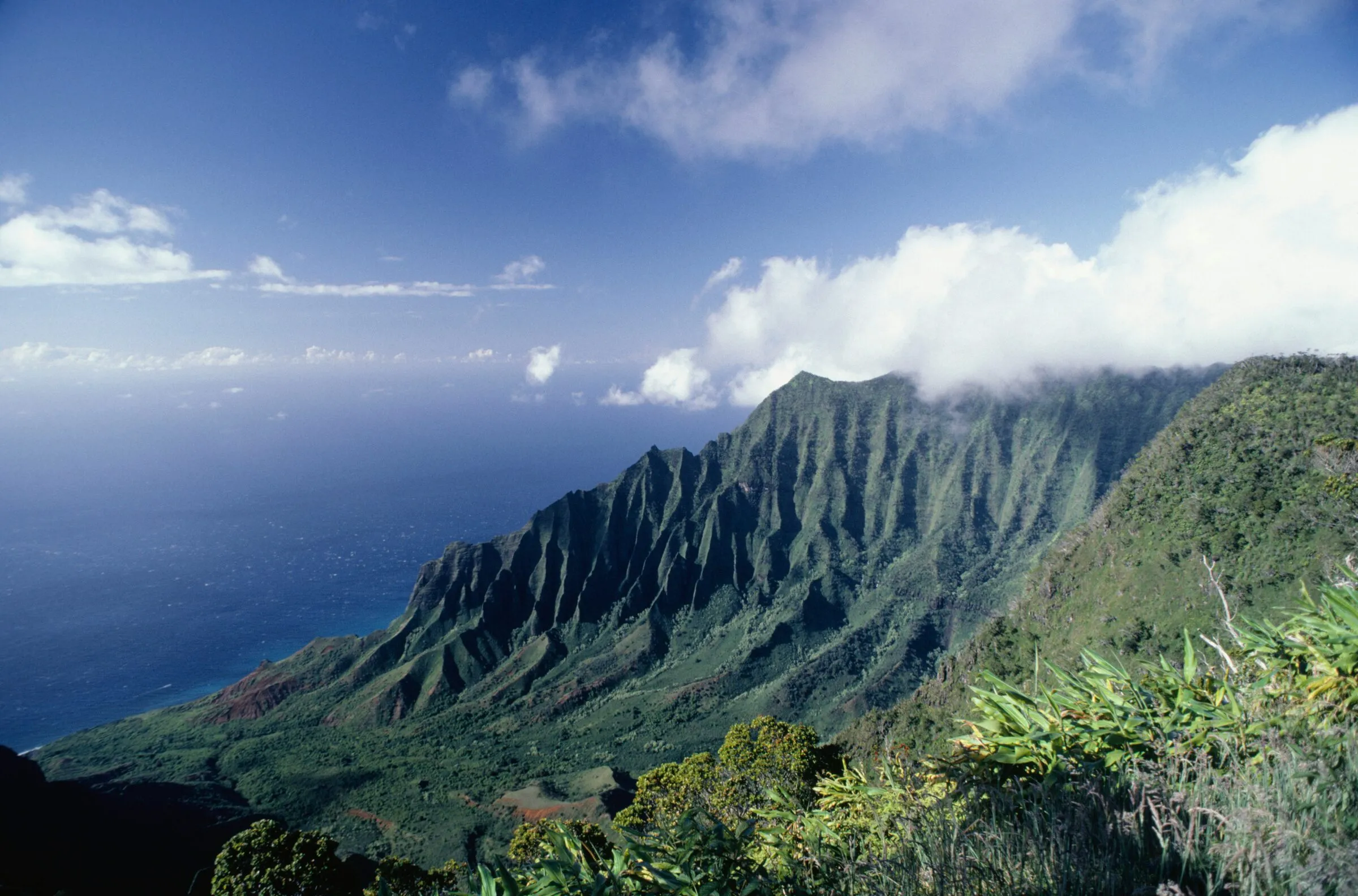
Kauai is the Hawaiian island where the landscape itself — and not the resort program, not the dining scene, not the multi-resort district — carries the trip. The other major Hawaiian islands have all developed varying versions of resort-and-beach tourism with the natural scenery serving as the backdrop. Kauai inverted that: the island has long-standing height restrictions that prevent any building from rising above the coconut tree line, the resort areas are concentrated in three small geographic pockets (Princeville on the north, Poipu on the south, Lihue on the east), and the interior of the island remains genuinely wild — Mount Waialeale at the center is one of the wettest spots on earth, and the Na Pali Coast cliffs on the northwest shore are accessible only by boat, helicopter, or a serious multi-day hike. The island has been featured in more films than any other Hawaiian island for the same reason it rewards the visit: the landscape is doing nearly all the visual work.
Done correctly, Kauai is the Hawaiian island where the scenery is the program. The Na Pali Coast boat or helicopter excursion is one of the genuinely extraordinary visual experiences in the Pacific. Waimea Canyon — the Grand Canyon of the Pacific, ten miles long and 3,500 feet deep — is the headline drive most travelers don’t realize Kauai contains. Hanalei Bay on the north shore (where the sea cliffs meet the wide crescent beach) is the canonical Bali-Hai-South-Pacific frame the brochures keep promising and most Hawaiian destinations don’t quite deliver. The waterfalls, the rainforest interior, the endangered monk seals on the beaches at dawn, the chickens running free across the entire island (a hurricane-and-history accident the locals find funny) — Kauai is the version of Hawaii where what’s outside is the trip.
Most clients come to me asking about Kauai in three contexts: as a four-or-five-night nature-led honeymoon (the most common — the brief is we want green, water, dramatic scenery, and the time to actually be in it — and Kauai delivers this register more than any other Hawaiian island), as the slower close of a multi-island Hawaii trip (Big Island for the geological drama, Maui for the resort variety, then Kauai for the scenic-finish), or as a hiker’s-and-photographer’s anchor for travelers building the trip around the Kalalau Trail, the Waimea Canyon hikes, or the Na Pali photographic excursions.
Here’s how I think about it.
At a Glance
| Best time to visit | Late April through early June and mid-September through early December. The north shore’s wet season (November through March) brings genuine rain and surf swells that close some beaches and trail sections — that’s a real planning constraint, not a marketing detail. Avoid the Christmas-and-New-Year window for both pricing and crowd reasons; the shoulder spring and fall windows are materially better. |
| How long to stay | Four nights minimum for the standalone Kauai brief. Five to six nights is where the island actually rewards the trip — long enough to do the Na Pali day, the Waimea Canyon day, both shores if you split the stay, and one full unstructured day. |
| How to get there | Lihue Airport (LIH) on the east coast is the only commercial airport on the island, with direct flights from most US west-coast hubs and frequent inter-island connections. From Honolulu, the Hawaiian Airlines and Southwest hops are 35 minutes. Most travelers fly direct from the mainland into Lihue; rental car is essentially required (the island has no comprehensive transit network). |
| Currency / language | US Dollar. English is universal; the Hawaiian language and pidgin English are both audibly present in local conversation. Aloha and mahalo carry you through every interaction. |
| One thing most guides won’t tell you | Kauai’s north shore vs. south shore decision is not a small preference choice — it materially decides the trip. The north shore (Hanalei, Princeville) is wetter, more dramatic, more remote, harder to access; the south shore (Poipu) is drier, sunnier, more developed, easier to navigate. Travelers who try to base on one and day-trip the other usually wish they’d just split the stay. The drive between them is 90 minutes-plus and the road quality varies. |
Why I Send Travelers Here
Because Kauai, planned correctly, is the Hawaiian island that delivers what travelers actually want when they say “I want the scenic Hawaii trip — the one with the waterfalls and the cliffs and the green.” The fantasy on a beach commercial is occasionally a Maui or Oahu shot; the fantasy on a Jurassic Park poster is almost certainly Kauai. The Na Pali Coast — fifteen miles of sea cliffs that rise three thousand feet straight from the ocean, accessible only by boat tour, helicopter, or the Kalalau Trail (a sixteen-mile multi-day hiking expedition for serious hikers) — is the island’s iconic frame and one of the most visually moving stretches of coastline anywhere in the Pacific. Waimea Canyon delivers a Grand-Canyon-scale geological frame that most travelers don’t expect on a Hawaiian island. The waterfalls on the Wailua River and the Hanakapiai Trail run year-round in volumes that make the island feel like a different country from the dry Kohala Coast. The chickens are everywhere and they’re funny.
The property pair across the island’s two resort coasts is what makes the trip work. The north shore anchors at 1 Hotel Hanalei Bay in Princeville — a 2023-opened sustainability-focused luxury property on the cliffs above Hanalei Bay, with the resort program (spa, oceanfront dining, beach club) framed by the genuinely dramatic Hanalei landscape. The south shore anchors at Grand Hyatt Kauai Resort & Spa in Poipu (the larger-scale luxury anchor, with the better calm-water beach access and the consistent sun) or at Ko’a Kea Resort on Poipu Beach (the boutique alternative — under a hundred rooms, on Poipu Beach itself, recently renovated). Some couples split a week across both shores. That’s the play I’d lean toward when the brief allows it.
I’m a traveling travel agent — in motion, in the rooms where this work happens. The Kauai hotel relationships I keep work through my preferred-partner channel. The amenity layers at the anchor properties come through those relationships rather than direct GM-level lines, and I’ll be straight about that distinction on the discovery call.
I send travelers here for nature-led Hawaiian honeymoons when the brief is we want green, water, scenery, and the time to actually be in it. I send couples for the multi-island Hawaii close when an earlier island has carried the resort-and-cultural content and Kauai becomes the scenic finish. I send rare clients for the hiking-and-photography anchor when the trip is built around Na Pali, Waimea Canyon, and the Kalalau Trail. And I send the right traveler for a north-shore-only Hanalei retreat when the brief is genuinely remote-and-romantic — couples whose honeymoon is we want to disappear.
Where I’d Anchor
The Kauai anchoring decision splits cleanly between the north shore (Hanalei / Princeville, dramatic scenery, more rain, more remote) and the south shore (Poipu, drier, sunnier, more amenities). Both work. The right answer depends on the trip you’re building.
1 Hotel Hanalei Bay (Princeville, north shore) — the sustainability-led luxury pick. Opened 2023 on the cliffs above Hanalei Bay, with the property’s sustainability-and-wellness program (1 Hotels’ brand-wide ethos around natural materials, biophilic design, low-carbon operations) integrated into the architecture and the program. The resort’s beach access is via the Pu’u Poa Beach below the property — a quieter alternative to the busier Hanalei Bay crescent itself. Oceanfront pool, spa, multiple dining outlets including 1 Kitchen, and the kind of cliff-side privacy the north shore consistently delivers. This is the anchor for travelers whose Kauai brief is contemporary luxury with the dramatic north-shore landscape carrying the trip.
Grand Hyatt Kauai Resort & Spa (Poipu, south shore) — the larger-scale resort pick. A sprawling beachfront property on the south coast with the kind of multi-pool, multi-restaurant, full-amenity program that travelers who want resort-vacation-with-a-Kauai-address are typically asking for. Calm-water Anara Beach access, the Anara Spa, four restaurant concepts, the Hawai’i tropical-pool complex, championship golf at the adjacent Poipu Bay Golf Course (former site of the PGA Grand Slam of Golf). This is the anchor when the Kauai brief is we want sun and beach and the resort doing most of the work.
Ko’a Kea Resort on Poipu Beach (Poipu, south shore) — the boutique alternative. Under a hundred rooms, directly on Poipu Beach itself, recently renovated. A smaller, more intimate Poipu register than the Grand Hyatt — an option I love for travelers who want the south-shore sun and beach access without the larger-resort footprint. Couples often prefer this when the brief leans toward we want a hotel rather than a resort.
The split-stay play — three nights north, three nights south. For travelers with five-to-seven nights and the willingness to absorb a mid-trip transfer, splitting between Hanalei (1 Hotel) and Poipu (Grand Hyatt or Ko’a Kea) is the version of Kauai that delivers the most complete experience. The two coasts are genuinely different climates, different landscapes, different rhythms — a single-base Kauai trip almost always leaves one shore underexperienced. The transfer is 90-100 minutes by car, scenic the whole way, with the Lihue / Wailua midpoint a natural lunch stop.
I’ll be straight on the relationship layer: Grand Hyatt Kauai and Ko’a Kea Resort are anchors I plan through my preferred-partner channel. The room categories and amenity strategy come through those relationships rather than a personal GM-level line. 1 Hotel Hanalei Bay I book outside that consortium channel, so its amenity layer works differently on the north shore — I’ll tell you honestly what applies. The trip still books cleanly — preferred-rate amenities, room-category strategy, on-arrival escalation if anything goes sideways — and the discovery call is where we pull live availability and walk through which anchor (or split) matches your dates.
Start a discovery call — I’ll pull live availability across the north and south shore anchors, walk through the split-stay option if it fits, and confirm which amenities apply to your dates.
What I’d Do With Five Days
Adjust to taste. The five-day version is the standalone-Kauai brief; the seven-day version splits between the two shores and adds a slow free day.
Day One — Arrival and shore settling
Arrive at Lihue, transfer to your anchor property by mid-afternoon (45 minutes north to Princeville, 25 minutes south to Poipu). Settle in. The first afternoon is for the resort itself and the immediate surrounding beach — Hanalei Bay crescent on the north, Poipu Beach on the south. Dinner at the resort’s signature restaurant. The Kauai sunset (north shore is the headliner — west-facing into the Na Pali — but south-shore sunsets at Poipu’s Spouting Horn Park are also worth the short drive).
Day Two — The Na Pali Coast day
The defining Kauai day, regardless of which shore you’re basing on. The boat option: a half-day catamaran tour from Port Allen on the south side (Capt. Andy’s Sailing or Holo Holo Charters are the established operators) — five hours, includes snorkel stops at Na Pali sea caves and a lunch on board. The helicopter option: sixty-five minutes airborne over the Na Pali, Waimea Canyon, and the Mount Waialeale interior (Blue Hawaiian or Mauna Loa Helicopter are the operators) — more expensive, more comprehensive, and the only way to see the interior. The Kalalau Trail day-hike option (north shore only): the first two miles of the trail to Hanakapiai Beach for a moderate-difficulty hike with serious scenic payoff. Choose one. Save the second-tier option for a later trip.
Day Three — Waimea Canyon and the west-side drive
The 90-minute drive to Waimea Canyon State Park is the headline west-side excursion. The canyon is ten miles long, 3,500 feet deep, and visible from the Waimea Canyon Drive overlooks (Pu’u Hinahina, Pu’u Ka Pele) plus the Kokee Lookout above. Pack a picnic lunch from the resort or stop in Hanapepe (the West Side’s old-town arts village) for lunch — the Hanapepe Café & Espresso Bar is the local move. Afternoon: the Polihale Beach drive (unpaved, requires four-wheel-drive — only the rental Jeep, not a sedan) for the most isolated Hawaiian beach you can drive to. Back to the resort by sunset.
Day Four — The slower beach-and-river day
Anchor on whichever shore you’re basing. North shore version: the Hanalei Bay morning paddleboard, lunch at Bar Acuda’s tapas (the destination-restaurant in Hanalei village), the Limahuli Garden self-guided afternoon tour (native plants and the cliff-and-valley landscape), back to the resort for sunset. South shore version: the Poipu Beach snorkeling morning (calm waters, frequent monk-seal sightings — keep distance, they’re endangered and protected), lunch at Beach House Restaurant (one of the genuinely good Pacific-Rim restaurants on the island, oceanfront), the Allerton Garden afternoon tour (one of the National Tropical Botanical Garden’s three Kauai gardens, with the bonus of housing the Indiana-Jones-and-the-Lost-Ark cliff-and-vine setting). Back to the resort.
Day Five — Free day or departure
The unscheduled day — sleep in, beach morning, late breakfast. Or — for travelers extending the trip — the morning departure to your second Hawaiian island. The five-day Kauai brief works either as a standalone or as the front half of a multi-island pair.
Specific Things I’d Tell You About
The north-shore-vs-south-shore decision is real and it shapes the trip’s whole tempo. This isn’t a marginal preference choice. The north shore is wetter (Hanalei Bay receives roughly 80 inches of rain a year), more dramatic (the Na Pali cliffs rise straight out of the water within view of every Hanalei beach), and quieter (Princeville is a single resort district with limited amenities). The south shore is drier (Poipu receives roughly 30 inches), sunnier, more developed (Poipu has a small commercial district, multiple restaurants, golf, the Spouting Horn blowhole), and easier for travelers who want resort amenities without earning them through a long drive. Honeymoon couples whose brief is we want quiet and dramatic scenery anchor north. Couples whose brief is we want sun and beach and easy access anchor south. Couples who want both should split the stay.
The Na Pali Coast helicopter ride is the experience couples consistently rate as the trip’s best. The boat tour is genuinely good. The helicopter is genuinely better — the perspective on the Na Pali from above, plus the over-Mount-Waialeale interior shots that no boat or hiking trip can deliver, plus the Waimea Canyon overflight as a bonus. If the budget can absorb it, the helicopter is what I’d book. Blue Hawaiian and Mauna Loa Helicopter are the established operators with the safety records; book six weeks out for high season.
The chickens are real and they are everywhere. Hurricane Iniki in 1992 freed a population of fighting roosters and wild jungle fowl that had been domesticated for centuries; with no significant predators on the island (Kauai is the only main Hawaiian island that escaped the introduced mongoose), the population has thrived. You will hear roosters at 4 a.m. You will see hens with chicks crossing the resort path at lunch. The locals find this funny and slightly proud; the resort sound-mitigation in your room category will determine whether you’re charmed or aggrieved. Pack good earplugs for the first night until your sleep adjusts.
Mount Waialeale is one of the wettest spots on earth and the helicopter rides into the crater are the experience. The mountain at the island’s center receives roughly 400 inches of rain per year — the volume that creates the waterfalls visible from every Wailua River and Na Pali viewpoint on the island. The helicopter excursions descend into the Mount Waialeale crater (the volcanic basin at the mountain’s summit) for the most dramatic interior view available; the Blue Hawaiian “Wings of Kauai” tour specifically routes through the crater. This is the underrated half of the helicopter experience.
Monk seals on the beaches are real and they’re protected. Kauai has more endangered Hawaiian monk seals than any other main Hawaiian island. You’ll likely see at least one sleeping on Poipu Beach or another south-shore beach during your stay. The legal-and-ethical framing: do not approach within 50 feet, do not interact, do not photograph from close. Hawaiian state law and federal Marine Mammal Protection Act enforcement is taken seriously. The resorts brief guests on this on arrival; honor the framing.
What I’d Skip
A two-night Kauai visit as part of a multi-island sprint. The island is geographically dispersed enough — 90+ minutes from north shore to south shore, an hour from Lihue to Waimea Canyon, the Na Pali day eats most of one day — that two nights almost always leaves the headline experiences uncompleted. Either give Kauai four nights minimum, or skip it for this trip and put it on the next one.
The drive from Princeville to Poipu without a 4WD or with a tight schedule. The cross-island route via the south coast is straightforward, but the northern back-road option through the Wailua valley adds significant time and requires a four-wheel-drive vehicle to handle the wet sections. Plan the south-coast route for any cross-island trip and budget the full 90-100 minutes plus a lunch stop.
Kauai in November-March without checking surf conditions. The north-shore beaches close to swimming during high winter surf; the Na Pali boat tours sometimes cancel for days at a time. The Princeville and Hanalei area accommodations remain open and beautiful during the winter window, but the active in-water program tightens significantly. Verify before booking the winter visit.
The Spouting Horn blowhole as a planned destination. The blowhole shoots water through a lava tube on Kauai’s south coast and is genuinely impressive when the surf is high. It’s also a five-minute roadside stop, not a destination — travelers who plan an afternoon around it are usually disappointed by the brevity. Combine it with the Allerton Garden tour or the Beach House lunch if you’re already in the Poipu area; don’t drive across the island for it.
For Honeymooners
Kauai honeymoons are the nature-led version of Hawaii — the trip where the landscape itself is the romantic infrastructure rather than a softer beach-and-resort frame. This is honeymoon work in the pragmatic register the practice handles it in: the Na Pali helicopter or boat day is the experience couples remember years later; the Waimea Canyon morning and the Poipu monk-seal sunrise are the smaller anchors; the property pair (1 Hotel Hanalei Bay on the north, Grand Hyatt or Ko’a Kea on the south) carries the resort rhythm. The Honeymoons specialty page makes the long-form case across all the practice’s anchor destinations; for the Kauai-specific honeymoon brief, the right answer is almost always split the stay — three nights on each shore — when the trip allows.
The contrast worth flagging: travelers choosing between Kauai and Maui for a Hawaiian honeymoon are choosing between scenery-led (Kauai’s nature-first shape) and resort-and-amenity-led (Maui’s softer, multi-resort shape). Both are valid. The discovery call is where we figure out which one is yours.
Multi-Island Hawaii Pairing
Kauai pairs cleanly with the other Hawaiian islands when sequencing is right.
With Maui as the resort-and-variety counterpart — three or four nights on Maui for the Wailea or Kapalua resort program, three or four nights on Kauai for the scenic close. This is the most common multi-island Hawaii honeymoon shape; the Maui side carries the resort variety, the Kauai side carries the dramatic-scenery finish.
With the Big Island as the geological-then-scenic arc — four nights on the Big Island for the volcano-and-mountain content, four nights on Kauai for the Na Pali-and-rainforest content. The two-island combination travelers who already know Hawaii find most rewarding.
With Lanai as the privacy close — Kauai for the scenic content, Lanai for the small-island-quiet finish. Less common but works for couples whose brief is Hawaii’s most-natural-then-most-private.
Standalone five-or-seven nights — the right play when Kauai is specifically the brief. The split-stay between the two shores is the version that delivers the most complete trip.
Plan Kauai With Me
Kauai is the Hawaiian island where the difference between a trip that lands and one that misses comes down almost entirely to the north-shore-or-south-shore decision (or the willingness to split-stay), the timing of the Na Pali day (helicopter vs. boat vs. hike), and how the cross-island drives are paced. The island rewards intention — it punishes the rushed and the over-scheduled. Start with a 30-minute discovery call — I’ll walk through the shore decision, sequence the Na Pali day for your trip’s rhythm, and tell you honestly when a different Hawaiian island is the better answer for what you’re describing.
Last updated: May 2026. Hotel relationships and amenity layers calibrated to current Signature consortium rates as of publication; specifics walked through on the discovery call.
Plan this trip with me.
A 30-minute discovery call is where it starts. No fee, no pressure.
Book a Discovery Call