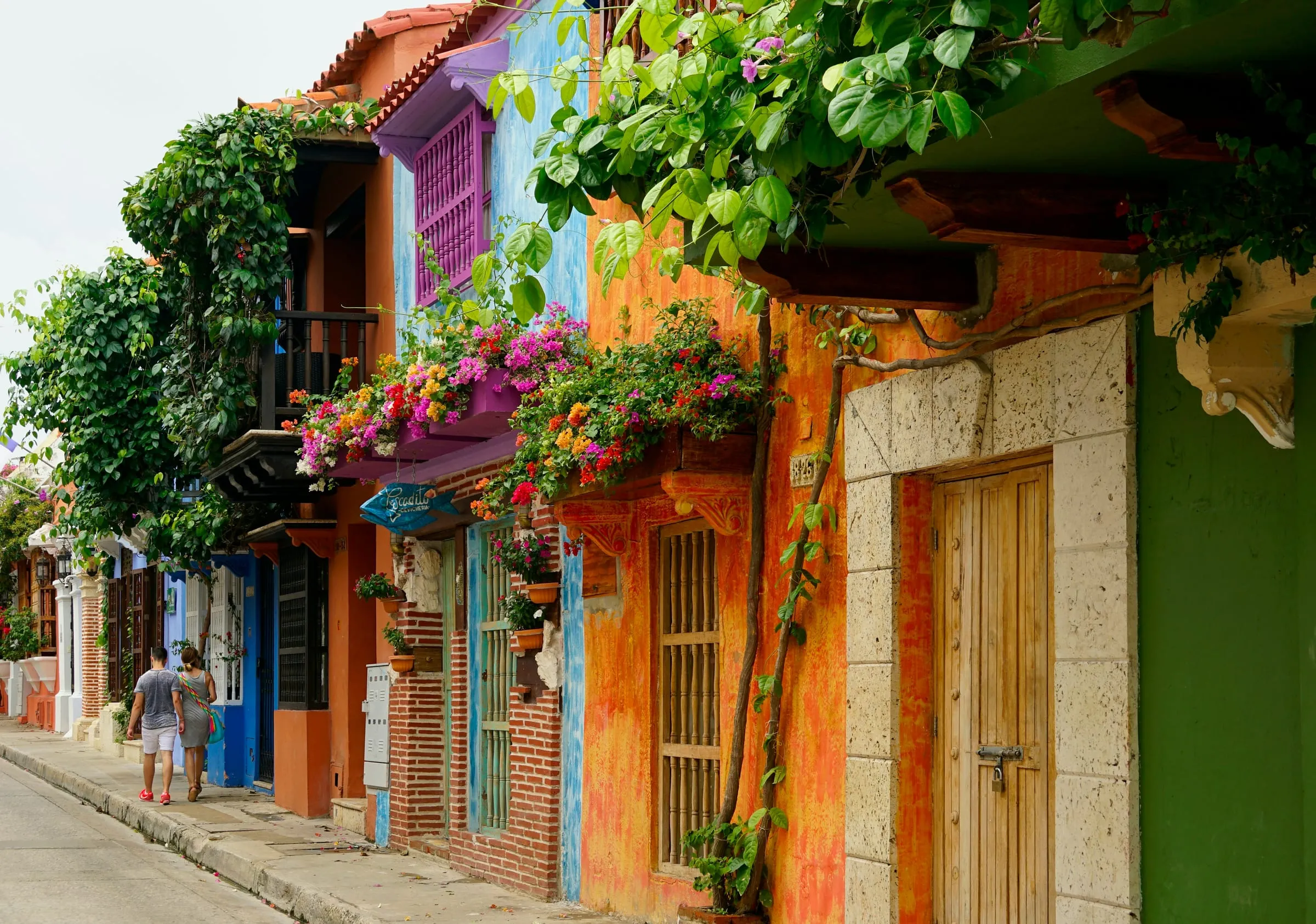
Cartagena is the city that quietly outperforms expectations for almost every American traveler who steps off a Caribbean cruise or a flight from Miami and walks for the first time through the Puerta del Reloj into the Centro Histórico. The walled colonial city is a UNESCO World Heritage Site (designated 1984), founded in 1533 as the Spanish Empire’s most fortified Caribbean port — the gold from the New World left for Europe through these gates — and the surviving 16th-century walls, the painted-pastel colonial mansions, the bougainvillea-fronted balconies, and the mix of Afro-Caribbean and Spanish-colonial culture together produce a city character unlike anywhere else in the Caribbean.
Done correctly, Cartagena is one of the most rewarding mid-sized cities in the Americas — the entire walled city walks itself in two unhurried days, the cuisine is the ocean’s-edge Afro-Caribbean-Spanish hybrid that exists nowhere else, the Castillo de San Felipe de Barajas fortress on the hilltop overlooking the city is one of the great surviving Spanish military engineering structures in the New World, and the Islas del Rosario archipelago a short boat ride offshore offers white-sand-and-turquoise-water Caribbean beach days. The climate is consistent — warm, humid, breezy from the trades — year-round, with the December-through-March dry season as the obvious peak.
Most clients come to me asking about Cartagena in three contexts: as a Caribbean cruise port stop (Princess, Holland America, Royal Caribbean, and luxury Caribbean lines all stop here on Panama-Canal and Southern-Caribbean itineraries — and one day in port is meaningfully insufficient for the city), as the front of a multi-city Colombia trip (Cartagena →︎ Bogotá →︎ Medellín, 8 to 11 days, the spine-of-Colombia arc), or as the launch city for a Magdalena River cruise (the Magdalena cruise programs originating in Cartagena are the newest river-cruise itineraries in the Americas and one of the strongest specialty additions to the global river-cruise inventory in the past decade).
Here’s how I think about it.
At a Glance
| Best time to visit | December–March for the dry season — sunny, breezy, pleasant. Early April still lands most days dry. Avoid June through November unless you specifically want the green-season rates and don’t mind afternoon rain showers and tropical-storm-watching. The annual Hay Festival Cartagena in late January (literary, conversational, international writers) is the city at its most cosmopolitan if your dates align. |
| How long to stay | Two full nights minimum if Cartagena is a cruise pre/post pause, three or four nights for a real city visit, five-plus for travelers including a beach day on the Islas del Rosario or a day trip to Mompox or the Magdalena Delta. |
| How to get there | Rafael Núñez International Airport (CTG) is in central Cartagena, just 3 km from the historic center; a taxi to the walled city runs USD $7–10 in 10 minutes. Direct flights from Miami (3h15m), Panama City (1h30m), Bogotá (1h30m). From Bogotá — domestic flight is the only realistic option (the road journey is 12+ hours through difficult terrain). |
| Currency / language | Colombian peso (COP). The dollar is widely accepted in tourist-facing settings, but you’ll get materially better value paying in pesos; ATMs throughout the historic center are reliable. Spanish is the only official language; English is spoken at most major hotels and in the tourist-facing economy, much less so in side-street restaurants and shops. Buenos días, gracias, por favor go a long way. |
| One thing most guides won’t tell you | Most American travelers’ mental model of Colombia generally — and Cartagena specifically — is 15 to 20 years behind the actual country. Cartagena in 2026 is one of the safer mid-sized Caribbean cities for tourists, with concentrated police presence in the walled city and the contemporary Colombian tourism economy heavily invested in the safety of the visitor experience. Trust the visit, exercise the same urban awareness you would in any other major city, and the Cartagena trip almost universally outperforms the version travelers psychologically arrive with. |
Why I Send Travelers Here
Because Cartagena, planned correctly, is the most rewarding small-walking-city in the Americas Caribbean — and one of the genuinely undercovered destinations in U.S. advisor-led travel content. The walled city is a near-perfect 1.5-mile-perimeter UNESCO World Heritage zone with concentrated colonial architecture; the San Diego barrio within the walls is the quieter residential quarter that locals call home; the food is meaningfully better and more distinctive than Caribbean cruise itineraries suggest; and the Afro-Caribbean cultural layer — palenquero language and music heritage from the San Basilio de Palenque community an hour inland (the first free Afro-descendant town in the Americas, founded by escaped enslaved people in the 17th century) — gives Cartagena a cultural depth the standard-Caribbean-cruise-stop framing entirely misses.
It’s also the launch city for Magdalena River cruises — the newest river-cruise itineraries on the Western Hemisphere, opened to international travelers in the 2020s, with the AmaWaterways and Variety Cruises lines now running full-season programs up the Magdalena to Mompox and beyond. The Magdalena cruise market is undercovered by U.S. advisor content, and the version of those itineraries that includes a real Cartagena stay before or after the sailing is the version I plan for clients. If you’re considering a Magdalena cruise, Cartagena earns at minimum two pre- or post-cruise nights.
I send travelers here as a Caribbean-cruise pre/post anchor (most commonly Princess and Holland America, but also luxury lines), as the front of a Colombia multi-city trip (Cartagena →︎ Bogotá →︎ Medellín, 8-11 days, the spine of Colombia), as a Magdalena river cruise pre/post, and for honeymoons and milestone trips that want a Caribbean-with-real-architecture-and-culture alternative to the standard resort-and-beach Caribbean trip.
Every recommendation below comes through the lens of how I plan Cartagena for the clients I send, the hotel relationships I rely on, and a clear point of view about which version of the city earns your time.
Where I’d Anchor
Three anchoring patterns cover almost any traveler’s reason for being in Cartagena:
Centro Histórico (the walled city). The 1533-founded historic core inside the surviving Spanish colonial walls — Catedral de Santa Catalina de Alejandría, Plaza de los Coches, Plaza de Bolívar, Plaza Santo Domingo, the small streets connecting them. Stay here on a first visit — almost everything you’ll do is within the walls, and the walking-out-of-the-hotel-into-the-photograph pattern is the entire reason most travelers come.
San Diego (within the walls, north quadrant). The quieter residential barrio inside the walled city — narrower streets, fewer restaurants, more local-resident character. The pick for travelers who want walls-and-colonial-architecture immersion without the Plaza-Santo-Domingo nightlife volume.
Isla de Barú (offshore beach resort). The white-sand-and-turquoise-water island 30 minutes by boat or 1 hour by road from central Cartagena. Different vacation entirely — this is the beach-resort version of Cartagena where the city is a half-day excursion rather than the trip’s center. Better for travelers building a beach-with-culture-day-trip arc, or for second visits.
For the walled-city heritage flagship pick — and the most iconic Cartagena hotel — Sofitel Legend Santa Clara Cartagena in the San Diego barrio is the call. The hotel occupies a 1621 former convent transformed into luxury accommodation in 1995, with colonial and republican-era architecture preserved throughout, a courtyard cloister at the heart of the property, gourmet cuisine, and the complimentary use of an in-house hammam that’s the only one in any Cartagena program-eligible property. On my rate at the property, the amenity layer is meaningful and doesn’t book direct — what applies depends on your dates and the room category, and the specifics get walked through on the discovery call. The property also runs seasonal stay-length promotions that materially shift the value math on longer Cartagena stays or full-Colombia arcs; we’ll check what’s live for your dates.
For the Relais & Châteaux honeymoon pick — and the most distinctive boutique property in Colombia — Casa Pestagua at Calle Santo Domingo 33-63 is the call. The renovated 18th-century mansion is the only Relais & Châteaux property in all of Colombia, set in the heart of the walled city, with double-height ceilings, Moorish-inspired arches of significant architectural value, and lush internal gardens that frame the colonial-courtyard atmosphere. On my rate at the property, the amenity layer doesn’t book direct, and the specifics — designed to land at check-in rather than appear in advance — get walked through on the discovery call.
For the beach-resort alternative anchor — and an option I love for travelers who want a city-and-beach combination — Sofitel Barú Cartagena Beach Resort on Isla de Barú is the call. The 187-room property sits on a private beach 30 minutes by boat from central Cartagena, surrounded by Caribbean biodiversity and white-sand-and-turquoise-water that delivers the iconic-Caribbean photograph the walled city itself doesn’t. On my rate at the property, the amenity layer is calibrated to your stay rather than itemized in advance — what applies depends on dates and the room category, and we walk through it on the discovery call.
For travelers who want additional walled-city options, Hotel Casa San Agustin (boutique 31-room property in three restored heritage houses, Centro Calle de la Universidad) and Hotel Charleston Santa Teresa Cartagena (former 17th-century convent, 87 rooms with rooftop pool, Centro Histórico) are the strong alternates I work with. Both with comparable amenity packages.
Want one of these stays? Start a discovery call — I’ll pull live availability, walk through the suite categories, and confirm which amenities and current promotions apply to your dates. And the small extra at check-in — a welcome note from me, the kind of touch the standard amenity package doesn’t list — is part of how I deliver these stays.
What I’d Do With Three Days
Adjust to taste. The three-day version is the right length for Cartagena city plus a half-day beach excursion; the two-day version is the cruise pre/post pause that compresses the must-sees.
Day One — The Walled City
Start the morning early — before 9 a.m., when the heat is forgiving and the cruise-bus groups haven’t arrived. Coffee at one of the small cafés in the Plaza de Bolívar and a slow walk through the surrounding Centro Histórico. Climb up onto the walls themselves at the Baluarte San Francisco Javier for the morning view across the colonial rooftops — the walls are walkable in long sections and the elevated perspective is the photograph the postcards underdeliver.
Visit Catedral Basílica Menor de Santa Catalina de Alejandría on Plaza de Bolívar (the 16th-century cathedral, late-Renaissance lines, a pirate-attack survivor twice over) and the Iglesia de San Pedro Claver a few blocks away (the Jesuit-saint church and adjoining museum, where the saint who advocated for African slaves’ rights in the 17th century is buried). Walk the Plaza Santo Domingo for the Botero sculpture La Gorda Gertrudis — Fernando Botero (Colombia’s most celebrated 20th-century artist, born in Medellín) gifted the piece to the city; rubbing the figure’s posterior is a local good-luck tradition.
Lunch at La Cevichería (the seafood ceviche house Anthony Bourdain made famous, on Calle Stuart) or Restaurante Marea by Rausch (high-end seafood with sea views, in the Bocagrande district). Both require reservations.
Afternoon: walking the smaller streets of San Diego barrio — the quieter residential walls-quarter, with bougainvillea-laden balconies and the kind of unfilmed-Cartagena ambiance most cruise-stop travelers don’t reach. End at Café del Mar atop the Baluarte de Santo Domingo for sunset over the Caribbean — the iconic Cartagena hour, with the walled city behind you and the sea opening in front, a watered-down rum cocktail in hand.
Dinner at Carmen (modern Latin in San Diego, the city’s most-celebrated tasting room) or Vera (Italian in the heart of the walled city). Reservations essential.
Day Two — Castillo de San Felipe and Getsemaní
Morning: walk or taxi to the Castillo de San Felipe de Barajas — the largest Spanish-built fortress in the New World, begun in 1536 and continuously expanded through the 18th century. The fortress climbs the San Lázaro hill outside the walls and commands the entire Cartagena bay. Explore the tunnels (a network of underground passages designed so that defenders could move unseen between the fort’s sections; the acoustics inside the tunnels are uncanny — designed so soldiers could hear footsteps approaching from minutes away). Allow 90 minutes. Wear shoes you can climb in.
Walk back across into the Getsemaní district — the working-class Cartagena neighborhood directly across from the walled city, now the city’s cool kid quarter with murals, bars, and small Afro-Caribbean restaurants. Plaza de la Trinidad in the heart of Getsemaní is the local-evening hangout square; the street art along Calle de la Sierpe and Calle del Espíritu Santo is some of the strongest urban-mural work in the Caribbean.
Lunch in Getsemaní at Lobo de Mar (Caribbean fusion, casual, atmospheric) or back into the walled city for a menu del día at one of the small spots away from the main plazas.
Afternoon: depending on energy and stamina, either the Museo del Oro Zenú (the gold museum showcasing pre-Columbian goldwork from the Zenú indigenous culture — a satellite of Bogotá’s main Museo del Oro, smaller but worth the hour) or a guided walking tour with an Afro-Caribbean-history focus through the Getsemaní quarter.
End at Café Stepping Stone or Townhouse Boutique Hotel rooftop for sunset; dinner back in the walled city or at one of the rooftop restaurants in Getsemaní.
Day Three — Islas del Rosario, or Slower Cartagena
Two strong options:
The Islas del Rosario. A 45-minute boat ride from Cartagena’s bay to the protected archipelago of 27 small Caribbean islands with white-sand beaches, coral reefs, and the kind of turquoise-water version of the Caribbean the walled city doesn’t deliver. Most cruise lines and tour operators offer day-trip packages; the better way is to book a private boat with a captain for the day (small group, four to eight passengers, customizable stops). Lunch at one of the small island restaurants. Snorkeling included. Back to Cartagena by mid-afternoon.
A Magdalena cruise pre/post day, or a slower Cartagena. If you’re embarking on a Magdalena cruise the next morning, day three becomes the unhurried pre-cruise day — slow morning, a final walk through the walled city, a long lunch, hotel pool time, dinner that ends at a reasonable hour. The slower-Cartagena version is a deliberate choice that some clients describe later as the favorite day of the trip.
By day three, Cartagena makes its own recommendations.
Specific Things I’d Tell You About
Botero’s La Gorda Gertrudis in Plaza Santo Domingo is the city’s quiet good-luck statue. Fernando Botero — Colombia’s most internationally recognized 20th-century artist, born in Medellín — gifted the bronze reclining figure to Cartagena, and rubbing the figure’s posterior is a local good-luck tradition. The statue is a meaningful preview of what’s coming in the Botero-rich Medellín leg of any Colombia multi-city trip. Touch it on the way past.
The walls of the Centro Histórico are walkable for long sections. The 11-kilometer surviving Spanish-colonial walls aren’t a museum exhibit — they’re a continuous walking platform that locals use for exercise and tourists can climb at any of the major baluarte (bastion) entry points. The sunset walk from Baluarte San Francisco Javier toward Café del Mar is one of the iconic Cartagena hours.
San Basilio de Palenque is an hour inland and historically significant. The first free Afro-descendant town in the Americas, founded by escaped enslaved people who fled Cartagena’s slave market in the 17th century. Palenquero — the Spanish-Bantu creole spoken there — is the only known surviving Spanish-based creole and is UNESCO-recognized as Intangible Cultural Heritage. Day-trip access is possible but requires real planning; the contemporary cultural-heritage experience is meaningful for travelers with a serious interest in the Afro-Caribbean dimension of Cartagena’s story.
The Castillo’s tunnels have deliberate acoustic design. When the Spanish military engineers expanded the fortress in the 17th and 18th centuries, they designed the underground passages with calculated acoustic properties — defenders could hear approaching footsteps from minutes away through the tunnel network. Walk the tunnels and stand quietly in one of the longer sections; the sound carries unsettlingly. Most cruise-bus tours skip the tunnel walk; the fortress-without-tunnels misses the engineering-marvel layer.
Cartagena’s cuisine is Afro-Caribbean-Spanish hybrid that exists nowhere else. The local specialties — posta cartagenera (sweet-savory braised beef), arroz con coco (coconut rice), cazuela de mariscos (Caribbean seafood stew), patacones (twice-fried plantains), and agua de panela con queso (sugarcane water with melted cheese) — combine Spanish colonial cooking traditions with West African influences and Caribbean seafood-and-tropical-fruit ingredients. Eat at the smaller restaurants away from the main plazas; the food gets meaningfully better and the prices halve.
The Hay Festival Cartagena in late January is the city at its most cosmopolitan. The annual literary festival — a satellite of the main Hay Festival in Wales — brings international writers, conversations, and cultural programming to the walled city for four days. If your Cartagena dates align with the festival, the city’s energy shifts measurably. Worth knowing.
What I’d Skip
The horse-drawn carriage tours through the walled city. Tourist tax. The walled city is small enough to walk in two unhurried days; the carriage tours add nothing the walking version doesn’t already provide and concentrate the worst of the cruise-bus-group experience.
Restaurants on Plaza Santo Domingo or Plaza de los Coches with English-only menus and pushy hosts. Same tourist-tax pattern as every European city in this library. Walk three blocks deeper into the walled city.
The Pablo Escobar / “narco-history” tours. I won’t sell these. The contemporary Colombian tourism establishment is actively trying to redirect international visitor interest away from the narco-tourism category, and the more rewarding version of Colombia’s 20th-century-history conversation is the contemporary urban-renewal arc — the version of Colombia 15 years ahead of where most American travelers’ mental model of it is stuck. If you have specific historical-research interest, that’s a discovery-call conversation.
Bocagrande as a base. The modern high-rise district south of the walled city has the resort hotels and casino-and-shopping infrastructure that Caribbean-cruise itineraries default to — and it’s the wrong base for the trip Cartagena rewards. Bocagrande is fine for a beach-resort vacation that happens to be in Colombia; it’s the wrong base for a Cartagena trip. Stay in the walled city or on Isla de Barú.
Driving anywhere in central Cartagena. The walled city is essentially pedestrian; taxis are cheap and metered for short trips outside the walls; the Castillo de San Felipe is a five-minute taxi from Centro Histórico. Don’t rent a car for the city itself. Hire a car-and-driver only if you’re doing a Mompox or Magdalena Delta day trip.
For Multi-City Colombia Travelers
Cartagena is the front of the spine-of-Colombia multi-city arc — Cartagena →︎ Bogotá →︎ Medellín, 8 to 11 days, all connected by short domestic flights (each leg is 1h to 1h30m by air; the road journeys are 12+ hours each and not recommended).
The classic 9-night Colombia trip: three nights Cartagena (Caribbean colonial), three nights Bogotá (high-altitude capital, Botero, Gold Museum, Andean cultural depth), three nights Medellín (eternal-spring climate, Comuna 13 transformation, urban innovation). The 11-night version adds a beach-day finale on the Caribbean coast or two nights in the Coffee Triangle (between Medellín and Bogotá — UNESCO-listed coffee-cultural-landscape with traditional fincas and coffee tasting).
If you want me to design the full Colombia multi-city trip — flight timing, hotel sequencing across three different climate zones, Magdalena-cruise integration if applicable — that’s exactly the kind of planning I do. Start a discovery call.
For Magdalena River Cruisers
If your Cartagena trip is the embarkation or disembarkation city of a Magdalena River cruise — AmaWaterways and Variety Cruises are the major operators currently sailing the Magdalena, with itineraries running between Cartagena and either Mompox (the colonial river-city), Barrancabermeja, or further upstream — the most important call you’ll make is adding a real Cartagena stay before or after the sailing, not treating the city as a transfer-day pause.
The Magdalena is genuinely different from the Danube or the Douro — a tropical river through dense biodiversity, fewer ports per day, more time on the water, and a colonial-Latin-American cultural focus that’s unlike any European river-cruise itinerary. The version of those cruises that includes 2–3 pre- or post-cruise nights in Cartagena is the version I plan for clients. One night as the cruise embarkation pause is the most common avoidable mistake on a Magdalena itinerary.
The deeper conversation about Magdalena cruise selection — and whether your dates and traveler-fit work for the AmaWaterways or Variety programs — lives on the Rivers & Small Ships specialty page.
For Honeymooners
Cartagena is the underrated Caribbean honeymoon city. The walled-city colonial backdrop, the Plaza Santo Domingo sunset evenings, the rooftop pools at the Sofitel Santa Clara and Casa San Agustin, and the Caribbean-and-culture combination together deliver a version of a Caribbean honeymoon meaningfully more interesting than the standard resort-and-beach Caribbean version. Anchor at Casa Pestagua for the Relais & Châteaux 18th-century-mansion intimacy, Sofitel Legend Santa Clara for the iconic 1621-convent flagship experience, or — if a beach-day-finale matters — Sofitel Barú for the offshore-island-resort week.
The honeymoon evening, in my read, is dinner at Carmen (modern Latin in San Diego, the city’s most-celebrated tasting room) followed by a slow walk through the lit colonial streets back to the hotel. The setup does the work.
If you want me to design the full Caribbean-with-real-architecture honeymoon — Cartagena plus optional Islas del Rosario beach finale, plus optional Bogotá and Medellín for the multi-city Colombia version — that’s exactly the kind of planning I do. Start a discovery call.
Plan Cartagena With Me
If you’re thinking about Cartagena as a Caribbean cruise pre/post anchor, as the front of a multi-city Colombia trip, as a Magdalena river cruise launch base, or as the standalone three-or-four-night city visit it deserves to be — that’s exactly the kind of planning I do. A 30-minute discovery call is where it starts. No fee, no pressure. Just the city, your timeline, and what you actually want to feel when you walk through the Puerta del Reloj the first time and the walled city opens in front of you.
Book Your Free Discovery Call →︎
Last updated: April 2026. I keep this guide current. If a hotel I recommend slips, a restaurant changes hands, or access to a site shifts, the page changes. Travel changes. The work doesn’t stop when the page goes live.
Plan this trip with me.
A 30-minute discovery call is where it starts. No fee, no pressure.
Book a Discovery Call