Medellín is the city most American travelers walk into with a pre-trip mental model rooted in the 1990s — Pablo Escobar, Medellín cartel, the most-dangerous-city-in-the-world reputation it briefly held — and walk out of three days later realizing they’ve encountered one of the most remarkable urban-renewal stories in Latin America. The transformation since 2002 has been extraordinary by any historical standard: the Metrocable (the cable-car public transit that connects the hillside comunas to the city center, opened 2004 — the first urban gondola system anywhere in the world used as primary commuter transit), the Comuna 13 escalators (the six-flight outdoor public escalator system installed 2011 in the formerly most-dangerous comuna in the city, now a working public-mobility solution and a thriving street-art neighborhood), the public-library-and-park program (the Spain Library, the Spain Library Park, the Botanical Garden expansion, and a series of architecturally-distinguished community libraries built specifically in the most economically marginalized hillside neighborhoods), and the broader political-and-civic-recovery arc make the contemporary Medellín a fundamentally different city than the 1990s caricature.
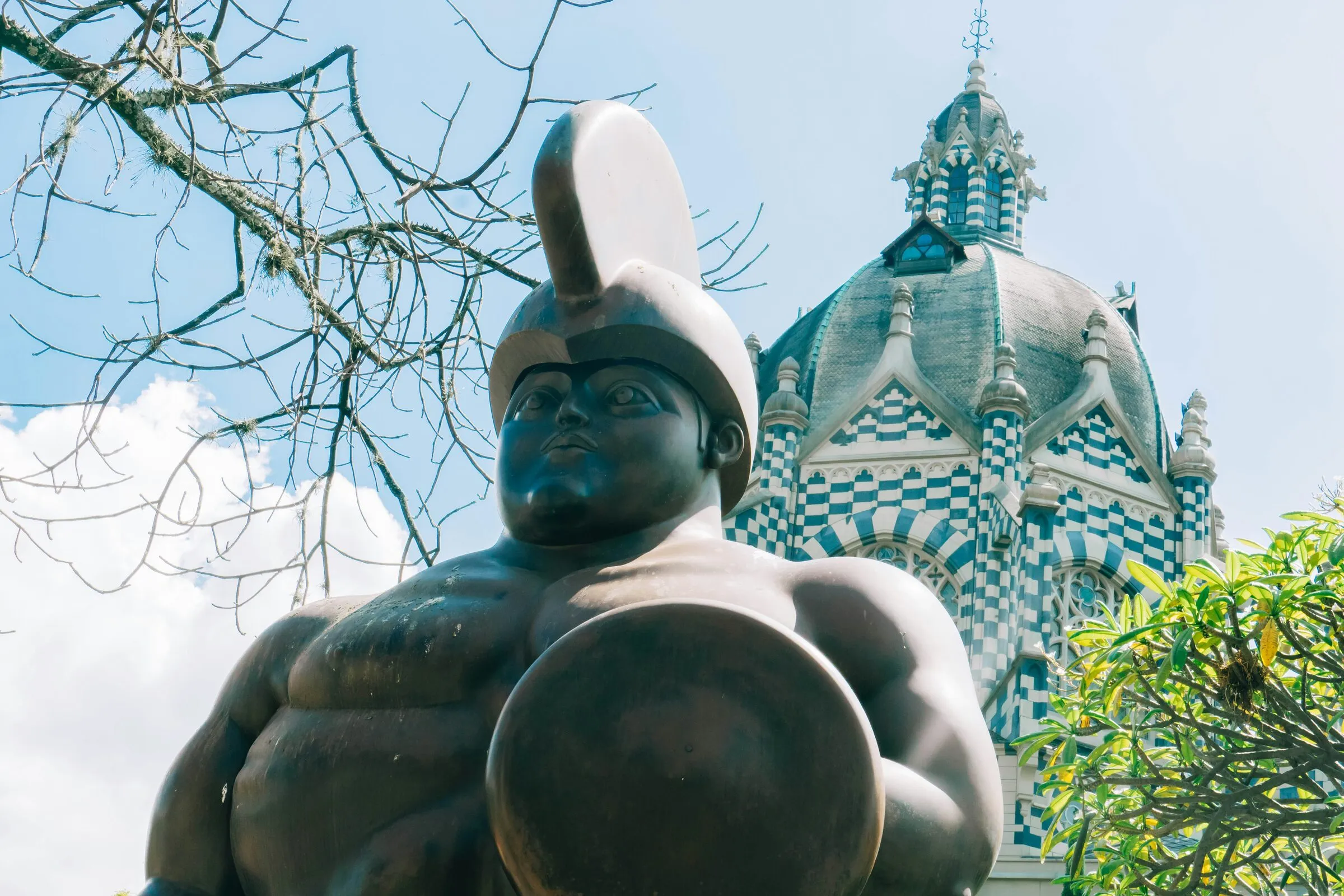
Done correctly, Medellín is one of the most rewarding small-walking-city-with-cable-cars experiences in the Americas — the cable cars themselves are the city’s defining urban-experience layer, the Botero Plaza in the historic center holds 23 outdoor sculptures the artist personally donated to his hometown, the Pueblito Paisao hilltop colonial-village reconstruction gives you the Antioquian rural-architecture register without leaving the city, and the eternal-spring climate (Medellín sits at 1,500 meters in a tropical valley with average temperatures of 22°C / 72°F year-round) delivers the most consistently pleasant urban climate on the entire Colombian itinerary.
Most clients come to me asking about Medellín in three contexts: as the southern anchor of a multi-city Colombia trip (Cartagena →︎ Bogotá →︎ Medellín, the spine-of-Colombia arc, three nights here), as the launching city for a Coffee Triangle extension (Salento, Manizales, Armenia — UNESCO-listed coffee-cultural-landscape, accessible by domestic flight or scenic drive from Medellín), or as a standalone Medellín-and-region week with day trips to Guatapé and El Peñol or to the surrounding paisa countryside.
Here’s how I think about it.
At a Glance
| Best time to visit | Eternal spring year-round at 22°C / 72°F average temperatures — Medellín genuinely doesn’t have meaningful seasons. December–March and June–August are the drier windows; April–May and September–November have more afternoon rain showers. The famous Feria de las Flores (Flower Festival) in late July–early August is the city at its most distinctive — the silleteros (flower carriers) parade is one of South America’s strongest cultural celebrations. |
| How long to stay | Two full nights minimum if Medellín is a multi-city pause; three nights is the right length for a real Medellín visit including a Comuna 13 morning, a Botero Plaza visit, and a Pueblito Paisao or Botanical Garden afternoon; four-plus for travelers including a Guatapé/El Peñol day trip or a Coffee Triangle preview. |
| How to get there | José María Córdova International Airport (MDE) is 30 km southeast of the city in Rionegro; the airport-to-city transfer runs 45 minutes by taxi (about USD $25) through a winding mountain road that’s part of the arrival experience. From Bogotá — domestic flight, 1h. From Cartagena — domestic flight, 1h30m. Medellín has direct U.S. service from Miami, Atlanta, and Fort Lauderdale. |
| Currency / language | Colombian peso (COP). The dollar is widely accepted at major hotels but you’ll get materially better value paying in pesos. Spanish is essential — Medellín’s English-speaking tourist economy is materially smaller than Cartagena’s. The local paisa dialect is one of Colombia’s most distinctive (rhythmic, melodic, with characteristic vos address forms instead of tú); Google Translate’s camera function handles menu work well. |
| One thing most guides won’t tell you | The Medellín most travelers’ mental model lives in is the 1991-1995 city, not the 2026 city. The transformation since 2002 has been historically significant — the public-transit and public-architecture investments that began under Mayor Sergio Fajardo’s administration genuinely changed the city’s social and physical structure, and the contemporary Medellín is dramatically safer and more welcoming than the U.S. travel-media coverage suggests. Trust the visit, exercise the same urban awareness you would in any major city, and the trip almost universally outperforms the version travelers psychologically arrive with. |
Why I Send Travelers Here
Because Medellín, planned correctly, is the eternal-spring counterweight to the multi-city Colombia spine — the climate is the most consistently pleasant of any Colombian city, the urban-renewal arc is genuinely one of Latin America’s most remarkable in the past quarter-century, and the city’s distinctive Antioquian (paisa) cultural identity is meaningfully different from Bogotá or Cartagena — the Botero connection runs deep (Fernando Botero was born in Medellín in 1932 and his hometown holds the most accessible public outdoor collection of his work in the world), and the Coffee Triangle access opens an entire UNESCO-listed cultural-landscape extension that the rest of the Colombian itinerary can’t deliver.
The Comuna 13 transformation specifically is one of the genuinely distinctive contemporary cultural experiences anywhere in Latin America — the formerly most-dangerous comuna in the city is now a thriving street-art-and-music neighborhood with the famous outdoor escalator system, guided community-led walking tours, hip-hop performance, and the kind of from-the-ground-up urban-recovery story that earns the trip on its own. Most American travelers’ mental model of Medellín doesn’t include this, and the version of the city that surprises them most is the one I plan for clients.
I send travelers here as the southern anchor of a multi-city Colombia trip, for honeymoons that want a Latin-American urban-renewal-and-eternal-spring honeymoon, for Coffee Triangle clients building a Medellín-and-coffee-region week, and for clients with serious Botero-and-art interest who recognize that the artist’s hometown holds the most accessible public collection of his outdoor sculpture in the world.
Every recommendation below comes through the lens of how I plan Medellín for the clients I send and a clear point of view about which version of the city earns your time.
Where I’d Anchor
Two anchoring patterns cover almost any traveler’s reason for being in Medellín:
El Poblado. The southern, hillside, restaurant-and-nightlife district — Medellín’s safest, most contemporary, most internationally-traveled-friendly quarter. Stay here on a first visit. The neighborhood concentrates the major luxury hotels, the Lleras Park restaurant cluster, the boutique design shopping, and easy Uber-or-taxi access to Comuna 13, the historic center, and the airport.
Laureles. The flatter, more residential, more local-feeling quarter west of El Poblado — slightly less expensive, more traditional Medellín ambiance, smaller hotel inventory but stronger local-restaurant character. Better for second visits or for travelers who want a more authentically paisa daily rhythm.
For Medellín hotels, the city’s hotel program inventory is meaningfully smaller than Cartagena — the major luxury properties I work with for Medellín include The Charlee Hotel (the design-forward El Poblado flagship with the iconic rooftop pool), The Click Clack Hotel (boutique-design alternative in El Poblado), Hotel Diez Categoría Colombia (heritage-luxury tier in El Poblado), and The Art Hotel (smaller boutique in the heart of El Poblado). Specific amenity packages and current promotions vary by property and dates — pairing the right Medellín property to the right traveler is the discovery-call conversation, since the program here is materially less standardized than the Cartagena hotel inventory.
Want help selecting a Medellín hotel? Start a discovery call — I’ll walk through the property options, confirm current program inclusions, and pair the right room to your trip. And the small extra at check-in — a welcome note from me, the kind of touch the standard amenity package doesn’t list — is part of how I deliver these stays.
What I’d Do With Three Days
The three-day version covers the city plus one Comuna 13 deep-dive plus one day-trip option.
Day One — El Poblado, Botero Plaza, and the Historic Center
Slow morning at the hotel — Medellín’s eternal-spring climate doesn’t punish slow starts the way the high-altitude Bogotá version does. Coffee at one of the small specialty cafés in El Poblado (Medellín’s coffee scene is genuinely strong; Pergamino Café is the local benchmark). Late morning, taxi to Plaza Botero in the historic center — the outdoor sculpture plaza in front of the Antioquia Museum where 23 monumental Botero bronze sculptures stand in public space, donated by the artist personally to his hometown. Free, photographable from any angle, allow 45 unhurried minutes.
Visit the Antioquia Museum beside Plaza Botero — the major regional art museum, with substantial Botero collections (paintings and sculpture both), plus a strong contemporary-Colombian-art floor. Allow 90 minutes.
Lunch in the historic center — El Trifásico (heritage Antioquian bandeja paisa, the iconic regional plate of beans, rice, ground beef, fried egg, plantain, avocado, and chicharrón) or Carmen (modern Colombian, the El Poblado branch of the same name has the iconic city-and-mountain views).
Afternoon: take the Metrocable (cable-car public transit) up to Parque Arví — the 4-line cable car ride from Acevedo station up over the working hillside comunas and into the Andean cloud forest at the top. The cable-car ride itself is the experience — one of the genuinely distinctive urban-transit moments in Latin America. Allow 90 minutes for the round-trip ride and a brief Parque Arví walk.
End the afternoon back in El Poblado at Pueblito Paisa — the small replica colonial Antioquian village atop Cerro Nutibara hill, with panoramic Medellín views. Sunset cocktails at one of the El Poblado rooftop bars (The Charlee Rooftop, Envy Rooftop, El Cielo’s rooftop terrace).
Dinner in El Poblado — El Cielo (the original location of Chef Juan Manuel Barrientos’s modernist tasting room, multiple Latin-50-Best appearances), Carmen (the El Poblado original of the modern-Colombian dining room), or Mercado del Río (the artisanal food hall — best for casual evenings or if your group has split tastes).
Day Two — Comuna 13
Pre-book a guided Comuna 13 walking tour — do not do this neighborhood without a local guide, and not because of safety (the tour areas are well-policed and welcoming) but because the community-led tour is the version that delivers the cultural depth the visit deserves. Several reputable local-guide cooperatives run Comuna 13 walking tours; the Real City Tours version and the various community-cooperative tours are the strongest options.
The visit covers the famous outdoor escalator system (six flights connecting the hillside to the lower city, opened 2011, the engineering project that anchored the comuna’s urban-renewal narrative), the dense street art along the escalator routes (the murals are mostly the work of comuna residents and are continuously refreshed), the local hip-hop performance culture (a defining feature of the contemporary comuna identity), and the broader story of the neighborhood’s transformation from the most-dangerous comuna in the most-dangerous city in the world (in the 1990s) to one of Medellín’s most-visited cultural-tourism destinations (in the 2020s). Allow 3-4 hours. The tour ends at the top of the escalator system, with city views and small cafés serving local coffee.
Lunch in the comuna at one of the small family-run restaurants the tour passes — the food is meaningfully better than its modest setting suggests, and the meal is part of the cultural-immersion experience.
Afternoon: contrast the comuna visit with a slower hour at the Medellín Botanical Garden (Jardín Botánico Joaquín Antonio Uribe — 14 hectares with thousands of plant species, free admission, the Orquideorama wood-canopy structure that’s an architectural reference in Latin American contemporary design) or the Modern Art Museum (MAMM — strong contemporary-Colombian-art collection in a converted industrial building in Ciudad del Río).
Dinner back in El Poblado.
Day Three — Guatapé / El Peñol Day Trip, or a Slower City Day
Two strong options:
Guatapé and El Peñol. Two hours northeast of Medellín, the small painted-pueblo town of Guatapé (the most photographed colonial pueblo in the Antioquia department, with painted-bas-relief facades on every building) and the adjacent Piedra del Peñol (a 200-meter rock monolith with a 740-step staircase to the panoramic top — the lake-and-archipelago view from the summit is one of Colombia’s iconic landscape photographs). Allow a full day; hire a private driver for the round trip. Lunch in Guatapé. Back to Medellín by sunset.
A slower city day. Morning at the Antioquia Museum if you skipped it day one, or at the Casa Museo Pedro Nel Gómez (the painter’s house-and-studio, one of the strongest Colombian-modernist collections). Lunch in Laureles. Afternoon at Pergamino Café or one of the specialty-coffee shops for a serious coffee tasting (Medellín is a major hub for the third-wave coffee movement in Colombia). Late afternoon at Pueblito Paisa for the Cerro Nutibara views, or at one of the El Poblado spas for a slow recovery hour.
By day three, Medellín makes its own recommendations.
Specific Things I’d Tell You About
The Metrocable cable-car system was the first urban gondola anywhere in the world used as primary commuter transit. Opened in 2004 as Line K (connecting Acevedo station to the hillside Santo Domingo neighborhood), then extended through Lines J, L, H, and M. The system isn’t tourism infrastructure — it’s working public transit that the hillside comuna residents use to reach the central Metro and the city’s job centers. The ride is the experience. Take the Metrocable up to Parque Arví on Line L — the longest of the cable lines, climbing through hillside neighborhoods and out into the cloud forest at the top — and stand at the Acevedo station watching the gondolas come and go for ten minutes. This is what urban-renewal actually looks like.
The Comuna 13 escalators are public infrastructure, not a tourist attraction. Six flights of outdoor escalators installed in 2011, free for residents and visitors, that solve a genuine commuting problem (the comuna’s hillside is too steep for buses) and incidentally became one of Medellín’s most-photographed cultural tourism destinations. The street-art and hip-hop scene that has grown up around the escalator routes is the comuna’s contemporary cultural-economic engine — and it works because the neighborhood is genuinely safer and more welcoming than its 1990s reputation suggests, while the residents themselves remain the central economic beneficiaries of the visitor traffic. Take the community-led tour, not the bus-tour version.
Plaza Botero in the historic center holds 23 outdoor Botero sculptures donated by the artist personally. Fernando Botero was born in Medellín in 1932 and built his international career across Paris, New York, and Pietrasanta — but he never broke the relationship with his hometown, and the donation of the 23 monumental bronze sculptures to public space in 2002 (alongside additional works for the adjacent Antioquia Museum) is the largest free public outdoor Botero installation in the world. Touch the sculptures. Local tradition holds that rubbing certain figures brings luck.
The Feria de las Flores in late July through early August is the city at its most distinctive. The annual Flower Festival — running since 1957 — culminates in the Desfile de Silleteros, a parade where farmers from Santa Elena (the rural community east of Medellín) carry massive flower-arrangement structures (silletas) on their backs through the city center. The arrangements weigh up to 70 kilograms, the parade runs three hours, and the cultural-historical significance (the silletas were originally the means by which farmers transported flowers to Medellín market) makes the event one of South America’s strongest surviving traditional cultural celebrations. If your dates align, plan around it.
Medellín’s coffee scene is genuinely strong and serves as a Coffee Triangle preview. The third-wave coffee movement in Colombia is concentrated in the Coffee Triangle (Salento, Manizales, Armenia) just south of Medellín — but the contemporary specialty-coffee shops in El Poblado and Laureles serve the same quality at significantly more accessible prices. Pergamino Café and Velvet Café are the local benchmarks. If you’re considering a Coffee Triangle extension, a serious coffee tasting in Medellín is the right way to decide whether the deeper Coffee Triangle visit fits your interests.
Antioquian bandeja paisa is the regional plate that defines the cuisine. Beans, rice, ground beef, chicharrón, fried egg, plantain, avocado, arepa, served on a single platter (the bandeja) in a quantity that genuinely cannot be finished by one person. Eat one bandeja paisa during your Medellín stay — it’s the iconic regional culinary moment, and the version at any of the heritage Medellín restaurants (El Trifásico, Hacienda Junin, Hatoviejo) is the genuine article.
What I’d Skip
The Pablo Escobar / “narco-history” tours. I won’t sell these. The contemporary Medellín tourism establishment is actively trying to redirect international visitor interest away from the narco-tourism category, and the more rewarding version of the city’s late-20th-century-history conversation is the urban-renewal arc — the Metrocable, the Comuna 13 escalators, the public-library-and-park program, the constitutional-and-civic-recovery decades. That story is genuinely more interesting than the cartel story, and it’s the story the contemporary Medellín wants to tell. If you have specific historical-research interest, that’s a discovery-call conversation. The destination-guide version of Medellín is the contemporary version.
Restaurants in the historic center with English menus and pushy hosts. Same tourist-tax pattern as every European city in this library. Walk three blocks deeper into the historic core, or take a taxi to El Poblado for a real meal.
Driving anywhere in central Medellín. The Metro and Metrocable cover most of the city; Uber and taxis are cheap and reliable. Hire a car and driver only for Guatapé/El Peñol day trips or Coffee Triangle airport-and-onward connections; don’t rent for the city itself.
Skipping Comuna 13 because the historical reputation feels uncomfortable. This is the most common avoidable mistake on a Medellín visit. The contemporary Comuna 13 is genuinely safe with a community-led tour, the cultural-economic story is one of the most distinctive urban-renewal narratives in Latin America, and the visit almost universally exceeds traveler expectations. The version of Medellín that doesn’t include Comuna 13 is the version that misses the city’s most consequential 21st-century chapter.
Trying to do “everything” in two nights. Medellín earns three full days minimum: one for El Poblado plus the Botero Plaza plus the Metrocable, one for Comuna 13 plus a museum afternoon, one for Guatapé or a slower city day. Two-night Medellín is the two-night Tokyo equivalent — it’s the version that leaves you knowing you missed the city.
For Multi-City Colombia Travelers
Medellín is the southern anchor of the Cartagena →︎ Bogotá →︎ Medellín spine — and the leg most travelers describe as the surprise highlight of the Colombia trip. Three nights is the floor; four is the right pace if you’re folding in a Guatapé/El Peñol day or starting a Coffee Triangle extension.
The classic 9-night Colombia trip: three nights Cartagena (Caribbean colonial), three nights Bogotá (Andean cultural depth), three nights Medellín (eternal-spring urban innovation). The 11-night version adds two nights in the Coffee Triangle (Salento, Manizales, or Armenia — UNESCO-listed coffee-cultural-landscape, accessible from Medellín by short domestic flight or scenic 4-hour drive south).
If you want me to design the full multi-city Colombia trip — flight timing across three different climate zones (Caribbean coast, high-altitude Andean, eternal-spring valley), hotel sequencing, the Comuna 13 community-tour booking, the Coffee Triangle integration if applicable, plus the cultural-context briefing that makes Medellín’s urban-renewal arc legible — that’s exactly the kind of planning I do. Start a discovery call.
For Honeymooners
Medellín is the eternal-spring half of a Colombian honeymoon — the climate is the most consistently pleasant of any Colombian city, the El Poblado restaurant scene delivers serious Latin-American culinary experiences, the Comuna 13 day is genuinely transformative for the right couple, and the Guatapé and El Peñol day-trip option gives you a postcard-Andean-lakes-and-painted-pueblo afternoon that the rest of the Colombian itinerary doesn’t deliver.
The honeymoon evening, in my read, is dinner at El Cielo (Chef Juan Manuel Barrientos’s modernist tasting room, the original location, multiple Latin-50-Best appearances) followed by a cocktail at one of the El Poblado rooftop bars with the city laid out beneath you. The setup does the work.
If you want me to design the full Latin American honeymoon — Medellín plus Cartagena plus optional Bogotá plus optional Coffee Triangle finale — that’s exactly the kind of planning I do. Start a discovery call.
Plan Medellín With Me
If you’re thinking about Medellín as the southern anchor of a multi-city Colombia trip, as the launching point for a Coffee Triangle extension, or as the standalone urban-renewal-and-eternal-spring city visit it deserves to be — that’s exactly the kind of planning I do. A 30-minute discovery call is where it starts. No fee, no pressure. Just the city, your timeline, and what you actually want to feel when you ride the Metrocable up over the hillside comunas and watch the contemporary Medellín spread beneath you.
Book Your Free Discovery Call →︎
Last updated: April 2026. I keep this guide current. If a hotel I recommend slips, a restaurant changes hands, or access to a site shifts, the page changes. Travel changes. The work doesn’t stop when the page goes live.
Plan this trip with me.
A 30-minute discovery call is where it starts. No fee, no pressure.
Book a Discovery Call