Bordeaux River Cruising: A Week on the Garonne, the Way I’d Plan It
The wine-region river cruise that earns the trip — what the rhythm of it actually feels like, and which line I’d put you on for which kind of week.
The first thing to understand about a Bordeaux river cruise is that it doesn’t behave like the river cruises most American travelers have already heard about. The Danube is a four-country imperial-history week that delivers a new capital every other morning. The Rhine is a UNESCO castle-and-Riesling corridor designed to be watched from a sun deck. The Garonne — and its sister waterways the Dordogne and the Gironde estuary, which together make up the cruising loop the lines call “Bordeaux” — is something else entirely. It’s a single-region wine-country week, in one country, on a slow tidal river, with no city stop bigger than the city you boarded in. The pace is unhurried by design. The ports are villages and grands crus châteaux. The variety is wine, oysters, medieval limestone, and 18th-century stone — repeated, deepened, and finally understood.
Most of the major lines run essentially the same loop: out of Bordeaux, down the Garonne to Cadillac (sweet Sauternes country), back upriver and into the Gironde estuary to Pauillac (the Médoc grands crus), across to Blaye (the citadel and the Côtes de Blaye), down to Bourg-sur-Gironde, into the Dordogne to Libourne (the gateway to Saint-Émilion), and back to Bordeaux for the final two or three nights. Seven nights. Six of those nights at the dock — which sounds boring until you realize what being at the dock in Pauillac at 6 p.m., with the Médoc light coming through the windows of the lounge and a glass of Pauillac in your hand, actually means.
Here’s how I think about the rhythm of a Garonne week — and the three lines I’d weigh for three different kinds of travelers asking after the same river.
The Rhythm of a Garonne Week
You board in Bordeaux on a Saturday afternoon. The ship is parked along the Quai des Chartrons — the rebuilt 18th-century wine-merchant quay, ten minutes’ walk from the Place de la Bourse and its mirrored reflecting pool. (If you’ve added two pre-cruise nights at the InterContinental Bordeaux - Le Grand Hôtel — an add-on I love for travelers who want the city to land before the ship pulls out — you walked here from the Place de la Comédie this morning, and the city is already in you.) The cabin is small the way river-cruise cabins are small, but the river is six feet outside the window, and within an hour you’ve stopped noticing the cabin entirely.
The first morning sails are short. The Garonne is a tidal river — the cruise schedule is built around when the tide will let the ship through, which means more time in port and less time underway than the Danube or Rhine. By the time you wake up the second day, you’re already docked somewhere new. The ship is your hotel. The hotel moves at night.
The day-shape is consistent and unhurried. Breakfast on board — the spread runs from sliced charcuterie and three kinds of cheese to hot eggs and the viennoiserie you’d expect a French-flagged kitchen to take seriously. Mid-morning excursion — almost always a winery visit, occasionally a village walk or a château tour. The lines all run the same kind of tiered choice: gentle for the slow walkers, active for the bike-ride alternative, late-riser for the people who’ve decided that today is a coffee-and-deck-chair day. Lunch on board — usually three courses, regional, paired with the wines of whatever appellation you’re docked at. Afternoon excursion — second tasting, or the medieval village you didn’t see in the morning. Sip & Sail hour — the late-afternoon cocktail in the lounge that is, on every river cruise, the moment the trip becomes social. Dinner — long, multi-course, formal-ish but not stiff. Lounge or bed. Bed wins more than you’d expect on a wine-country week.
That’s day two through day six. The variation is the port — and which appellation you’re tasting at lunch.
The Ports That Earn Their Day
Pauillac. The Médoc port. This is the Atlantic-coast appellation that holds Château Lafite Rothschild, Château Latour, Château Mouton Rothschild — the premier crus of the 1855 classification, the most decorated names in red wine. Most cruise excursions visit the cinquième- or quatrième-cru châteaux that actually run public tours (Château Beychevelle and Château Pichon Baron come up often, and both are well worth the visit), with the famous five visible on the drive between properties — a polite glimpse rather than the inside-the-gate visit. Lines that include a Médoc grand cru tasting in the standard excursion package read differently than lines that gate it as a paid upgrade. For the kind of traveler who came for the wine first and the boat second, the upgraded Pauillac excursion — when the line offers one — is the lever I’d reach for first.
Cadillac and Sauternes. The opposite end of the wine spectrum. Sauternes is botrytized dessert wine — the famous noble rot that turns the grapes into raisin-concentrated sweetness — and Château d’Yquem is the only premier cru supérieur in the entire 1855 Sauternes classification. (You won’t tour Yquem from a cruise excursion; the Cadillac days usually include a Sauternes-region château that runs visits, then a tasting flight that sets up the Yquem story without delivering the room itself.) Sauternes is a wine most American travelers know vaguely but haven’t tasted in serious form, and a glass of well-chilled Sauternes paired with a foie gras course is one of the food memories people come home from a Garonne cruise still talking about.
Blaye. The 17th-century Vauban citadel that defended the estuary approach to Bordeaux, now UNESCO-listed and walking-distance from where the ship docks. The wine is the Côtes de Blaye appellation — softer, more approachable, sub-grand cru pricing — and the village itself has a small Saturday market that tells you more about working Bordelais life than the Pauillac châteaux do. Some lines pair Blaye with a stop in Bourg-sur-Gironde the same day for a second small village visit; others use Bourg as its own port. Either rhythm works.
Libourne and Saint-Émilion. The day-six excursion is the one most people remember. Libourne is the working town on the Dordogne; Saint-Émilion is the UNESCO-listed medieval village of honey-stoned limestone houses 15 minutes inland by coach. The village’s monolithic underground church (the largest in Europe — carved downward into the rock the village sits on between the 9th and 12th centuries) is the thing you came to see. The wine is the right-bank Merlot-led profile of the Saint-Émilion appellation — softer, rounder, more immediately pleasurable than the Médoc Cabernets you tasted on day three. Most travelers tell me, on the way home, that Saint-Émilion was the day. Some lines name the village in their itinerary; others bury it under “Libourne” — that’s worth checking before you book.
Bordeaux. Two or three nights bookending the cruise loop. This is when the city you boarded in becomes a city you actually know — the Place de la Bourse Miroir d’eau (the largest reflecting pool in the world, on a 23-minute mist-water-dry cycle), the Cité du Vin wine-and-civilization museum (the XTU-designed bouchon de carafe building you can see from the ship), the Triangle d’Or for the city’s serious dining, and the Marché des Capucins for the oyster bars where you’ll eat a dozen huîtres de Marennes standing at the counter with a glass of Entre-Deux-Mers. This is the part of the week where the cruise opens out into the city, and it’s the part of the week the Bordeaux destination guide covers in full.
Three Lines I’d Weigh First — and Three More Worth Knowing
The Bordeaux river-cruise loop runs essentially the same across the major lines on the river — AmaWaterways, Avalon Waterways, Uniworld, Viking, Scenic, and Tauck all share the same general port rotation, the same general tasting structure, and a price band somewhere between $4,200 and $8,500 per person for a 7-night sailing (Scenic and Tauck running higher). The differences are in the texture of the week, and that’s the difference that makes the line you sail the line you remember.
I’m starting with the three I’d weigh first for most travelers — each an option for a different kind of person, none of them the answer — and then walking through three more that belong on the same shortlist for travelers asking different questions.
AmaWaterways — the wellness-and-active version
An option I love for the couple who want the wine and the morning bike ride, and who are happiest on a ship that’s set up for both. AmaWaterways’ Garonne sailings run aboard the AmaDolce — a smaller-format ship whose Sun Deck has a walking track and a whirlpool, whose Wellness Host is a dedicated crew role (not an upsell) leading exercise classes and on-shore active programming, and whose excursion menu is the most tiered of the three: the standard gentle coach tour, the regular walking version, the active hike or bike-from-the-dock option, and the late-riser slow-start alternative. The dining program is anchored by the included Chef’s Table specialty restaurant and a La Chaîne des Rôtisseurs Dinner built into the week. Sip & Sail hour is the line’s calling card — wine, beer, spirits, and soft drinks complimentary, every afternoon, in the Main Lounge with the panoramic view.
The price entry point sits in the low $5,000s per person for a Category E stateroom and runs to the $8,000s for the suite categories. Not the cheapest of the three — but for the traveler who wants the Garonne to also work as the active wine-country week, with the bike option built into every port and the wellness layer running quietly through the days, it’s the option I’d put first on the table. The line I’ve been recommending most consistently since my own AmaReina sailing on the Danube in November 2024 — the full reason behind the recommendation lives here.
Avalon Waterways — the design-forward couple’s version
An option I love for the couple who care about the room and the open air. Avalon’s Garonne sailings run aboard the Avalon Artistry II, and the line’s distinctive cabin — the Panorama Suite, 200 square feet, with a wall-to-wall window that opens into an Open-Air Balcony rather than the standard French-balcony slider — is the kind of room honeymooners who care about the cabin itself tend to gravitate toward. The bedding is the line’s Comfort Collection with the choice-of-firmness pillow menu; the bath is L’Occitane; the suite includes a loveseat and a glass-enclosed shower. The Sky Deck has a grill that runs lunch in good weather, and the line keeps 16 bikes on board with an Adventure Host whose only job is the active layer of the trip.
Excursion structure: Classic, Active, Discovery — a clean three-way choice in every port. Pricing entry around $4,930 per person for the Deluxe Stateroom, with the Panorama Suite categories running roughly $6,700 to $6,900 — the suite tier is where I think Avalon earns its case on the Garonne, and the suite tier is where I’d weigh it most seriously. Avalon’s current Bordeaux sailings include either a complimentary pre- or post-cruise night in the city, or a $300-per-couple savings applied to a land extension — between the two, I lean toward the pre-cruise night, because for travelers who want the city to register before the ship pulls out, the two-nights-in-Bordeaux version tends to land deeper.
One more thing worth knowing: Avalon runs the most consistently solo-friendly river program on the water — the line most often offers waived or reduced single-supplement pricing on Bordeaux sailings, an option I love for solo travelers who’d otherwise be paying double for a river-cruise cabin. If you’re traveling alone and weighing the Garonne, this is the line where the math most often works.
Uniworld — the all-inclusive concierge version
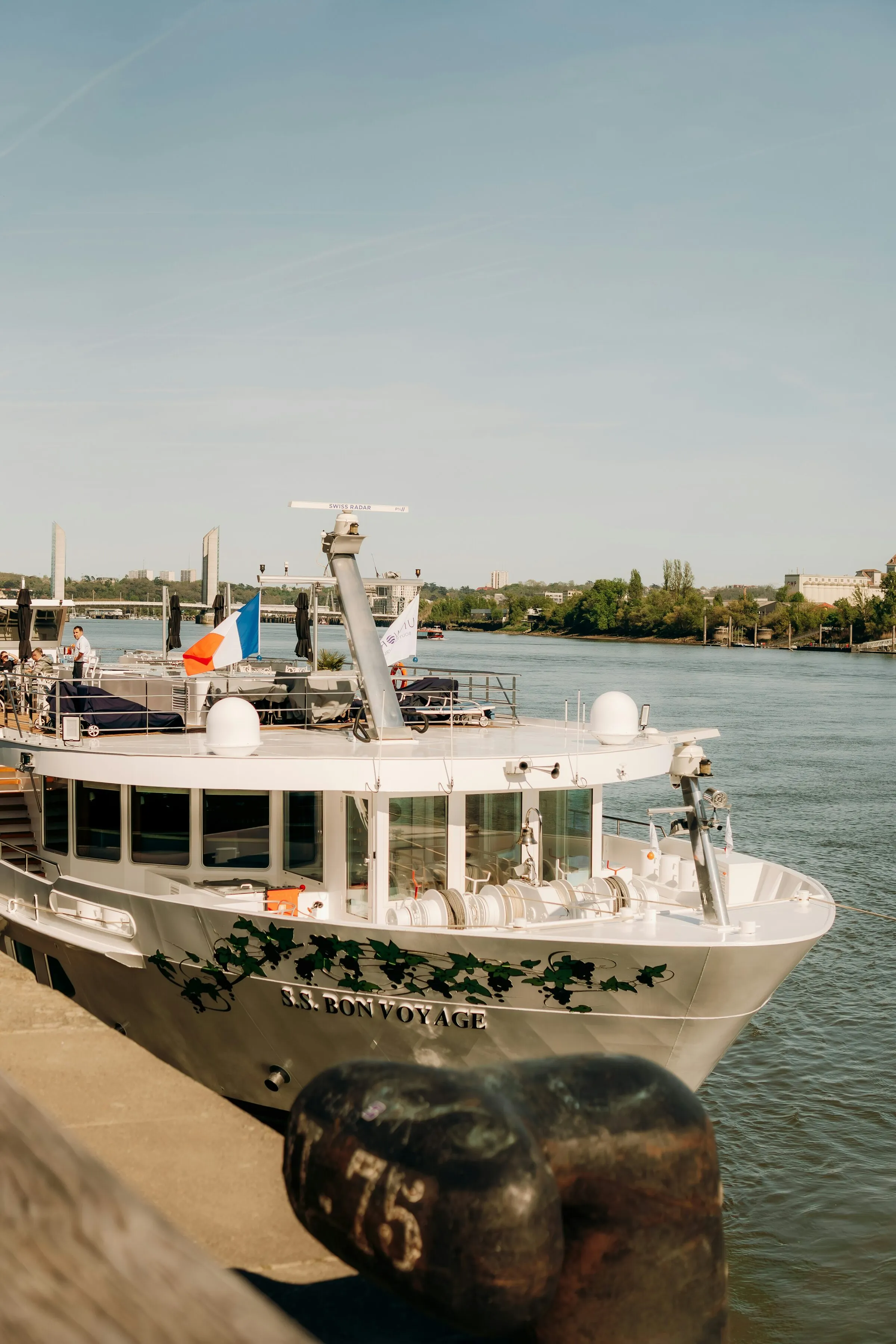
An option I love for the couple who want the boutique-hotel-on-water rather than the cruise-ship-with-good-design. Uniworld’s Garonne sailings run aboard the S.S. Bon Voyage — a smaller-format boutique ship whose cabin program is handcrafted Savoir Beds of England (the same beds at Claridge’s), high-thread-count Egyptian cotton, and a curated layering of European duvets and pillow choice. The line’s True All-Inclusive program — gratuities, fine wine and beer at meals plus full spirits all day, all shore excursions, all transfers, full Wi-Fi — is the most genuinely all-inclusive of the three, and it’s the option I’d flag for travelers who want to stop calculating what each thing costs.
Excursion structure: Let’s Go, Do as the Locals Do, Village Day — Uniworld’s three-way choice leans most toward immersive small-group programming, with the Quietvox portable headset on every walk. Pricing entry around $4,199 for a Classic Stateroom and into the $7,000s for the French Balcony tier; the all-inclusive math means the entry price is doing more work than the equivalent number on the AMA or Avalon line. One detail worth flagging for the day-six excursion: Uniworld names Saint-Émilion in its itinerary directly, while the other lines list the same village under Libourne. Same village either way — but for the kind of traveler who reads itineraries closely before booking, the explicit naming is a useful tell.
Three More Worth Knowing
Those three are where I’d start most conversations — but they aren’t the only three options on the Garonne. Three more lines belong on the same shortlist for travelers asking different questions:
Viking — for the traveler who wants the most-recognized name on the water
An option I love for the traveler who’s heard the Viking name a hundred times and wants the most predictable, no-surprises river-cruise rhythm. Viking’s Garonne sailings run aboard the Viking Forseti — adults-only (no kids’ programming, no casino, no theme nights), Scandinavian-clean design, the most structurally reliable river-cruise product on the market. The inclusions are more limited than the all-inclusive lines (one excursion per port included, beverage package as upgrade), but for the kind of traveler who values consistency and brand recognition over inclusion-stacking, Viking is often the right first answer. The line most first-time river cruisers recognize by name — and the option I’d weigh first for travelers who want the river-cruise experience without the line being the conversation.
Scenic — for the traveler who wants the butler-and-e-bike ultra-luxury version
An option I love for the traveler who wants the highest service ratio on the river. Scenic’s Bordeaux sailings run aboard Scenic Diamond — every cabin is a suite, every suite has a butler, the e-bike fleet is included, multiple specialty dining venues are included, and the Scenic Enrich program builds bespoke private experiences (a private château dinner, a winemaker’s lunch) into the standard week. Pricing sits meaningfully higher than the other lines — typically $6,000 to $11,000+ per person for a 7-night Bordeaux sailing — and the all-inclusive math is the most genuinely all-inclusive of all six. For the traveler who wants the river-cruise version of a six-star resort, this is the option I’d put on the table.
Tauck — for the traveler who wants the deeply curated tour-director overlay
An option I love for the traveler who’d be perfectly happy on a Tauck land tour and is asking how to do the same thing on the river. Tauck’s Bordeaux program runs aboard AmaWaterways ships through a long-standing partnership — so the ship, the cabins, and the food are AMA’s (which is to say, excellent) — but the tour-direction is Tauck’s signature: small-group, lecture-led, with included experiences that often go beyond the standard cruise excursion (a private château visit, a guided Saint-Émilion deep-dive). Pricing sits higher than the standalone AMA equivalent because of the Tauck programming overlay; for the kind of traveler who reads the chapter books before the trip and wants the curatorial layer, the math earns itself.
And two more, briefly
Emerald Cruises (Scenic’s active-traveler sister line) runs a Bordeaux sailing aboard the Emerald Liberté — an option I’d flag for travelers who want the active-and-design-forward Scenic ethos at a more accessible entry price (typically $4,500 to $6,500 per person). Riviera Travel runs a British-heritage version of the Garonne week — value-luxury pricing, predominantly UK-clientele on board, an option I’d flag for travelers who specifically appreciate the British-touring sensibility (small-group walks, leisurely pace, afternoon tea actually programmed into the day).
A Few Things Worth Knowing Before You Book
Two pre-cruise nights in Bordeaux is the option I’d flag for travelers who want the city to land before the ship pulls out. One transit night rarely registers as a real city visit. The build I love for the kind of traveler who wants Bordeaux to register — not just appear on the itinerary — includes two real nights at the InterContinental Bordeaux Le Grand Hôtel before the ship pulls out, a proper Place de la Bourse morning, and a night at Le Pressoir d’Argent (the Gordon Ramsay tasting room in the hotel itself). The destination guide covers the city in full — and the Wine Concierge Service the InterContinental runs is the kind of in-house specialty resource that turns a vineyard day into something the standard cruise excursion can’t replicate.
Hand-luggage shoes matter on a wine-region week. The Médoc châteaux are gravel courtyards. The Saint-Émilion village is medieval cobblestone climbing a hilltop. The Blaye citadel is grass-and-stone ramparts. The cabin closets are small. Pack one good walking shoe and one dressier dinner shoe, and assume you’ll re-wear both.
The shoulder-season call is May–June or September–early October. May is the tail end of the spring-rains season and the green-vine moment; June is the calm warm-weather window before the August château-staff-vacation dead zone. September is the vendanges — the harvest itself, when the winemakers are doing the work the trip is built around. October is the post-harvest amber light, my own favorite. Avoid late July and August on the Garonne — the châteaux close, the temperatures climb, and the version of the week you came for hides in the cellar.
Add Porto if you have the time. The two great European wine-river-cruise origins — Bordeaux and Porto — pair into a serious wine traveler’s two-cruise arc, often run a year apart, sometimes (for the most committed) back-to-back. For the wine traveler weighing both, the case for doing both — eventually — is one I find compelling.
Six Options, Six Kinds of Traveler
The simplest read across all six:
For the traveler who wants the wellness-and-active version of the Garonne — AmaWaterways is an option I love.
For the traveler who cares most about the design-forward suite itself, or who is traveling solo and wants the most consistent waived-single-supplement program on the water — Avalon Waterways is the option I’d flag first.
For the traveler who wants the all-inclusive boutique-hotel-on-water version — Uniworld is the option I’d put on the table.
For the traveler who wants the most-recognized name and the most predictable river-cruise rhythm — Viking is the option I’d start with.
For the traveler who wants the butler-and-e-bike ultra-luxury version with the highest service ratio on the river — Scenic is where I’d land.
For the traveler who wants the deeply curated tour-director overlay of small-group lecture-led programming on top of an AMA ship — Tauck is the option I’d weigh.
All six sail essentially the same river. None of them is wrong. The one that fits you is the one that matches who you are when you’re not optimizing — which is exactly the conversation the discovery call below is for.
Plan Your Bordeaux River Cruise With Me
If you’re weighing a Garonne week — whether as the wine-region cruise that finally earns its place on your itinerary, as the underrated French honeymoon, or as the front half of a Bordeaux-and-Porto two-cruise wine arc — that’s the kind of trip I love planning. A 30-minute discovery call is where it starts. No fee, no pressure. Just the river, your timeline, and the version of the week that fits the kind of traveler you actually are.
Book Your Free Discovery Call →︎
Related reading: the Bordeaux destination guide for the city-and-region context · Why I Recommend AmaWaterways · Douro vs. Rhine vs. Danube · Fall Wine Country River Cruising · Rivers & Small Ships specialty page.
Last updated: April 2026. Cruise pricing, ship assignments, and itinerary details change. The version of this week I’d plan for you today reflects the current Signature Travel Network programs and the Bordeaux supplier ecosystem as it stands the week of publish.
Plan your trip with me.
A 30-minute discovery call is where it starts. No fee, no pressure.
Book a Discovery Call