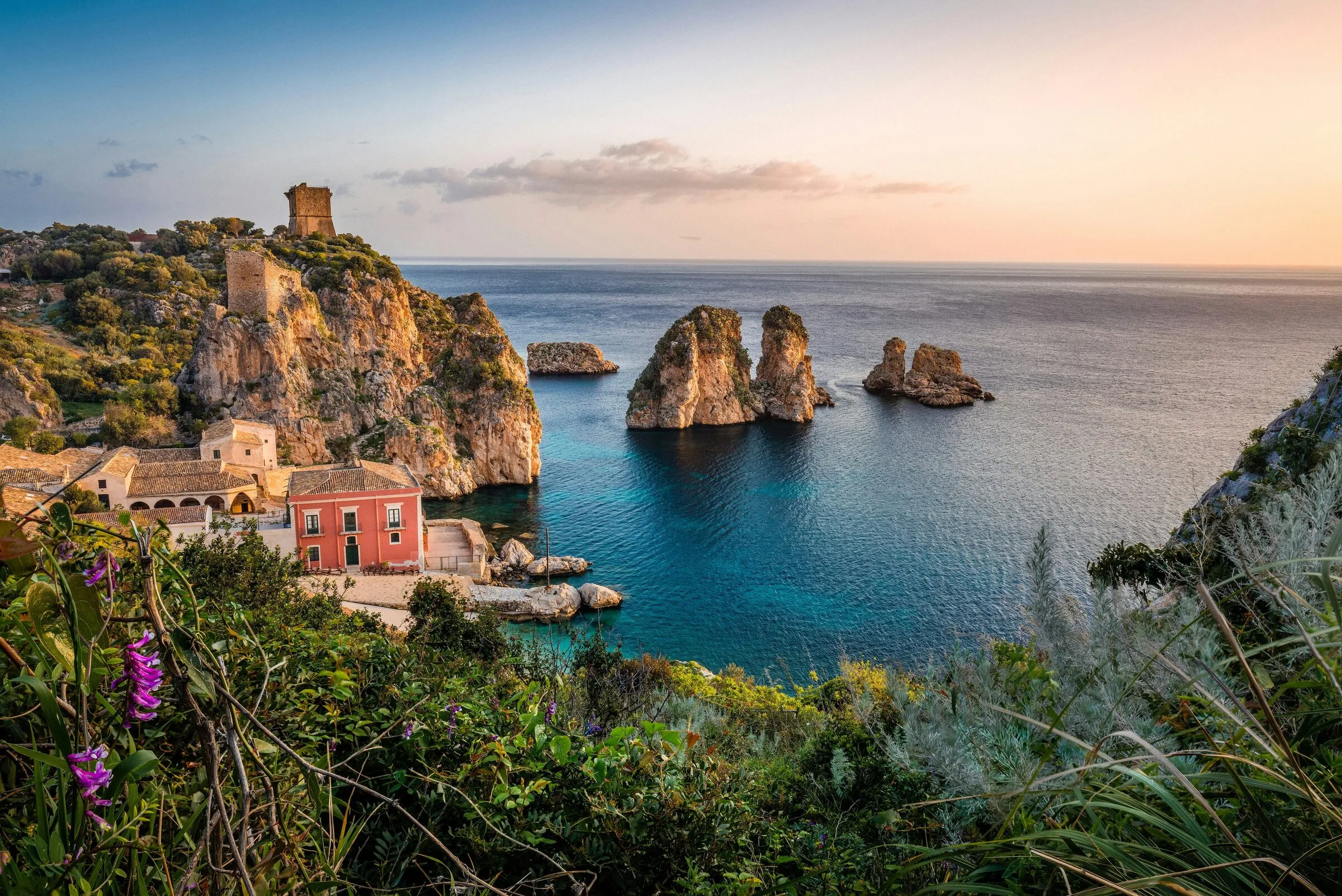
Sicily is the Italian island that is not quite Italy. It’s been owned by Phoenicians, Greeks, Romans, Arabs, Normans, Spanish, French, and Italians — and you can taste the entire history in the food, see it in the architecture, feel it in the rhythm of daily life. The island is also the most misunderstood destination in Italy — tourists either skip it entirely or try to squeeze it into a two-day add-on to a mainland sweep, which is like trying to read a novel in five minutes.
Done correctly, Sicily is the version of Italy that rewards the deepest slowness. The capital Palermo is one of the messiest, most chaotic, most alive cities in Europe — street food, Arabic architecture, baroque churches, markets that have been running in the same piazza for a thousand years. Taormina is the more refined island choice — hilltop village, Greek theater, the Ionian Sea visible from the streets, the pick for travelers who want beauty with less chaos. Mondello is the beach alternative. And the smaller towns and fishing villages between them are where the real Sicily lives — the version that hasn’t been packaged for tourists yet.
Most clients come to me asking about Sicily in one of two ways: as a solo trip or slow week devoted to the island, or as an extension to a multi-city Italy sweep (Rome →︎ Naples →︎ Sicily as the final southern arc, slower pacing). The first is the version I most want to plan.
Here’s how I think about it.
At a Glance
| Best time to visit | April–early June (spring in the Mediterranean, wildflowers, water warming, Easter celebrations) and September–October (golden light, water still swimmable, the August crush gone). Avoid July–August — peak heat, peak crowds, many restaurants close mid-August for Ferragosto, street food vendors close in the afternoon heat. |
| How long to stay | Five nights minimum to feel the island settle. Seven to ten nights is ideal — enough to anchor in Palermo or Taormina for 3–4 nights, day-trip to smaller towns, and not feel rushed. Three nights works as an add-on to mainland Italy but forces compromise; better to commit to five+. |
| How to get there | Fly into Palermo (PMO) if anchoring in Palermo or western Sicily. Fly into Catania (CTA) if anchoring in Taormina or eastern Sicily. Internal Sicily travel is either by rental car (the most flexible, the most stressful given mountain roads) or hired driver (€70–100/hour, recommended). |
| Currency / language | Euro. Italian is official, though Sicilian (a distinct dialect mixing Italian, Arabic, Spanish, and French) is spoken locally. English is less widely spoken outside tourist areas. Street food vendors and older Sicilians often speak limited English; smiling and pointing works. |
| One thing most guides won’t tell you | Sicily has two distinct personalities — Palermo (chaotic, street-food focused, Arabic architecture) and Taormina (refined, quieter, Greek and baroque history). They’re both Sicily, but they’re different experiences. Choose based on whether you want immersion in chaos or beauty with slight distance. |
Why I Send Travelers Here
Because Sicily is the island where the layers of history are so visible, so present, that even walking the streets feels like moving through time. The Arab conquest left architecture. The Norman synthesis created some of Europe’s greatest cathedrals. The Spanish left baroque. The Italians created organized chaos. Palermo is where you taste all of it simultaneously — in a single meal, in a single street.
Sicily is also the version of Italy where the food becomes the history. Arancini (fried rice balls), caponata (eggplant dish with Arabic spices), pasta con le sarde, the seafood pasta, the granita for breakfast, the street food that exists at every corner — these aren’t just recipes; they’re the island’s historical layers compressed into cuisine. Eating in Sicily is eating the island’s story.
I send slow-travel travelers who want five to seven nights devoted to understanding one place. I send cultural travelers interested in Greek ruins (there are more intact Greek temples in Sicily than in Greece itself), Norman churches, and the Arab-Norman synthesis that created some of the world’s most beautiful architecture. I send food travelers — the street food in Palermo is legendary and earned. I send travelers pairing Italy with something more chaotic and less refined than the north.
Every recommendation below comes from the lens of how I plan Sicily for the clients I send, the four hotel relationships I’ve locked in, and a clear point of view about which anchor base fits which traveler and which experiences are worth the chaos versus which are tourist packaging.
Where I’d Anchor
Two distinct regions, each with its own character:
Palermo (the chaotic cultural capital) The capital of Sicily, on the northwestern coast. One million people, the historical seat of every conqueror, the most Arabic city in Italy (Palermo was Arab-ruled before Norman conquest). Street food, baroque churches, a massive central market (the Vucciria), organized chaos, the version of Sicily where you’re constantly overwhelmed and enriched simultaneously. The pick for travelers who want immersion rather than comfort.
Taormina (the refined refined alternative) On the eastern coast overlooking the Ionian Sea. A smaller medieval village on a hilltop with Greek theater ruins, refined hotels, galleries, a quieter pace. The pick for travelers who want Sicily’s beauty and history without the street-level chaos of Palermo. The compromise between culture and comfort.
Mondello (the beach alternative) Just outside Palermo on the northern coast. A beach town built in the early 1900s, quieter than Palermo but accessible to it (30 minutes by car or local train). A mix of Palermo’s energy and Taormina’s quieter pace. The pick for beach-focused travelers who want culture nearby.
For Palermo cultural immersion, Villa Igiea is the flagship. A Belle Époque palazzo converted to a luxury hotel, on the Acquasanta waterfront at the foot of Monte Pellegrino on the Gulf of Palermo, with gardens, terraces, and sea views. One hundred rooms, sophisticated but not stuffy, close to Palermo chaos but far enough to escape it. On my rate at the property, the amenity layer is real and quiet — and the culinary tour of Palermo street food with a local guide is one of the touches that come through the relationship rather than the booking engine. The specifics get walked through on the discovery call.
For Taormina refined luxury, Belmond Grand Hotel Timeo sits on the hillside overlooking the Greek Theater and the Ionian Sea — 80 rooms, gardens, a spa, the classic Sicilian luxury hotel. On my rate at the property, the amenity layer doesn’t book direct — including a Sicilian cooking class sourcing from local Taormina markets that’s the kind of experience the property’s relationships make possible. The specifics get walked through on the discovery call.
For Taormina alternative, San Domenico Palace, a Four Seasons Hotel is the competing luxury choice — similarly positioned on the hilltop, 98 rooms, spa, gardens. Both are magnificent; Belmond Timeo has more history and more charm. San Domenico Palace is more streamlined and modern. On my rate at the property, the amenity layer is calibrated to your stay rather than itemized in advance — what applies depends on dates and the suite category, and we walk through it on the discovery call.
For Mondello beach-and-culture balance, Verdura Resort sits on the beach west of Palermo with direct water access, three pools, spa, multiple restaurants, and the ease of a resort while being close enough to Palermo (25 minutes by car) for cultural immersion. One hundred rooms, more family-friendly than the refined anchors but still luxury. On my rate at the property, the amenity layer doesn’t book direct — calibrated to your dates and how you want to split the trip between beach time and culinary experiences. The specifics get walked through on the discovery call.
Want one of these properties? Start a discovery call — I’ll match you with the anchor that fits your vibe — cultural immersion or refined retreat — and lock in the experiences that make Sicily work.
What I’d Do With Five to Seven Days
The Palermo Deep Dive (Six Days)
Day One — Palermo Arrival and Street Food Introduction Arrive at Palermo airport. Check into Villa Igiea. Afternoon in the hotel’s seafront gardens (relax, reset from travel). Late afternoon, drive into Palermo proper. Aperitivo and dinner at a local restaurant away from tourists.
Day Two — Palermo Street Food and Markets Full day guided street food tour (the hotel arranges this, or I arrange through a local guide). The Vucciria market, the Capo market, the Ballarò market. Taste arancini, panelle (fried chickpea street food), sfincione (Sicilian pizza), street seafood. Lunch at a casual spot in the markets. Afternoon rest. Evening stroll the harbor.
Day Three — Norman Sicily Churches and Baroque Morning at the Monreale Cathedral (15 km outside Palermo, one of the most beautiful cathedrals in the world, the Arab-Norman synthesis at its peak). Audio guide or hire a guide. Lunch in the village of Monreale. Afternoon back in Palermo exploring the city’s baroque churches (Gesù, Santo Domingo). Evening aperitivo on the Mondello beach.
Day Four — Palermo Slower Pace Optional cooking class (Belmond Timeo equivalent in Palermo, learning to make pasta con le sarde and Sicilian caponata). OR: A slower day in Palermo exploring neighborhoods without a schedule — the historic quarters, smaller piazzas, galleries. Long lunch somewhere on the harbor. Afternoon rest. Dinner at a neighborhood restaurant.
Day Five — Day Trip to Mondello or Extended Palermo Option A: Spend the day at Mondello beach (hotel train or car, 20 minutes). Swim, long lunch on the beach, return by evening. Option B: Drive up the coast to Cefalù (1.5 hours from Palermo) — a smaller fishing village with a Norman cathedral and a quieter rhythm. Lunch on the harbor. Return to Palermo/Villa Igiea by evening.
Day Six — Departure or Taormina Extension Flight back, or extend east to Taormina (3-hour drive over the mountains, or 2-hour train to Catania, then drive up to Taormina).
The Taormina Refined Version (Four Days)
Day One — Taormina Arrival Fly into Catania, drive north to Taormina (1.5 hours). Check into Belmond Grand Hotel Timeo or San Domenico Palace. Walk the village streets (narrow, medieval, steep). Dinner on a terrace overlooking the sea.
Day Two — Greek Theater and Cooking Morning at the Greek Theater (a stunning 3rd-century BC structure carved into the hillside, still used for performances in summer). Afternoon cooking class learning to make Sicilian pasta and seafood dishes. Dinner featuring what you’ve made (or at a local restaurant).
Day Three — Isola Bella Beach and Taormina Deeper Morning beach day at Isola Bella (a small island off the coast below Taormina, accessible by boat, with sandy beaches and clear water). Lunch on the beach. Afternoon back in the village exploring galleries, churches, the smaller piazzas. Dinner.
Day Four — Departure or Day Trip to Palermo Option A: Drive back to Catania for departure, or stay a second night. Option B: Drive back west to Palermo (3 hours over the mountains) for a night in Palermo before departing from there.
Specific Things I’d Tell You About
Palermo is chaotic and that is the entire point. The city is the opposite of streamlined. The traffic is insane, the street vendors are aggressive in the right way (they’re selling real food, not tourist trinkets), the piazzas are crowded with actual Palermitans, not tourists. If you want Sicily distilled to its essence, Palermo is it. If you want refinement and beauty without the street-level intensity, Taormina is the move — the choice for travelers who want a polished base over Palermo’s deliberate chaos.
The Vucciria and Capo markets are the real thing. They’ve been running in the same piazzas for over a thousand years. The vendors are permanent fixtures. The food is honest. Go early (before 1 p.m.), go hungry, eat as you walk. Bring cash (many vendors don’t take cards). This is not a tourist experience; it’s how Palermo eats.
Monreale Cathedral is one of the great buildings on earth. The Arab-Norman synthesis — Islamic geometric patterns combined with Christian imagery, Arab arches meeting Norman structure — is visible in every inch. The mosaics are among the most beautiful in Europe. It’s 15 km outside Palermo but worth the drive. Don’t skip it.
Taormina’s Greek Theater is still used for performances. In summer, concerts and plays happen in the 2,000-year-old amphitheater. Check the schedule; if something is running during your visit, it’s worth the experience of watching a performance in an ancient theater with the sea visible beyond the stage.
Sicilian cooking is not Italian cooking. It’s a blend of Arab, Norman, Spanish, and Italian. Caponata is Arabic eggplant preparation. Arancini have Arab spice origins. Pasta con le sarde is uniquely Sicilian. Learning to cook it is learning the island’s history in the kitchen.
Street food is not a tourist activity in Palermo — it’s how the city eats. Panelle (fried chickpea croquettes), croquette di patate (fried potato), sfincione, pani ca’ meusa (spleen sandwich), arancini. All of it is real. Vendors have been at the same spot for decades. The food is cheap, it’s delicious, and it’s the most authentic Palermo experience available.
What I’d Skip
Trying to see both Palermo and Taormina in three days. The island is large, the drive between them is 3+ hours, and rushing defeats the purpose. Pick one, anchor there, give it real time. If you want both, stay 5+ nights total (3 in one, 2+ in the other).
Renting a car in Palermo if you’re not confident driving in chaos. Palermo traffic is genuinely intense — narrow streets, scooters going the wrong direction, the normal rules suspended. Use taxis (cheap and fast) or hire a driver (€70–100/hour) for longer trips. The stress of navigating Palermo yourself is not worth the savings.
The overcrowded Taormina tourist restaurants. If it has a view of the Greek Theater and a multilingual menu, it’s a tourist trap. Ask your hotel concierge for the neighborhood spot where staff is speaking Sicilian, not English.
Mondello as a full stay if you want immersion. Mondello is nice but it’s the compromise. If you’re coming to Sicily, commit to Palermo chaos or Taormina beauty. Mondello is the version where you get watered-down both.
For Slow Travelers
Sicily’s best version is the slow version. Five to seven nights in Palermo, anchoring in one neighborhood (Palermo is broken into distinct quarters — the historic old city, the newer quarters, the harbor), with one day trip to Monreale or Mondello. The rhythm: late breakfast in the piazza, markets and street food, long lunch, rest, aperitivo, long dinner. Repeat. By day five, you know vendors by name, you have a favorite arancini stand, you can navigate the old city’s alleys without a map. That’s the Palermo that becomes a story you tell for years.
For Cultural Travelers
Sicily is layered with history — Greek temples (there are more intact Greek temples in Sicily than in Greece), Norman cathedrals (the Arab-Norman synthesis that created some of the world’s most beautiful architecture), Spanish baroque, Italian organizing. The Monreale Cathedral, the Palazzo Reale (the Norman palace, now part of the regional government), the Church of the Martorana, the Mondello cathedral — each tells a different layer of Sicilian history. Hire a guide for a day focusing on a specific era (Arab-Norman, Spanish baroque, or Greek) and go deep rather than hitting all of them in a rush.
For Multi-Generational Trips
Sicily works for three generations because the pace accommodates different energy levels. Grandparents can rest at the hotel and explore markets and churches slowly. Parents can do cooking classes and day trips. Kids can swim at Mondello or explore the Taormina streets. Evening meals are the family gathering point, and Sicilian restaurants, being family-oriented, accommodate all ages well.
Plan Sicily With Me
Whether you’re thinking about Sicily as a solo slow-travel week, as a multi-generational trip, as a cultural deep dive, or as an extension to a multi-city Italy sweep — that’s exactly the kind of planning I do. A 30-minute discovery call is where it starts. No fee, no pressure. Just the island, your timeline, and what you actually want to feel when you’re eating street food in a piazza that’s been running in the same spot for a thousand years.
Book Your Free Discovery Call →︎
Last updated: April 2026. I keep this guide current. If a property changes hands, a restaurant closes, or a market moves, the page changes. Sicily changes. The work doesn’t stop when the page goes live.
Plan this trip with me.
A 30-minute discovery call is where it starts. No fee, no pressure.
Book a Discovery Call