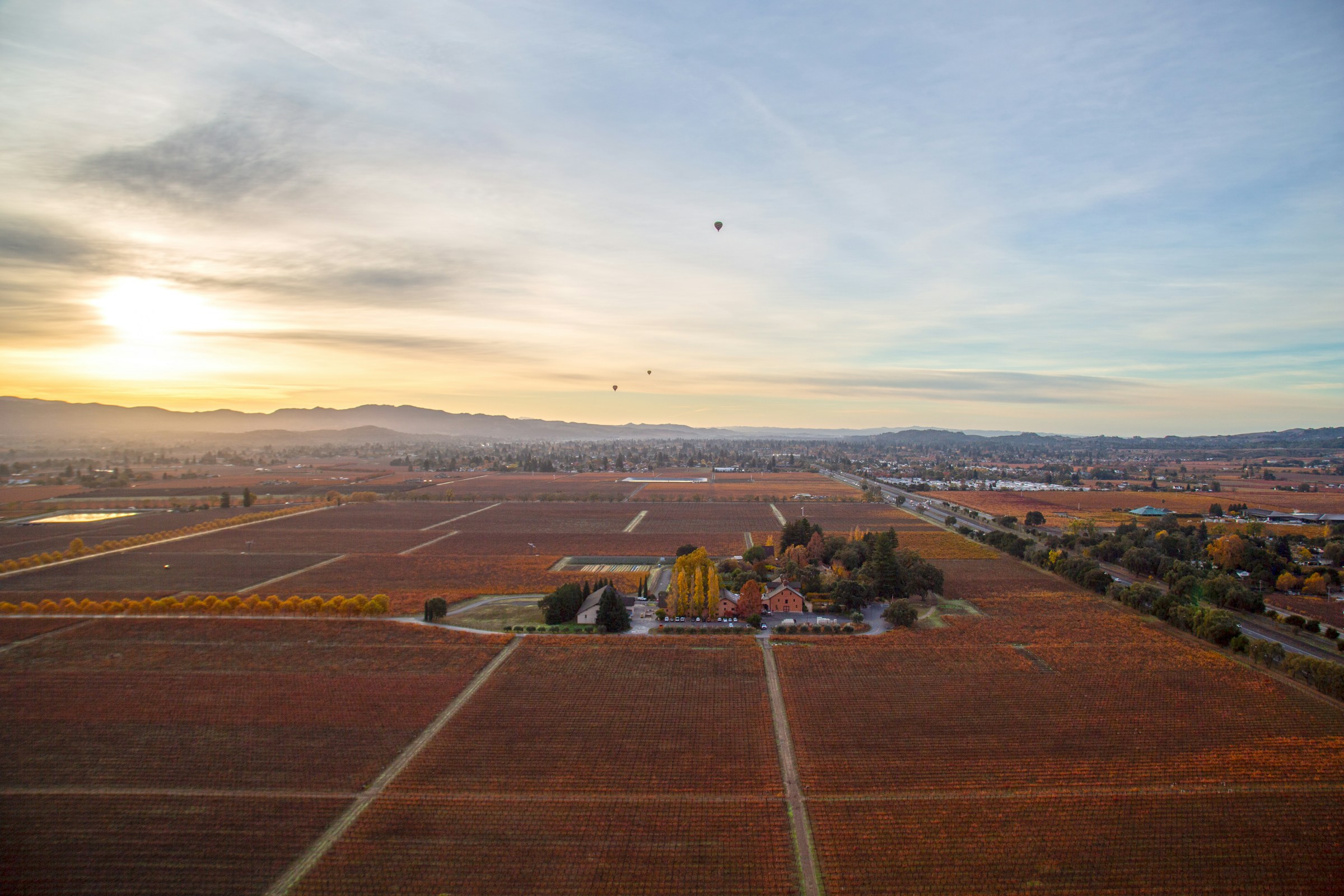
Napa Valley is thirty miles long. You can drive it end to end in under an hour, and that single fact is responsible for most of the bad Napa trips I hear about. It looks small on the map, so people schedule it like it’s small — four wineries, two towns, a dinner reservation, all in one day — and they arrive home having tasted a great deal of wine and experienced almost none of it.
The valley rewards the opposite instinct. Fewer stops, longer at each, and someone else driving.
Most people ask me about Napa in one of three frames: as a couples’ trip or milestone anniversary, as a small group celebration — a birthday, a reunion, a bachelorette that has outgrown the sash — or as the wine-country trip they’ve been meaning to take for fifteen years and finally are. The couples’ version is the easiest to get right. The group version lives or dies on transportation. The fifteen-years version usually needs someone to gently talk them out of doing too much.
Here’s how I think about it.
At a Glance
| Best time to visit | Late April into early June is the answer I give most often — the vines have leafed out, the hills are still green, the weather is genuinely pleasant, wildfire risk is effectively nil, and appointments are gettable at rates well below harvest. Avoid the BottleRock weekend in May. Harvest (roughly late August–October) is the romantic answer and the expensive one: crowds, rates 50–100% above winter, and real smoke risk. Winter is the insider’s pick — the trade calls it Cabernet Season, and it’s the one time of year the winemaker is actually standing in the room. |
| How long to stay | Three to four nights. Two full days of tasting is genuinely enough; a third is a bonus, not a requirement. Beyond four nights you want a second region — Sonoma, the coast, or San Francisco on either end. |
| How to get there | SFO for flight inventory (about an hour on a weekday, up to two on a weekend). OAK is closer at 51 miles and often the faster real-world transfer if the nonstop works. SMF (Sacramento) is the sleeper — comparable drive, usually cheaper, far less chaos. APC (Napa County) is ten minutes away and mostly private aviation — but JSX runs a seasonal public-charter service in from Burbank, Santa Monica and Orange County, which lands you in the valley without ever touching a major airport. A car is essential for getting to the valley; see below for why it shouldn’t be how you move around it. |
| Currency / language | US dollars, English. |
| One thing most guides won’t tell you | The walk-in Napa of the 1990s no longer exists. Roughly seventy percent of producers are appointment-only, and the marquee estates want two to four weeks’ notice. Tasting fees run $40–50 at entry level and $75–200+ at flagship Cabernet houses — the valley-wide average sat near $79 in 2025. Showing up hoping to wander in is not a plan; it’s how people end up at the four wineries that still take walk-ins, which are rarely the four you’d have chosen. |
Why I Send Travelers Here
Because the concentration is extraordinary. Thirty miles of valley floor holds four Michelin-starred restaurants — one of them a three-star — alongside seventeen sub-appellations and several hundred producers, and there is nowhere else in America where world-class wine and world-class food sit that close together.
Because Napa is unusually good at the thing people actually want from a wine trip, which is not education but unhurried time. A long lunch. An afternoon on a terrace. A dinner you talk about afterward.
Because it works at three nights. That sounds minor until you compare it to every other great wine region on earth, most of which require a transatlantic flight before the trip even starts.
And because it is a genuinely easy place to be a couple. Napa is a wealthy, liberal, wedding-heavy corner of Northern California an hour from San Francisco, and same-sex couples are entirely unremarkable here — I’ll say more on that below, including where the welcome is ambient and where it’s something you can actually book.
What I add is mostly restraint and access: talking people out of the fourth winery, getting them into the estates that don’t have a public booking page, and solving the transportation problem before it becomes the story of the trip.
Where I’d Anchor
A quick word on how I book these. Some of these properties carry a consortium amenity layer — a breakfast, a resort credit, a room-category bump — that I confirm against your specific dates on the call. Others I book directly, without that layer. I’ll always tell you plainly which is which. The pick comes first; the perk, where it applies, is a bonus and not the reason.
Where you anchor matters more in Napa than in most destinations, because the valley is linear. Staying in Calistoga and touring Carneros means driving the whole valley twice in a day.
Yountville — the gastronomic center of gravity. The French Laundry, Bouchon, Ad Hoc, Bistro Jeanty, and a walkable main street, all within a few blocks. If food is the point of your trip, anchor here and don’t overthink it. The trade-off is that Yountville is very small and goes quiet early; some people find it a beautifully manicured stage set.
St. Helena — the most convincing small-town wine country. The prettiest main street in the valley and central enough that drive times are short in both directions. The trade-off is that Highway 29 is Main Street here, so afternoon traffic runs straight through your evening stroll.
Calistoga — geothermal springs and the most relaxed end. Mud baths, hot springs, genuine frontier-town character, and the best value in the valley. The trade-off is real distance: you’re at the far north end, thirty-five to forty-five minutes from downtown Napa, and you will drive the length of the valley more often than you expect.
Downtown Napa — the only place with actual range. Restaurants at every price, real nightlife, the Oxbow market, the Wine Train depot. The trade-off is that it’s a working city of eighty thousand, not a vineyard fantasy, and you’re twenty-five to thirty-five minutes from the upvalley estates.
A note on two names you’ll see constantly: Rutherford and Oakville are appellations, not towns. Rutherford is the Cabernet heartland and home to Auberge du Soleil; Oakville is arguably the most valuable farmland in America and has essentially no lodging. You visit Oakville. You don’t stay in it. And American Canyon, the southern gateway, is not a wine-country base — it’s the commercial approach road. I’d never anchor you there.
The properties
Auberge du Soleil (Rutherford) — the one everyone pictures. Fifty rooms and suites on a thirty-three-acre olive grove on the Rutherford hillside, with the terrace that has launched a thousand proposals and a one-Michelin-star restaurant on site. It holds three MICHELIN Keys, which is the hotel-side equivalent of the star and a cleaner signal than most awards. One honest note: the resort words its policy as not recommended for guests under twenty-one — that’s a recommendation, not a prohibition, and third-party listings state it three contradictory ways. If children are part of your trip, I confirm it with the property rather than trusting a booking site.
Four Seasons Napa Valley (Calistoga) — the newest of the true luxury set. Eighty-five rooms and suites plus twenty private residences — eleven of which are in the rental program — on twenty-two and a half acres at the north end of the Silverado Trail, with a working winery on the property and Auro, a Michelin-starred restaurant, on site. The one I reach for when a client wants full-service polish and doesn’t want to leave the grounds for dinner.
Bardessono (Yountville) — walk to everything. LEED Platinum, three villas, Lucy Restaurant & Bar, two MICHELIN Keys, and a location that puts The French Laundry within a stroll. The pick when you want the food-first trip and want to leave the car parked for three days.
Solage (Calistoga) — the wellness answer. Roughly a hundred freestanding studios and suites, the geothermal bathhouse, and Solbar, a resort restaurant that locals actually use. This is where I send people whose real request is rest, with wine as the accompaniment rather than the itinerary.
Alila Napa Valley (St. Helena) — central and adult. Sixty-four rooms and suites, some of them in the historic manor house, with Violetto — Thomas Lents’s Italian room — on site. Genuinely well-placed for touring in both directions. (If you remember this address as Las Alcobas, it’s the same building; it rebranded in 2021. And if you remember Chris Cosentino in that kitchen, he left in 2024.)
Stanly Ranch (Carneros) — the ranch, not the valley. A hundred and thirty-five cottages and rooms across seven hundred acres at the southern end. Cooler, windier, more agricultural, and a genuinely different feeling from the upvalley resorts. Best for groups and for people who want space more than proximity.
Meadowood (St. Helena) — with a caveat I’d rather you hear from me. The 2020 Glass Fire destroyed roughly half the property. It operates today with thirty-six rooms and cottages — materially fewer than before the fire — and Christopher Kostow’s three-star restaurant has not returned; the resort still points guests to The Charter Oak instead. A rebuild toward the original footprint is approved and years out. None of that makes it a lesser hotel: it holds three MICHELIN Keys, the same as Auberge. But anyone booking on a pre-2020 memory is booking a smaller place than they remember, and I’d rather say that up front.
Want one of these? Start a discovery call — we’ll match the anchor town to how you actually want to spend the days, and I’ll confirm what applies to your dates.
The Thing Nobody Warns You About
You cannot taste wine all day and then drive.
This is the single largest planning constraint in Napa and it is routinely hand-waved. Three tastings is a substantial amount of alcohol even with disciplined spitting, and Highway 29 in the late afternoon is not the road to test yourself on. Every good Napa trip solves this before day one.
The options, in the order I reach for them:
A private driver for the day. The right answer for most of my clients. Full route flexibility, no strangers in the van, and no one watching the clock but you. The credential to insist on is a CPUC TCP permit and commercial insurance — any legitimate operator holds both, and asking is the cleanest way to filter out the improvised ones.
An established tour company. Beau Wine Tours and Platypus Wine Tours are the two names that come up most consistently, both offering private itineraries; Platypus leans toward smaller family-owned estates, which suits people who don’t want a day of famous labels.
The Napa Valley Wine Train. Worth being honest about: it is a restaurant that moves, not an efficient way to see wineries. Thirty-six miles round trip from downtown Napa to St. Helena, with tiers from a lunch service up to a six-hour day with winery stops. Genuinely lovely for a celebration, for a guest with limited mobility, or for a rainy February afternoon. Not a substitute for a driver.
Bicycles, with an asterisk. The Napa Valley Vine Trail is paved and car-free and beautiful, but it is not yet continuous — the finished stretches are Napa to Yountville, Calistoga to St. Helena, and Vallejo to American Canyon — thirty-three of an eventual forty-seven miles. Several hotels lend bikes. Treat it as a morning activity or a two-taste day; riding impaired on narrow shoulders is the same bad idea in spandex that it is in a car.
What I’d Do With Four Nights
Day One — Arrive and do almost nothing
Land, collect the car, drive up. Check in mid-afternoon. Sit somewhere with a view and don’t schedule a tasting — you’ve been on a plane, your palate is shot, and the valley is not going anywhere.
Dinner close to where you’re sleeping. In Yountville that’s Bistro Jeanty (classic French, unchanged in twenty-five years, deliberately) or Bouchon Bistro (Keller’s brasserie — steak frites, oysters, the reliable answer). In downtown Napa, Angèle on the river has the best patio in town. In St. Helena, Cook St. Helena is a tiny Northern Italian storefront the locals keep to themselves — book it, it’s small, and it’s closed weekends.
Day Two — Two wineries, properly
This is the day the trip is actually about. Two tastings, not three. One in the morning around 10:00 or 10:30, a long lunch, one in the afternoon around 2:00.
Drive north on Highway 29 in the morning — it’s the valley’s main street, where the famous estates and the traffic both live — and come back south on the Silverado Trail, which carries roughly a third of the traffic and is prettier in a landscape sense. The cross-roads between them (Oakville Cross, Yountville Cross, Zinfandel Lane) take about five minutes, so you can hop between the two corridors freely.
Lunch outdoors if the weather allows: Farmstead at Long Meadow Ranch in St. Helena serves off their own ranch and takes walk-ins, or Gott’s Roadside for burgers and ahi tacos at a picnic table, which is a more genuinely Napa experience than its price suggests.
Dinner is the reservation you made weeks ago. La Toque in Napa is Ken Frank’s tasting room — a fourteen-time star holder currently outside the Michelin guide — and the grown-up special-occasion pick that isn’t The French Laundry. The Charter Oak in St. Helena is Kostow’s hearth-cooked, family-style room in a historic stone building — the good-looking, less formal version of that kitchen.
Day Three — One winery, one appellation, one long afternoon
Go deeper rather than wider. One appointment somewhere that needed an introduction to get into, then an afternoon that isn’t scheduled at all — the spa at your hotel, the pool, an hour in Oxbow Public Market in Napa working through Hog Island oysters, a Model Bakery English muffin, and a coffee.
If you’re in Calistoga, this is the mud-bath afternoon. That’s not a novelty; the geothermal wellness culture up there is a century old and it’s the reason Calistoga exists.
Dinner: The Restaurant at North Block in Yountville (now under Antonio Natal — live fire, pasta, a dog-friendly courtyard), Ciccio for wood-fired pizza and pasta when you’re finished with tasting menus, or Solbar at Solage if you’ve stayed north.
Day Four — The morning you don’t rush
Breakfast slowly. If you want one last stop, make it a producer near your route to the airport rather than doubling back upvalley. Leave earlier than feels necessary if you’re flying out of SFO on a weekend.
Specific Things I’d Tell You About
The French Laundry reservation mechanics, correctly. Reservations open on Tock, and the booking window is a rolling monthly release: new reservations for a given month are released at 5:00 PM local time on the first of the preceding month. You will find guides all over the internet saying 10:00 AM, or a sixty-day rolling window — those are wrong, and the restaurant’s own page is the source. Pricing runs $425 per person in the dining room, $525 in the courtyard, and $600 at the private tables, prepaid, before add-ons. Everything being sold out when you look is normal, not a signal.
Kenzo takes reservations exactly thirty days out. Traditional kaiseki with ingredients flown from Japan; it held a Michelin star until the 2026 California guide, which didn’t renew it. Note the cancellation policy — $200 per person plus tax, inside twenty-four hours for parties up to four and inside seventy-two hours for parties of five or six — because it’s steeper than people expect and worth putting in your calendar, not just your inbox.
Book dinner before you book wineries. The restaurants are the harder constraint. Tasting appointments can flex by an hour; a Saturday table at a starred room cannot.
Ask about fee waivers, but don’t count on them. Waiving the tasting fee with purchase used to be near-universal and is now inconsistent, especially at the top end, where it often requires a club join or a multi-bottle commitment rather than a single bottle.
Everything jams between 3:00 and 6:00 PM. Both Highway 29 and the Silverado Trail — the Trail has developed its own late-afternoon crush as people flee 29. Plan your last tasting to end before three or accept that you’re sitting in it.
Ship the wine. Don’t fly with it. Every serious producer will handle it, and it removes an entire category of luggage anxiety. Just check the rules for your own state before you buy — they vary more than you’d think.
The Wildfire Conversation
I’d rather have this with you before a deposit than after.
Northern California’s fire season runs roughly August through October, with late September and October the peak — the 2017 Tubbs Fire hit in October, and the 2020 Glass Fire started on September 27th and burned well into it. That isn’t abstract: the Glass Fire is precisely why Meadowood is a thirty-six-room hotel today instead of the substantially larger one it was.
Smoke is the more common disruption than flame. A fire nowhere near Napa can put the valley under poor air quality for days — closing outdoor tastings, grounding the balloons, and erasing the views that are half the reason to come.
What that means practically: keep late-August-through-October itineraries flexible, check air quality before you fly, expect wineries to modify operations during Red Flag Warnings, and let’s talk about travel insurance explicitly for trips in that window. The risk is foreseeable, which cuts both ways on coverage — it’s a conversation to have before the deposit, not after.
Most Octobers are clear and magnificent. But if a smoke-affected trip is something you couldn’t absorb, I’ll book you in May.
For Same-Sex Couples
Napa’s welcome is real, and I’d describe it as ambient, with a few genuine anchors. This is a wealthy, liberal, wedding-heavy destination an hour from San Francisco. Same-sex couples are unremarkable here and the wedding industry actively courts them.
But I’m not going to oversell it: Napa is not a gay destination the way Palm Springs or Provincetown are. There’s no district, no scene, no bar. If that’s what you’re after, it isn’t here.
What is here is more interesting than ambient reassurance. Napa Valley Pride has run annually since 2003 — twenty-plus years of volunteer and local-business organizing, which is institutional history rather than a seasonal logo change. And Gentleman Farmer is a gay-owned Napa winery founded by husbands Joey Wolosz and Jeff Durham, certified LGBTBE® through the National LGBT Chamber of Commerce — an actual third-party credential, which is rarer than you’d hope. Majuscule is another gay-owned producer, genuinely tiny — fewer than a hundred cases of each wine they make.
That’s the version I’d rather give you: not a paragraph about how welcoming everyone is, but a tasting you can actually book where the money goes somewhere specific.
What I’d Skip
A fourth winery. Two is relaxed, three is the working maximum, four is a mistake. Each tasting runs sixty to ninety minutes before travel time, and palate fatigue is real — it arrives around the third stop even for people who do this professionally.
Driving yourself between tastings. Covered above. It’s the one non-negotiable.
Harvest, unless you specifically want harvest. Late August through October is the most romantic answer and also the most crowded, most expensive, and highest-risk. Rates run fifty to a hundred percent above winter and the appointments vanish. Worth it if watching crush is the point. Not worth it by default. (Worth knowing that harvest moves — 2026’s first sparkling grapes came off the vine at Round Pond on July 21, roughly three weeks early.)
BottleRock weekend, unless you’re going to BottleRock. The May festival transforms downtown Napa and spikes lodging valley-wide; 2027’s dates are May 28–30.
Trying to add Sonoma as a day trip. It’s a genuinely different region over the Mayacamas, not a side quest. Give it its own nights or leave it for next time. (And while we’re here: Montage Healdsburg, which turns up on a lot of Napa lists, is in Sonoma County.)
If You’re Also Considering Wine Country by River
Some of you reading this are weighing Napa against a wine-country week on the Douro or in Bordeaux — I get that question often enough that it’s worth answering plainly.
They are not competing versions of the same trip.
Napa is a driving-and-dining trip where your own taste sets the route. You choose every producer and every meal, you can chase a small estate someone mentioned at lunch, and the food is genuinely world-class. The cost of that freedom is that you carry the logistics: appointments booked weeks out, a driver arranged, and a bill that arrives à la carte rather than as one number.
The Douro and Bordeaux are landscape-and-heritage trips where the logistics dissolve. You unpack once, the geography comes to you overnight, and the drinking-and-driving problem stops existing structurally rather than being solved with a hired car. The cost is agency: you visit the quintas and châteaux on the ship’s contract and the ship’s clock.
The rough sorting question: if you want to eat at a three-star and then talk your way into a cult Cabernet appointment, go to Napa. If you want to watch a UNESCO river valley slide past a balcony without ever touching a car key, sail.
Most people who love one eventually do the other. I’m hosting a wine-country week on one of those two rivers in the fall of 2027 and the valley genuinely isn’t picked yet — the vote is open here if you want a say in it.
Plan Napa With Me
If you’re thinking about Napa as an anniversary, a milestone birthday, a small group celebration, or the wine-country trip you’ve been postponing — that’s exactly the kind of planning I do. Thirty minutes, no fee, no pressure. We’ll figure out which town you should sleep in, how many wineries you actually want, and who’s driving.
Book Your Free Discovery Call →︎
Last updated: August 2026. I keep this guide current. Napa changes — restaurants close, properties rebuild, harvest arrives early. When it does, the page changes.
Plan this trip with me.
A 30-minute discovery call is where it starts. No fee, no pressure.
Book a Discovery Call