About the Destination
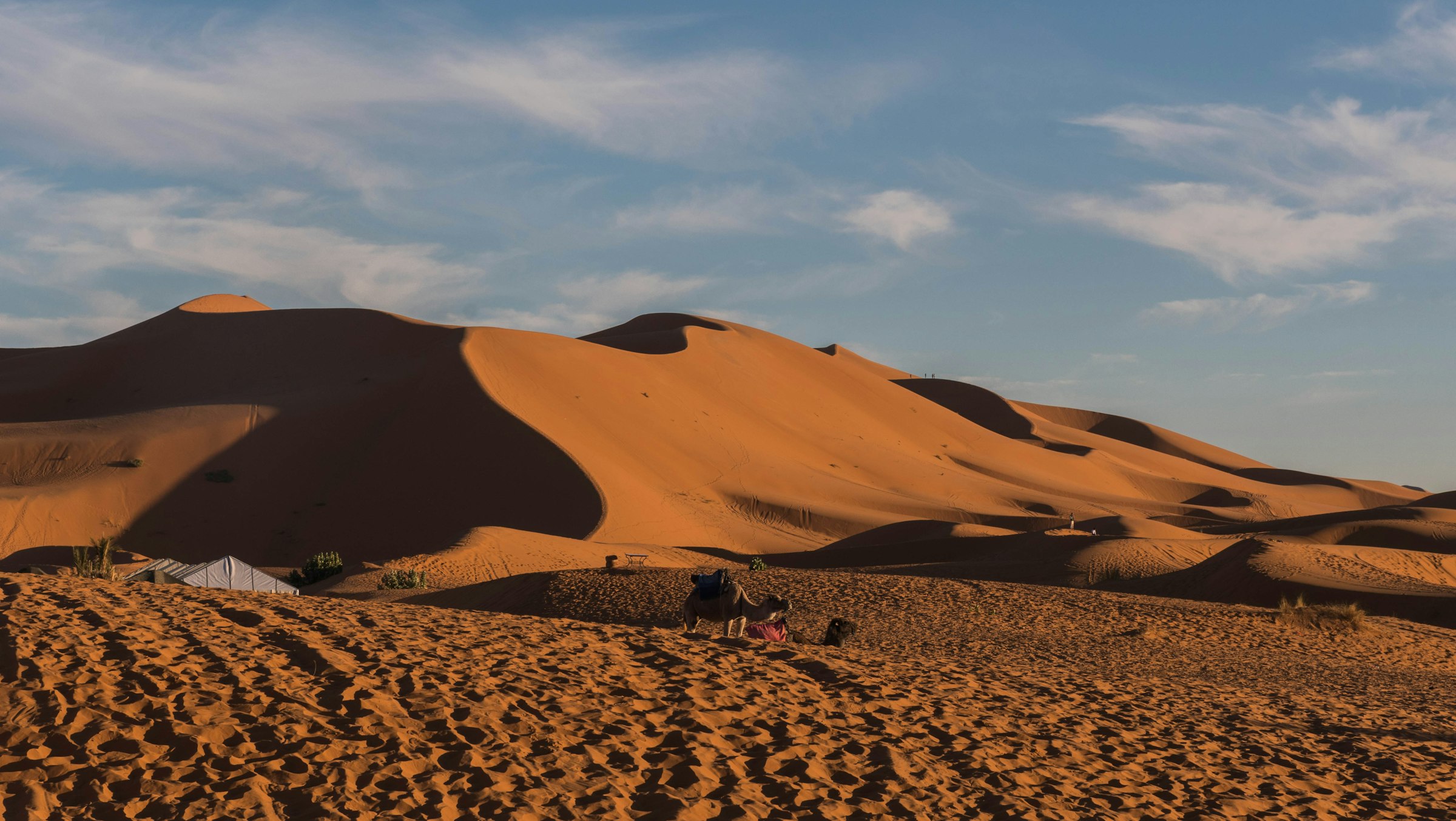
South of Marrakech the ground rises into the High Atlas — Toubkal, the highest peak in North Africa at 4,167 meters, snow-capped much of the year and visible from the city on a clear morning — and then, over the passes, it falls away into another world entirely. This is the interior: the mountain villages, the palm-filled gorges, the road of a thousand kasbahs, and at the far end of it the great orange dunes of Erg Chebbi, rising two hundred feet out of the flat like something invented. It’s the Morocco of the imagination, and it’s the part of the country that people who’ve only done Marrakech don’t realize is even there.
Two things matter about this leg before you plan it. The first is that it’s a journey, not a destination — the interior is covered overland, and the drive is the trip: over the Tizi n’Tichka pass, down to Aït Benhaddou, along the Dades and the Todra gorges, out to the dunes. The second, and the one people get wrong, is that it takes days. Marrakech to the Erg Chebbi dunes is eight to ten hours of driving; done right it’s a two-day journey each way, with real stops, not a punishing there-and-back. The travelers who try to “do the Sahara” in an overnight see a lot of van and very little desert. The ones who give it the days come home with the best part of the whole Morocco trip.
This is the leg I plan most carefully, and the one I plan through operators on the ground — the good version of the Moroccan interior is a DMC’s craft, the drivers who know which kasbah to stop at and which to pass, the desert camps that get the sunset right. It is not a booking-engine line item.
At a Glance
| Best time to visit | September–May. October–November and March–April are ideal — warm days, cold clear desert nights, the passes open and the light long. Winter is beautiful and quiet (snow on the Atlas, genuinely cold nights in the dunes — pack for it). Avoid high summer: the desert in July–August is punishing, well past 40°C, and the experience suffers for it. |
| How long to stay | As a leg, four nights minimum, and five to seven is better — the interior does not compress. The classic shape is two days out to the dunes (overnighting in the Dades Valley), a night or two in the desert itself, and the return either retracing the route or looping back a different way. Bolted onto Marrakech, this turns a city trip into a real Morocco. |
| How to get there | Overland from Marrakech, over the Tizi n’Tichka (2,212 m), the great pass that links the city to the south. A private driver-guide is not optional here — it’s the entire mechanism of the trip, and it’s arranged through my operators. There are small airports (Ouarzazate; a strip near Erg Chebbi) that can shorten the return for travelers short on time, and I’ll build that in when the days are tight. |
| One thing guides won’t tell you | The Sahara you’re picturing — the tall, clean, cinematic dunes — is Erg Chebbi, near Merzouga, and it’s the far one: a full journey from Marrakech, worth every hour. What gets sold cheaply as “the desert” from Marrakech is often the nearer, rockier country, or a rushed dash to Zagora. If the great dunes are the dream, give them the days; if you just want the feeling of the desert on a tight trip, the Agafay — a stony near-desert 45 minutes from Marrakech with excellent luxury camps — is the honest short version. |
Why I Send Travelers Here
Because this is the Morocco that changes people — the scale of the Atlas, the strangeness of the kasbah road, the silence of the dunes at night with more stars than most travelers have ever seen. Because the set-pieces are real: Aït Benhaddou, the earthen ksar that has stood since before the films found it; the Todra and Dades gorges; the oasis valleys; and the dunes themselves, which do not disappoint. Because a night in a genuinely good desert camp — a proper bed, a fire, dinner under the sky, the dunes gone silver in the moonlight — is one of the singular nights in travel.
This leg earns the slot for the traveler who wants Morocco to be an adventure and not just a city break; for photographers and star-people and anyone who’s been dreaming of the Sahara specifically; and for families and couples who want a shared expedition with the comfort dialed up. It’s the wild half of the country, and it’s the half people describe with their hands.
Where I’d Anchor
The interior is a route, so the “where” is really a sequence — but three kinds of stay carry it.
The Atlas — Kasbah Tamadot
Up in the High Atlas foothills near Asni, about an hour from Marrakech, Kasbah Tamadot — Sir Richard Branson’s mountain retreat, on my Signature relationship — is the graceful way to start or end the leg: Berber-kasbah architecture, an infinity pool over the valley, mountain air, and a complete change of register from the city. I plan it as the Atlas bookend, the decompression before or after the long drive south.
The kasbah road — the valley kasbahs
Between the mountains and the dunes, the overnight stops are the restored kasbahs and valley lodges of Ouarzazate, the Dades, and the Skoura oasis — some genuinely lovely, some merely convenient, and knowing which is which on a given night is exactly what the ground operator is for. These are matched to the route and the pace, not booked off a website.
The desert — the luxury camp
At Erg Chebbi, the stay is a desert camp, and the range runs from basic to genuinely luxurious — private tents with real beds and bathrooms, rugs and lanterns, a fire and dinner under the stars, camel or 4×4 out to the high dunes for sunrise. The good camps are the difference between roughing it and the night-of-the-trip, and I book them through the operators who run them, calibrated to how much comfort you want between you and the sand.
Because so much of this leg is operator-led, the honest version is: I don’t hand you a hotel list, I hand you a route — the drivers, the stops, the camps, sequenced for your days and your pace. That design is the work.
How the Route Works
The classic loop, the way I’d shape it: Day one, out of Marrakech over the Tizi n’Tichka, down to Aït Benhaddou — the UNESCO ksar of earthen towers that has been Hollywood’s Morocco since Lawrence of Arabia, and Yunkai in Game of Thrones — with the film-studio town of Ouarzazate beyond it, ending the day in the Dades Valley. Day two, up the Dades and through the Todra Gorge, its walls rising three hundred meters over a river you can walk beside, and on across the pre-Sahara to Merzouga and the dunes of Erg Chebbi by late afternoon — in time for the light. A night (or two) in the desert. Then the return — retracing the route with different stops, or a longer loop back through the Draa Valley and its palmeries. Travelers short on days fly one leg out of Ouarzazate; I build that in when the calendar’s tight.
Specific Things I’d Recommend
Give the dunes a full night, ideally two. The magic of Erg Chebbi is the sunset, the night sky, and the sunrise — a single rushed evening catches one of the three. The second night is where the desert stops being a photo and becomes a memory.
Aït Benhaddou in the low light. The ksar is extraordinary at either end of the day, and mobbed in the middle. Time the stop for morning on the way out or late afternoon on the way back.
A good camp, not a cheap one. This is the stay where the money shows most — the difference between a thin mattress and a proper bed, a shared block and your own bathroom, a generic dinner and a fire under the stars. It’s worth the jump.
The Atlas as a bookend. A night at Kasbah Tamadot before or after the drive turns a long overland leg into a trip with a soft landing. Most travelers who do it wish they’d done two.
What I’d Skip
The overnight Sahara dash. The two-day, there-and-back “desert tour” sold cheaply out of Marrakech delivers a lot of van and a thin slice of dune. If the Sahara is the point, give it the days; if it isn’t, the Agafay near-desert is the honest short version, 45 minutes away.
Zagora instead of Merzouga, if the dunes are the dream. The Zagora/M’hamid side is closer but its dunes are lower and less cinematic; the tall Erg Chebbi dunes are the ones in your imagination, and they’re the far ones for a reason.
Self-driving the passes and the pre-Sahara. The Tizi n’Tichka is a serious mountain road and the desert navigation is real; this is a driver-guide leg, and the cost is small against the difference it makes.
High summer. July and August in the desert are genuinely brutal. Shift the trip to the shoulders and the whole thing improves.
Onward — The Interior in the Trip
This leg is almost never the whole trip — it’s the wild middle or end of a Morocco that usually starts in Marrakech and sometimes reaches Fez. It’s the part that turns “we did Marrakech” into “we crossed the Atlas and slept in the Sahara,” and it’s the chapter people lead with afterward. The broader category — the lodges, the landscapes, the wild-and-remote end of travel that this leg belongs to — lives on Wild Places & Luxury Lodges; the city it launches from is Marrakech.
Plan the Atlas & the Sahara With Me
If you’re thinking about the Moroccan interior — the mountains, the kasbah road, the great dunes — as the adventure half of a Morocco trip, that’s exactly the kind of planning I do, and exactly the kind I plan through trusted operators on the ground. A 30-minute discovery call is where it starts. No fee, no pressure. We talk through the days you have, how much comfort you want between you and the sand, and how the interior sequences with Marrakech, Fez, and the coast.
Last updated: July 2026. I keep this guide current. If a camp I recommend slips, a road washes out, or access to a site shifts, the page changes. Travel changes. The work doesn’t stop when the page goes live.
Plan this trip with me.
A 30-minute discovery call is where it starts. No fee, no pressure.
Book a Discovery Call