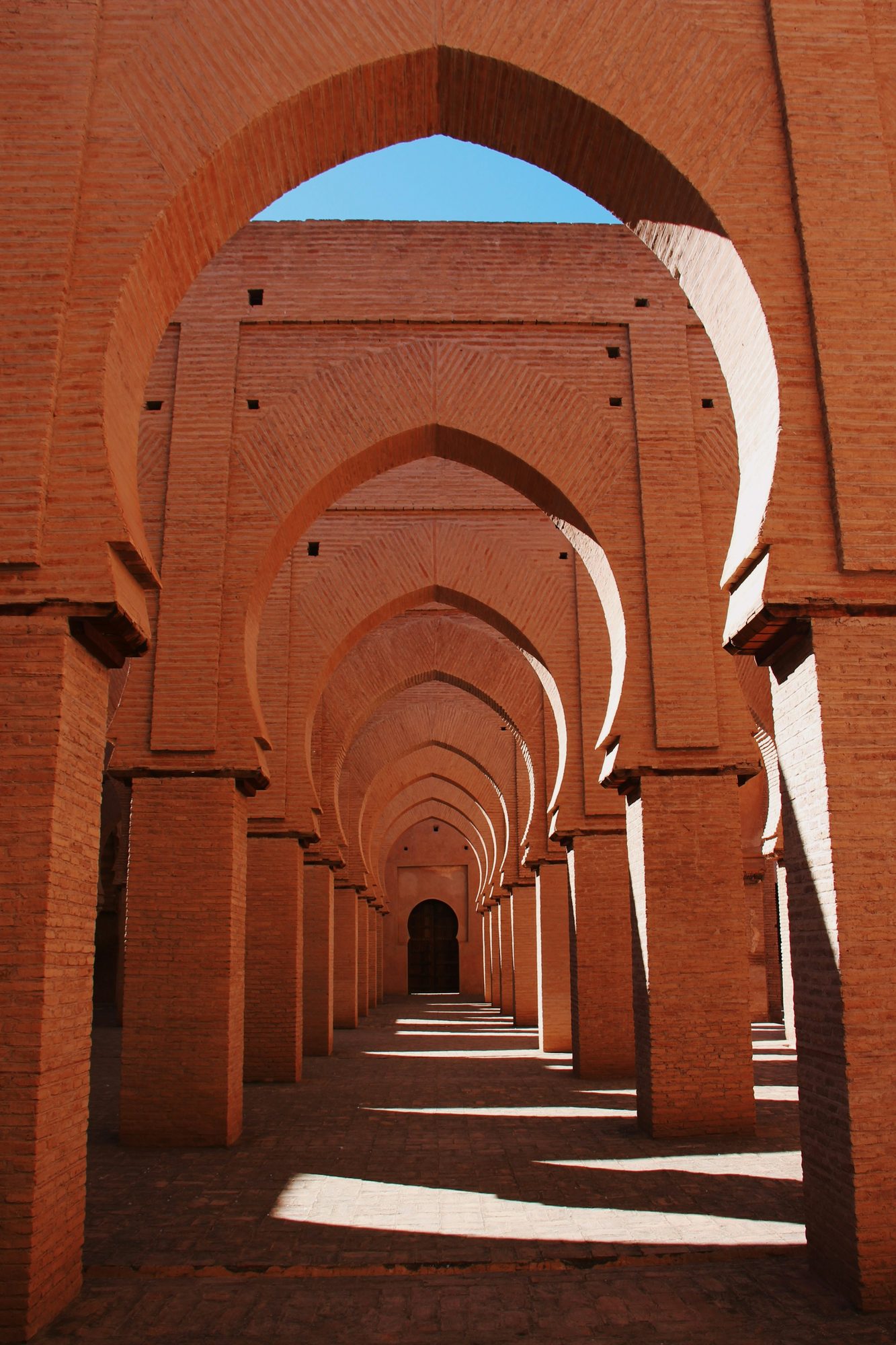
About the Destination
Marrakech is a walled medieval city that never quite modernized its center on purpose, and that decision is the whole appeal. Inside the ochre ramparts is a medina of unmarked doors, blind alleys, and courtyards you’d never guess were there from the street — and behind some of those doors are the best hotels in Africa. Outside the walls, the Ville Nouvelle spreads into palm groves and golf and the newer luxury properties. Over all of it, on a clear morning, the High Atlas stands on the southern horizon — snow-capped for a good part of the year — which is the detail that surprises first-timers: you can be in the souks by ten and in the mountains by lunch.
Most luxury travelers come to Marrakech for one of two shapes of trip — a short, sensory, design-led city break built around one extraordinary hotel, or Marrakech as the front door to a longer Morocco: the Atlas Mountains, the desert, Fez, the coast. Both work. What both require is the thing Marrakech punishes you for skipping — pacing. This is a hot, dense, overstimulating city, and the travelers who try to conquer it leave frazzled. The ones who treat the hotel as a destination in itself, move through the medina in short deliberate bursts, and keep the middle of the day for the pool and the shade — those travelers fall in love with it.
The hotel matters more here than almost anywhere I plan. In most cities the property is where you sleep between the things you came to do. In Marrakech the riad — the courtyard house, water at the center, rooms turned inward away from the street — is one of the things you came to do. Choosing it is the single most important decision of the trip, which is where I come in.
At a Glance
| Best time to visit | March–May and October–November are the sweet spots — warm days, cool evenings, the gardens at their best. Summer (June–August) is genuinely punishing, regularly past 100°F; a pool becomes non-negotiable and the day reorganizes around dawn and dusk. Winter (December–February) is underrated — mild sunny days, cold nights, and snow on the Atlas that makes the mountain backdrop unforgettable. |
| How long to stay | Three nights minimum for Marrakech itself, four preferred. Three handles the medina, a garden or two, and enough hotel time to justify the hotel; four lets the city breathe and leaves room for an Atlas day. Add nights, don’t compress, if the Atlas or the desert are on the table. |
| Currency / Language | Moroccan Dirham (MAD) — a closed currency, so you get it on arrival, not before you fly. Arabic (Darija) and Amazigh (Berber) are the mother tongues; French is the working second language of the luxury trade; English is fluent at the properties I use. |
| How to get there | Marrakech Menara (RAK). From the U.S., United flies a seasonal nonstop from Newark (winter-weighted); the rest of the year, one connection through Paris, Madrid, Lisbon, London, or Casablanca (on Royal Air Maroc) is the shape. Arrange the hotel transfer in advance: the medina riads sit down pedestrian derbs (alleys) a porter has to walk you into, and “the taxi can’t reach the door” is a bad first ten minutes to discover on your own. |
| One thing guides won’t tell you | The medina’s great riads are invisible from the street — no marquee, no lobby you drive up to, just a door in a wall. That secrecy is the luxury, but it means arrival, luggage, and coming and going are choreographed by the hotel, not by you. It’s why the property you choose and the transfers you pre-arrange carry more weight here than in a normal city — and why I plan the logistics, not just the reservation. |
Why I Send Travelers Here
Because Marrakech delivers a kind of luxury that’s getting rare — sensory, specific, and impossible to replicate at home. The riad-hotels are genuinely among the finest in the world, and they’re houses, not towers: water and quiet and courtyards, a staff that runs the place like a private residence. Because the medina is a working thousand-year-old city, not a preserved one, and an hour in the souks with someone who knows which doorway leads where is one of travel’s great afternoons. Because thirty minutes past the ramparts the landscape turns — olive groves, then the rocky Agafay, then the snow line of the Atlas — and the trip stops being a city break and becomes a region.
Marrakech earns the slot for honeymooners and milestone couples who want somewhere photogenic and enveloping without a long-haul to Asia; for design-and-food travelers who’ll happily spend a trip on the strength of one hotel and three restaurants; and for travelers building a longer Morocco who need a soft, spectacular front door before the mountains and the desert. It’s also, quietly, one of the best-value ways left to sleep in a truly great hotel — the ceiling of the experience is very high and the entry point is lower than the equivalent in Europe.
Where I’d Anchor
The luxury map of Marrakech splits three ways — inside the medina (the historic riad experience), the palm grove and Ville Nouvelle (space, gardens, pools, families), and the Atlas foothills (the mountain escape, usually as an add-on). Each is the right answer for a different trip.
Royal Mansour Marrakech
The one most people mean when they picture the top of Marrakech. Commissioned by the King and run as the country’s flagship, it’s not a hotel with rooms but a private medina of individual riads — your own multi-story courtyard house with a plunge pool and a rooftop, staff moving through service corridors you never see. It is the definitive Marrakech splurge and the honeymoon-and-milestone answer when the property is the occasion. Royal Mansour books through my Signature Travel Network relationship; Signature amenities auto-apply, calibrated to your dates and the riad category, and we walk through exactly what’s on your reservation on the call.
La Mamounia
The grande dame — the historic house inside the ramparts, twenty acres of gardens that predate the hotel, and the sense of place that a century of guests built. Where Royal Mansour is private and hushed, La Mamounia is grand and social: the gardens, the bars, the pastry, the ritual of the place. It’s the choice for travelers who want the icon — the Marrakech hotel with a capital H — and the address that puts the medina at your feet. Also on my Signature relationship, amenities auto-applied; we confirm the specifics for your stay on the call.
The Oberoi Marrakech · Selman · Palais Ronsard (the palm grove)
Out toward the Palmeraie, the properties trade the medina’s intensity for space, gardens, and a pool you’ll actually live in. The Oberoi is the serene, Moorish-Andalusian answer — a 28-acre orchard estate, olive groves, reflecting pools, the Oberoi service ethic — and, with a children’s area and a shuttle into town, the easiest of the great properties to do with kids in tow. Selman is the design-forward one — Jacques Garcia interiors and a stable of Arabian thoroughbreds on the grounds — often the smarter value and, for a certain traveler, the most characterful room in the city. Palais Ronsard is the boutique answer: a Relais & Châteaux riad-palace of twenty-seven rooms, each its own private residence, hidden behind secret gardens — the kind of place you don’t find by Googling. All book through my Signature relationship; which one is right depends on the trip, and that’s the call.
Kasbah Tamadot (the Atlas escape)
Sir Richard Branson’s mountain retreat in the Atlas foothills near Asni, about an hour from the city — Berber-kasbah architecture, mountain air, and a complete change of register from the medina. It’s the natural second half of a Marrakech trip: two or three medina nights, then up into the mountains to decompress. I plan it as the pairing, not the alternative.
Want one of these stays? Start a discovery call — I’ll pull live availability, walk through the riad and room categories (they vary enormously), and confirm which Signature amenities and current promotions apply to your dates.
What I’d Do with Four Days
Day One — Arrival and the Riad
Land at RAK, hotel transfer into the medina (or out to the Palmeraie). Resist the itinerary. The first day in Marrakech is for the hotel — the courtyard, the hammam, the rooftop at dusk, dinner where you’re staying. The city is intense and the flight is long; arriving slowly is the difference between loving Marrakech and being defeated by it. If you have energy at golden hour, a short first walk toward Jemaa el-Fnaa to feel the pulse, then back.
Day Two — The Medina, with a Guide
The souks reward a guide the way few places do — not to be walked through, but to be read. A morning with someone who knows the trades (the dyers, the metalworkers, the leather) turns a maze into a map. Fold in the set-pieces that are worth it: the Bahia Palace, the Ben Youssef Madrasa, the Saadian Tombs. Keep the midday for the pool — this is the rule the heat enforces. Late afternoon, the Jardin Majorelle and the Yves Saint Laurent museum (book ahead; the garden times out). Dinner in the medina — I have the current specifics; we choose on the call.
Day Three — The Atlas or the Agafay
The day the trip stops being a city. Two shapes: the High Atlas — a drive up into Berber villages, a lunch with a view of the peaks, a walk if you want one — or the Agafay, the rocky moonscape desert forty-five minutes out where the luxury camps do sunset dinners and camel-or-quad theater against the mountains. Both are day-trips; both are better with a private driver-guide, which I arrange. (If the real Sahara — the dunes at Erg Chebbi — is the dream, that’s a different, multi-day trip I plan through my operators on the ground; see below.)
Day Four — Slow Marrakech
The day to do less. A garden you skipped (Le Jardin Secret inside the medina; the Menara olive-grove basin outside it), a long lunch, a hammam and a nap, a last wander through the parts of the souk that aren’t on the guide’s route. The best last day in Marrakech isn’t a checklist — it’s the city at your own speed, now that you can read it. Then the rooftop, one more time.
Specific Things I’d Recommend
A guided first walk of the souks. The single highest-value half-day in Marrakech. The medina is a working city, not a museum, and the difference between “we got lost and it was stressful” and “we got lost and it was the best afternoon of the trip” is a guide. I have specifics; ask on the call.
A hammam at the hotel. The traditional steam-and-scrub is part of the place, not a spa add-on. Do it early in the stay, not the last morning — it resets the body after the flight.
A dinner in a private riad. Beyond the hotel, the medina hides restaurants inside courtyard houses that seat a few tables a night. The right one is a highlight; the wrong one is a tourist trap thirty feet away. This is exactly what the advisor relationship is for.
The rooftops at dusk. Marrakech is a low city, and the call to prayer moving across the medina at sunset from a rooftop is the sound people come home talking about. Build it into at least two evenings.
What I’d Skip
The overnight dash to the Sahara. The real dunes (Erg Chebbi, near Merzouga) are eight-plus hours each way from Marrakech — a punishing there-and-back that gets sold as a two-day trip and delivers a lot of van and very little desert. If the Sahara is the point, give it the days it deserves as its own leg. If you just want the feeling of the desert, the Agafay is forty-five minutes away and lovely.
Cramming Fez in as a day trip. Fez is a full trip of its own — a different, older, more labyrinthine medina — and the drive is long. Do it properly with a night or two, or leave it for next time.
Self-navigating the medina after dark with luggage or on arrival day. The alleys aren’t lit or signed the way you’d expect, and the first night is not when to learn them. Let the hotel choreograph the arrival.
A hotel chosen on the website alone. Riad categories vary wildly — a “suite” can be a jewel or a windowless interior room three floors up. This is the reservation where the room, the floor, and the aspect matter most, and where a fifteen-minute call saves the trip.
Onward — Morocco Beyond Marrakech
Marrakech is the anchor, but it’s the front door to a country. The High Atlas (Kasbah Tamadot and the mountain lodges) is the natural extension for a week that wants a second act; the desert — whether the near Agafay or the far Sahara — I plan through my operators on the ground, DMC-led, because the good version of the Moroccan desert is an operator’s craft, not a booking-engine line item; and Fez, the coast (Essaouira), and the imperial cities each add a distinct chapter to a longer loop. When the trip grows past the city, the wild-lodge-and-landscape end of it lives on Wild Places & Luxury Lodges.
Plan Marrakech With Me
If you’re thinking about Marrakech as a short, spectacular city break built around one great hotel, as a honeymoon or milestone somewhere enveloping and photogenic, or as the front door to a longer Morocco — that’s exactly the kind of planning I do. A 30-minute discovery call is where it starts. No fee, no pressure. We talk through the time you have, the shape you’re imagining, which anchor is right — the private-medina hush of the Royal Mansour, the grand social sweep of La Mamounia, the palm-grove calm of the Oberoi — and how the city plays into a longer Morocco if the mountains and the desert are calling.
Last updated: July 2026. I keep this guide current. If a hotel I recommend slips, a restaurant changes hands, or access to a site shifts, the page changes. Travel changes. The work doesn’t stop when the page goes live.
Plan this trip with me.
A 30-minute discovery call is where it starts. No fee, no pressure.
Book a Discovery Call