The Safari Property Spectrum: Lodge, Camp, and Private Reserve
Every safari property sits somewhere on a scale — from permanent lodge with a wine cellar to mobile tented camp to private conservancy. Understanding where a property lands tells you everything about what you’re actually paying for and what the experience will feel like.
The mistake most first-time safari travelers make is assuming all safari properties deliver the same thing: rooms, a vehicle, a guide. That’s like saying all hotels are the same because they all have beds. A Singita Grumeti permanent lodge and a Wilderness Safaris tented camp are fundamentally different experiences built around fundamentally different travelers. The choice isn’t “which one is better.” It’s “which one is built for what I actually want.”
The Permanent Lodge — Comfort, Curation, Certainty
A permanent lodge is what it sounds like: a fixed property with solid architecture, permanent staff, a wine cellar, and a spa menu. Singita Grumeti in Tanzania and andBeyond Phinda Private Game Reserve in South Africa are the reference points here. These are destinations that happen to include safari.
What you get: You arrive at a property that feels like a luxury hotel transplanted to the bush. The rooms are designed. The linens are high-thread-count. The chef has a résumé. You can expect a massage after your afternoon game drive, wine from an actual selection, and dinner courses that arrived from somewhere other than “we heated it in the kitchen.”
The property has been built, landscaped, and staffed for years. The guides are permanent employees who know every tree, every water hole, every seasonal migration pattern. The logistics are invisible — transfers are timed, meals hit the table reliably, your laundry comes back folded.
What you sacrifice: You’re staying in the lodge, not the landscape. Your room has a view of the savanna but the architecture, the décor, the dinner-bell schedule — these are all human-built. The experience is curated. It’s not wilderness; it’s wilderness with excellent linens and a sommelier.
The lodge creates a perimeter. You return to it each evening. The property protects you from the actual remoteness of the place. That might sound negative — and for some travelers, it’s a feature. For others, it’s the whole reason to go somewhere else.
Who this is for: Travelers who want the immersion of a safari — the game drives, the guides, the stories — but who also want fluidity between adventure and comfort. Couples on a honeymoon who want to wake early for lions and then spend the afternoon by a pool. Multigenerational families where not everyone is equally interested in five-hour game drives. Anyone who’d rather have a glass of wine that wasn’t bought in a dusty supply run.
The Tented Camp — Closer to the Bush, Still Luxury
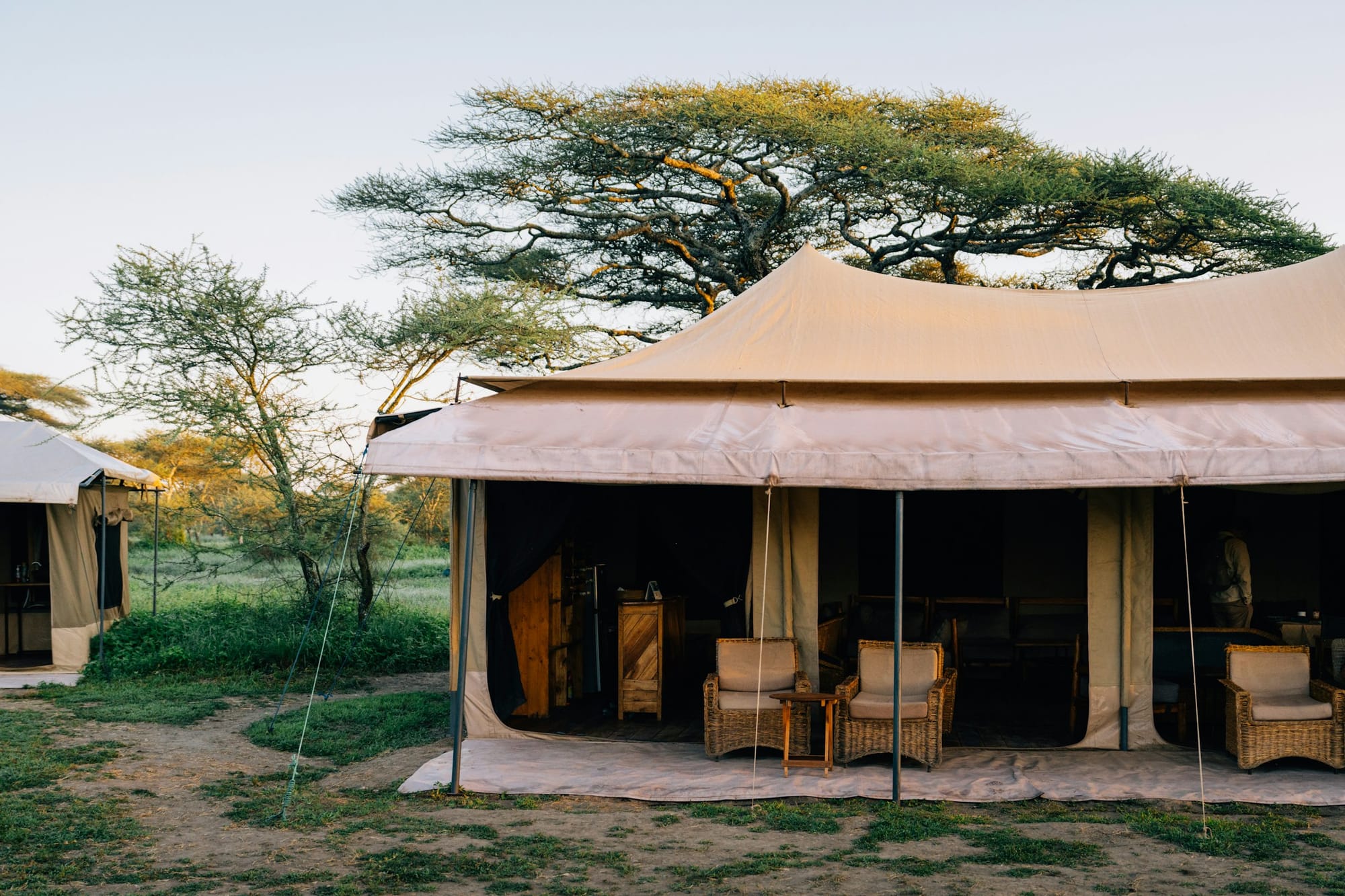
A tented camp is what happens when you move the lodge concept three steps closer to the landscape. Wilderness Safaris, Asilia camps, and Great Plains properties are the caliber here. These properties still have staff, still have excellent meals, still have the amenities of a high-end experience. But they’re built to be temporary in texture, even if some have been in the same location for a decade.
What you get: You live in a tent (usually a very large, very well-appointed tent) rather than a room. The tent has an en-suite bathroom, often heated water, beds with real mattresses. But the architecture is canvas and wood poles, not stone and glass. The walls are thin enough that you hear the world around you — not disturbingly, but noticeably. You hear animals at night. You hear the wind. You hear the difference between a warm night and a cool one.
The meals are still excellent, but they happen in a communal space. The guides are permanent staff who’ve chosen to work camps rather than lodges, which often means they’re more engaged with the wilderness part of the equation. The property feels more like a base camp than a destination hotel.
What you sacrifice: Some of the polish. A tented camp doesn’t offer spa services, fine wine lists, or five-course dinners (though the food is often better in tented camps than in lodges, because the chefs are more invested in the place than the presentation). You can’t retreat to a private suite the way you can in a lodge; the communal gathering areas are where you socialize and decompress.
The tents are secure and comfortable but they’re still tents. A heavy rain is audible. If you’re particular about your bedtime routine or you need privacy between game drives, a lodge handles that better.
Who this is for: Travelers who want the real safari experience — waking to the sounds of the landscape, the sense of being in place rather than observing it — but who don’t want to rough it. First-time safari travelers often find tented camps are the exact right balance. You get the magic of proximity without the romance-breaking friction of actual camping.
The Mobile Camp — Maximum Immersion, Minimum Infrastructure
A mobile camp is the extreme point: a temporary installation that moves seasonally to follow wildlife patterns or to offer different landscapes. These camps run anywhere from a handful of tents to a small cluster, and they’re set up and broken down as part of their design.
What you get: You’re as close to the actual safari experience as you can be while still having a bed and a meal. The camps move to where the wildlife is — if the elephant migration is happening 50 kilometers north, the camp moves. The guides are specialists who’ve chosen this life specifically because they want to be where the animals are, not where the hotel is.
The tents are spacious but truly tents — canvas, good infrastructure, but you’re living in the landscape, not above it. The communal spaces are minimal. The focus is entirely on what you see and experience outside the camp, not what the property offers.
What you sacrifice: Everything that makes a lodge comfortable. There’s no wine list (though there’s often excellent local beer). The meals are good but they’re camp food, not restaurant-level preparation. Shower water is heated over a fire. The laundry is hand-washed. Privacy is minimal. You share the camp with the same 8–12 people for the duration of your stay.
This is not a property for the traveler who needs to retreat or recharge at the end of the day. It’s not comfortable in the way a lodge is comfortable. What it is is honest — you’re here to be in the bush, and everything about the camp reflects that.
Who this is for: Seasoned travelers or determined first-timers who understand that the discomfort is the point. If you’re the kind of person who gets irritable when you can’t check email or when your shower doesn’t have hot water on demand — or if you need downtime after a full day of concentrating on wildlife — a mobile camp will frustrate you. If you’re energized by remoteness and you think sleeping to the sound of hyenas is peak tourism, this is where you belong.
The Private Conservancy — Exclusivity and Access
A private conservancy is not a property at all — it’s a private land concession that usually supports multiple safari properties (lodges, camps, or both). The difference is that the land is exclusive to you or a small group of travelers, not shared with dozens of vehicles and guests.
What you get: This is where safari access becomes the defining feature. In a national park or shared reserve, you’re competing with other vehicles for sightings. A private concession means your guide can drive off-road where it matters, spend as much time with a leopard as you want, traverse the landscape without waiting for other groups to move.
The property infrastructure might be identical to a shared-reserve property. But the exclusivity is the product you’re paying for. You might stay in a lodge or a camp on the concession — the difference is that you have the landscape to yourself.
What you sacrifice: Sometimes nothing except money. A private concession adds a real premium because you’re paying for access that doesn’t share the space. Sometimes you sacrifice infrastructure — private concessions occasionally have smaller, more remote properties because the draw is the land, not the building.
Who this is for: Travelers with serious wildlife photography ambitions. Travelers who want to move at their own pace without the social dynamics of shared camps. Anyone who values solitude enough to pay for it.
How I Match Travelers to Properties
When we talk on the discovery call, I ask three core questions:
First — what does a good evening look like? If you want to return from a game drive and have a massage, dinner courses, and wine options, you’re a lodge traveler. If you want to shower the dust off and gather around a fire with other guests, you might be happier in a camp. If you’d rather spend the evening journaling alone or reviewing the day’s photos, you might want camp solitude or a private concession with your own guide.
Second — what’s your relationship with creature comforts? I don’t ask this to judge. I ask because I’ve sent travelers with limited-camp experience to tented camps and they’ve found it harder than they expected — not dangerous, but harder. If your normal Friday night is a quiet hotel room with room service, a mobile camp’s communal rhythm might chafe. If you’re someone who travels with a carry-on and sleeps anywhere, a lodge might feel suffocating by comparison.
Third — what’s the actual trip? A couple on a five-day anniversary trip might choose a permanent lodge because the time is short and the comfort adds something. A family with kids often needs lodge infrastructure — private pools, flexibility around meal times, space to retreat. A group of friends looking for a real adventure might choose a camp specifically because the communal experience is part of what bonds you.
The answer isn’t an objective “which is better.” It’s “which matches who you are and what you’re after.”
Why Operator Relationships Matter
Here’s the part that changes everything: not all permanent lodges are actually well-run. Not all camps deliver what they promise. The difference between a property that earns its price and a property that’s coasting on reputation lives in the details — which guides are specialists versus generalists, which chefs rotate in and out, which properties have been quietly declining.
This is where my relationships through Signature Travel Network and my direct connections to operators like A&K, Micato, and smaller family-run camps make the actual difference. I don’t see these properties through marketing videos. I sit with the operators at industry conferences. I check in with my BDMs. I ask the guides questions that don’t appear in brochures.
When I recommend a Singita property, I’m recommending it because I know what’s actually happening there right now — who the head guide is, whether the chef is still there, what the recent reviews in the trade channels are saying. When I suggest a Wilderness camp, I’m not defaulting to the name; I’m matching your specific trip to the specific property and the specific guide who’s going to lead you.
That’s the part you can’t buy on Booking.com.
Where to Go From Here
If the idea of a safari is calling you — whether that’s the curated comfort of a lodge, the closer-to-the-bush magic of a tented camp, the full immersion of a mobile camp, or the solitude of a private concession — the place to start is the discovery call. I’ll ask the questions that actually matter, listen to what your answers reveal, and recommend the property and timing that earns the investment.
A first safari changes how you see the world. Getting the property right is how we make sure that change is the kind you’re hoping for.
Book Your Free Discovery Call →︎
The lodge-camp-reserve spectrum is the heart of Wild Places & Luxury Lodges, where these trips live.
Last updated: May 2026. I keep this guide current.
Plan your trip with me.
A 30-minute discovery call is where it starts. No fee, no pressure.
Book a Discovery Call