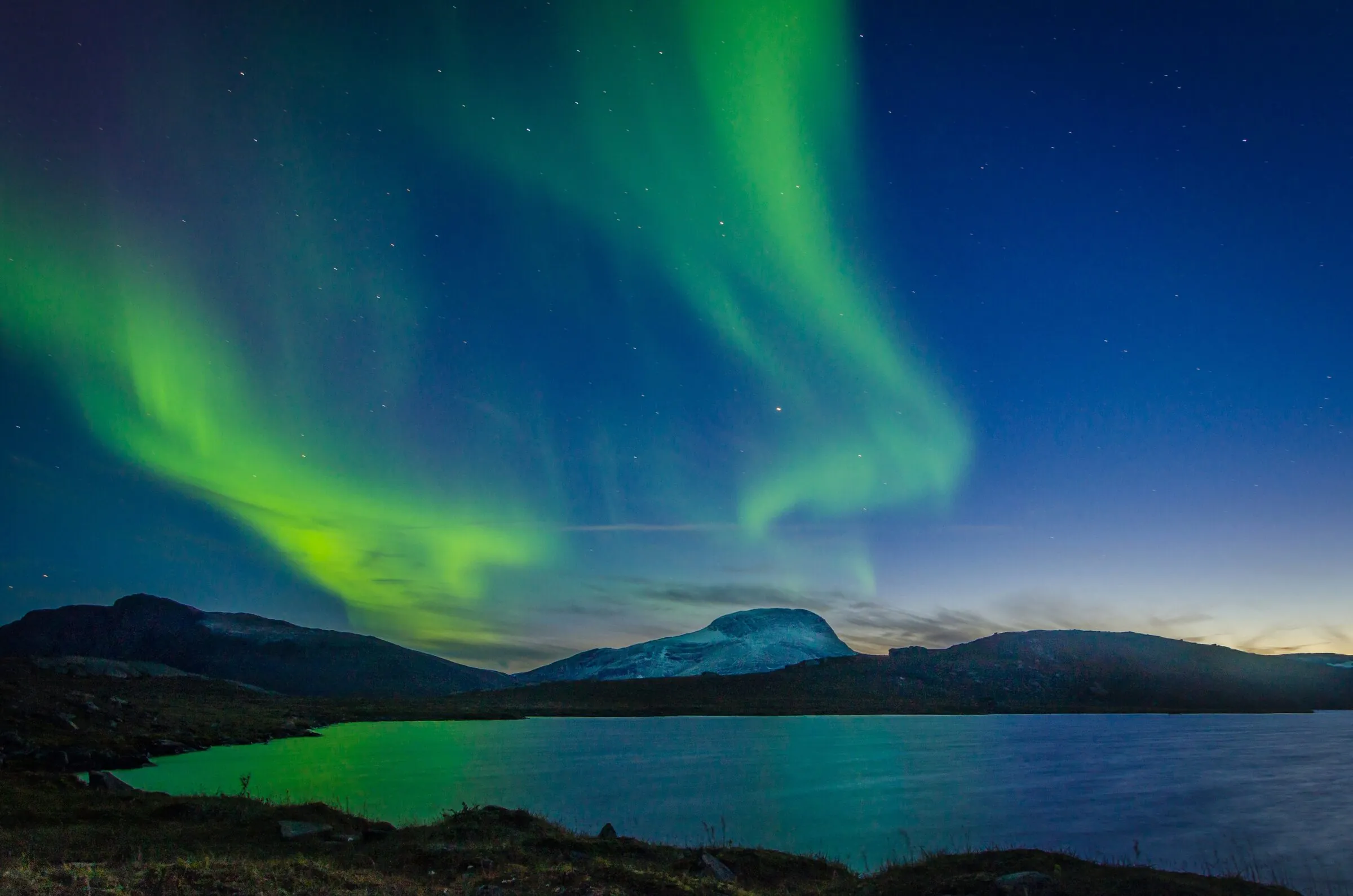
Most aurora travel coverage skips the science entirely and goes straight to the inspiration photography. You’ve seen the images: green ribbons over snow-covered trees, silent and perfect. What the images don’t tell you is that seeing those lights in person is much less certain than they make it look — and that the difference between a trip where you almost certainly see strong aurora and a trip where you might see it if you’re lucky comes down to four variables that most people don’t know to ask about.
Here’s the version I give clients before they book.
What the Aurora Actually Is
The northern lights are a geomagnetic event, not a weather one — and that distinction matters for how you plan around them.
The sun constantly emits charged particles in a stream called the solar wind. When those particles reach Earth’s magnetic field, most get deflected — but some travel along the field lines toward the poles, entering the upper atmosphere. There, they collide with oxygen and nitrogen atoms and excite them into a higher energy state. When those atoms return to their resting state, they release the excess energy as light. That light is the aurora.
The green you see most often is excited oxygen at altitudes around 60–150 miles. The reds appear at higher altitudes, where oxygen is thinner. The blues and purples are nitrogen. The colors you see on a given night depend on what’s in the atmosphere at what altitude and how energetic the solar event is.
None of this requires a solar flare, though flares and coronal mass ejections produce the strongest events. On any given clear night in the right location, there’s some solar wind interacting with the atmosphere overhead. The question isn’t whether there’s aurora — there usually is — but whether it’s strong enough and high enough to be visible from the ground.
The Auroral Oval
This is the piece most aurora travelers haven’t seen before — and it’s the reason Fairbanks is the canonical aurora destination and most other places are secondary.
Earth’s geomagnetic activity doesn’t concentrate evenly around the poles. It concentrates in a rough donut-shaped band around each magnetic pole called the auroral oval. The oval isn’t centered on the geographic pole — it’s offset toward the night side of Earth. On a map of the northern hemisphere, the densest part of that oval passes over:
- Interior Alaska (Fairbanks sits almost directly under it)
- Northern Canada (Whitehorse, Yellowknife)
- Northern Iceland (Reykjavík is just south of the optimal zone)
- Northern Norway and Sweden (Tromsø, Abisko)
This is why aurora viewing from these cities is categorically different from aurora viewing from, say, northern Scotland or southern Iceland or anywhere in the continental US. The oval pin points to specific geography. Fairbanks sits under it more centrally and more consistently than almost anywhere else in North America.
The Geophysical Institute at the University of Alaska Fairbanks maintains the aurora forecast that most of the world’s serious chasers use. They’re forecasting their own backyard. Their offices are a fifteen-minute drive from downtown Fairbanks.
The Timing Math
Three variables determine how likely you are to see strong aurora on any given night in Fairbanks.
1. Darkness. Aurora is present year-round, but it’s invisible during the bright Arctic summer. You need darkness — real night-sky darkness, not just after-sunset twilight. In Fairbanks, reliable darkness runs October through mid-April. The sweet spot for actual trip-planning is late February through mid-March: nights are dark enough for excellent viewing, days are light enough (7–9 hours) for daytime activities, and temperatures are cold but not brutal.
2. Clear skies. Clouds block aurora viewing completely. Interior Alaska is a dry, subarctic climate — significantly drier than coastal Alaska or Scandinavia — which means clearer skies more often. January and February are the statistically clearest months; March is still excellent. Coastal aurora destinations (Iceland, Tromsø) fight more cloud cover than their promotional materials usually acknowledge.
3. Geomagnetic activity. The strength of the aurora on a given night depends on solar wind conditions. The Geophysical Institute forecasts this on a scale from 0 to 9 (the Kp index). Kp 3 or higher is reliably visible from Fairbanks. Kp 5 and above produces dramatic displays that extend south into the lower 48. You can’t control this variable — but you can build a trip long enough that the math works in your favor regardless.
The number that matters: Three or more nights in Fairbanks during late February through mid-March gives you roughly 90%+ probability of witnessing at least one strong aurora display. One night is a coin flip. Two nights is better odds. Three nights, planned around the right location and with an aurora wake-up call in place, is the math that converts a bucket-list trip from I hope we see it to we almost certainly will.
What “Strong Aurora” Actually Looks Like
The images most people have seen are real — but they often represent 20-30 second exposures on high-ISO camera settings, which means the camera captures more light than the naked eye does.
Here’s what you’ll actually see in person, at different activity levels:
Kp 1–2 (quiet): A pale green glow on the northern horizon. Looks like a slightly luminescent cloud. Beautiful if you know what it is; easy to mistake for city light if you don’t.
Kp 3–4 (moderate): Visible green bands, sometimes with motion — the ribbons you’ve seen in photos start to become real. At Kp 4, the whole northern sky can be active.
Kp 5+ (active to storm): The full show. Colors overhead and in multiple directions, visible motion (the aurora moves — it doesn’t stay still), and on strong nights, visible reds and purples along the top edge of the display. This is what people mean when they say the lights are “dancing.” This is also what makes Fairbanks work: even a moderate event (Kp 3–4) produces a display from there that would require Kp 7+ to see from the continental US.
The One Decision That Changes Everything
Where you stay for your aurora viewing nights.
Hotel-parking-lot viewing in downtown Fairbanks works for very strong events (Kp 5+). For moderate events — the kind that happen on most clear nights — you need to be away from city light. The standard options in increasing order of quality:
Cleary Summit / Murphy Dome — viewing sites 15–20 miles north of Fairbanks, dark-sky, accessible by road. Where most operators run their evening viewing tours.
Chena Hot Springs Resort — 60 miles northeast of Fairbanks, sitting directly under the densest part of the auroral oval, with the extraordinary option of soaking in 106°F hot springs while the sky does things overhead. The single best aurora-viewing setup in the accessible North American auroral zone. Two nights at Chena is the math that converts a good aurora trip into a great one. Full guide: Chena Hot Springs →︎
Fairbanks →︎ has the full breakdown of both, with specific venues and the aurora wake-up service at SpringHill Suites (which rings your room when the activity is strong — a small operational detail that has saved a lot of sleeping-through-the-show).
A Note on Chasing vs. Planning
There’s a category of traveler who goes to Iceland with three nights and a hope, sees nothing but clouds, and spends the next ten years saying the northern lights are overrated. There’s another category who builds three nights into a Fairbanks trip around the right window, stays at Chena for two of them, has an aurora wake-up service on the third, and sends me a photo at 1:30 AM from a hot spring with green ribbons overhead.
The difference between them isn’t luck. It’s the four variables above — location, darkness, clear skies, enough nights. Aurora is not a rare event. In the right place, in the right month, it’s an almost-certain one. What’s rare is building the trip with that understanding from the start.
For the March 2027 Northern Lights Alaska trip Liz and I are hosting — one of the hosted group trips I run — this is the framework the whole itinerary is built around — three dedicated viewing nights, two nights at Chena, the aurora wake-up protocol, and the flexibility to follow a strong event rather than running to a fixed schedule. If you want the architecture rather than the explanation, that trip page has it →︎.
If you want to build your own version: start with the Fairbanks guide and start a discovery call — I’ll quote the bespoke version.
Chasing the aurora is one corner of a wider category — Wild Places & Luxury Lodges is the canonical version of how I think about it.
Last updated: May 2026. Aurora science, viewing math, and Fairbanks infrastructure covered here reflect current conditions and my ongoing research as a travel advisor planning aurora trips.
Plan your trip with me.
A 30-minute discovery call is where it starts. No fee, no pressure.
Book a Discovery Call