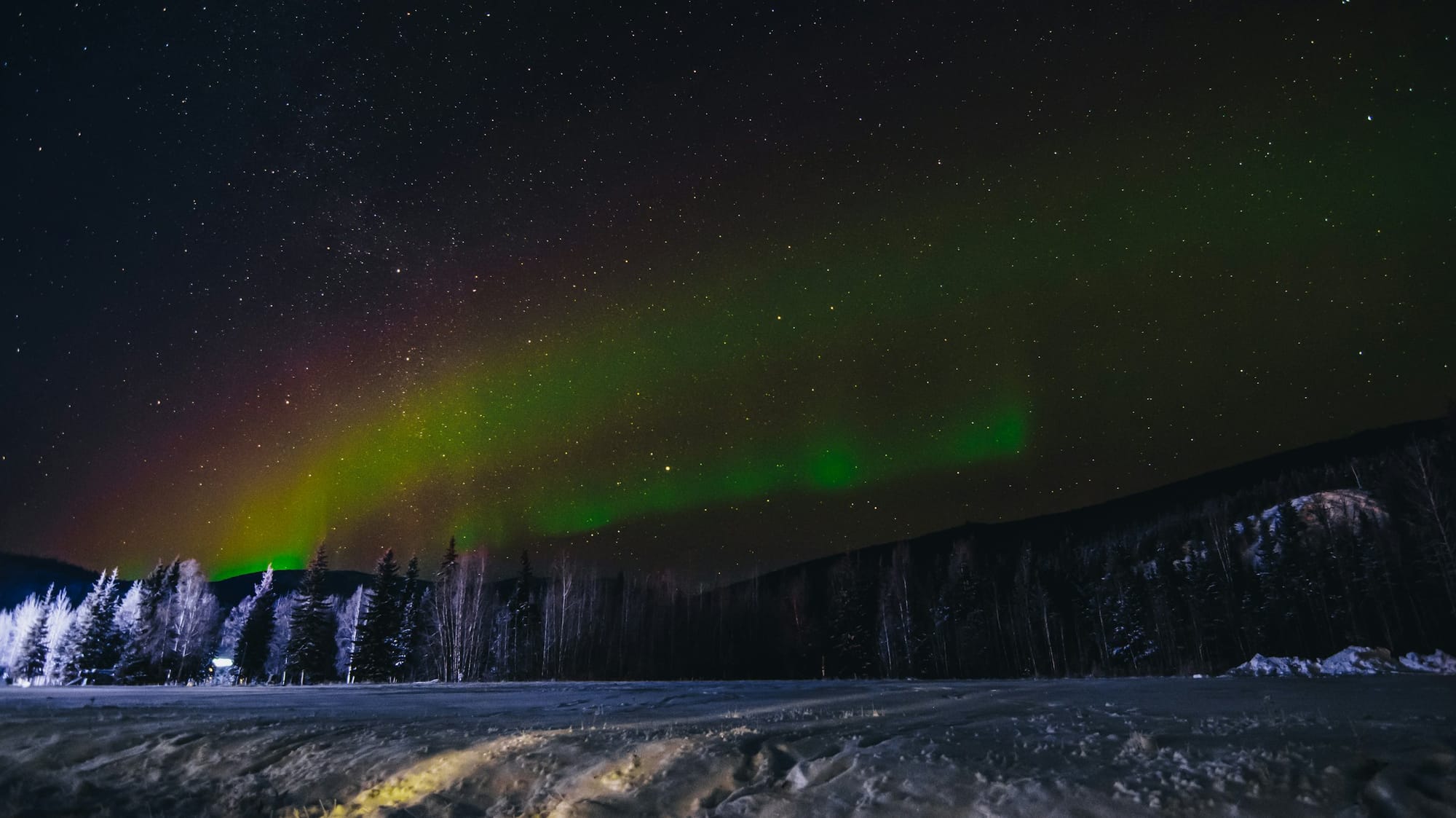
Chena Hot Springs Resort is one of those rare destinations where the entire pitch fits in a single sentence: it sits directly under the densest part of the auroral oval, and you can soak in 106°F water while the sky does things over your head that take a minute to understand.
That’s it. That’s the case for the property.
Most aurora itineraries treat Chena as a day-trip from Fairbanks — one of several activities to slot in between viewing nights in town. That framing is wrong. Chena should be a two-night minimum stay, and on most aurora trips it should be the anchor night-viewing setup, with Fairbanks-town nights serving as the connective tissue around it. The math on this single decision is the biggest one you’ll make about the structure of your Alaska aurora week.
Here’s the version of Chena I’d plan for you.
At a Glance
| What it is | A working resort 60 miles northeast of Fairbanks, accessed by Chena Hot Springs Road. Sits on 440 acres in interior Alaska, surrounded by the Chena River State Recreation Area. Owned and operated by Bernie and Connie Karl since 1998; powered by an on-site geothermal system. |
| Why you’d come | The aurora viewing math. Chena’s location places it directly under the densest part of the auroral oval, meaning the lights frequently appear directly overhead on clear nights — including while you’re soaking in the hot springs. Plus the geothermal-greenhouse setup, the year-round Aurora Ice Museum, and the operational rhythm of a resort built around aurora travelers rather than around general tourism. |
| Best time to visit | Late September through mid-April for aurora season; peak viewing is late February through mid-March. Summer (June–August) is beautiful but the aurora is invisible during white-night season. |
| How long to stay | Two nights minimum for any serious aurora trip. Three nights if you can swing it. The day-trip-from-Fairbanks version (driving out for the hot springs and back the same day) misses the entire reason to come. |
| How to get there | 60 miles northeast of Fairbanks via Chena Hot Springs Road — about 90 minutes by car in winter conditions. The resort runs a shuttle service from Fairbanks for guests without their own vehicle. Most aurora-trip operators handle the transfer as part of their itineraries. |
| One thing most guides won’t tell you | The springs are open until midnight. The aurora often peaks between 11 PM and 2 AM. Plan accordingly: the canonical Chena experience is being in the water during the active aurora window, not before or after. |
Why I Send Travelers Here
Because the only thing better than seeing the aurora is seeing the aurora while you’re in 106°F water with snow on the trees around you and the steam rising into a sky that’s actively performing. Most travelers don’t believe that experience is real until they’ve had it. Then they understand why every Chena aurora trip generates the same kind of “I had to text you immediately” message a couple days later.
The science underneath the experience is real. Chena’s location at 65° north latitude pins it under the densest visible part of the auroral oval. The property is far enough from Fairbanks that there’s no city light dome interfering with viewing — just the dark sky and the heated geothermal water below it. The owners built the resort around aurora travelers from the start; the operational rhythm reflects that. There’s an Aurora Ice Museum kept cold year-round by an on-site absorption chiller. There’s a snowcat tour that runs to a 360°-viewing dome at Charlie Dome when the sky is showing strongly. There’s heated yurts on the property for travelers who want to be outside but not directly in the cold. The whole place is engineered for the experience.
I send travelers here for the part of the trip that turns “the aurora is impressive” into “I understand why people change their lives over this.” For first-time aurora travelers it’s the single decision that ensures the trip works. For seasoned chasers it’s the first time the sky has been over them rather than at the horizon.
For our March 2027 hosted trip, Chena is two of the six nights. The other four are at SpringHill Suites Fairbanks. The Chena nights are where the trip earns the aurora.
Where to Stay (and What to Pick)
There’s only one property — Chena Hot Springs Resort itself — and it offers several lodging categories. The right choice depends on how much you want to spend and what kind of experience you’re optimizing for.
Moose Lodge Rooms — the standard hotel-style rooms, 80 of them, in the main lodge buildings. Comfortable, clean, walking-distance to the springs and dining. The right call for most travelers; this is what we book for the March 2027 hosted trip. No frills, but well-located inside the property and the closest to the dining hall.
Cabins — standalone log cabins around the property edge, ranging from basic two-person to larger family-sized units. More privacy and a more “in the woods” feel; trade-off is a longer walk to the springs and dining (which in -20°F weather is not a trivial trade-off). Best for couples who specifically want the cabin experience.
Aurora Yurts — heated yurt-style accommodations for travelers who want a memorable lodging experience as part of the trip. Smaller and more rustic than the rooms; the aurora viewing from the yurt deck is genuinely excellent. A specialty product, not the default.
The honest framing on Chena lodging: This isn’t a luxury resort, and the property isn’t pretending to be one. It’s a working geothermal resort built around aurora science and the springs themselves. The rooms are functional, the dining is solid roadhouse-style fare, the bathrooms are clean. If you’re expecting Aman-tier finishes, you’ll be disappointed — and you’ll have missed the point. The pitch is the property location and the engineered-for-aurora operational rhythm. Pick the room category that fits your budget and prioritize the time you spend in the springs and outside under the sky.
What to Do With Two Nights
This is the canonical two-night Chena arc.
Day One — Arrive and the First Soak
Arrive in the afternoon (most travelers come from Fairbanks; the drive is 90 minutes). Check in, drop bags, and head to the Hot Springs Pool while there’s still daylight to see what you’re doing. The springs are open until midnight; the daytime version is for orientation, not the main event. Brief tour of the property if it’s offered. Dinner at the Resort Restaurant in the main lodge — straightforward roadhouse menu (steak, salmon, meatloaf, the chef’s specials), no frills, served family-style during peak season.
After dinner, the main event: the aurora viewing soak. Change into your suit, grab a towel, and walk out to the rock-walled outdoor pool. The water is 106°F. The air around you is somewhere between -10°F and 0°F. Steam is rising. The sky above you is dark and, on a strong night, actively performing. Stay in for as long as the cold/hot rhythm works for you — 20-minute soak, 5-minute outside, repeat — and watch.
If the sky is exceptionally strong on this night, ask the front desk about the Charlie Dome snowcat tour — a snowcat ride up to a 360°-viewing dome on the resort’s high ground, with heated yurts, hot drinks, and an aurora photographer often on site to help with camera settings. Not every night runs; check on arrival.
Day Two — The Full Property Day
Late breakfast (you’ll need it after the night). Morning Aurora Ice Museum tour — the largest year-round ice environment on the planet, kept cold by a patented absorption chiller, with chandeliers carved from ice, an ice bar, ice-carved bedrooms (purchasable for novelty overnights, not recommended unless you specifically want the photos), and the famous Appletini served in a glass made of ice. Yes, this is a real thing. Yes, you will absolutely Instagram it. The tour runs 60-90 minutes and is genuinely impressive even for travelers who came primarily for the aurora.
Afternoon options — pick one or two, not all of them:
- Snowshoe through the woods around the property; gear is provided.
- Cross-country ski the trail network around the resort.
- Geothermal greenhouse tour — the property grows its own produce in greenhouses heated by the on-site geothermal system. The chef uses the produce in the dining hall. The tour is short (20-30 minutes) and surprisingly fascinating.
- Snowmobile excursion for travelers who haven’t already done one in Fairbanks.
- Massage at the property spa — solid but not luxury-tier.
- Second hot springs soak in the daylight, which is its own pleasure.
Dinner at the resort. Then the main event again: the second aurora viewing soak. With two nights at Chena you’re putting your aurora-viewing math in the high-90s percentage range. On a typical March visit, at least one of the two nights will deliver strong aurora viewing.
Day Three — Depart
Late breakfast, final soak if you can fit it in, and the drive back toward Fairbanks (or onward to wherever the trip continues). Most aurora itineraries make a stop in North Pole, Alaska on the return — the Christmas-themed town that’s both absurd and worth the photo op — and at the Running Reindeer Ranch for a short walk through the woods alongside a small reindeer herd. Both are easy roadside additions.
This is exactly the Chena half of the March 2027 hosted trip — two nights at the resort, all activities included, transfers from Fairbanks handled, aurora viewing built into the structure rather than left to chance.
Specific Things to Know
The springs themselves. A large outdoor rock-walled pool at 106°F (the canonical aurora-viewing soak), an indoor pool at slightly cooler temperature for kids, and a series of indoor mineral pools at varying temperatures. The outdoor pool is where you want to be at night. Bathing suits required; towels and lockers provided.
The Aurora Ice Museum. Built from 1,000+ tons of ice and snow, kept cold year-round by a patented absorption chiller (the kind of engineering trivia that’s actually delightful). Open for tours during the day. The Appletini is real; the ice-bar experience is part of the tour ticket.
The food. Roadhouse-style — solid, generous portions, not destination dining. Breakfast is included with most lodging packages. Lunch and dinner are à la carte. The salmon and the reindeer sausage are the local specialties; the chef’s specials are usually the best call.
Activity bookings. Most additional activities (snowmobile, dog sled, the Charlie Dome snowcat tour) need to be booked separately, often on arrival. If you’re traveling with a tour operator, this is handled for you. If you’re self-booking, plan to confirm activities with the front desk on day one.
The shuttle. A van shuttle runs between Fairbanks and Chena daily during aurora season; check the resort website for current schedules and pricing. For travelers without a rental car, this is the easiest way to get there.
Connectivity. Cell service is spotty; WiFi is available but slow. Plan accordingly. Tell anyone who needs to reach you in real time that you’ll be off-grid for the duration.
What to Skip
Day-tripping from Fairbanks. The 60-mile drive each way eats most of your day, and the aurora-viewing portion of the experience requires being on the property at night. If your trip can’t accommodate two overnights at Chena, you’re better off doing your aurora viewing from Fairbanks-area sites (Cleary Summit, Murphy Dome) and treating the springs as something you may not get to.
The ice-room overnight gimmick. The Aurora Ice Museum offers ice-carved overnight rooms as a novelty product. They’re fascinating to tour. They are not comfortable to sleep in. Book a Moose Lodge room and visit the ice museum during the day.
Massage during peak aurora windows. Save spa appointments for daytime hours; the property is calmer in the evening when most guests are out viewing or in the springs.
Treating Chena as a beach-resort substitute. It’s a working geothermal property in interior Alaska. The pitch is the springs and the sky. If you’re looking for poolside service, palm-trees-and-cocktails infrastructure, and beach-resort polish, that’s not what you’re booking.
For Aurora Photographers Specifically
A few notes if photography is part of why you’re here:
- The Charlie Dome snowcat tour is the prime aurora-photography setup on the property. Heated yurts, hot drinks, 360° viewing, and an aurora photographer often on site. Worth the upcharge if it’s running on your nights.
- The springs themselves are a tricky photography environment — the steam from the water creates lens-fogging issues and the contrast between the dark sky and the ambient light from the pool deck is hard to manage. Most photographers walk a few hundred yards from the springs to set up.
- Battery management is critical. Cold temperatures drain lithium-ion batteries fast. Keep spare batteries in an inside pocket close to body heat.
- Bring a tripod. The standard aurora photography setup is a wide-aperture lens (f/2.8 or wider), 10-30 second exposures, ISO 1600-3200. A tripod is non-negotiable.
From the Journal
- Why We’re Going to Alaska in March (And Why You Should Come) — the pillar post on the March 2027 hosted trip.
- Aurora 101: What the Northern Lights Actually Are (and How to See Them) — the longer version of the geography and viewing math.
- Fairbanks Travel Guide — the city anchor of any Chena trip.
Plan With Me
If Chena is on your calendar, the trip works best as part of a longer Fairbanks aurora arc — typically 5-6 nights total, 3 in town and 2 at Chena. I plan these both as bespoke independent trips and as the hosted small-group version Liz and I are running March 8-13, 2027. The hosted trip includes two nights at Chena, three at SpringHill Suites Fairbanks, all transfers, all activities, all gratuities — $3,950 double / $4,550 single.
If the hosted dates don’t work but Chena does, start a discovery call — I’ll quote the bespoke version and route you to the right transfer and activity setup.
Book your free discovery call →︎
Plan this trip with me.
A 30-minute discovery call is where it starts. No fee, no pressure.
Book a Discovery Call