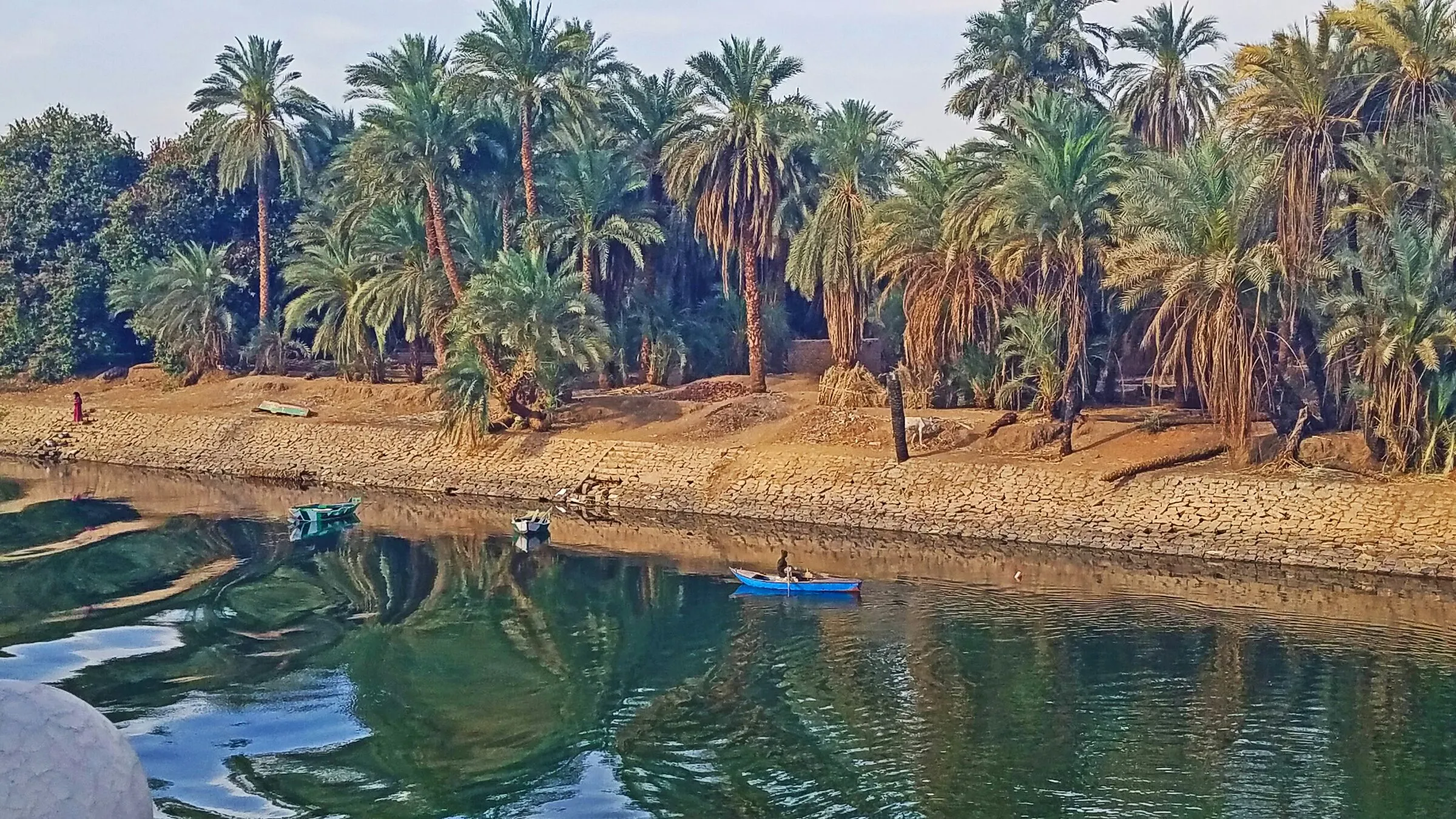
The Nile doesn’t overwhelm you the way a museum does. The Nile puts the temples in sequence — you wake up somewhere different every morning, you walk through Karnak in the golden hour light, you find Edfu at sunset from the gangway — and your threshold for the remarkable rises by the day until you realize somewhere around Aswan that you’ve been inside one of the oldest civilizations on earth for a week and you’ve understood it, piece by piece, at the pace that lets it mean something.
That’s what a Nile cruise is. Not the Cairo museum version — the overwhelming catalogue of a dynasty you can’t keep straight — but the river version, where the context arrives in installments and the Nile is still doing exactly what it has done for five thousand years.
At a Glance
| Best season | October–April (winter dry season); November–February is ideal — cooler temperatures and peak Egyptological tourism infrastructure; avoid May–September summer heat |
| Typical duration | 7 nights (cruise) + 2–3 nights Cairo pre- or post-cruise + Jordan/Petra extension adds 3–5 nights |
| Classic routing | Luxor →︎ Edfu →︎ Kom Ombo →︎ Aswan (4 nights, southbound) or Aswan →︎ Luxor (4 nights, northbound) with Abu Simbel day trip from Aswan |
| Operators I work with | AmaWaterways (AmaLilia / AmaDahlia), Uniworld, Abercrombie & Kent, TTC/Luxury Gold — small-vessel, Egyptologist-led programs. Which one fits depends on your dates and priorities. |
| One thing most guides won’t tell you | Abu Simbel is a four-hour drive or a forty-minute flight from Aswan — most itineraries do it as a very early morning excursion (3am departure by road). The flight option is the one I’d book for you. The temples justify the cost. The sleep justifies the upgrade. |
Why I Plan This River
The Nile is ancient Egypt at a scale you can actually hold in your head. Cairo is extraordinary and overwhelming in equal measure — the Egyptian Museum alone requires a day and leaves you with more information than you can process. The Nile gives you the same civilization in chapters, spaced across four days of river travel, with the ship as your base and the temples arriving at the right pace for comprehension.
Luxor and the West Bank alone — the Valley of the Kings, the temple complex of Karnak, the temple of Hatshepsut rising from the cliff face at Deir el-Bahari — would justify a week in Egypt without the ship. The Nile adds Edfu, one of the best-preserved temples in the country; Kom Ombo, split down the middle as a dual temple to Sobek and Horus; and Aswan, with the Nubian villages and the Philae temple and the High Dam that remade the Egyptian water economy in the twentieth century. Abu Simbel — the temples Ramesses II carved into the cliff face at the Nubian frontier — is a day trip from Aswan that operates as a separate category of awe.
I plan this river through operators I trust — small-vessel programs with quality Egyptologist guides and the kind of ship programming that treats a Nile sailing as an intellectual experience rather than a floating resort. The specific vessel depends on your dates, your priorities, and what’s available in the category that matters: small passenger counts, private excursion formats, and guides who know the program rather than rotating contractors who don’t. That’s the conversation.
I’m building in this direction — Nile operator relationships, Signature network resources, the infrastructure to plan Egypt properly. I know who’s earning the trust in this category right now, and I plan through operators whose quality I can verify.
The Operators I Work With
The Nile river cruise market has an unusually wide quality range. At the bottom, ships carry 200+ passengers, guides are shared across groups, and the temple experience happens in crowds. At the top, you have small vessels — 40 to 60 cabins — with dedicated Egyptologist guides who stay with the program rather than rotating contractor guides who don’t know the ship or the itinerary. The difference matters more on the Nile than almost anywhere else, because this trip is about understanding something, not just seeing it.
The operators I have high confidence in for this river:
AmaWaterways — the AmaLilia (launched March 2024) and AmaDahlia (2021) are AmaWaterways’ current Nile fleet. The same family-owned operator philosophy that runs the Danube and Rhine programs applies here: Kristin Karst’s involvement in quality means the Egyptologist programming is built into the product, not an optional add-on. I have an active operator relationship with AmaWaterways and this is where I’d start the conversation for most travelers.
Uniworld Boutique River Cruises — Uniworld’s Nile program runs at the higher end of the all-inclusive river cruise category. Smaller passenger counts, the art-hotel design sensibility they bring to their European ships translated to the Egyptian context, and the culinary programming that reflects the destination. An option I love for travelers who want the full-service all-inclusive experience with a luxury-hotel aesthetic onboard.
Abercrombie & Kent — A&K has been operating luxury Egypt travel longer than most operators have existed. Their Nile program reflects that depth: private excursion formats, deep Egyptologist guide relationships, and the kind of access that comes from decades of in-country infrastructure. An option I love for travelers whose priority is private, bespoke access over group departure schedules.
TTC / Luxury Gold — the Platinum on the Nile program through TTC’s luxury tier is a fourth option worth knowing about, particularly for travelers coming from a touring background who want the Nile as part of a broader Egypt land program. It belongs in this conversation and I’ll tell you what I know on the call.
The specific vessel and operator I’d recommend depends on your travel dates, your priorities (fully private versus small-group, all-inclusive versus à la carte, AmaWaterways relationship benefits versus boutique operator depth), and what’s available when we look. That’s the discovery call conversation.
The Ports and Temples
Luxor (arrival city + 2 nights pre-cruise strongly recommended) — Arrive two nights before boarding. Luxor’s East Bank — Karnak and the Luxor Temple — and the West Bank — the Valley of the Kings, Hatshepsut’s mortuary temple, the Colossi of Memnon — are each a full day. Karnak at golden hour, when the light turns the sandstone columns amber, is the image that doesn’t leave you. Plan both days before you board; the ship will revisit the East Bank on embarkation day but not with the same time.
Edfu — The Temple of Horus at Edfu is the best-preserved cult temple in Egypt — two thousand years of dust and Nile silt kept it intact until excavation in the nineteenth century. The ceremonial gateway is intact, the interior sanctuary still has its ceiling paint. The horse-drawn calèche ride from the dock to the temple is the one tourist-tax experience I’d take anyway.
Kom Ombo — The temple of Sobek (the crocodile god) and Horus (the falcon), side by side, a theological compromise that somehow produced one of the more visually striking temple complexes on the river. The adjacent Crocodile Museum holds mummified crocodiles that were found in the temple walls. The sunset timing here, if your itinerary arrives in the late afternoon, is worth staying on the deck for.
Aswan — The southernmost city and the end of the classic Nile itinerary. The Nubian village communities across the river, reachable by felucca; the Philae Temple, relocated to its island after the High Dam construction; the unfinished obelisk in the granite quarry south of town, abandoned mid-carve when a fissure appeared in the stone — Aswan gives you a different Egypt than Luxor. Slower, warmer, with the Nubian cultural identity distinct from the pharaonic Egypt of the northern temples. Give it a full day.
Abu Simbel — Not a port stop — a day excursion from Aswan, by road (3–4 hours each way) or by flight (40 minutes). The twin temples of Ramesses II and Nefertari, carved into the cliff face at the Nubian frontier, relocated sixty-five meters uphill in one of the largest archaeological engineering projects ever undertaken to save them from the rising waters of Lake Nasser. The scale and the engineering both require standing in front of them to understand. The flight is the right call.
Cairo (pre- or post-cruise) — The Great Pyramid, the Sphinx, the Egyptian Museum — and, if you’re open to it, the Khan el-Khalili bazaar and the Islamic Cairo district, which is as layered as anything in the ancient city. Cairo is a multi-day experience. I’d put it before the cruise if you want to arrive in Luxor with context, or after if you want to arrive in Luxor fresh and let the river build toward the capital.
Before You Board / After You Disembark
Cairo (2–3 nights, pre- or post-cruise): The Giza plateau, the Egyptian Museum (the new Grand Egyptian Museum in Giza, opened 2025, is the destination now — better organized, better lit, Tutankhamun’s treasury properly installed for the first time). A Cairo hotel I’d steer toward is Zamalek neighborhood or the Corniche — neither the airport zone nor the tourist-facing properties that put you in front of tourist-facing prices. That’s the conversation.
Post-cruise Aswan night: Some itineraries end in Aswan rather than returning to Luxor. One night in Aswan before flying to Cairo or home — at the right small property on the West Bank, with the Nubian village visible from the terrace — is worth building in if the timing allows.
The Extension
Jordan and Petra — The natural Nile extension for travelers who want more of the ancient world. Fly Cairo to Amman, two nights, Petra as the centerpiece: the two-kilometer Siq canyon walk, the Treasury emerging from the rose-red cliff face, the High Place of Sacrifice above the city if you have the energy for the climb. The Jordanian food and the Wadi Rum desert are secondary attractions that earn their billing. Fly home from Amman or back through Cairo.
Israel — For travelers interested in the full ancient Near Eastern arc: Egypt →︎ Jordan →︎ Israel, ending in Tel Aviv or Jerusalem before flying home. This is a longer trip — plan three to four weeks total. The context for each country deepens when they’re visited in sequence.
Galápagos / Antarctic pairing — For the expedition traveler: Egypt in October–November, followed by the Antarctica season (November–March) or a separate Galápagos visit. This is the two-expedition year for travelers whose appetite runs toward the extreme end of what’s possible.
What I’d Skip
The Nile without an Egyptologist guide. The temples have labels and the sites have printed guides. None of them replaces someone who can tell you why the hieroglyphic register at the top of this particular wall reads differently from the one below it, or what the flooding sequence in a Nile agricultural calendar actually meant for the people who worshipped in this room. The guide is the experience.
Cairo without structure. Cairo rewards the traveler who arrives with a plan — a specific neighborhood sequence, a specific museum strategy (the Grand Egyptian Museum is too large to wander), a specific food itinerary. Going without those leads to sensory overload and wasted time. The discovery call is where we build the plan.
Rushing Abu Simbel. Most tour groups arrive, take photos of the facade, and leave within ninety minutes. The interior chambers — the sanctuary, the painted reliefs, the alignment chamber where sunlight falls twice a year on the inner statues — require time. Plan for two hours at minimum.
Plan This River With Me
The Nile is one of those trips that people think about for years before they book it. Thirty minutes on a call and I can tell you which vessel, which direction, whether Cairo goes before or after, and whether Jordan is the extension that makes this trip complete.
Last updated: May 2026 · Nile operators: AmaWaterways (AmaLilia, AmaDahlia), Uniworld, Abercrombie & Kent, TTC/Luxury Gold Platinum on the Nile. Confirm vessel availability and Abu Simbel excursion logistics at time of booking.
Plan this trip with me.
A 30-minute discovery call is where it starts. No fee, no pressure.
Book a Discovery Call